
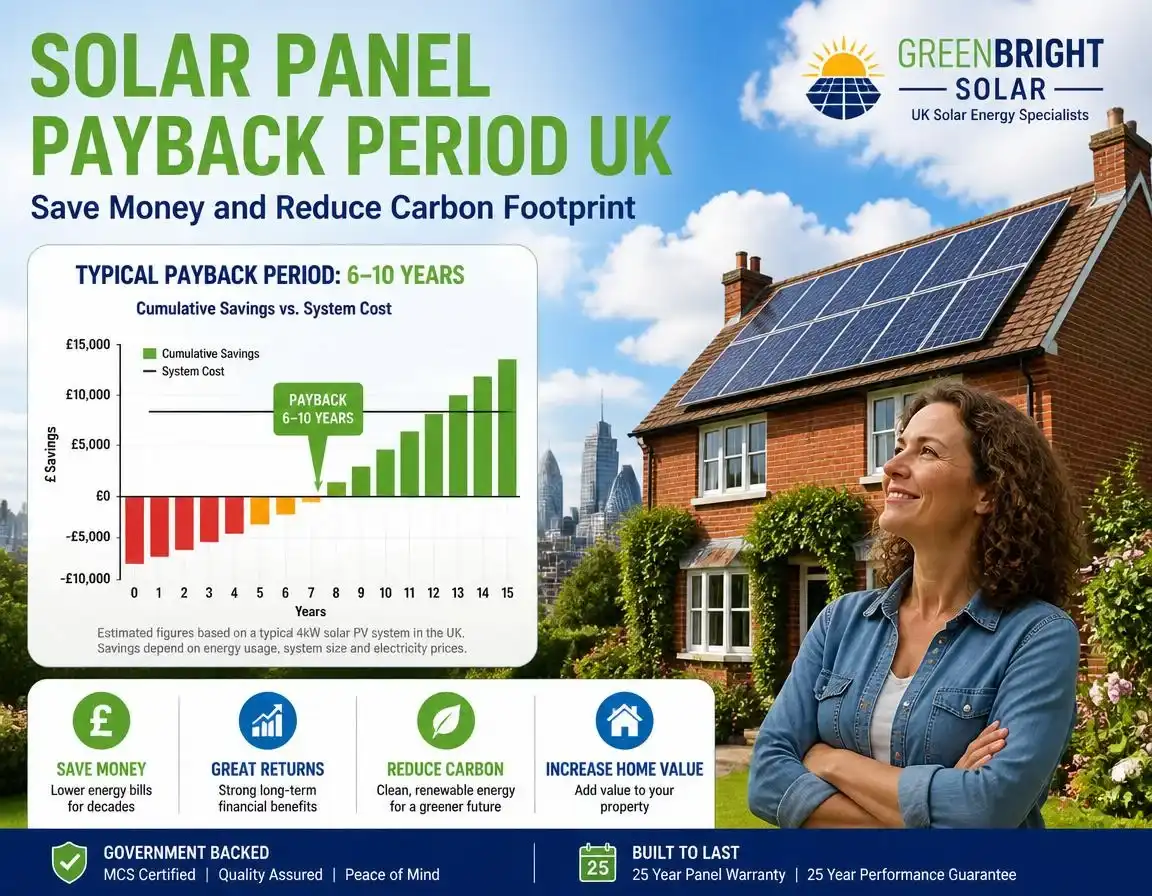
Solar Panel Payback Period UK 2026

Solar Panel Payback Period UK 2026: How Long Until They Pay for Themselves?
If you’re thinking about installing solar panels in the UK, the question that really matters isn’t just “how much do they cost?” — it’s “when will they actually pay for themselves?” It’s the right thing to ask. And in 2026, I can tell you honestly: the numbers look more encouraging than they ever have. With electricity bills still persistently high, 0% VAT on qualifying solar installations until March 2027, and Smart Export Guarantee (SEG) tariffs now reaching up to 32p per kWh, going solar has never made better financial sense for UK homeowners.
What Is the Solar Panel Payback Period?
Simply put, it’s the number of years it takes for your solar system to earn back what you paid for it — through lower electricity bills and money earned selling surplus electricity back to the grid. Once you’ve hit that point, every unit of power your panels generate is, for all practical purposes, free. Given that modern systems comfortably last 25–30 years, that’s a seriously long runway of free electricity once you’ve crossed the break-even line.
The 2026 Numbers in Plain English
A typical 4kW solar panel system now costs between £6,500 and £8,500 fully installed — and that’s at 0% VAT, which applies to all qualifying domestic installations until March 2027. Once fitted, the same system can cut your electricity bill by £600 to £900 per year, depending on how much of the solar generation you actually use at home. Factor in Smart Export Guarantee income, and most UK households are looking at a break-even point somewhere between 7 and 12 years. After that? The electricity is essentially on the house. Want a figure specific to your own roof rather than a UK-wide average? Our free Solar Panel Calculator factors in your location, roof size and usage to estimate your own payback timeline in a couple of minutes.
| System Size | Best Suited For | Installed Cost | Est. Annual Savings | Typical Payback | 25-yr Net Return |
|---|---|---|---|---|---|
| 3 kW | 1–2 bed flat / low usage | £5,000 – £6,500 | £450 – £650 | 9–13 yrs | £5,000+ |
| 4 kW | 2–3 bed semi-detached | £6,500 – £8,500 | £600 – £900 | 7–12 yrs | £8,000 – £12,000 |
| 5 kW | 3–4 bed house | £7,500 – £10,000 | £700 – £1,050 | 8–12 yrs | £9,000 – £14,000 |
| 6 kW | 4–5 bed / EV owner / heat pump | £8,500 – £11,500 | £800 – £1,200 | 8–13 yrs | £10,000 – £18,000 |
How the Maths Actually Works
Payback isn’t complicated. The formula is:
Regional Payback Periods Across the UK
Where you live makes a genuine difference. Homes in southern England get around 15–20% more solar energy per kWp installed than those in Scotland, simply because of longer sunshine hours. That said, modern high-efficiency panels have narrowed the gap considerably. Here’s how 2026 payback periods break down by region:
Shorter bar = faster payback. Figures based on a 4kW south-facing system, 50% self-consumption, and Ofgem Q2 2026 rate of 24.67p/kWh. Note: from 1 July 2026, the rate rises to 26.11p/kWh (+13%), which will shorten payback further.
For a closer look at how this plays out where you live, our regional guides dig into the local detail — from Cornwall in the South West to coastal South East properties, plus dedicated breakdowns for Wales and the North East.
Scotland’s payback is longer, yes — but modern panels still generate around 85% of what the same system produces in London. With a 25-year warranty, Scottish homeowners still enjoy a decade or more of near-free electricity after break-even. Home Energy Scotland also provides additional local support.
Six Things That Affect Your Personal Payback Period
No two properties are identical. Your actual payback depends on a mix of factors — some you can control, some you can’t:
Roof Orientation
South-facing is ideal. East/west cuts output by 10–15%. North-facing can add several years to payback — avoid if possible.
Self-Consumption
Every unit you use yourself saves 24.67p (Ofgem Q2 rate). Every unit you export earns just 5–25p. This single factor is the biggest lever you have.
SEG Tariff Choice
The gap between the best and worst export tariffs is worth £200–£400 per year for a typical 4kW system. Always compare before signing up.
Shading
Even moderate shading from trees or a chimney can add 2–4 years to your payback period. An on-site survey will spot problems before installation.
Location
Every 10° further north roughly reduces annual generation by 3–5%, directly affecting when you break even.
Installer Quote
Quotes for the same system often vary by £1,500–£2,500. Getting three quotes from MCS-certified installers is genuinely worth the afternoon.
The Smart Export Guarantee: Getting Paid to Generate
One government-backed incentive that too many solar owners underuse is the Smart Export Guarantee. Administered by the Department for Energy Security and Net Zero, it requires all major UK energy suppliers to pay you for every unit of surplus electricity you send to the grid. Choosing the right tariff can shave up to a year off your payback — and you don’t need to switch your import supplier to take advantage of the best export rates. Not sure what your own exports might be worth? Try our SEG Income Estimator for a quick personalised figure.
Best SEG Export Tariffs — June 2026
A 4kW system without a battery exports roughly 1,200–1,700 kWh per year. Here’s what the top tariffs pay right now:
Does Adding a Battery Make Sense?
A solar battery adds £3,000–£5,000 to your upfront cost, which does extend the initial payback period in isolation. But here’s the trade-off worth understanding: without a battery, the average UK household self-consumes around 50% of its solar generation, exporting the rest. Add a battery and self-consumption rises to roughly 80%. Over a 25-year lifespan, particularly if you’re on a time-of-use tariff that rewards peak-time exports, the overall financial return is often substantially better with storage included. If you’re weighing up which unit to buy, see our best solar battery picks for 2026 — or, if your panels are already installed, our guide to adding a battery to an existing system.
The 25-Year Journey: What Happens After Payback?
Here’s what genuinely surprises people when they sit down and do the sums properly. Once your solar system has paid for itself — say in year 9 or 10 — you haven’t reached the finish line. You’ve just started the most rewarding stretch. With 15 or more years of generation still ahead, and electricity prices that historically only move in one direction (the Q3 2026 Ofgem cap is already set to rise by 13% from July), the long-term return is substantial. A typical 4kW system delivers £10,000–£15,000 in net savings over its 25-year life above the installation cost. The payback period is just the warm-up.
Install
Saving
Break-even 🎉
£5k+ profit
£10–15k net
My Honest Take: Is Solar Worth It in 2026?
Yes — without question. Solar panels in 2026 represent one of the soundest home investments a UK homeowner can make. Payback periods are realistic, the government incentives are real and accessible, and the technology has never been more reliable. Whether you’re in Brighton or Dundee, a well-positioned system on a suitable roof will earn its keep — and carry on giving for years after. The key is doing it properly: get three quotes from MCS-certified installers, sign up for the best SEG tariff once you’re live, and run your energy-hungry appliances during the sunniest part of the day. Those three habits alone can cut a year or two off your break-even.




14 Comments