
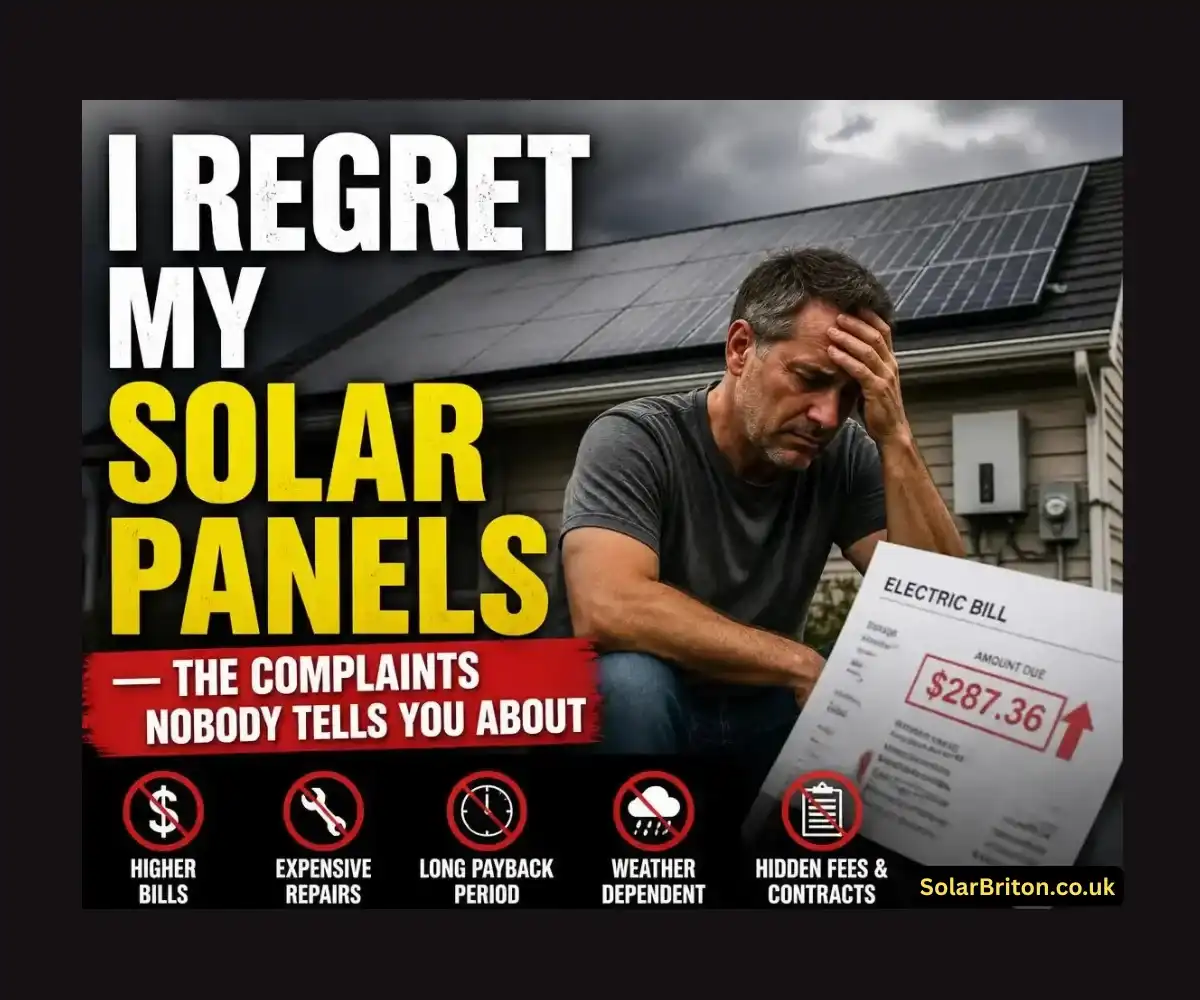
I regret my solar panels

“I regret my solar panels” — the complaints nobody tells you about
Most people who go solar are glad they did. But a fair few aren’t, and the reasons rarely make it into a sales brochure. Here’s what actually goes wrong for UK homeowners — the pushy sales calls, the loans that outlive the savings, the installers who vanish — and how to make sure none of it happens to you.
The short version
Solar panels themselves are reliable bits of kit — most complaints aren’t really about the panels. They’re about how the deal was sold, who financed it, and what happens when the company behind it disappears. Doorstep pressure, over-optimistic savings promises, rent-a-roof leases from the 2010s, and installers going bust mid-warranty are the recurring themes. None of it is inevitable — a bit of homework before you sign avoids nearly all of it.
I’ll say this upfront: most people who’ve gone solar in the UK are happy with the decision. It quietly does its job on the roof and knocks a decent chunk off the electricity bill. But if you spend any time on consumer forums, you’ll find another crowd entirely — people who feel like they were talked into something, or left holding a loan for a system that never delivered what was promised. Their stories rarely get told next to the glossy “how much you’ll save” calculators, so here they are, with the real cases behind them.
The doorstep pressure and the fake urgency
The classic pattern hasn’t really changed in fifteen years: a rep turns up unannounced, or calls out of the blue, and tells you a “government grant” or discount is about to disappear — so you need to sign today. It’s almost always untrue, and it’s a recognised warning sign that Trading Standards teams across the UK actively warn people about.
Trident West Industries Ltd & Star Solar Ltd — shut down November 2025
The Insolvency Service confirmed both companies misled dozens of homeowners with cold calls and doorstep visits, promising “government refunds” that never existed. The average victim was 76 years old. Over £3.1 million passed through the companies’ accounts between May 2023 and January 2025 — yet only £7,010 was ever returned to the nine people who complained, despite County Court Judgments worth more than £400,000 against the firms.
If someone tells you a scheme is closing “this week” or that you must sign before they leave the house, that’s your cue to ask them to leave and do your own research instead. Every legitimate off-premises sale in the UK comes with a legal 14-day cooling-off period under the Consumer Contracts Regulations 2013 — a genuine installer won’t rush you past it.
Savings that assumed a perfect life
The second big regret is subtler: the savings figure on the quote was real, technically, but it was built on assumptions that rarely hold up — perfect south-facing pitch, zero shading, and a British summer’s worth of sunshine, twelve months a year. A poor or rushed survey can leave you with a system that performs nothing like the brochure.
Typical self-consumption range for a solar-plus-battery home, by season. A brochure photographed in June rarely mentions the right-hand bar.
None of this means solar “doesn’t work” in winter — it means a decent installer should show you a month-by-month estimate, not just an annual headline figure, and should be upfront that a January afternoon and a July one are not the same thing. If your quote only ever showed one number for the whole year, that’s worth questioning before you sign.
Still paying off a loan for a system that isn’t paying you back
This is where regret turns into genuine financial pain. Thousands of people financed their solar panels through personal loans, sold on the promise the panels would effectively pay for themselves. When the real-world export payments and bill savings fell short, the loan didn’t get any smaller.
PV Solar UK and the Barclays loans
The Financial Ombudsman received around 2,000 complaints from people who said their solar panels weren’t delivering the returns they were promised, many of whom had taken out loans to pay for them. Barclays, which financed a number of these deals, set aside £38 million to deal with potential claims. One customer, sold the idea as a pension top-up, took out a loan of over £10,000 — an independent survey later found the panels wouldn’t cover the loan cost even after 20 years. PV Solar UK went into liquidation in 2017.
The lesson isn’t “never use finance” — plenty of people finance solar sensibly. It’s to treat any savings projection with healthy scepticism, get an independent second opinion on the numbers if a loan is involved, and remember that if you paid any part of the deposit by credit card, Section 75 of the Consumer Credit Act may give you a route to claim against the card provider if things go wrong. Our guide to no-upfront-cost solar finance options breaks down which schemes are worth considering in 2026, and our payback period guide shows how a realistic figure should actually be calculated.
Rent-a-roof: free panels, expensive freedom
Between roughly 2010 and 2019, “rent-a-roof” schemes were everywhere — a company fitted panels for free in exchange for a 20 to 25-year lease on your roof, keeping the Feed-in Tariff income for itself. It sounded harmless at the time. The Feed-in Tariff closed to new applicants on 1 April 2019, and since then the stories have mostly been about people trying to move house.
| Aspect | You own the system | Rent-a-roof lease |
|---|---|---|
| Who owns the panels | You do, outright | The solar company, for the lease term |
| Selling your home | No extra paperwork needed | Buyer inherits the lease — many walk away |
| Getting a mortgage or remortgage | Straightforward | Some lenders won’t lend at all |
| Ending the arrangement early | Entirely up to you | Often a large, non-negotiable buyout fee |
| Still commonly offered in 2026 | Yes — the standard model | No — the subsidy that funded it ended in 2019 |
Real cases from that era include a homeowner only permitted to sell after journalists got involved, then charged a non-negotiable £20,500 buyout, and a retired homeowner with a disability whose buyer pulled out because her lease didn’t expire until 2035 and couldn’t be broken early. If you’re buying a house today and it has older solar panels, it’s worth asking outright whether they’re owned or leased before you get attached to the place — our guide on buying a house with solar panels covers exactly what to check.
When the company just disappears
The solar boom of the past few years pulled in a lot of new installers, and not all of them were built to last. Since 2023 there’s been a steady run of smaller firms folding, usually after scaling up too fast during the post-2022 demand surge. And it isn’t only small installers — even well-known manufacturers aren’t immune.
GivEnergy Ltd — entered administration 9 April 2026
One of the UK’s most widely fitted battery and hybrid inverter brands, GivEnergy stopped trading in April 2026. Warranty support for existing customers is no longer honoured by the company directly, leaving owners to work through the administration process or lean on their MCS installer for backed cover instead. Our full GivEnergy battery review has the latest on what this means if you already own one.
Solar Together London (GET-UK) — supplier liquidation
A London-wide, council-backed group-buying scheme saw its main installer, GET-UK, go into liquidation, leaving around 1,000 customers across two installation phases affected and prompting 1,456 complaints to City Hall. One Bexley resident’s system had no battery fitted and no certificate of installation more than a year after paying a deposit — a missing certificate that would have invalidated her home insurance had anything gone wrong.
The reassuring part: if only your installer disappears, your panel, inverter and battery manufacturer warranties usually carry on unaffected, because they’re a contract with the manufacturer, not the installer. It’s only when the manufacturer itself folds — as with GivEnergy — that a warranty genuinely stops. Our guide to what a solar warranty actually covers explains the difference between product, performance and workmanship cover, and why an Insurance-Backed Guarantee is worth asking for specifically.
The paperwork nobody chases up
MCS certificates, DNO grid connection paperwork, and the installer’s own commissioning records don’t feel important on installation day. They matter enormously later — for insurance, for SEG payments, and for selling your house. A surprising number of complaints boil down to a missing document nobody noticed until it was needed.
Scan every certificate the day it arrives, save it in two places, and note down your panel and inverter serial numbers. It costs nothing and it’s the single easiest regret to avoid entirely.
💬 The scam on top of the scam
Since early 2026, Trading Standards teams have been warning about a second layer of fraud: cold callers offering to “claim your mis-selling compensation” for an upfront fee, then vanishing once they’ve been paid. Some homeowners genuinely were mis-sold solar panels — but the way to pursue that is through the Financial Ombudsman, your card provider, or a solicitor you’ve chosen yourself, never through someone who called you out of the blue.
So is it all doom and gloom?
No — genuinely not. The vast majority of the roughly one million UK homes with solar panels never make the news, because nothing dramatic happens. They generate power, quietly knock money off the bills, and get on with it. Every regret story in this piece has a common thread: it traces back to a sales pitch, a finance deal, or a company’s paperwork — not to the solar panels themselves failing on the roof. That’s actually good news, because it means the whole thing is avoidable with a bit of care before you sign, not a reason to rule solar out altogether.
How to avoid becoming a regret statistic
Check the company on Companies House first
A two-minute search shows you how long they’ve traded, whether they’ve changed names, and whether there’s any insolvency history.
Get three quotes, always
Wildly different prices or savings claims for the same roof are a sign that at least one of them isn’t being straight with you.
Never sign on the day
A legitimate installer expects you to think it over. Anyone pushing for a same-day signature is telling you something about themselves.
Check MCS certification independently
Don’t just take their word for it — look the company up yourself. Our guide to what the MCS badge actually means explains what it does and doesn’t guarantee.
Ask for a month-by-month generation estimate
Not just one annual figure — you want to see December and January called out honestly, not hidden inside a yearly average.
Keep every certificate, twice
MCS certificate, DNO paperwork, warranty documents — save digital copies in two separate places the day you receive them.
| Case | What happened | Outcome |
|---|---|---|
| Trident West / Star Solar | Doorstep & cold-call fraud targeting pensioners | Shut down Nov 2025; only £7,010 of £3.1m recovered |
| PV Solar UK / Barclays loans | Savings projections didn’t match reality | ~2,000 Ombudsman complaints; Barclays set aside £38m |
| Solar Together (GET-UK) | Installer went into liquidation mid-rollout | 1,456 complaints to City Hall; some homes left unfinished |
| GivEnergy Ltd | Manufacturer entered administration | Direct warranty support ended 9 Apr 2026 |
The recurring pattern: subsidy-driven booms attract fast-scaling companies, and some of them don’t survive the slowdown that follows.
Common questions
Can I get compensation if I was mis-sold solar panels?
Possibly, depending on how you paid. If you financed the panels through a regulated loan, the Financial Ombudsman Service can investigate mis-selling complaints against the lender. If you paid any part of the cost by credit card, Section 75 of the Consumer Credit Act may let you claim against the card provider too. Be very wary of anyone who cold-calls you offering to chase this compensation for a fee — that’s become a scam route in its own right. Go through the Ombudsman or your card provider directly instead.
What happens to my warranty if my installer or the manufacturer goes bust?
If it’s just the installer that closes, your panel, inverter and battery warranties usually continue unaffected, since they’re a contract with the manufacturer rather than the installer — any MCS-certified installer can then take over servicing. If you had an Insurance-Backed Guarantee, your workmanship cover is also protected separately. It’s only when the manufacturer itself goes under, as happened with GivEnergy in April 2026, that the specific product warranty genuinely stops.
Can solar panels make it harder to sell my house?
Rarely, if you own the system outright with proper MCS paperwork — most buyers and lenders have no issue with that at all. It’s really only the older “rent-a-roof” leased schemes, mostly signed before the Feed-in Tariff closed in April 2019, that cause delays, because the lease itself can complicate a mortgage lender’s position or put buyers off entirely.

One Comment