How many solar panels do you need to charge a Tesla Car in the UK?

How many solar panels do you need to charge a Tesla car in the UK?
Updated 4 November 2026
The short version
At the 8,900 miles a year the average UK electric car covers, six 430W panels (2.6 kWp) generate enough electricity over twelve months to cover a Model 3, and seven (3 kWp) cover a Model Y. At the 7,100-mile average for all cars it’s five and six. Those figures assume a south-facing Midlands roof, so add about one panel in Scotland. Winter is the catch. From November to February no sensible UK roof covers a Tesla, the grid tops you up, and a cheap overnight tariff makes that painless.
Every week somebody emails me a version of the same question. They’ve ordered a Model 3, or they’re circling a Model Y, and they want the roof to run it. So how many solar panels do you need to charge a Tesla? Not the brochure answer. The one that survives a December in Manchester.
Online you’ll see “ten panels!” and “fourteen panels!” shouted with equal confidence. Both can be right, and both can be rubbish. The answer comes from three numbers: what the battery holds, what the car uses per mile, and what a UK panel makes month by month. Get those right and the panel count falls out of the maths. I’ll show where each number comes from, so you can swap in your own.
What a Tesla battery holds, and what the car really uses
Tesla quotes a nominal battery size, but you never get all of it. There’s a buffer at the top and bottom to protect the cells, so I plan around usable capacity. Trim names keep changing (Standard, Long Range, Premium), so check the usable kWh in the spec sheet rather than trusting the badge. These are the figures I work with:
| Tesla model | Usable battery | Real-world efficiency | Battery energy for a 24-mile day |
|---|---|---|---|
| Model 3 Standard / rear-wheel drive | ~60 kWh | 4.0–4.3 mi/kWh | 5.6–6.0 kWh |
| Model 3 Long Range / Premium | ~75–79 kWh | 3.8–4.3 mi/kWh | 5.6–6.3 kWh |
| Model Y Standard / rear-wheel drive | ~60 kWh | 3.4–3.7 mi/kWh | 6.5–7.1 kWh |
| Model Y Long Range / Premium | ~75–79 kWh | 3.3–3.7 mi/kWh | 6.5–7.3 kWh |
Usable capacities are approximate and vary by model year. Efficiency ranges are mixed UK driving from owner logs and road tests, not WLTP brochure figures. In every calculation below I use 4.2 mi/kWh for the Model 3 and 3.6 mi/kWh for the Model Y.
Two things stand out. First, these cars use less than people expect. The average UK car does about 19 miles a day, and an electric car nearer 24, according to the Department for Transport’s National Travel Survey (2024 figures). A 24-mile day costs a Model 3 around 6 kWh and a Model Y around 7. Second, the Model Y premium is real. It’s taller and heavier, so it uses roughly 15–20% more energy per mile than the Model 3. Size for the car you’ve actually got.
Then add charging losses. Home AC charging wastes about 10% between the meter and the battery: converter heat, battery conditioning, the car staying awake. It’s more in cold weather. So 5 kWh into the battery is roughly 5.5 kWh from your panels or your tariff. I build that 10% into everything below. Forgetting it is how people end up half a panel short.
Winter bites at both ends. Cold batteries accept charge more slowly, the cabin heater draws power, and I knock about a fifth off those efficiency figures from December to February. That’s one more reason to size on the year rather than on a January bill.
What one solar panel produces in the UK
The standard domestic panel in 2026 is 430–450W, about 1.95 m² and 22 kg. I use 430W so the sums stay on the cautious side. If your quote says 450W, scale everything up by roughly 5%.
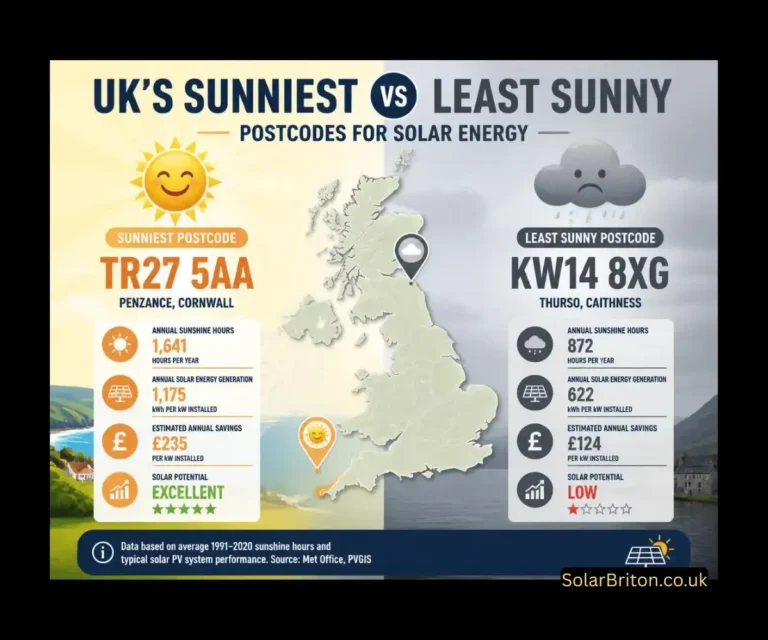
Where you live matters more than most people expect. These are annual yields for a south-facing roof at 35 degrees, using the regional figures in my guide to how many solar panels a UK home needs (PVGIS data). The last two columns show how many 430W panels cover 8,900 miles a year, the average for a UK electric car.
| Region | kWh per kWp a year | One 430W panel | Model 3 panels | Model Y panels |
|---|---|---|---|---|
| South East | 1,050 | ~450 kWh | 6 | 7 |
| South West | 1,020 | ~440 kWh | 6 | 7 |
| East Anglia | 970 | ~415 kWh | 6 | 7 |
| Midlands (my baseline) | 920 | ~395 kWh | 6 | 7 |
| North England, including Manchester | 890 | ~385 kWh | 7 | 8 |
| Wales | 880 | ~380 kWh | 7 | 8 |
| Scotland | 810 | ~350 kWh | 7 | 8 |
| Northern Scotland | 750 | ~320 kWh | 8 | 9 |
Panel counts are rounded up. The Midlands Model 3 figure is 5.95, so it’s a snug six: add a spare if your roof is shaded. The rest of this article uses the Midlands figure of 920 kWh per kWp, which makes one 430W panel worth about 395 kWh a year.
Orientation changes the total too. East–west roofs lose about 15–20% against due south. For car charging that’s often a fair trade, because a flatter generation curve suits morning and evening plug-ins better than one sharp midday peak. My piece on east-west solar panels in the UK covers the output loss and when it wins. If you’re still working out the whole roof, what size solar system to go for is the next read.
How many solar panels for a Model 3 or Model Y
Here’s the part you came for. Both tables use 430W panels on a Midlands-type roof, 4.2 mi/kWh for the Model 3, 3.6 mi/kWh for the Model Y and the 10% charging loss. They count the miles the system pays for over a year. Some of that energy goes straight into the car on sunny days. The rest is exported, and the export payment goes towards overnight grid charging. That swap works well at some export rates and badly at others, which I come back to in the cost section.
Start from your annual mileage
| Miles a year | Model 3: kWh needed | Model 3: panels | Model Y: kWh needed | Model Y: panels |
|---|---|---|---|---|
| 5,000 | ~1,320 | 4 | ~1,540 | 4 |
| 7,100 (average car) | ~1,880 | 5 | ~2,190 | 6 |
| 8,900 (average electric car) | ~2,350 | 6 | ~2,750 | 7 |
| 12,000 | ~3,170 | 9 | ~3,700 | 10 |
Average mileage is from the DfT’s National Travel Survey 2024: 7,100 miles for all cars and 8,900 for battery electric cars. Round up, and add one panel if your roof is shaded or well off south.
Or start from the panels you have
| Panels (430W) | System size | Yearly generation | Model 3 miles covered | Model Y miles covered |
|---|---|---|---|---|
| 4 | 1.72 kWp | ~1,580 kWh | ~6,000 | ~5,100 |
| 6 | 2.58 kWp | ~2,370 kWh | ~9,000 | ~7,700 |
| 8 | 3.44 kWp | ~3,160 kWh | ~12,000 | ~10,300 |
| 10 | 4.30 kWp | ~3,960 kWh | ~15,000 | ~12,800 |
| 12 | 5.16 kWp | ~4,750 kWh | ~17,900 | ~15,400 |
| 14 | 6.02 kWp | ~5,540 kWh | ~20,900 | ~17,900 |
Miles include the ~10% AC charging loss. Round down for east–west roofs and for anywhere north of the Midlands.
Read the 8,900-mile row and you have the headline answer: six panels cover a year in a Model 3, seven in a Model Y. But a covered year isn’t a lived one. If the car sits at home most days and you want it running on sun from March to October, with real surplus to export, that’s the 10–12 panel band. Beyond about 14 panels the car stops being the reason, and you’re powering a house, a heat pump or a business.
How long does it take to charge a Tesla from solar panels?
People love the “empty to full in a day” thought experiment, so let’s do it once. A Model 3 with the ~60 kWh battery needs about 67 kWh from your panels once losses are in. On an average June day, one kWp delivers roughly 4 kWh. So a one-day full charge needs around 16–17 kWp, call it 38 panels. Most roofs can’t hold that, and the scenario never happens anyway.
Stretch it to a June week and the answer drops to about six panels. Stretch it to a December week and you’re back near 30. That swing is the whole story of solar-powered EVs in the UK. The daily view is meaningless, the weekly view is seasonal, and only the yearly view is worth sizing a system against.
My rule on “from empty”Nobody drives to 0% and waits for sun. Real life is top-up charging, often 20% to 80%, in small cheap slabs. Size for the pattern you actually have, not the Instagram version.
Month by month: what one panel pays for in Model Y miles
Miles of Model Y driving per 430W panel, by month
Multiply by your panel count and you have a feel for the year. Ten panels hand a Model Y roughly 1,700 miles a month in June and July, and about 320 in December. That December number isn’t a problem to solve. It’s a bill to expect, and a dull December can come in lower still.
Winter: the bit nobody puts in the advert
From late November to early February, a grey fortnight can leave a 4 kWp roof with single-digit kWh a day, and the car still wants 6 to 7. Across the whole of December a typical 4 kWp roof makes somewhere between 75 and 105 kWh, depending on the roof and the weather. That’s roughly 250 to 340 Model Y miles if every unit went into the car, which it won’t, because the house needs power too.
So the grid steps in, and here’s the twist: that’s often the cheapest outcome. On a smart EV tariff with off-peak charging around 7p per kWh, a Model Y fills for a few quid and runs at roughly 2p a mile. Petrol for an average family car is 14–18p a mile. The “failure” state of winter solar is still very cheap motoring.
This is where tariff choice matters more than panel count. I’ve compared the two big Octopus options for solar homes in Octopus Flux vs Intelligent Octopus Go. For most solar-plus-Tesla households I see, midday solar from April to September plus smart overnight charging for the rest of the year beats either extreme. Tesla holds a UK electricity supply licence but hasn’t launched a tariff, so don’t plan around it: my Tesla Electric UK launch date page tracks where that stands.
Is charging a Tesla from solar cheaper than an overnight tariff?
Not always, and this is where a lot of solar-and-EV advice goes soft. Solar isn’t free. Every kWh you put in the car is a kWh you didn’t export, so its real cost is the export income you give up. My solar and EV charger guide shows diverted solar at 0–1p a mile. That’s the right comparison against standard-rate electricity or a 3–4p export deal. At 12–13p the picture changes.
| Where the kWh comes from | Cost per kWh | Model 3, pence per mile | Model Y, pence per mile |
|---|---|---|---|
| Solar, if you’d otherwise export at 3–4p | 3–4p given up | 0.8–1.1p | 0.9–1.2p |
| Overnight smart tariff (Intelligent Octopus Go) | ~7p | ~1.9p | ~2.2p |
| Solar, if you’d otherwise export at 12–13p | 12–13p given up | 3.2–3.4p | 3.7–4.0p |
| Standard variable tariff (Ofgem cap, Oct–Dec 2026) | 26.32p | ~7.0p | ~8.1p |
| Petrol car, about 40 mpg | n/a | 14–18p | 14–18p |
Pence per mile = pence per kWh ÷ (mi/kWh × 0.9), using 4.2 mi/kWh for the Model 3 and 3.6 for the Model Y. Solar rows show export income given up, not a bill. Export rates are from my best SEG tariff rates table (3p at the bottom, 12p Outgoing Octopus, 13p Fuse Energy open to all). Intelligent Octopus Go is around 7p, but check live rates for your postcode.
Read it row by row. If you export at the weakest SEG rates, or you pay the standard 26p, charging from the roof wins easily. If you can export at 12–13p and you’re on a 7p overnight tariff, exporting the surplus and charging overnight is cheaper by roughly £1.30 to £1.80 per 100 miles. That’s a small gap, and no reason to skip solar. It is why I like a split: solar charging from April to September when the car’s home, and the cheap overnight rate the rest of the year.
Getting the solar into the Tesla (it isn’t automatic)
Panels don’t charge cars. Chargers, schedules and settings do. Since mid-2022 every home charge point sold in Great Britain has to be smart, with a default off-peak schedule, under the smart charge point regulations. That’s great for cheap miles and useless for sunny ones until you change it. So change it. These are the routes, roughly from most to least gear:
| Method | How it works | Suits |
|---|---|---|
| Solar-tracking charger (Zappi, Indra, Hypervolt) | A CT clamp reads your export and the charger ramps the car’s charging up and down to match it | Roofs of about 4 kWp and up, where there’s surplus to divert |
| Scheduled daytime window | Set 11am to 3pm from April to September in the Tesla app or your charger’s app. It catches most of the peak with no extra kit | Smaller roofs, and anyone without a tracking charger |
| Lower the charging current | Drop the amps in the Tesla app. Six amps is about 1.4 kW on a 230V supply, a crude way to match a modest surplus | A free workaround when you’re home and watching the app |
| Tesla Wall Connector | Follows solar through an integration, and works best alongside a Powerwall | Households already in the Tesla ecosystem |
On a roof as small as six or seven panels, a tracking charger often isn’t worth the premium. My charger guide puts the break-even at around 4 kWp, so below that a scheduled window or a cheap smart charger usually does the job. Charger capability, earthing and single vs three-phase all change what’s sensible, and solar and EV charger combos walks through it.
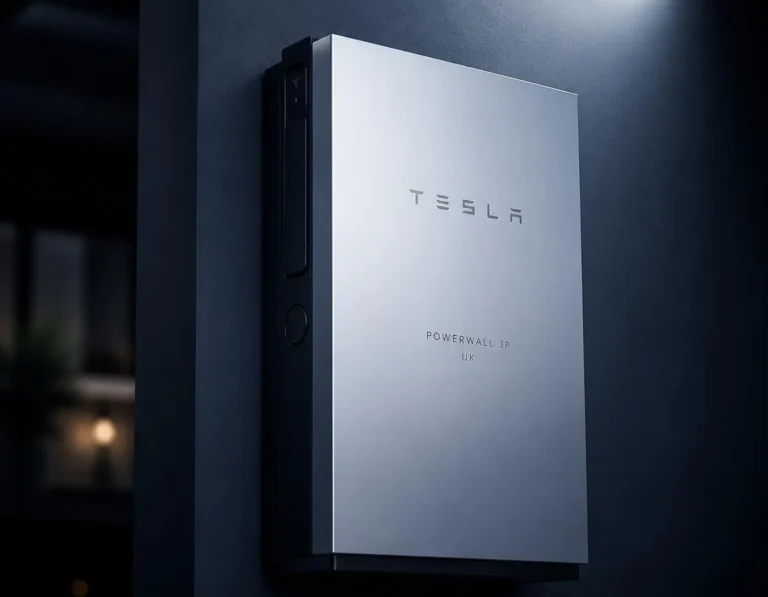
Think in surplus, not just car. The same midday glut that fills a battery pack runs the washing machine, the dishwasher and the immersion. My piece on the best time to run appliances with solar has the order I use. And if you want midday solar in the car overnight, that’s a home battery’s job. A Powerwall 3 starts from about £7,499 installed on Octopus’s published price, and my Tesla Powerwall cost guide has the rest.
One more question I get a lot: can a Model 3 or Model Y power the house or sell to the grid? Not in the UK today. As of October 2026, Tesla’s Powershare home backup for those cars is limited to the US and Puerto Rico, and Tesla says grid support isn’t available for them. Vehicle-to-home in Britain mostly works with CHAdeMO cars like the Nissan Leaf. My V2H guide and V2G guide have the detail.
What it costs in 2026, and where the payback sits
I’ve covered prices in full in UK solar panel costs for 2026. These are the points that matter for a car.
A car-sized 2–3 kWp system costs about £4,000 to £5,500 fully installed, and a typical 4 kWp system £5,500 to £7,500. Small systems cost more per kW because scaffolding, labour and paperwork are mostly fixed. If six or seven panels cover the car but the roof fits twelve, the extra panels are usually the cheapest electricity per kWh you’ll buy, because the house soaks them up.
VAT on solar and battery installs is 0% until 31 March 2027, then 5%, not 20%. Coverage of the 28 October Budget that I checked showed no extension, so plan around the March date. On a typical 4 kWp job the 5% adds about £275 to £375, and £450 to £575 with a battery. My guide to the April 2027 VAT change has the full table.
Export payments come from your supplier, not the government, and the spread is wide: 3p to 32p per kWh, though the 32p top end is a time-of-use tariff that needs a battery. The best open-to-all fixed rate on my table is 13p. Compare them in best SEG tariff rates, check the rules on the Ofgem Smart Export Guarantee page, and estimate your own figure with the SEG income estimator. To run your whole system, my solar panel calculator beats any generic figure here, mine included.
For a typical solar-plus-Tesla household, payback against combined house and car electricity lands somewhere around 8 to 12 years at current prices, the national range on my cost guide. The panels then keep going for another decade or more. The car doesn’t shorten that much, because overnight charging was already cheap, and a kWh of solar in the car only saves you the gap between your overnight rate and your export rate.
Roof space, weight and planning
A 430W panel is about 1.95 m² and around 22 kg. Seven panels need roughly 14 m² of glass and ten need about 20 m². Add walking gaps and edge margins and plan on around 24 m² of usable roof for ten. Most UK semi roofs cope fine. Small terraces and dormer bungalows are where the 12-panel dream meets geometry.
Planning is usually a non-event. In England, roof panels are normally permitted development as long as they don’t protrude more than 200mm beyond the roof plane or sit above the highest part of the roof, chimneys aside. Listed buildings, conservation-area slopes facing the road and some flats are the exceptions. Scotland, Wales and Northern Ireland have their own rules. I’ve mapped the lot in solar panel planning permission, so check it before you fall in love with a layout.
FAQs
How many solar panels do I need to charge a Tesla?
For the 8,900 miles a year that the average UK electric car covers, you need about six 430W panels (2.6 kWp) for a Model 3 and seven (3 kWp) for a Model Y, on a south-facing Midlands roof. At the 7,100-mile average for all cars it drops to five and six. Add about one panel in Scotland and round up if your roof is shaded. Those figures cover a full year, not every month: summer gives you a surplus and winter gives you a shortfall.
Can I charge my Tesla entirely from solar panels in the UK?
Over a full year, yes on paper: six or seven 430W panels generate as much electricity as a Model 3 or Model Y uses at average electric-car mileage. Day to day it doesn’t line up. You get a surplus from April to September and a shortfall from November to February, and the grid tops up the gap. That’s normal. Most households charge from the roof on sunny days and from a cheap overnight tariff in winter.
Is charging a Tesla from solar cheaper than an overnight tariff?
Not always. An overnight tariff at around 7p per kWh costs about 2p a mile in a Model Y. A kWh of solar costs you the export income you give up: roughly 3p to 4p on the weakest SEG deals and 12p to 13p on the better fixed ones. Solar charging wins if your export rate is low or you pay standard-rate electricity (26.32p per kWh from October 2026). Overnight charging can win if you export at 12p or more. Petrol costs roughly 14p to 18p a mile.
My rule of thumb
Average mileage, and the car’s out at work all day? Six or seven panels’ worth of generation covers your year, and the rest of the roof should go to the house. Car at home most days, or you hate buying electricity in July? Ten to twelve panels, a charger that tracks solar, and a summer of smugness. And in December, when the roof gives you next to nothing? Plug in overnight at 7p and stop apologising to the sun. It’ll be back.