
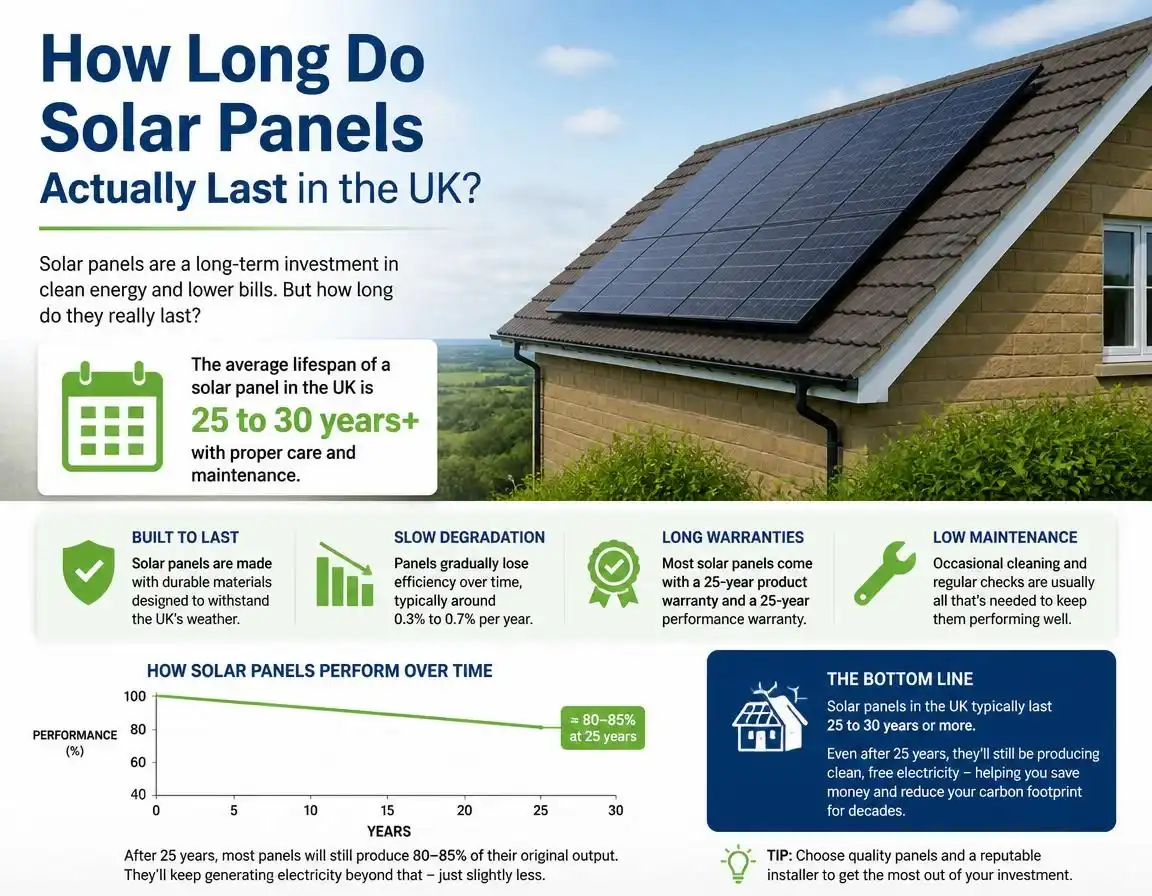
How Long Do Solar Panels Actually Last in the UK

Everyone quotes “25 years” like it’s the panel’s expiry date. It isn’t. Here’s the honest, fact-checked answer on what solar panels really do over 30, 40, even 60 years.
Let’s clear something up straight away, because it trips up almost everyone weighing up whether solar panels are worth it: the 25-year figure you keep seeing quoted is a warranty, not a use-by date. A properly installed panel doesn’t stop generating electricity the day that warranty ends. It just keeps going, a tiny bit less efficient each year, for a good while longer.
I’ve gone through manufacturer data, MCS documentation and real-world monitoring figures from UK installers to answer this properly. No vague “decades” hand-waving. Here’s what actually happens to a solar panel on a British roof, year by year, and which part of your system is genuinely likely to need attention before the panels themselves do.
So, How Long Do They Actually Last?
Modern Tier 1 monocrystalline panels installed in the UK in 2026 are physically built to run for 30 to 40 years. The 25-year figure that dominates every quote and brochure is the manufacturer’s performance warranty period, a commercial promise that output won’t fall below a set threshold, not an engineering limit. Solar cells have no moving parts to wear out, which is exactly why they age so gracefully compared with almost anything else on your roof.
To put that in perspective: the very first modern solar panel, built in the 1960s, is still functional today, over 60 years on. Your 2026 installation isn’t going to match that exactly, but it tells you everything about how forgiving this technology is over the long haul.
What Is Solar Panel Degradation, and Why Does It Happen?
Degradation is just the slow, permanent decline in a panel’s power output as its materials age under sunlight, weather and temperature swings. It’s not a fault. Every panel on the planet does this. The question is only how fast.
There are a handful of forces at play. Light-induced degradation (LID) causes a small dip, typically 1–3%, in the first few months as a brand new panel settles under sunlight for the first time. After that initial stabilisation, UV exposure and thermal cycling, the constant, gentle expansion and contraction as temperatures rise and fall through the day, take over as the main long-term factors. Over 25 years, a UK panel typically retains between 80% and 90% of its original output. Cheaper, lower-tier panels degrade noticeably faster than that, which is exactly why our guide to the different types of solar panels available in the UK matters more than most buyers realise.
Does Britain’s Weather Help or Hurt Panel Lifespan?
Genuinely, mostly helps. Solar cells are semiconductors, and semiconductors dislike extreme heat, it actually increases electrical resistance and drags down efficiency. Countries with scorching summers see faster degradation, often close to 1% a year, because the cells are constantly running hot. The UK’s moderate climate, with our infamous grey but temperature-stable days, is genuinely one of the friendlier environments for long-term panel health worldwide.
What Britain does throw at panels is damp and rain, relentlessly. When seals around the panel frame start to fail after years of exposure, moisture can creep between the glass and the encapsulant layer. That process, called delamination, lets water reach the cells directly and causes slow internal corrosion. It’s rare, and it’s largely preventable, but it’s the one genuinely UK-specific risk worth knowing about. It’s also why frame seal quality and IP rating matter more here than in drier climates, and why coastal properties exposed to salt air, or homes near heavy agricultural dust, tend to see slightly faster ageing of frames and seals than inland suburban roofs.
Panels, Inverter or Battery: What Actually Wears Out First?
This is the part most “how long do solar panels last” articles skip entirely, and it’s arguably more useful than the panel figure itself. Your solar system has several components, and they don’t age at the same rate. Understanding this properly stops you being surprised by a bill in year 12.
| Component | Typical Lifespan | Warranty | Replacement Cost (2026) |
|---|---|---|---|
| Solar panels (Tier 1) | 30–40 years | 25–30 yr performance | Rarely needed within lifetime |
| String / hybrid inverter | 10–15 years | 10–12 yr (extendable to 20) | £1,200–£2,500 |
| Microinverter (e.g. Enphase) | 20–25 years | Up to 25 yr | Usually not needed |
| LiFePO4 home battery | 15–20+ years | 10 yr / 6,000–10,000 cycles | £3,000–£5,000 |
| Mounting & racking | 30+ years | 10–15 yr (installer) | Rarely needed |
| Cabling & connectors | 25+ years | Covered under workmanship | Low, if installed correctly |
Notice the pattern: the panels are almost always the last thing to need attention, not the first. If you’re weighing up whether to bundle a solar battery in with your system, or add one later, our guide on adding a battery to an existing solar setup walks through the cost and savings side of that decision in more detail.
Why Your MCS Certificate Is Part of the Lifespan Story
An MCS certificate isn’t just red tape, it’s the thing that actually protects the long-term value of your system. Installations certified under the Microgeneration Certification Scheme use only MCS-listed products tested against independent performance and safety standards, and they’re the only installations eligible for the government’s Smart Export Guarantee (SEG), which pays you for every unit of surplus electricity you export back to the grid over the full life of the system. Skip MCS, and you lose SEG income entirely, along with most manufacturer warranty protections if something does go wrong.
It’s genuinely worth checking that both your panels and your installer appear on the official MCS Product and Installer Directories before signing anything. If you haven’t worked out roughly what your system should cost or generate yet, our solar panel calculator and SEG income estimator are quick ways to sanity-check a quote against what a properly sized, long-lasting system should realistically deliver over its lifetime.
How to Help Your Panels Reach the Full 30–40 Years
A 30-year warranty is only worth what the manufacturer’s balance sheet can back up. Stick with brands that have real manufacturing scale and a UK track record.
Most real-world lifespan problems come from installation errors, not panel defects. Good mounting, correct torque and proper roof sealing prevent the vast majority of premature failures.
A sudden, unexplained drop in generation (not just a run of grey days) is usually the first sign of a fault, often the inverter rather than the panels. Catching it early keeps repair costs down.
Dirt, moss and bird droppings block light and create hotspots over time. A periodic check, especially after storms, catches cracked glass or loose fixings before they become bigger issues. See our maintenance and cleaning guide for a simple seasonal routine.
Most home insurance policies cover solar panels as part of the roof, but it’s worth confirming this explicitly. Our solar panel insurance guide covers what to check before you assume you’re covered.
What Happens When Panels Finally Reach End of Life?
Even once a panel genuinely is past its useful working life, decades from now for anything installed in 2026, it isn’t destined for landfill. UK panel recycling has matured considerably: aluminium frames, glass, silicon, silver and copper are all recoverable, with over 95% of a panel’s material typically reclaimed through registered recyclers. Panels fall under producer responsibility and WEEE-equivalent regulations in the UK, meaning manufacturers help fund the collection and processing infrastructure, and some Tier 1 brands even offer free take-back schemes at end of life. For a system going in now, this is genuinely a problem for the 2060s, and the recycling chain will only be better established by then.
☀️ The Bottom Line
Solar panels installed properly in the UK today are built for the long game, 30 to 40 years of realistic service, not the 25 years the warranty paperwork implies. The panels themselves are, honestly, the most reliable part of the whole system. If anything needs your attention over the system’s life, it’ll be the inverter around year 10 to 15, not the panels. Buy Tier 1, use an MCS-certified installer, keep half an eye on your generation figures, and a 2026 installation should still be quietly earning its keep well into the 2050s and 2060s.

One Comment