
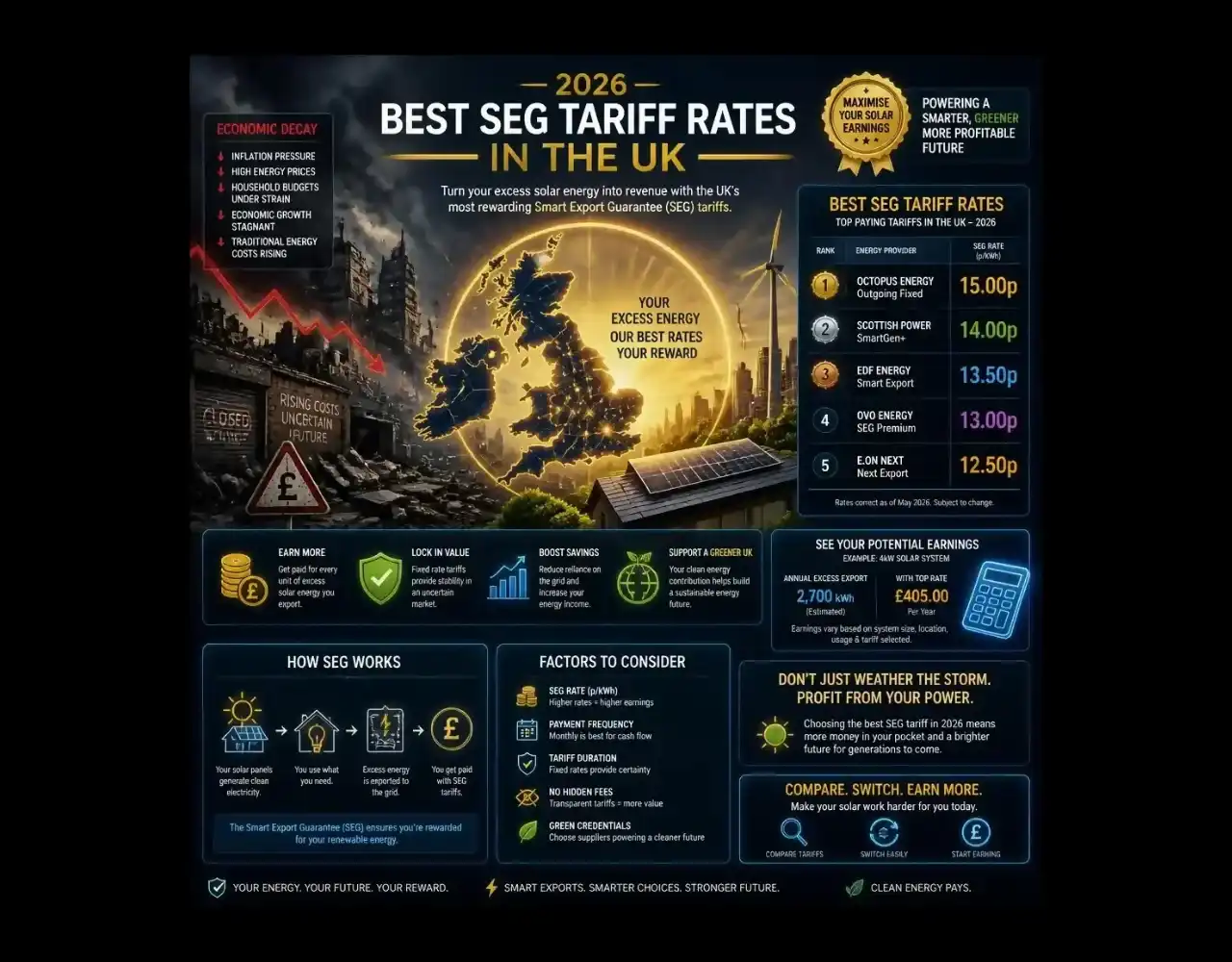
Best SEG Tariff Rates UK 2026: Smart Export Guarantee Compared

From 3p to 32p per kWh — we’ve compared every UK SEG tariff so you can stop leaving money on the table and start earning what your solar actually deserves.
What Is the Smart Export Guarantee?
The UK Scheme That Pays You for Solar You Don’t Use
If you’ve got solar panels and you’re not on a Smart Export Guarantee (SEG) tariff, you’re essentially handing electricity to the grid for free. The SEG is the government-backed scheme that replaced the old Feed-in Tariff in January 2020 — and it requires every licensed energy supplier with more than 150,000 UK domestic customers to offer at least one export tariff for eligible solar owners.
Here’s the bit that most people miss: you can use a completely different supplier for your SEG export than the one supplying your import electricity. That one fact alone can be worth hundreds of pounds a year. By the end of March 2025, 270,395 UK solar homes had joined an SEG tariff — a 63% rise on the previous year, with suppliers paying out a combined £56.97 million. But the gap between the highest and lowest tariff is enormous, so choosing the right one really matters.
Check out how many solar panels are required in the U.K.
SEG Rate Comparison
Every Major UK SEG Tariff Ranked — 2026
Rates verified 2026. SEG tariffs can change with 30 days’ notice — always confirm directly with the supplier before applying.
| Supplier | Tariff Name | Rate (p/kWh) | Type | Eligibility | Annual Est.* |
|---|---|---|---|---|---|
| Octopus | Intelligent Flux | Up to 32p | Time-of-use | Octopus import + battery req. | £300–£640 |
| Good Energy | Solar Savings Exclusive | 25p | Fixed | Install via Good Energy req. | ~£500 |
| EDF Energy | Export Exclusive 12m V2 | 24p | Fixed | Install via EDF / Contact Solar req. | ~£480 |
| OVO Energy | SEG Install Exclusive | 20p | Fixed | Install via OVO req. | ~£400 |
| E.ON Next | Export Exclusive | 16.5p | Fixed | E.ON Next import required | ~£330 |
| British Gas | Export & Earn Plus | 15.1p | Fixed | British Gas import required | ~£302 |
| Good Energy | Solar Savings | 15p | Fixed | Good Energy import required | ~£300 |
| Fuse Energy | Solar Export | 13p | Fixed | Open to all — no import switch | ~£260 |
| Octopus | Outgoing Fixed | 12p | Fixed | Octopus import required | ~£240 |
| ScottishPower | SmartGen | 6p | Fixed | Open to all | ~£120 |
| OVO Energy | SEG Standard | 4p | Variable | Open to all | ~£80 |
| E.ON Next | Export (standard) | 3p | Variable | Open to all | ~£60 |
*Annual estimate based on 2,000 kWh exported per year — typical for a 4kWp solar system with ~50% self-consumption and no battery. Actual figures will vary.
Check out Solar panels north facing roof
Annual Earnings Comparison
What the Same 2,000 kWh of Exports Earns at Each Rate
This is why tariff choice matters so much. The chart below shows annual SEG income for a typical home exporting 2,000 kWh per year — the difference between the worst and best rate is staggering.
Based on 2,000 kWh exported per year. Time-of-use rates shown at headline peak — average annual income will vary.
Check out Solar panels for renters uk
Understanding Tariff Types
Fixed vs Variable vs Time-of-Use — Which Is Right for You?
🔒 Fixed Rate Tariffs
You earn the same p/kWh for every unit exported, regardless of when you export it. Predictable income — ideal if you don’t have a battery and can’t control when your surplus hits the grid. Most of the best fixed rates (E.ON Next, British Gas, Good Energy) require you to switch your import supply to that same company, so weigh up the combined import + export cost
- Predictable, consistent income
- No battery or smart tech needed
- Best for solar-only households
⚡ Time-of-Use (TOU) Tariffs
Export rates shift by the half-hour. During peak demand hours (typically 4pm–7pm weekdays), the grid pays a premium — Octopus Flux has hit over 32p/kWh during these windows. You need a compatible battery to benefit: the strategy is to store solar generation during the day and discharge to the grid during the expensive peak. More complexity, more reward.
- Highest potential earnings
- Requires battery + smart inverter
- Best for tech-savvy battery owners
Check out Solar panels for caravan
How to Switch SEG Tariff
It Takes Under 10 Minutes
Switching SEG is genuinely simple — far easier than switching energy supplier for import. Here’s all you need:
- Your MCS certificate number (from your installer)
- Your MPAN (electricity supply number, on your bill)
- A smart meter installed and working
- Give your old SEG supplier 14 days’ written notice before switching
Quick Eligibility Check
Do You Qualify for SEG?
- Solar PV system under 5MW capacity
- MCS-certified installation (must be issued at time of install)
- SMETS2 smart meter (or DCC-enrolled SMETS1)
- Not already receiving Feed-in Tariff payments
- Not registered for SEG with another supplier
Payments are tax-free for most domestic households. If combined SEG + other side income exceeds £1,000/year, check your self-assessment position.
Check out Solar panels for Garden Shed UK
Frequently Asked Questions
SEG Tariff Questions Answered
The highest headline rate is up to 32p/kWh via Octopus Intelligent Flux during peak export windows — but that needs an Octopus import tariff and a compatible battery. For households without a battery, the top fixed rates are Good Energy Solar Savings Exclusive at 25p/kWh and EDF Export Exclusive 12m V2 at 24p/kWh — both require solar installed through their own networks. The best completely open-to-all rate (no import switch, no installer condition) is Fuse Energy at 13p/kWh.
Yes — and this is one of the most useful things to know. The SEG is fully decoupled from your import electricity supply. You can keep buying electricity from your current supplier and sell your surplus solar to a completely different SEG provider. The only exception is bundled tariffs like Octopus Flux, which requires you to be an Octopus import customer on both sides. You can switch SEG provider at any time with no exit fees — all you need is your MCS certificate and MPAN.
Not for the best fixed rates. Good Energy at 25p, EDF at 24p, E.ON Next at 16.5p, and British Gas at 15.1p are all accessible without battery storage. A battery becomes essential only for time-of-use tariffs like Octopus Intelligent Flux, where the headline 32p/kWh peak rate requires you to discharge your battery to the grid during the 4pm–7pm evening peak. Without a battery, your export pattern is unpredictable, so fixed-rate tariffs are almost always the better match.




28 Comments