
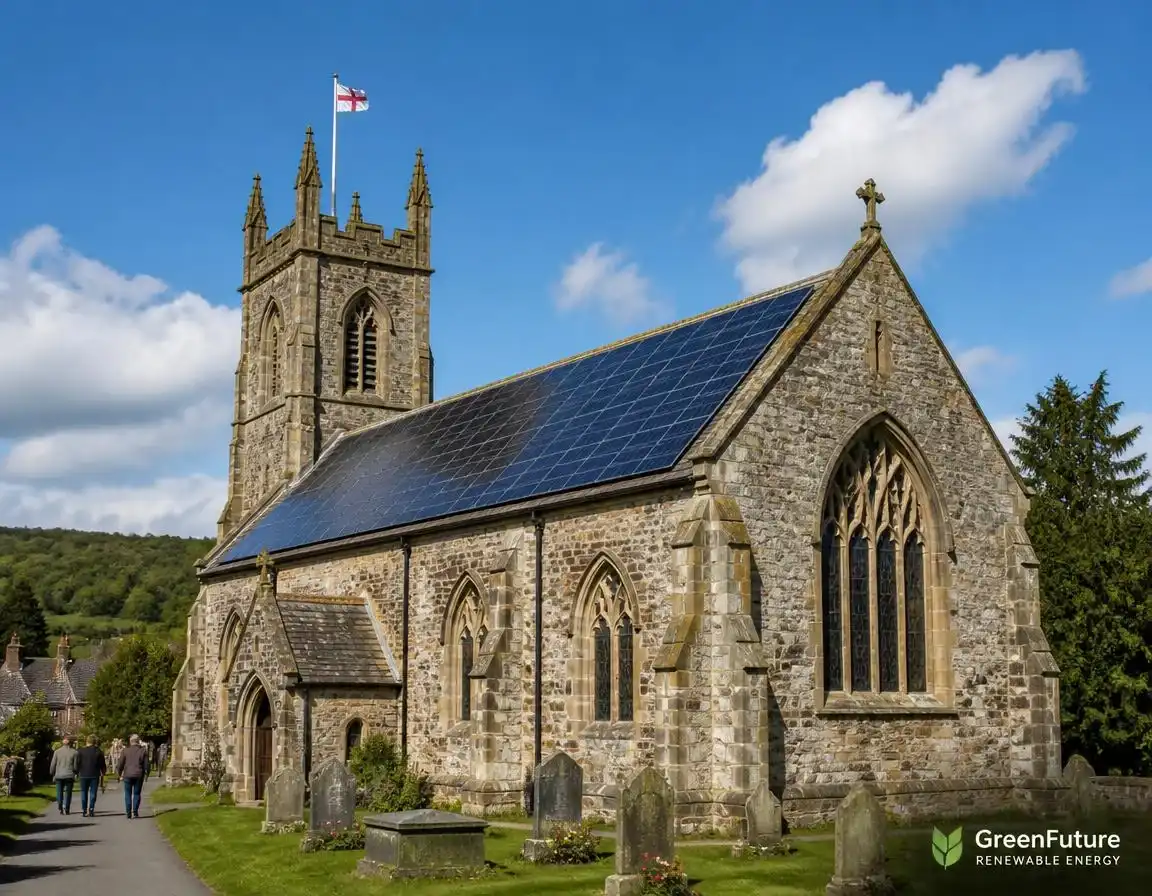
Solar Panels for Churches & Places of Worship UK: Funding, Listed-Building Rules and Real Costs

UK CHURCHES & PLACES OF WORSHIP · 2026 GUIDE
I’ve lost count of the number of PCC treasurers, church wardens and diocesan officers who’ve asked me some version of the same question this year: can we actually afford this, and will anyone let us? Here’s the honest 2026 answer — what’s changed with the funding, what “permission” really means for a listed church, mosque or chapel, and what it costs once the grants are in.
Church energy bills have been brutal these last few years, and most congregations are sitting on the single biggest asset they’ll ever get a straight financial return from: a huge, mostly south-facing roof that’s been up there for two hundred years already. The trouble is, church solar has always come tangled up in two separate questions people struggle to untangle — “are we even allowed to?” and “who’s going to pay for it?” Both answers changed materially in 2026, so if you read anything about this last year, some of it is now out of date.
This guide is for anyone weighing up solar on a church, chapel, mosque, gurdwara, synagogue or meeting house in the UK — whether you’re a churchwarden filling in your first faculty form, a PCC treasurer trying to make the numbers add up, or a diocesan environment officer fielding the same question from six parishes at once. I’ll cover who actually needs to say yes, what’s genuinely fundable in 2026 now the VAT scheme has changed, and what a real installation costs once you strip out the sales-pitch numbers.
Yes, you can install solar on a listed place of worship in the UK — thousands already have. Most mainstream denominations don’t need Listed Building Consent at all (a different, faith-specific process applies instead), solar and battery installs still get automatic 0% VAT until March 2027, and a typical parish system now costs somewhere between £10,000 and £34,000 before any grant funding is even applied.
Why Now
Why 2026 is genuinely different for church solar
Three things have shifted at once this year, and together they change the calculation for most congregations:
- The funding landscape flipped in April 2026. The scheme that had quietly supported churches for over two decades closed, and a new, much larger one opened in its place — more on that below, because the confusion around this is currently the single most-searched question in this space.
- Every major denomination now has a 2030 net zero target. The Church of England committed to net zero carbon by 2030 at General Synod in 2020, the Methodist Conference followed in 2021, and Catholic dioceses are running their own Laudato Si’ action plans. Solar is usually the single biggest lever any individual building has to pull.
- Heritage bodies have stopped treating solar as a threat. Historic England formally told local planning authorities in late 2023 to approve solar on heritage buildings unless it causes genuine, demonstrable harm — and Diocesan Advisory Committees across the country have been approving faculties for matte-black, in-roof panels on Grade I and Grade II* churches ever since.
The Listed Places of Worship Grant Scheme — which let any listed church, chapel or meeting house reclaim the VAT on repair and alteration work — closed for good on 31 March 2026 after 25 years running. It’s been replaced by the Places of Worship Renewal Fund, a very different kind of scheme: competitive capital grants of £10,000–£1,000,000, run by Historic England, for England only. I’ve broken down exactly how the two compare further down this page, because they work nothing alike.
Permissions
Do you actually need Listed Building Consent? Probably not — but you need something else
This trips up more people than anything else in this whole process. Most UK churches are listed, and normally a listed building needs Listed Building Consent from the local council for anything that affects its character. Churches are the exception — but only for the denominations covered by what’s called the ecclesiastical exemption.
Five denominations are exempt from civil Listed Building Consent for their listed places of worship: the Church of England, the Roman Catholic Church, the Methodist Church of Great Britain, the Baptist Union of Great Britain, and the United Reformed Church. In exchange for that exemption, each runs its own equivalent heritage-protection system. For the Church of England, that’s the Faculty Jurisdiction.
Church of England, Roman Catholic, Methodist, Baptist Union, United Reformed Church
- No Listed Building Consent needed for the listed building itself
- Instead: a faculty (CofE) or your denomination’s own consent — for the CofE, your Diocesan Advisory Committee (DAC) advises and the Diocesan Chancellor grants the faculty
- You’ll usually still need ordinary planning permission from your local council for anything visible externally
- Legal basis: Ecclesiastical Exemption (Listed Buildings and Conservation Areas) Order 2010, and for the CofE, the Care of Churches and Ecclesiastical Jurisdiction Measure 2018
Mosques, gurdwaras, synagogues, temples, Quaker meeting houses, most independent and free churches
- Standard Listed Building Consent applies, exactly as for any other listed building — see our full listed buildings guide for the process
- Plus ordinary planning permission where the panels will be externally visible
- Applied for through the Planning Portal, via your local planning authority
- Grade II approval rates for solar on the general listed-building stock currently run at roughly 45–60% for well-prepared applications — see our breakdown by grade
Since 2022, the Faculty Jurisdiction Amendment Rules have required CofE parishes to show “due regard” to the Church Buildings Council’s net zero carbon guidance whenever it’s relevant to a proposal — which in practice has pushed DACs firmly towards approving well-designed solar, not blocking it. If your church, mosque or chapel isn’t covered by the ecclesiastical exemption but is listed, you’ll go through the same civil process, timelines and approval odds as any other listed building.
| Grade | Faculty route (exempt denominations) | Listed Building Consent route (everyone else) |
|---|---|---|
| Grade II | 10–18 weeks | 8–12 weeks |
| Grade II* | 18–26 weeks | 10–16 weeks |
| Grade I | 24–40 weeks | 12–20 weeks |
Faculty timelines tend to run longer at the top grades because Historic England and national amenity societies are statutory consultees on the most significant buildings. Civil LBC figures are consistent with our wider listed buildings timeline data.
Whatever route applies to you, an informal chat before you submit anything formal is the single most useful hour you’ll spend. For CofE parishes, that’s your Diocesan Advisory Committee secretary or Archdeacon; for everyone else, it’s your council’s conservation officer. It’s free, and it tells you which roof slope, panel colour and mounting style will actually get approved before you’ve paid an architect to draw the wrong one.
One genuinely church-specific wrinkle: if you’re looking at a ground-mounted array in the churchyard rather than on the roof, factor in an archaeological assessment. Churchyards are burial ground, and groundworks close to graves or within a scheduled monument boundary usually need extra sign-off before anyone can put a spade in the ground — your DAC or conservation officer will flag this early if it applies.
Money
The 2026 funding landscape, scheme by scheme
Church solar is genuinely one of the best-funded categories of building improvement in the UK — but the picture reshuffled significantly this year, so it’s worth going through what’s actually live rather than what used to be.
| Scheme | What it covers | Typical value | Status, Aug 2026 |
|---|---|---|---|
| 0% VAT (energy-saving materials) | Solar panels, batteries, heat pumps — automatic | ~20% off the bill | Runs to 31 Mar 2027 |
| Places of Worship Renewal Fund | Capital works incl. essential building improvements | £10,000–£1m | Competitive, England only |
| CofE Decarbonising Churches Grant Fund | Solar, heat pumps, insulation, LED | 50–70% of capex* | Opening to all dioceses, June 2026 |
| Diocesan Net Zero Capital Programmes | Top-up grants (Oxford, Bristol, Manchester, Salisbury, Lichfield & others) | Up to £40,000 | Ongoing, varies by diocese |
| Methodist Church Net Zero Programme | Solar, heat pumps, insulation | Varies by district | Ongoing, target 2030 |
| Great British Energy Community Fund | Feasibility & development funding (not capex itself) | Up to £140,000 | Open via regional Net Zero Hubs |
| National Churches Trust grants | Repairs, kitchens, toilets — can support a wider works package | £3,000–£50,000 | Ongoing, match-funded |
| Smart Export Guarantee | Income for electricity you export | 4–32p/kWh | Ongoing, shop around |
*Buildings for Mission / Decarbonising Churches Grant Fund awards typically cover 50–70% of capex on successful applications — around 30% of applications are funded nationally, and success rates vary by diocese.
0% VAT — automatic, and unaffected by the April changes
This is the one that gets confused with the VAT scheme that closed, and it’s worth being precise about. Since 2024, solar panels, battery storage and heat pumps installed in a building used solely for charitable, non-business purposes qualify for 0% VAT — the same relief a homeowner gets, and it applies automatically with no application needed. Churches, chapels and church halls count, provided the space isn’t run as a commercial venture. The Church of England’s own guidance on VAT zero-rating confirms this runs until 31 March 2027, after which it’s due to revert to 5%. Any quote your installer gives you should already reflect the 0% rate — if it doesn’t, ask why, exactly as with a domestic install.
The Places of Worship Renewal Fund — what replaced the VAT scheme
The old scheme simply refunded VAT already spent on repairs. The new fund works completely differently: it’s a competitive capital grants programme, £92 million over four years, delivered by Historic England on behalf of DCMS, for listed places of worship in England of any faith. Grants range from £10,000 to £1,000,000, split across small, medium and large project streams, and applications start with an Expression of Interest before a full application is invited. Priority goes to buildings in areas of high deprivation or community need. Solar isn’t guaranteed funding under this scheme — it’s aimed at urgent fabric repairs and essential improvements — but where solar sits alongside re-roofing, electrical upgrades or wider building works, it can reasonably be included in the case you make. Full eligibility and the current application window are on the Historic England fund page.
Denominational and diocesan funds
The Church of England’s national Net Zero Carbon Programme has allocated more than £30 million so far, including the £5.2 million Demonstrator Churches project supporting 114 high-emission churches, and the Decarbonising Churches Grant Fund opening to every diocese from June 2026 with grants for both planning and capital works. On top of the national pot, several dioceses run their own additional capital programmes — Oxford diocese offers up to £40,000 per parish, with Bristol, Manchester, Salisbury and Lichfield all running active schemes. Methodist churches have an equivalent Net Zero programme through their district structure, and Catholic dioceses typically fund parish solar through diocese-level capital funds tied to their Laudato Si’ action plans, since there’s no single national Catholic equivalent to Buildings for Mission. Charitable trusts including the Benefact Trust and Allchurches Trust also fund church energy projects specifically, alongside the National Churches Trust’s Medium and Large Grants, which are aimed at repairs, kitchens and accessible toilets but can support solar where it’s part of a wider works package.
What a typical funding stack actually looks like
Worked example: a £22,000 parish church solar install, before and after typical grant support
Illustrative only — actual grant coverage depends on your diocese, listing grade and the strength of your application. See our full UK solar grants guide for how these stack against the domestic and commercial routes.
Real Numbers
What does it actually cost in 2026?
Church solar tends to cost a little more per kWp than an equivalent commercial building — usually 15–25% more — because of heritage-sympathetic fixings, matte-black or in-roof panels, and generally trickier access on a tall pitched roof. Here’s what’s landing on real quotes this year, before any grant funding, with VAT already at 0%.
| System size | Typical setting | Gross cost | Typical net cost after grants | Annual saving |
|---|---|---|---|---|
| 6–8 kWp | Small rural chapel | £10,000–£14,000 | £3,500–£9,000 | £400–£700/yr |
| 10–15 kWp | Typical parish church | £13,000–£19,000 | £4,000–£10,000 | £700–£1,400/yr |
| 20–30 kWp | Larger town church or minster | £22,000–£34,000 | £7,000–£16,000 | £1,500–£2,800/yr |
| 40 kWp+ | Cathedral or major complex | From £45,000 | Case by case | From £2,800/yr |
Gross cost vs typical net cost after grants
Midpoint figures by system size, £ (2026)
Why the annual saving is such a wide range — the hall matters more than the roof
This is the single biggest thing that separates church solar from a normal home or school install, and almost nobody mentions it. A church used only for a Sunday service generates most of its solar power on weekdays when the building is empty — most of that electricity gets exported at Smart Export Guarantee rates rather than saving you the full retail unit rate. A church with a busy hall attached — a weekday nursery, a food bank, a lunch club, a community lettings programme — can self-consume 50–60% of what the panels generate, which roughly doubles the annual saving for an identical system. If your PCC is deciding between a Sunday-only church and a hall-and-church combined system, size the array around the hall’s usage, not the church’s.
Unfunded payback on church solar typically runs 12–20 years — longer than a domestic system, for the reason above. With a typical grant covering 50–70% of the gross cost, that drops to roughly 3–9 years, well inside the 25-year panel warranty most manufacturers offer. See our general solar payback period guide for how this compares to a standard home install, and our battery storage cost guide if you’re weighing up adding storage to push self-consumption higher on a Sunday-only building.
Design
Choosing the right technology for a heritage roof
What you specify tells your DAC or conservation officer how seriously you’ve thought about the building — and it materially affects your odds of approval.
| Technology | Best used when | Heritage acceptability | Cost vs standard |
|---|---|---|---|
| Standard on-roof, matte-black | Rear or hidden slopes; Grade II | Good, on non-visible slopes | Baseline |
| In-roof / flush mounting | Where a slate or tile roof needs replacing anyway | Well received across all grades | +15–20% |
| Solar tiles or slates | Prominent slopes needing a full re-cover | Lowest visual impact, but not always convincing on show-front slopes | +80–120% |
| Ground-mounted (churchyard) | Roof refused, or grounds available away from graves | Often well received, subject to siting and archaeology | Site-dependent |
| Battery storage | Sunday-only buildings wanting higher self-consumption | No heritage impact — internal only | +£3,000–£6,500 |
A lot of older parish churches have lead roofs, and metal theft has been a real headache for decades — Historic England’s own places of worship guidance flags it as an ongoing issue. A re-lead project is often the exact moment a re-roof and a solar install make sense together: in the 2023 case Re King’s College Chapel Cambridge, panels were added as part of a like-for-like lead roof replacement, with only the PV element needing full faculty scrutiny. If your roof’s already due for attention, it’s worth asking your architect whether solar can ride along with it rather than being a separate project two years later.
Historic England’s guidance is also honest about where solar tiles fall short: they “do not usually convincingly replicate the look of traditional slates” and aren’t automatically suitable for prominent, publicly-visible slopes — matte-black standard or in-roof panels on a rear slope are usually the more successful, more affordable route. See our fuller technology comparison in the listed buildings guide.
Process
From idea to switched-on panels: the practical sequence
Get a proper energy audit
Pull 12 months of bills for the church and any attached hall separately. This tells you your real weekday vs Sunday usage pattern — the single biggest driver of how big a system actually makes sense.
Have an informal chat before drawing anything up
Your DAC secretary, Archdeacon, or (for non-exempt buildings) your council’s conservation officer, can tell you which slope and panel type stands a real chance — for free, before you’ve spent money on drawings.
Get two or three quotes from installers with real heritage experience
Ask to see faculty or Listed Building Consent applications they’ve actually had approved, not just domestic work. Confirm MCS certification — it’s required for Smart Export Guarantee eligibility and most grant applications. Our MCS certification guide explains what the badge actually covers.
Run consent and funding applications in parallel
Don’t wait for a faculty before applying for a grant, or vice versa — most funders and DACs expect to see both moving at once, and it saves months.
Install, commission, and register for the Smart Export Guarantee
Your installer’s MCS certificate is what lets you register with an SEG supplier — rates currently range from roughly 4p to 32p per kWh, so it’s worth shopping around rather than defaulting to whoever supplies your electricity already.
Real Examples
Churches already doing this

206 solar panels installed in 2023, now generating roughly 22–25% of the cathedral’s total electricity needs — proof that even the very highest listing grade isn’t a dead end with the right design.
The largest of Norwich’s 31 surviving medieval parish churches, and one of the first sites in the Church of England’s Demonstrator Churches project, sharing what it learns with other parishes nationally.
Cut its heating bill by around 80% after removing its gas boiler and switching to all-electric heating alongside its wider energy efficiency work — a reminder that solar tends to work best paired with fabric and heating improvements, not alone.
Added solar as part of a 2023 lead roof replacement, in a case that helped establish how PV can sit alongside routine like-for-like roof repair within the faculty system.
Across the UK
England, Scotland, Wales & Northern Ireland — what’s different
The Places of Worship Renewal Fund is England-only, which is a genuine gap for the other nations. Here’s the honest, current picture across all four.
| Nation | Heritage body / consent | Main funding route in 2026 |
|---|---|---|
| England | Historic England; faculty (exempt denominations) or Listed Building Consent | Places of Worship Renewal Fund, Buildings for Mission, 0% VAT |
| Scotland | Historic Environment Scotland; Church of Scotland uses civil planning + Kirk Session approval | National Lottery Heritage Fund, 0% VAT — see our Scotland grants guide |
| Wales | Cadw; Church in Wales faculty via its own Constitution | National Lottery Heritage Fund, 0% VAT — see our Wales grants guide |
| Northern Ireland | NI Environment Agency (Historic Environment Division) Listed Building Consent | National Lottery Heritage Fund, 0% VAT (no dedicated capital fund equivalent yet) |
If your place of worship sits outside England, the National Lottery Heritage Fund is worth investigating early — it’s open to listed places of worship of every faith UK-wide and isn’t restricted the way the new English fund is.
How long from application to consent?
Typical weeks to decision, midpoint by listing grade — faculty and Listed Building Consent routes combined
The quick recap
- Most CofE, Roman Catholic, Methodist, Baptist Union and URC churches don’t need Listed Building Consent — they need a faculty or their own denominational consent instead, plus usually ordinary planning permission.
- Every other listed place of worship — mosques, synagogues, gurdwaras, temples, most independent chapels — goes through standard Listed Building Consent, the same as any other listed building.
- The old VAT-reclaim scheme for listed places of worship closed on 31 March 2026. The new Places of Worship Renewal Fund is a competitive capital grants scheme, not an automatic reclaim, and it’s England only.
- Solar panels and batteries still get automatic 0% VAT in a church until 31 March 2027 — completely separate from the scheme above, and unaffected by its closure.
- A typical parish church system costs £13,000–£19,000 gross; a busy hall attached to the church, not the church alone, is what really determines your payback.
- Talk to your DAC, Archdeacon or conservation officer before you spend money on drawings — it’s free, and it shapes everything that follows.
❓ Common Questions
Frequently asked questions
Do we need planning permission to install solar panels on our church?
It depends on your denomination and whether the building is listed. If you’re Church of England, Roman Catholic, Methodist, Baptist Union or United Reformed Church, your listed church is covered by the ecclesiastical exemption, so you don’t need Listed Building Consent — instead you need a faculty (Church of England) or your own denomination’s equivalent consent. You’ll usually still need ordinary planning permission from your local council for anything visible from outside. If your place of worship belongs to a different faith or an independent congregation not covered by the exemption, you’ll need standard Listed Building Consent plus planning permission, just like any other listed building.
Is there still a VAT grant for church solar panels in 2026?
Yes, but it’s changed. The old Listed Places of Worship Grant Scheme, which refunded VAT on repairs, closed on 31 March 2026. In its place, the Places of Worship Renewal Fund now offers competitive capital grants of £10,000 to £1,000,000 for listed places of worship in England, run by Historic England. Separately — and unaffected by that change — solar panels, batteries and heat pumps installed in a church still qualify for 0% VAT automatically, because churches count as buildings used solely for charitable purposes. That’s the same relief homeowners get, and it runs until 31 March 2027.
How much does it really cost to put solar panels on a parish church?
A typical parish church system (10–15kWp) costs roughly £13,000–£19,000 fully installed before any grant funding, a little more than a similar-sized commercial building because of heritage fixings and DAC-approved matte-black panels. After 0% VAT and a typical grant such as Buildings for Mission, most PCCs end up paying a net cost somewhere between £4,000 and £10,000 — sometimes less. Larger town churches or minsters with 20–30kWp systems typically cost £22,000–£34,000 gross before grants.
Keep reading on SolarBriton
Guides & tools
- Solar panels on listed buildings UK
- Solar panel grants UK 2026
- Solar panel planning permission
- Solar panels for schools UK
- Is PSDS still funding school solar in 2026?
- Solar panels for commercial property UK
- Commercial solar finance & capital allowances
- MCS certified installers: what the badge means
- Solar panel payback period UK 2026
- Ground-mounted solar panels UK cost
- Best solar battery UK 2026
- Find an MCS-certified installer
Official & heritage resources
- Historic England — Places of Worship Renewal Fund
- GOV.UK grant finder — Places of Worship Renewal Fund
- Church of England — VAT zero-rating for church works
- Church of England — Net Zero Carbon Programme grants
- Church of England — how we manage our buildings (ecclesiastical exemption)
- Historic England — consents and permissions for PV systems
- Planning Portal — apply for Listed Building Consent
- GOV.UK — Smart Export Guarantee
- National Churches Trust — grants
Sources: Historic England Places of Worship Renewal Fund guidance (2026); GOV.UK grant finder; Church of England Net Zero Carbon Programme and VAT zero-rating guidance; House of Lords Library briefing, “Funding for listed places of worship” (2026); Church Buildings Council faculty jurisdiction guidance; Planning (Listed Buildings and Conservation Areas) Act 1990. This article is for general information only and isn’t planning, legal or tax advice — always confirm your specific position with your DAC, denominational property team or local planning authority, and check current scheme details before applying, as funding rounds and eligibility can change.





One Comment