
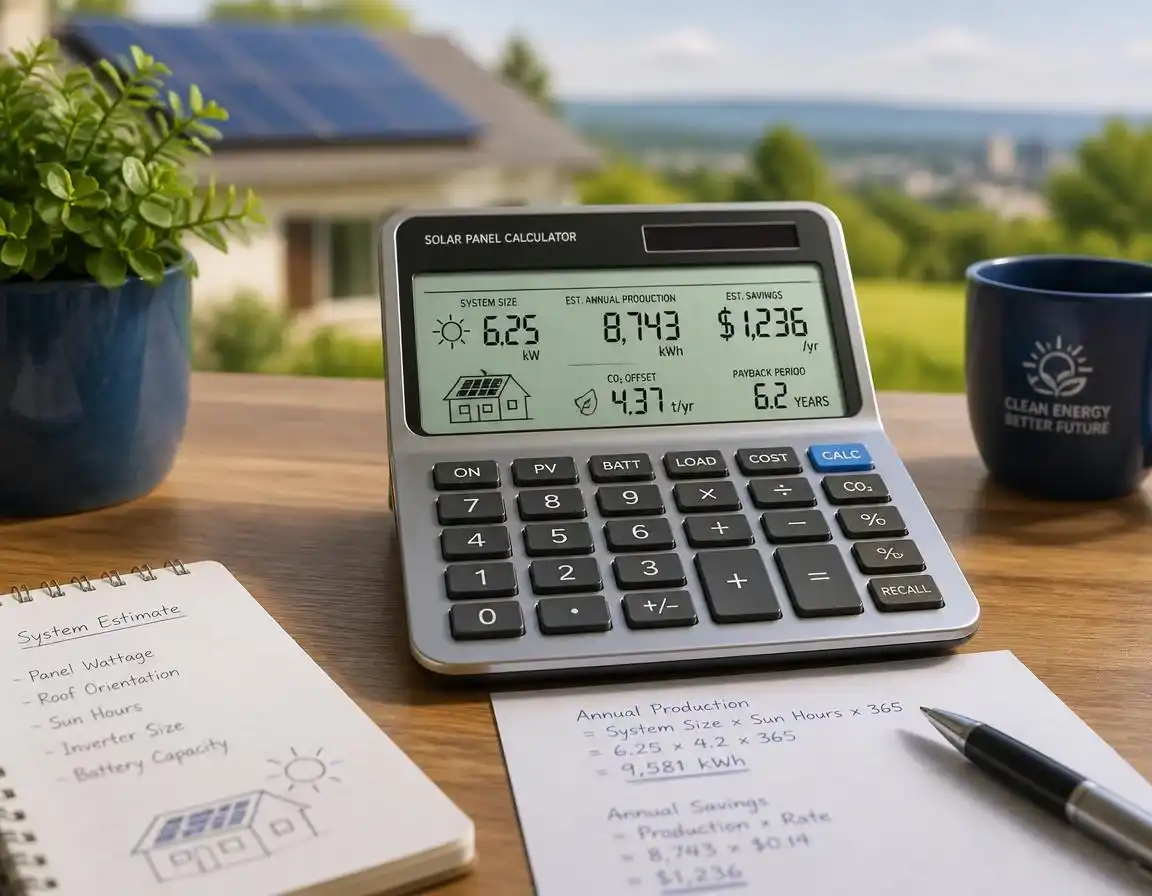
Solar Panel Calculator

Thinking about going solar but not sure if the numbers stack up for your home? This Solar Panel Calculator is built to give you a genuine, personalised estimate — not a vague ballpark figure that means very little to your specific situation.
Here’s how it works. You tell us three things: the basics about your home (size and region), which way your roof faces, and roughly what you pay each month on electricity. From those inputs, we work out your recommended system size, what it’s likely to cost installed, and — most importantly — what you’ll actually save year on year.
Every figure in this calculator is grounded in real 2026 UK data. Installed costs are benchmarked against MCS-certified installer records. Electricity savings are calculated using Ofgem’s current Q2 2026 unit rate of 24.67p per kWh. Regional output figures draw on UK solar irradiance data from PVGIS, adjusted for your roof orientation. Unlike most tools out there, we’ve also included your Smart Export Guarantee income — the payments you receive for surplus electricity exported to the grid — because leaving that out understates the true financial case for solar.
You’ll get your full results instantly. No email address, no sales call, no catch.
Solar Panel Savings Calculator
Find out exactly how much you could save with solar — personalised to your home in under 2 minutes.
Please select the number of bedrooms.
Please select your region.
Please select your roof orientation.
Please make a selection.
Please make a selection.
📋 Your selections
☀️ Your Solar Savings Estimate
Personalised to your home, location, and energy preferences
🏛️ You may qualify for grants
Several UK government schemes can meaningfully reduce your upfront costs. The ECO4 scheme (closing December 2026) provides funding for eligible low-income and fuel-poor households. The Warm Homes Plan offers grants of up to £30,000 towards home energy improvements including solar. Until March 2027, solar panels benefit from 0% VAT, saving a significant sum on installation costs.
🏴 Scotland: Home Energy Scotland provides grants of up to £7,500 for energy improvements including solar panels. Call 0808 808 2282 or visit homeenergyscotland.org.
Check your eligibility at gov.uk.
⚡ Maximise your SEG earnings
The Smart Export Guarantee (SEG) requires energy suppliers with 150,000+ customers to pay you for every unit of surplus solar electricity exported to the grid. Rates vary between suppliers — Octopus Energy currently pays up to 27p/kWh, amongst the highest available. Shopping around annually for the best SEG tariff can add meaningfully to your returns over time.
Important: SEG income requires your system to be installed by an MCS-certified installer. Your MCS certificate will be required when you apply for a SEG tariff with your energy supplier.
✅ Always get at least 3 quotes
Solar installation prices vary considerably between companies. Getting at least three quotes is the single most effective way to ensure you’re paying a fair price. Always verify that any installer is MCS-certified before proceeding — this is a requirement for SEG eligibility, product warranties, and consumer protections.
Check certification status at mcscertified.com.
Results are estimates based on MCS installer benchmarks, Ofgem Q2 2026 unit rate (24.67p/kWh), DESNZ 2024 grid carbon factor, and average UK regional irradiance data. Actual savings and costs will vary. Always obtain at least three quotes from MCS-certified installers at mcscertified.com. SEG rates shown are indicative mid-range figures (15p/kWh). For the latest government grant eligibility, visit gov.uk. This tool does not constitute financial advice.
FAQ 1: How accurate is this solar panel savings calculator?
This calculator is designed to give you a reliable, realistic estimate — accurate enough to help you decide whether solar is worth pursuing — before you spend time sourcing and comparing installer quotes. The figures are built on current MCS installer cost benchmarks, Ofgem’s Q2 2026 unit rate of 24.67p per kWh, and regional UK irradiance data. That said, it produces estimates, not exact quotes. Your actual results will depend on your specific roof condition, the precise panels and inverter your installer specifies, your exact daily energy usage patterns, and which SEG tariff you register on. For a precise, binding quote, you’ll need an MCS-certified installer to survey your property in person. Think of this calculator as step one — it gives you the confidence to know whether the conversation with an installer is worth having.
FAQ 2: What data and sources does this calculator use?
The calculator draws on four main data sources, all updated for 2026. Installed system costs are based on MCS-certified installer benchmarks sourced from industry data published in early 2026, reflecting the post-0% VAT pricing environment. Electricity savings are calculated using Ofgem’s Q2 2026 standing tariff unit rate of 24.67p per kWh — the figure most UK households are currently paying. Solar output estimates for each UK region use irradiance data from PVGIS (the EU’s Photovoltaic Geographical Information System), adjusted per the roof orientation you select. The Smart Export Guarantee income estimate uses a conservative mid-range SEG export rate of 15p per kWh — below the best available rate of 27p (Octopus Flux, June 2026) but above the lowest-paying suppliers. The 25-year projection applies a 3.5% annual energy price escalation and a 0.4% annual panel degradation rate, both consistent with current industry modelling. All data points are reviewed and updated whenever official figures change.
FAQ 3: Why does my location in the UK change the results so much?
Solar panels generate electricity from daylight, and the amount of usable daylight hours across the UK varies significantly by region. The south of England receives meaningfully more solar irradiance per year than Scotland or the north of England — not because it is always sunnier, but because it accumulates more peak sunlight hours across the year. A south-facing 4kW system installed in London or the South East typically produces around 3,800 kWh per year. The same system in Scotland generates closer to 3,100–3,200 kWh. That difference of 600–700 kWh per year represents roughly £170 in annual bill savings — a significant gap over a 25-year system life. The calculator applies a regional irradiance multiplier specific to your selected UK region, so your results reflect where you actually live rather than a UK-wide average that could meaningfully overstate or understate your output.
FAQ 4: Why is the Smart Export Guarantee (SEG) income included in my results?
Because it is real, ongoing income that the majority of solar calculators simply do not show you — and leaving it out significantly understates the financial case for going solar. The Smart Export Guarantee is a government-backed scheme, introduced in 2020, that legally requires licensed energy suppliers to pay you for every kilowatt-hour of surplus solar electricity you export to the National Grid. You need an MCS-certified installation and a smart meter to register, but once you are on a tariff, the income is automatic and ongoing. At a mid-range rate of 15p per kWh, a typical 4kW system without battery storage earns approximately £270–£290 per year in export payments on top of your bill savings. At the best available rate (currently 27p per kWh with Octopus Energy’s Flux tariff), that rises to over £600 per year. Including SEG income in your results gives you a complete and honest picture of what solar is actually worth to you financially.
FAQ 5: Does the calculator account for battery storage?
Yes. If you select “include battery storage” in Step 2, the calculator makes two key adjustments. First, it adds an estimated £4,200 to your total installation cost, reflecting the current 2026 price of a typical 9–10 kWh lithium iron phosphate (LFP) battery unit fully installed. Second, it increases your self-consumption rate from 45% to 75%, meaning you use a much greater share of the solar electricity you generate during the day — storing it for evening use — rather than exporting it to the grid at the SEG rate. This results in higher annual bill savings, a different payback calculation, and a meaningfully larger 25-year return. Battery storage is also currently zero-rated for VAT in the UK until at least March 2027, so the installed cost shown already reflects this saving. If you are unsure whether battery storage makes sense for your household, our guide to battery storage covers the decision in detail.
FAQ 6: Do I need to give my email address to see the results?
No — and that is a deliberate decision on our part. This calculator gives you your complete results immediately: recommended system size, number of panels, estimated installation cost, annual bill saving, SEG export income, total annual financial benefit, payback period, 25-year return, and CO₂ savings. All of it, upfront, with no email address required, no account creation, and no phone number. We believe you should be able to access honest information and make an informed decision before anyone contacts you. If after reviewing your results you would like to take the next step, we signpost you to the MCS certified installer directory at mcscertified.com, where you can find vetted local installers and request quotes on your own terms.
Require further help with Solar Panel Savings? Contact Us