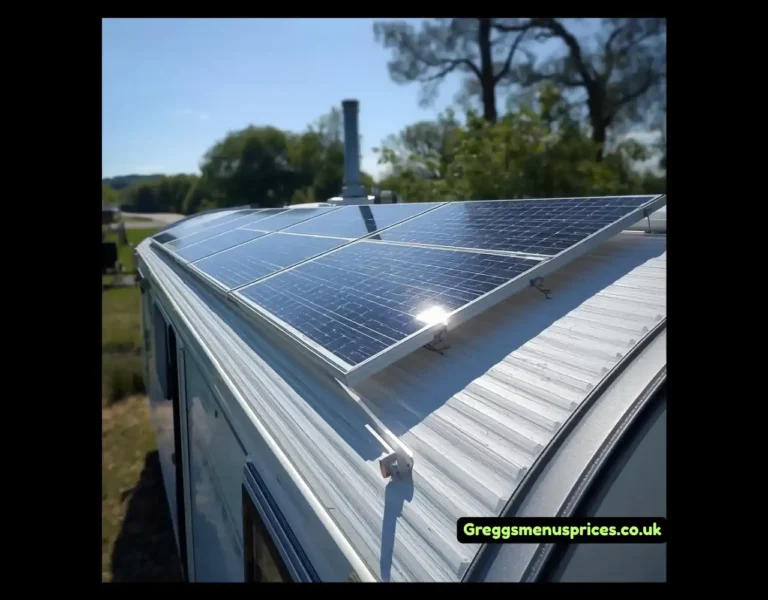
Solar Panels for Motorhomes

If you own a motorhome in the UK, solar panels are not a luxury. They are the single most effective upgrade you can make to your vehicle. A well-designed motorhome solar system eliminates hook- up dependency, opens up laybys, National Park car parks, and wild camping spots that no EHU-reliant traveller can access, and saves £300–£600 per year in hook-up fees for anyone touring regularly across the UK and Europe.

The technology has improved dramatically. In 2026, monocrystalline panels deliver efficiencies above 22% even in the diffuse light conditions typical of UK touring. Flexible panels allow roof mounting on curved or non-flat motorhome profiles without drilling through the shell. And LiFePO4 (lithium iron phosphate) batteries — now the strongly recommended choice for motorhome solar systems — deliver twice the usable capacity of traditional AGM batteries, last 10–15 times as many charge cycles, and weigh roughly half as much.

For most motorhome owners, a 200W fixed roof panel paired with a 100Ah LiFePO4 battery is the practical starting point, covering LED lighting, phone and device charging, a water pump, a 12V cool box, and basic appliances through a UK summer. For full-time and four-season travellers, 400W+ with 200Ah battery capacity is a more realistic specification to maintain a comfortable charge through British winters.

TOP 3 MOTORHOME SOLAR OPTIONS (2026 UK PRICES)

  1. 100W rigid panel kit with PWM controller £60–£150 | Covers lights, USB, 12V cool box | Summer touring
  2. 200W monocrystalline kit with MPPT controller £120–£250 | Year-round reliability | Ideal for 3-season use
  3. 400W system with 100Ah LiFePO4 battery £400–£700 | Covers full motorhome loads | Wild camping ready

Renogy, ECO-WORTHY, and Victron dominate the UK motorhome solar market in 2026, all offering complete kits with panels, MPPT charge controllers, cables, and connectors. If you are buying your first motorhome solar system, start with 200W and a 100Ah LiFePO4 battery — you can always add panels later, but you cannot easily get back the weight and cost you wasted on an undersized system that needed replacing.

You Might Have Questions

Q1: How many solar panels does a motorhome need in the UK?

A1: For occasional summer UK touring, a single 100–200W panel is sufficient to cover lights, USB charging, a water pump, and a 12V cool box. For year-round or full-time touring, 300–400W with a 100–200Ah LiFePO4 battery is recommended. The number of panels depends on your roof space, typical daily consumption in amp- hours, and how often you rely on electric hook-ups.

Q2: What is the best battery for a motorhome solar system?

A2: LiFePO4 (lithium iron phosphate) batteries are strongly recommended for motorhome solar systems in 2026. They provide 80–100% usable capacity compared to 50% for AGM batteries, last 5,000+ charge cycles versus 400 for AGM, and weigh roughly half as much. Although LiFePO4 batteries cost more upfront, the cost per cycle is dramatically lower, making them the better long-term investment for any regular motorhome user.

Q3: Do I need planning permission or DNO notification for motorhome solar panels?

A3: No. Solar panels installed on a motorhome, campervan, or caravan do not require planning permission, G98 DNO notification, or any other regulatory approval. They are vehicle-based systems operating on 12V or 24V DC circuits and are completely outside the scope of building regulations and grid connection rules. Simply purchase a compatible solar panel kit, install it on your roof, and connect it to your leisure battery via an MPPT charge controller.