
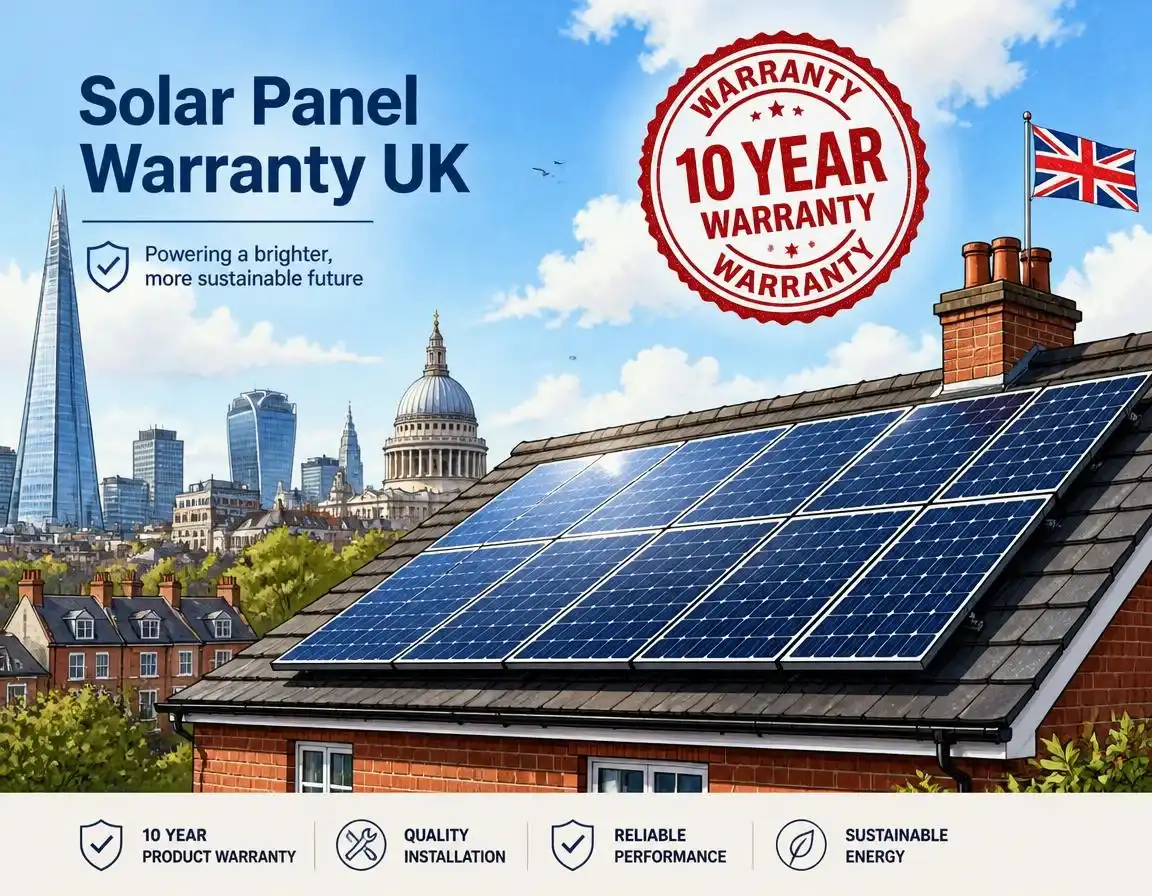
Solar Panel Warranty UK: What’s Covered

Solar Panels · Buyer’s Guide · Updated 11 July 2026
Solar Panel Warranty UK: What’s Covered (And What Isn’t) in 2026
Solar panels are meant to be a 25-year investment, not a 25-year worry. But “it’s under warranty” means almost nothing until you know which warranty, who’s backing it, and for how long. I get asked about this more than almost anything else — usually after something’s already gone wrong. So here’s the plain-English breakdown for 2026, including a change to installer protection that most warranty guides haven’t caught up with yet.
The three warranties you actually have
Solar systems don’t come with one warranty — they come with at least three, from two different sources. Two are issued by the manufacturer of your panels (and separately, your inverter and battery). The third comes from whoever installed your system, and it’s the one people misunderstand most.
| Warranty type | Who backs it | Typical length in 2026 | What it actually covers |
|---|---|---|---|
| Product warranty | Panel / inverter / battery manufacturer | 20–30 yrs (panels), 10–12 yrs (inverters & batteries) | Manufacturing defects — cracked cells, delamination, faulty electronics |
| Performance warranty | Panel manufacturer | 25–30 yrs | Guaranteed minimum output, usually 87–90% of original at year 25–30 |
| Workmanship warranty | Your installer | 2 yrs legal minimum, 5–10 yrs common, up to 6 yrs on newer FPP-backed cover | Installation quality — wiring, mounting, roof penetrations, water ingress |
For reference, panels like the Jinko Tiger Neo carry a 30-year product warranty and JA Solar’s range runs to 25 — you’ll find lengths for every major brand we track across our solar panel guides.
How long does each warranty actually last?
Laid out side by side, the gap between panel cover and everything else becomes pretty obvious.
What’s covered — and what genuinely isn’t
This is where most disappointment happens. Manufacturer warranties are generous on paper but narrow in practice: they cover the product doing its job, not everything that could happen to it.
| Usually covered | Usually NOT covered |
|---|---|
| Manufacturing defects — cracked cells, delamination, hot spots | Storm, hail or falling-branch damage |
| Output dropping below the guaranteed curve | General wear, dirt or bird mess reducing output |
| Faulty wiring or mounting from a poor install | Damage from DIY work or non-MCS repairs |
| Component failure within the warranty term | Pressure-washing panels — voids most manufacturer terms |
| Installer insolvency, if the workmanship warranty is insurance-backed | Skipped servicing where the manufacturer requires proof of maintenance |
Storm damage, theft, fire and accidental damage sit with your buildings insurance, not your solar warranty — we’ve covered exactly what that should include in our solar panel insurance guide.
The 2026 change that shortens the riskiest warranty you have
Of your three warranties, the workmanship one has always been the runt of the litter — a legal minimum of just 2 years, propped up by an Insurance-Backed Guarantee (IBG) most homeowners never actually see the paperwork for. That’s changing. MCS is rolling out a Redeveloped Installer Scheme through 2026, and one headline shift is financial protection: the old 2-year minimum IBG is being replaced by MCS-approved products offering at least 6 years of cover — three times what you’d have got twelve months ago. Every certified installer has until 31 March 2027 to make the switch, so it’s worth asking exactly which product backs your quote today. We’ve gone deep on the wider MCS shake-up — assessment frequency, complaints handling, the lot — in our MCS certification guide, but for warranty purposes, the financial protection change is the one that actually affects your money.
What happens if your installer — or the manufacturer — goes bust?
This isn’t hypothetical. In April 2026, GivEnergy — one of the UK’s biggest battery brands — entered administration. Its administrator confirmed that, going forward, the company itself could no longer stand behind existing hardware warranties. The batteries themselves kept working fine, since they don’t need the manufacturer to function, but anyone still mid-warranty lost their direct route to a claim overnight. It’s a useful, if uncomfortable, reminder that a 25-year system is only as secure as the weakest company behind it — worth weighing up alongside our battery brand comparison before you buy.
- Go to your installer first. Most warranty processes run through the installer, not the manufacturer directly.
- Check for an insurance-backed guarantee or FPP. This exists specifically for a company ceasing to trade — it should still pay out.
- Check Section 75. If you paid any part of the system (over £100) by credit card, your card provider may be jointly liable under the Consumer Credit Act 1974.
It’s also worth reading our guide to spotting a shaky installer before you sign — the financial red flags usually show up well before the news does.
Your legal rights don’t disappear when the warranty does
Separately from any manufacturer or installer warranty, you have statutory rights under the Consumer Rights Act 2015. If goods are faulty, not as described, or not fit for purpose, you can claim against whoever sold them to you for up to 6 years in England, Wales and Northern Ireland (5 years in Scotland) — regardless of what the warranty paperwork says. GOV.UK is clear that this right applies whether or not a warranty or guarantee is still valid. It’s a genuinely useful backstop most homeowners don’t realise they have.
Keeping your warranty valid — the quick version
Use an MCS-certified installer
Non-certified installs can void your manufacturer’s product and performance warranty outright. Find a certified installer →
Register your system
Some manufacturers need this within 30–60 days of installation — check your handover pack.
Keep every document
Certificates, serial numbers and invoices — store digital copies as well as paper ones.
Book an annual check
Many extended warranties require proof of maintenance. See our maintenance checklist →
Common questions about solar panel warranties
How long is a solar panel warranty in the UK?
Most tier-1 panels sold in the UK in 2026 carry a 20–30-year product warranty and a 25–30-year performance warranty guaranteeing at least 87–90% of the original output. Inverters typically run 10–12 years (up to 25 for microinverters), batteries 10–12 years, and the installer’s workmanship warranty is a legal minimum of 2 years — though many 2026 installs now come with up to 6 years of insurance-backed cover as standard.
What happens to my solar warranty if the installer or manufacturer goes bust?
Manufacturer warranties become very difficult to claim directly once a company enters administration — GivEnergy’s April 2026 administration is a recent example. Your first step should always be your original installer, since many warranty claims are processed through them. If your installer holds an insurance-backed guarantee or MCS-approved financial protection product, that cover should still apply even if the company has closed. Paying by credit card also gives you Section 75 protection for purchases over £100.
Does my solar panel warranty cover storm or accidental damage?
No — manufacturer and workmanship warranties only cover manufacturing defects, faulty installation, or underperformance. Storm damage, falling branches, theft, fire and accidental damage are covered by your buildings or contents insurance instead, not your solar warranty, so it’s worth confirming your policy includes your panels before you need to make a claim.
A solar system is a two-to-three-decade relationship with your roof — the warranty is what makes sure you’re not the only one holding up your end of the bargain. If you’re still comparing quotes, run the numbers first and always check who you’re signing with.
Try the solar panel calculator Find an MCS-certified installer



17 Comments