
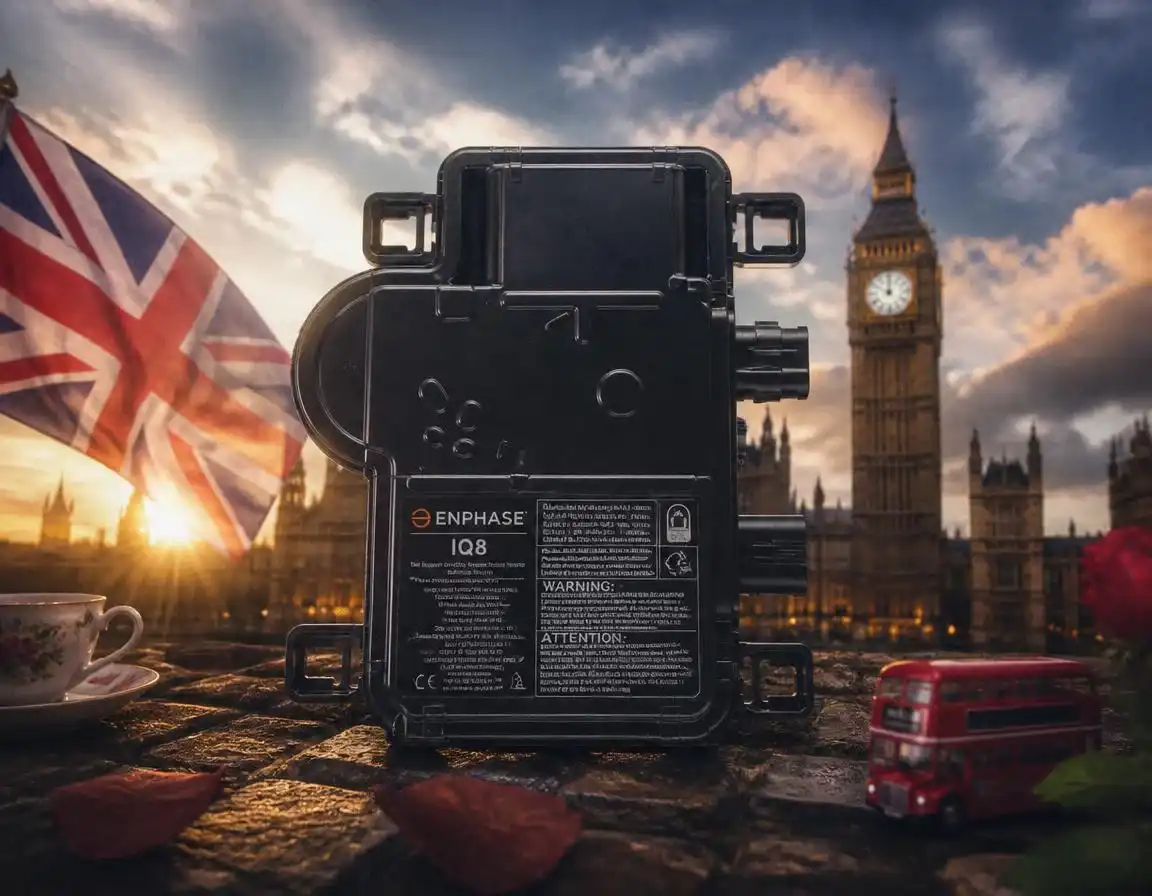
Enphase IQ8 Microinverter Review UK (2026)

Enphase IQ8 Microinverter Review UK (2026): Specs, Price & an Honest Verdict
The IQ8 is the microinverter most UK installers now reach for when a roof gets complicated. I’ve specified Enphase kit for the better part of twenty years, so here’s my honest take on what the IQ8 actually does, what it really costs in 2026 — and, just as importantly, whose money it isn’t worth.
⚡ The 60-Second Verdict
Let me be blunt, because this is the part most review pages skip: on a clean, south-facing roof with no shading, the IQ8 is a waste of your money. A decent hybrid string inverter will generate the self-same electricity for £800 to £2,000 less, and you’d be better spending the difference on a battery. That’s not a flaw in the IQ8. It’s just what microinverters are.
But point me at a Victorian terrace with a chimney stack, a dormer, an east–west split and a neighbour’s oak tree, and the IQ8 is exactly what I want on that roof. Every panel works independently, shade on one panel stays on that panel, and the whole lot is covered by a warranty that matches the panels’ own life. No other inverter architecture does all three.
✅ What the IQ8 gets right
- True panel independence — shade never spreads
- 25-year warranty, no extension upsell
- Panel-by-panel monitoring included free
- Grid-forming: limited power even in a cut, with the right controller
- Handles modern high-wattage panels (up to 480W on the IQ8MC)
- Easy to extend later — just bolt on another panel and unit
⚠️ Where it falls short
- Premium you’ll never recover on a clean roof
- Battery pairing works best inside the Enphase ecosystem
- Every unit sits on the roof — servicing means roof access
- More components on the roof than a single string box
- UK stock skews to a couple of model codes — check the datasheet
🔬 The Specs, Without the Marketing Gloss
Enphase’s naming gets confusing, so here’s the UK reality: distributors here mainly stock the MC4-connected “C” variants, with the IQ8MC the one you’ll see on most quotes. The base IQ8 is the entry model. The family as a whole runs from 240 VA right up to 380 VA, so there’s a match for everything from a small 410W panel to a beefy 540W module.
| Specification | IQ8 (base) | IQ8MC (UK stock favourite) |
|---|---|---|
| Peak AC output | 245 VA | 330 VA |
| Max continuous output | 240 VA | 325 VA |
| EU-weighted efficiency | 96.5% | 96.7% |
| MPPT operating window | Low-voltage DC (tens of volts, not the hundreds a string carries) | |
| Panel compatibility | Smaller / older modules | 54-, 60-, 66- & 72-cell panels up to 480W |
| Weight / dimensions | 1.08 kg | 1.1 kg · 212 × 175 × 30 mm |
| Comms & safety | Power-line communication, built-in rapid shutdown, Class II double insulation | |
| Grid behaviour | Grid-forming — the backbone of Enphase’s Sunlight Backup | |
| Warranty | 25 years | |
Sources: Enphase datasheets and UK distributor listings (Midsummer Wholesale), checked September 2026. Always confirm the exact model code on your quote.
One number people misread: that 96.7% EU efficiency looks lower than a string inverter’s 98%-plus headline figure, and salesmen love pouncing on it. It’s the wrong comparison. The string’s 98% applies after it has already dragged a shaded panel’s output down across the whole array. The IQ8’s 96.7% applies to each panel independently, at its own sweet spot. On a real British roof with a chimney shadow crawling across it at 3pm in February, the “less efficient” microinverter regularly delivers more electricity. That’s the whole product in one paragraph.
🆚 IQ8 vs IQ7: What’s Actually New
The IQ7 series — IQ7A, IQ7+, IQ7X — was discontinued in 2024, and the IQ8 has been the standard fit on new UK Enphase systems since early 2025. Most of what you’ll read about the IQ8 online is still American, split-phase, 240V stuff, so here’s what matters for a UK home:
| IQ7 (discontinued 2024) | IQ8 (current) | |
|---|---|---|
| Grid behaviour | Grid-following only | Grid-forming — can keep a compatible system producing in a cut |
| Panel headroom | Suited to older 250–350W modules | Comfortable with modern 400–480W+ panels |
| Backup | With battery + controller | Sunlight Backup — limited power from panels alone, with the right controller |
| Warranty | 25 years | 25 years |
| UK availability | Leftover stock only | Current range, stocked by UK distributors |
Enphase officially supports expanding an IQ7 array with IQ8 microinverters on the same IQ Gateway — handy if you want to add a few higher-wattage panels or top up an east roof. The installer needs the current Installer App (v4.9.0 or newer) and gateway firmware, and the new panels run as their own IQ8 branch. Same gateway, no rip-out. It’s one of the nicest ownership perks in solar.
Should existing IQ7 owners upgrade for its own sake? No. An IQ7 that’s working is earning its keep; the warranty stands. The IQ8 matters when you’re buying new, extending, or replacing a failed unit’s generation.
☔ The Only Reason Most People Buy One: UK Weather & Shading
With a string inverter, panels in series share one current — Christmas lights, basically. Shade one panel and every panel on that string dims to match it. I’ve logged systems where a single chimney cost a third of the array’s afternoon output in winter. The IQ8 deletes that problem at the source: each panel converts its own DC to AC on the roof, so the shaded panel simply produces less on its own, and the rest carry on regardless.
How big is the gain, honestly? US research from the National Renewable Energy Laboratory puts microinverter yields 5–25% ahead of string setups on partially shaded or mixed-orientation arrays. On the typical shaded British roof — one chimney, one tree, maybe an east–west split — I’d expect 10–20% in practice, which tracks the 10–25% range I quote across this site. On a spotless south roof, the gain is essentially zero, and I’ll say so on your survey too.
Weather matters in a softer way as well. UK light is diffuse more often than direct — cloud, mist, low winter sun. Panel-level MPPT tracks each panel’s moving sweet spot through that murk, which is why microinverter systems tend to feel “livelier” on grey mornings in the app than a string system of the same size.
The question your installer should answer before quoting anything: is there meaningful shading between 9am and 4pm? Yes → IQ8 (or SolarEdge optimisers) earns its keep. No → save the premium and put it towards a battery instead. My full walkthrough is in the micro inverter vs string inverter guide.
🛠️ Installation, MCS and the G99 Bit Nobody Explains
Fitting IQ8s is quicker per panel than old-generation micros — two-wire plug-and-play cabling, power-line communication instead of separate comms wires — but it’s still more roof-time than hanging one box on a wall, and that labour shows up in your quote. The units are 1.1 kg each and sit behind the panels, invisible from the street.
Two things to check on any quote, because they decide both your SEG eligibility and your paperwork:
| Check | What it means for you |
|---|---|
| MCS-certified installer | Non-negotiable if you want SEG export income. The certificate number goes on your SEG application — no MCS, no export payments. |
| G98 / G99 grid connection | Microinverters don’t dodge the rules. Total system capacity still counts: under 3.68kW per phase is the simple G98 route; bigger systems need a G99 application to your network operator. A good installer sizes and files this for you. |
| IQ Gateway | Needed for commissioning and monitoring. It’s the same gateway that later lets you add IQ8s to an IQ7 system, or bolt on Enphase batteries. |
| Model code on the quote | Ask for it in writing (e.g. IQ8MC). UK stock varies, and the code tells you which panels it pairs with. |
Servicing is the honest trade-off: there’s no single wall-mounted box to swap, but if a unit ever fails (Enphase claims a 0.05% failure rate across its fleet, and in my own experience claims are handled without drama), someone is going up a ladder rather than into your garage. The rest of the array keeps generating meanwhile — with a string inverter, a fault takes the whole system down until it’s fixed. That difference matters more in year 12 than it does on day one.
💷 What It Costs in the UK in 2026 — and the VAT Cliff
Unit prices I’m seeing in the trade right now: the IQ8MC lists around £105 ex. VAT at UK distributors, and once you’re paying an installer’s margin and labour, homeowners typically see £105–£150 per panel for the microinverter side of things. For a 10-panel system that’s £1,050–£1,500 in microinverter hardware before the rest of the system is priced.
| System | Typical installed cost (2026) | Notes |
|---|---|---|
| 4kWp, hybrid string inverter | £5,500–£7,500 | The sensible default on a clean roof |
| 4kWp, Enphase IQ8 | £6,300–£9,500 | String price plus the £800–£2,000 micro premium |
| 5–6kWp, Enphase IQ8 | £8,000–£11,500 | Larger roofs, EV owners, possible G99 application |
Ranges reconcile my 2026 solar panel cost guide with current Enphase hardware pricing. Get three quotes; the same system can vary by £1,500–£2,500 between installers.
Installation of solar and batteries in UK homes is 0% VAT right now, rising to 5% from 1 April 2027 under HMRC’s Notice 708/6 (see the official guidance). On a £7,500 job that deadline is worth about £375; against the full 20% standard rate, 0% VAT saves roughly £1,000–£1,500 on a typical system. If you’re going to do it anyway, doing it before the cliff is free money.
📊 SEG Export & the Payback Maths
Here’s a worked example I’d be happy to defend, for a 4kWp IQ8 system in southern England generating around 3,400 kWh a year, with half used at home and half exported — no battery, current Ofgem cap of about 26p/kWh, and a decent open export tariff at 13p:
That sits inside the 7–12 year window my payback guide quotes for 4kW systems, and two levers pull it down: shading (where the IQ8’s 10–20% extra harvest is pure profit a string system never sees) and export tariff choice. Standard SEG tariffs pay a few pence to around 15p/kWh, while bundled and peak-window deals run 25–32p — my SEG tariff comparison has the current table, and the gap between best and worst is worth £200–£400 a year on its own.
Add an Enphase battery later and self-consumption jumps from about half to around 80%, which changes the maths again in your favour. The IQ8’s AC-coupled design means storage bolts on without touching the panels — though you’re marrying into the Enphase ecosystem for the battery, and that’s a pricing conversation of its own.
🥇 IQ8 vs SolarEdge vs Hybrid String: The Real Contest
The IQ8 isn’t competing against “solar inverters” in general. It’s competing against two specific alternatives on your quote. Here’s the honest three-way:
| Enphase IQ8 | SolarEdge optimisers | Hybrid string | |
|---|---|---|---|
| Shading handling | Best — fully independent | Excellent | Poor |
| Upfront (10 panels) | £1,400–£2,000+ inverter side | £1,400–£2,000 inverter side | £700–£1,200 unit |
| Warranty | 25 yrs, everything on the roof | 25 yr optimisers / 12 yr inverter | 10–12 yrs |
| Single point of failure | None | Central inverter | Central inverter |
| Battery pairing | Enphase ecosystem | SolarEdge Home Battery | Easiest — any compatible battery |
| Monitoring | Enlighten — near real-time, free | mySolarEdge — ~15 min refresh | Varies by brand |
| Best for | Heavy shade, mixed roofs, keep-it-forever buyers | Light shade + easy servicing | Clean roofs, tightest budgets |
Notice what the table says: SolarEdge, not string, is the IQ8’s true rival — similar money, similar shading gains, different philosophy (one wall box vs none). I’ve compared the two monitoring apps panel-by-panel in my SolarEdge vs Enphase monitoring comparison if the app is going to sway you. And if your quote currently features a string box, my Huawei SUN2000 review is still worth a read for context — it explains why that brand disappeared from UK quotes in January 2026 and rounds up the string alternatives installers have shifted to since.
Panel pairing, since it comes up: the IQ8MC is happy with current N-type modules up to 480W — the Jinko, LONGi and REC panels in my best solar panels for UK homes list all pair sensibly. Ask your installer to show the module-pairing calculation rather than taking “it’ll be fine” on trust.
🛡️ Warranty & Reliability: The Quiet Killer Feature
Every inverter brand talks reliability. The IQ8’s answer is structural: there is no central unit to fail, and each microinverter carries a flat 25-year warranty — the same horizon as your panels. String boxes, by contrast, are the most failure-prone component in a solar system, and budgeting for a swap around year 12 (£600–£1,500 supplied and fitted) is just sensible ownership.
Two practical notes from the field. One: Enphase quotes a fleet failure rate around 0.05%, and the units I’ve had to deal with over the years have almost always been installation errors rather than product faults — installer quality matters as much as the badge. Two: if you move house, the monitoring account and remaining warranty need a formal ownership transfer with Enphase — five minutes on completion day that people forget, then mourn. The step-by-step is in the monitoring guide.
❓ FAQs
Yes. The IQ8 series replaced the discontinued IQ7 range in early 2025 and is now what UK installers fit on new Enphase systems. UK distributors stock the MC4-connected versions such as the IQ8MC, and most MCS-certified installers can quote it alongside string and SolarEdge alternatives.
Roughly £800 to £2,000 installed on a typical 10-panel system. The microinverters themselves run about £105 to £150 each depending on model and installer volume. On a clean, unshaded roof that premium buys you very little; on a shaded or multi-orientation roof the extra 10–25% generation usually earns it back.
Yes, as an extension. Enphase officially supports expanding an IQ7 array with IQ8 units on the same IQ Gateway, so you can add higher-wattage panels without ripping out working hardware. Your installer will need the current Installer App and gateway firmware, and the new panels get their own IQ8 branch rather than being interleaved with the old ones.



One Comment