Beginner’s Guide

Solar Panels for Beginners: Your Simple UK Start Guide (2026)
You’ve noticed your neighbour’s roof looks a bit different, your electricity bill keeps creeping up, and you’re wondering whether solar is actually worth looking into. This is the page we wish existed when we first started digging into it ourselves. No jargon dumped on you without explanation, no scary sales pitch — just a plain-English starting point that gets you from “no idea” to “right, I know what to do next.”
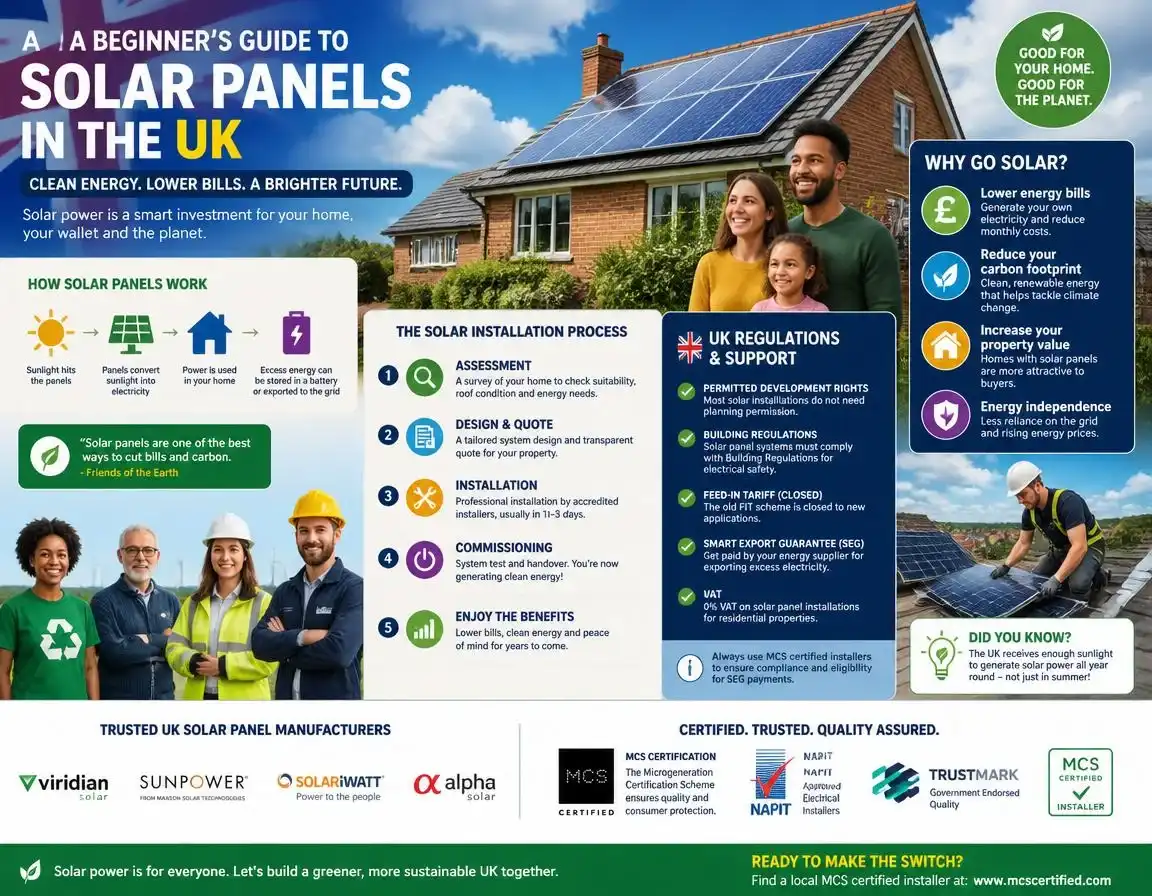
You don’t need a physics degree or an afternoon spent reading a 40-page technical brochure to understand solar. What actually trips most beginners up isn’t the science — it’s the jargon, working out what size system suits your home, and knowing what to actually do first. That’s exactly what this page sorts out. If you’re after the full breakdown of 2026 costs, every grant going, and the different panel technologies, our main solar panels guide covers that in depth — this page is your starting point before you get there.
The Solar Jargon Buster
Every solar conversation seems to come with its own dictionary. Here’s the plain-English version of every term you’ll actually hear from an installer, grouped so it’s easy to scan.
Kit & Generation
| Term | What it actually means |
|---|---|
| kW / kWp | The size of your system. kWp (“kilowatt-peak”) is the maximum output your panels can produce under lab-perfect conditions — it’s how systems are labelled and sold. |
| kWh | A unit of actual energy used or produced over time. This is what shows up on your electricity bill and what your panels get credited for. |
| PV | Short for “photovoltaic” — the tech inside a panel that converts light into electricity. |
| DC / AC | Direct Current (what panels produce) and Alternating Current (what your home’s sockets use). Your inverter converts one into the other. |
| Inverter | The box that turns your panels’ DC electricity into usable AC electricity for your home. |
| Hybrid inverter | An inverter built to work with a battery, even if you don’t fit one on day one — useful if you might add storage later. |
| String vs micro-inverter | One big inverter for the whole roof, versus a small inverter behind each panel (better if part of your roof gets shaded) — see our full micro vs string inverter comparison. |
| Degradation rate | How much a panel’s output drops each year. Modern panels lose roughly 0.3–0.4% annually — barely noticeable. |
| Bifacial panel | A panel that can also catch reflected light on its back — handy for flat roofs and ground mounts. |
Money & the Grid
| Term | What it actually means |
|---|---|
| Self-consumption | The percentage of your solar electricity you use yourself, rather than sending it to the grid. |
| Export rate | What you’re paid per kWh for surplus electricity sent to the grid, via the SEG. |
| SEG | The Smart Export Guarantee — the scheme that pays you for exported electricity. We’ve built a free SEG Income Estimator if you want to run your own numbers. |
| Payback period | How many years of savings it takes to cover what you paid for the whole system. |
| Smart meter (SMETS2) | The meter type needed to record your exports so you can actually be paid under the SEG. |
| Time-of-use tariff | An electricity tariff with cheaper and pricier hours — useful for charging a battery overnight on cheap rates. |
Certificates & Permissions
| Term | What it actually means |
|---|---|
| MCS | The Microgeneration Certification Scheme — the UK’s quality mark for installers and kit. You need it for the SEG and most grants. |
| DNO | Your Distribution Network Operator — the company that owns the local electricity cables. Your installer must notify them before you switch on. More at the Energy Networks Association. |
| G98 notification | The simple, standard form your installer submits to your DNO for most home solar systems. It’s a notification, not an approval process. |
| Permitted development | Planning rules that let most homes fit solar without a formal planning application — though listed buildings are a common exception. |
| EPC | Energy Performance Certificate — the A–G energy rating for your home. Some grants depend on it. Check yours at gov.uk/find-energy-certificate. |
Quick tip: if an installer uses a term you don’t recognise mid-conversation, just ask them to explain it in one sentence. A good installer will happily do this. One who gets impatient or vague is a small red flag worth noting.
What Size Solar System Do You Actually Need?
Before you get quotes, it helps to have a rough number in mind. The starting point isn’t your roof — it’s your annual electricity usage in kWh, which you’ll find on any recent bill (look for the total in kWh, not just the pounds figure). Here’s roughly how usage maps to home type (see our full system sizing walkthrough for a more detailed method):
| Home type | Typical annual usage | Sensible starting point |
|---|---|---|
| Studio or 1-bed flat | 1,800–2,200 kWh | ~2 kWp |
| 2-bed house or flat | 2,600–3,000 kWh | ~3 kWp |
| 3-bed semi-detached | 3,400–4,000 kWh | ~4 kWp |
| 4–5 bed detached | 4,500–6,000 kWh | 5–6 kWp |
| + Electric vehicle | Add ~2,500–3,500 kWh/yr | Add 1–2 kWp |
| + Heat pump | Add ~3,000–4,500 kWh/yr | Add 2 kWp+ |
Figures are illustrative UK averages, not a quote. Your actual usage depends on household size, appliances and habits — an installer’s site survey will confirm the right size for you.
Where to actually find your kWh figure: check the annual summary on a paper bill, your supplier’s online account, or the in-home display that came with your smart meter. Got a day/night meter (Economy 7 or similar)? Add both readings together for your true annual total.
Don’t want to do the maths by hand? Our free Solar Panel Calculator takes your usage and roof details and gives you a straightforward estimate of the right system size in a couple of minutes.
A Day in the Life of Your Solar Panels
Most people picture solar output as constant throughout the day — it isn’t. Generation follows the sun in a curve, building from sunrise, peaking around midday, and tailing off by evening. Here’s what that actually looks like for a south-facing system on a clear June day compared with a December day.
Same panels, same roof — just far fewer daylight hours to work with in December, and a much shorter, steeper curve squeezed into the middle of the day. This is exactly why it pays to size your system around your annual usage rather than judging it by a single sunny afternoon. It’s also the main reason a battery is so useful: it lets you shift some of that fat midday summer bulge into the evening, when you’re actually home using electricity.
Solar Myths, Busted
A handful of persistent myths put people off solar unnecessarily. Here’s the honest version of each one.
What Kind of Solar Buyer Are You?
Solar looks a bit different depending on your circumstances. Here’s a quick steer to the right corner of the site for your situation.
You own your home
The most straightforward route — your roof, your call, and the widest choice of grants.
Solar for your own home →You’re renting
You’ll need your landlord’s written permission first, but it’s becoming far more common.
Solar panels for renters →You live in a flat
Roof-mounted solar usually needs the freeholder’s sign-off, but balcony solar may be an option.
Solar for apartments →You run a farm
Big barn and outbuilding roof space can mean serious commercial-scale savings.
Solar panels for farms →You run a business
Commercial solar has its own tax treatment and payback logic worth understanding.
Solar for commercial property →You’re part of a school
Schools have unique funding routes, and long summer holidays to plan generation around.
Solar panels for schools →Moving into a new build
Developers increasingly fit solar as standard — worth knowing what to check before you move in.
Solar for new builds →Just powering a shed
A small standalone system can be far simpler than a full household install.
Solar for garden sheds →You own a motorhome
A different world of compact, portable 12V systems entirely.
Solar for motorhomes →Your First-Month Action Plan
Here’s the order we’d actually do things in, if we were starting from scratch this week.
Check which way your roof faces
A compass app on your phone is all you need. South-facing is best, but east and west both work well — see how regional and roof direction affects output in our regional breakdown.
Pull up 12 months of bills and note your total kWh
Not just the pounds figure — the actual kWh usage. This is what tells you (and your installer) roughly what size system makes sense, using the table above.
Check your home’s EPC rating
Some grants depend on it. Look yours up for free at gov.uk/find-energy-certificate.
Run the numbers with our free calculator
Plug in your usage and roof details on our Solar Panel Calculator for a straightforward system-size estimate.
See what grants and VAT savings apply to you
Use our free UK Solar Grant & VAT Savings Checker to see what you might qualify for before you get quotes.
Work out what you could earn from exporting electricity
Try our SEG Income Estimator to see roughly what your surplus solar could be worth per year.
Get at least three quotes from MCS-certified installers
Use our Find an Installer page, and double-check any certificate number directly at mcscertified.com.
Read the full technical guide before you sign anything
Our complete 2026 solar panels guide covers exact costs, every grant, panel technology and how to spot a bad installer.
The Paperwork You’ll Get, and Why to Keep It Safe
A proper installation comes with a small stack of documents. Don’t let them get lost in a drawer — you’ll need them again.
| Document | What it’s for | Why keep it |
|---|---|---|
| MCS certificate | Proves your installer and kit meet the UK quality standard | Needed for SEG registration, and buyers’ solicitors ask for it |
| Building Regulations certificate | Confirms the electrical work meets Building Regs | Requested during any future house sale |
| DNO / G98 confirmation | Confirms your network operator knows about your system | Needed for a smooth SEG application |
| Product & workmanship warranty | Covers panels, inverter and installation labour | You’ll need this if anything ever needs fixing or replacing |
| Updated EPC (if applicable) | Reflects your improved energy rating | Can support green mortgage applications later on |
Beginner FAQs — The Questions People Actually Ask First
What’s the difference between kW and kWh?
kW (kilowatt) measures power — how fast electricity is being generated or used at any one moment, a bit like the speedometer in a car. kWh (kilowatt-hour) measures energy — the actual amount used over time, which is what you’re billed for and what your solar panels are credited for. A 4kW system running flat out for one hour produces 4kWh.
Do I need a new fuse box or consumer unit for solar panels?
Sometimes, but not always. If your existing consumer unit is old, has the wrong type of circuit breaker, or has no space left for the extra connections, your installer may need to upgrade it. A good installer checks this during the site survey and includes it in your written quote, so it shouldn’t be a surprise on installation day.
Will my solar panels still work during a power cut?
Not automatically. Standard grid-tied solar systems switch off during a power cut for safety, so they don’t feed electricity into a network engineers might be working on. If you want backup power during an outage, you need a battery with a specific backup or EPS (Emergency Power Supply) function, which your installer can specify.
What happens to my solar panels if I move house?
They stay with the property and become the new owner’s asset, much like a boiler or a kitchen. Keep your MCS certificate, warranty documents and Building Regulations compliance certificate safe, as your solicitor will usually pass these to the buyer’s solicitor. Homes with solar and a good EPC rating are generally seen as a selling point.
Can I install solar panels myself?
Some small plug-in kits can be self-installed, but a full roof-mounted system should always be fitted by a qualified, MCS-certified installer. Beyond the safety risks of DIY roof work, you’d lose access to the Smart Export Guarantee, most grants, and your installer’s workmanship warranty, all of which require MCS certification.
What’s the difference between a string inverter and a micro-inverter?
A string inverter is one central unit converting the DC electricity from your whole panel array into AC — the standard, cost-effective choice for most UK roofs with little shading. A micro-inverter is a small unit fitted behind each panel, so shading or a fault on one panel doesn’t drag down the whole system. Micro-inverters cost more but suit part-shaded or multi-facing roofs. For a fuller breakdown of when each makes sense, see our micro-inverter vs string inverter guide.
Do I need to tell my home insurer about my solar panels?
Yes. Most UK home insurers require you to declare solar panels, as it affects your buildings cover and sometimes your contents cover for the inverter and battery. Most insurers don’t charge extra for a standard, professionally installed system, but failing to declare it could affect a future claim. Always check with your specific provider.
Can I get solar panels if I have a flat roof?
Yes. Flat roofs use a triangular mounting frame that tilts the panels to around 10–15 degrees, which also lets rainwater run off. It costs a little more due to the extra mounting hardware, and your installer will check the roof can take the added weight and wind loading, but it’s a common, well-established installation type across the UK.
Trusted Official Resources
Don’t just take our word for it — these are the official and independent bodies worth checking directly.
Where to Go Next on SolarBriton
About this guide: Written for people new to solar, using publicly available government, MCS and industry information as of 2026. Figures for usage, generation and timing are illustrative averages to help with planning, not a personalised quote — your installer’s site survey will confirm exact numbers for your home. SolarBriton.co.uk is independent and not affiliated with any installer, panel manufacturer, energy supplier or government body. Always verify grant eligibility and MCS certification directly with the official sources linked above. Got a question we haven’t covered? Email support@solarbriton.co.uk — we read every message ourselves.