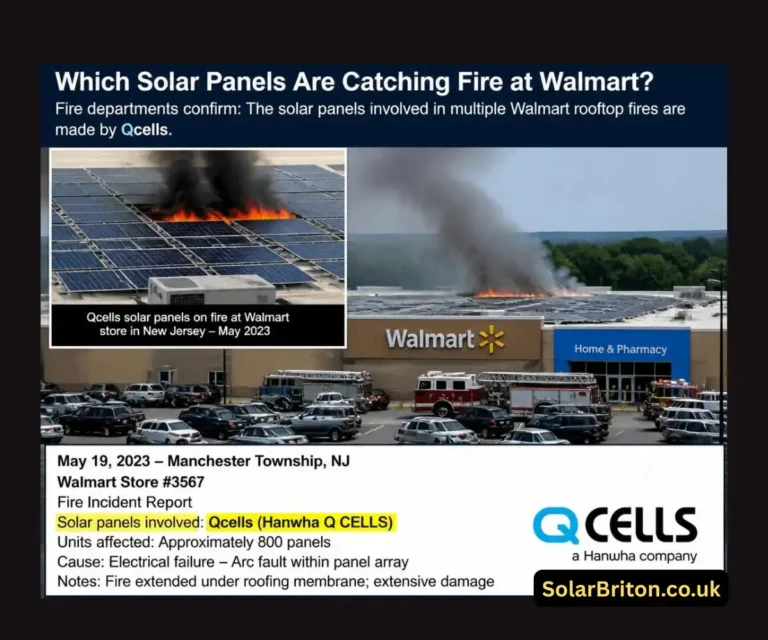
UK Fire Crews Attend a Solar Panel Fire Every Two Days

SOLAR PANEL SAFETY · 2026 UPDATE
Solar panels are, statistically, one of the safest things you can put on a roof. But the fire brigade’s own numbers tell an uncomfortable second story: call-outs are climbing much faster than installations are. Here’s what’s actually behind the numbers, which bit of your system is the real weak point, and how to check yours in ten minutes flat.

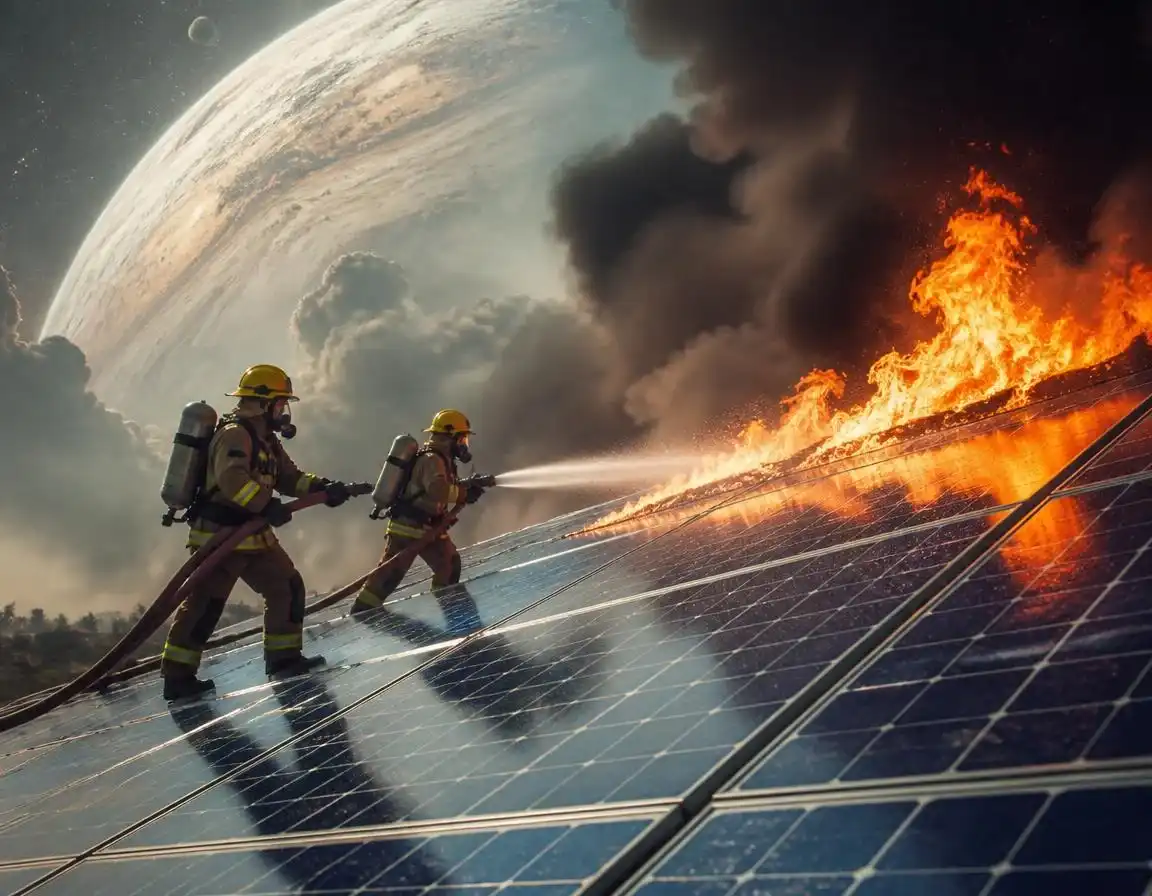
Let’s start with the reassuring bit, because it’s true and it matters: with well over two million solar installations now on UK roofs, the overwhelming majority will never cause a moment’s trouble. But insurer QBE went digging through Freedom of Information requests to UK fire services, and what came back is worth your attention. UK crews attended 212 fires involving solar panels in 2025 alone — more than double the number in 2022 — and the rate of fires is rising considerably faster than the rate of new installations.
That last point is the one that should make you sit up. If fires were simply keeping pace with the solar boom, you’d shrug and move on — more panels, proportionally more incidents, nothing to see. That’s not what’s happening. QBE’s own analysis puts it starkly: fires are up 133% over the last four years, against a 52% rise in installations over the same period. Something about how systems are being installed, aged, or maintained is going wrong more often than the growth in numbers alone would explain.
UK fire services are now attending a solar-panel-related fire roughly every two days, and the rate has more than doubled since 2022 — rising faster than the number of installations. The single biggest identified cause, going back to the UK’s most detailed study on this, is the DC isolator: the switch that’s meant to let you (or a firefighter) cut the power. Poorly designed or ageing isolators, especially on systems installed between 2010 and 2016, are the leading culprit, followed by faulty DC connectors. It’s a fixable, checkable problem — not a reason to distrust solar as a technology.
The Data
What the fire service call-out numbers actually show
QBE has now published two waves of this research. The first, in November 2025, covered 2022 to 2024 and found fires had risen 60% in two years — “almost every two days” by 2024. A newer update, based on FOI data gathered through February 2026, takes the picture through the whole of 2025 and shows the trend hasn’t slowed down.
The 2022 baseline shifts slightly between QBE’s two research waves (91 vs 107, depending on which set of fire services responded to each FOI request) — a normal quirk of FOI-based research, not a contradiction. Either way, the direction is unmistakable.
Here’s the detail that matters most: only 37 of the UK’s 49 fire services were able to supply data for the first wave of research. That means the real national total is very likely higher than reported — this is a floor, not a ceiling.
| Building type | Fires recorded |
|---|---|
| Residential buildings | 97 |
| Commercial properties | 27 |
| Solar farms | 17 |
| Industrial buildings | 10 |
Ordinary homes account for the clear majority of incidents — this isn’t a problem confined to big commercial arrays.
The Real Cause
What’s actually going wrong — and it’s not the panels themselves
The most detailed UK study on this remains a 2018 government-commissioned report by the Building Research Establishment (BRE), which forensically examined 80 solar-related fire incidents. It’s still the reference point every serious fire safety guide in this space goes back to, and its findings line up closely with what’s still being reported today.
Based on the BRE’s 2018 “Fire and Solar PV Systems” report for the then Department for Business, Energy and Industrial Strategy — 26 of 80 incidents were probably caused by DC isolators, with a further 12 (5 probable, 7 possible) linked to DC connectors. Thirteen of the 80 incidents involved injuries, including three fatalities, which is exactly why the fixes below are worth ten minutes of anyone’s time.
In plain terms: the panels sitting on your roof, generating electricity from sunlight, are rarely the problem. The weak points are the bits of electrical hardware around them — particularly the DC isolator, the switch designed to let the system be safely cut off. When one is badly made, badly installed, or simply worn out, it can develop a loose connection. Electricity then “arcs” across the tiny gap, generating intense, localised heat — hot enough to ignite nearby material. Unlike the mains electricity in your house, this DC arc doesn’t self-extinguish the way an AC fault often does, which is part of why these faults can be so persistent once they start.
Check Your Own System
Is your installation year part of the problem?
This is the bit most coverage of this story misses entirely, and it’s genuinely useful: certain DC isolator designs used specifically on installations completed between roughly 2010 and 2016 are known to suffer from accelerated internal wear, leading to exactly the kind of overheating and arcing described above. If your system falls into that window, it’s worth a proper look, not because it’s dangerous by default, but because it’s the batch where problems have most reliably turned up.
Systems installed 2010–2016
- Covers the era before most inverters had built-in DC isolation, when a separate external isolator box was standard
- Certain isolator designs from this period are known to suffer accelerated contact wear
- Look for a box near your inverter, usually labelled “DC isolator” or “PV isolator”
Systems installed since ~2018
- Most modern string inverters now integrate DC isolation internally, removing that historic failure point
- MCS tightened installation standards significantly following the 2018 BRE findings
- DC connectors remain the main residual weak point industry-wide — still worth an occasional visual check
Warning signs worth acting on immediately, whatever your installation year: an isolator box that’s warm or hot to the touch during normal daylight operation, any discolouration or scorch marks on the casing, a burning or “hot plastic” smell near the inverter or isolator, or a drop in generation output with no obvious cause like shading or dirt. Any of those means switching the system off at the AC isolator and calling an MCS-certified installer straight away, rather than waiting for your next scheduled service.
Not Just Statistics
Recent incidents that made the news
Forced an evacuation after a rooftop blaze. Avon Fire and Rescue Service later confirmed it was accidental, caused by a fault in the building’s solar panels — a reminder these incidents aren’t confined to older domestic systems.
Blamed on solar panels within a twelve-month period, prompting around 80 Suffolk schools to switch their panels off as a precaution. The local council was clear the school fires were believed to have separate, unrelated causes rather than one shared fault.
Worth noting on that second example: precautionary switch-offs are a sensible, low-cost response while investigations are ongoing — they’re not, on their own, evidence that a specific fault has been found across every affected site.
The Response
What’s changed since the 2018 report
To be fair to the industry, this isn’t a problem that’s been ignored. MCS (the Microgeneration Certification Scheme) tightened its installation standards directly in response to the 2018 BRE findings. Since then, most string inverters have shipped with DC isolation built in as standard, removing the external isolator box — historically the single biggest identified failure point — from the equation entirely on newer systems. Every UK PV installation must also comply with BS 7671 wiring regulations, covering correct cable management, isolation switches and safe commissioning, checked off as part of any properly certified installation.
Arc-fault detection is the newer frontier: some current inverters and add-on devices now actively monitor for the electrical signature of an arc fault and shut the circuit down automatically before it can spread — closer to the smoke-alarm model than the old “hope the isolator holds” approach. It’s not yet universal or mandatory across every UK installation, but it’s the clear direction of travel, and worth asking your installer about directly if you’re having a new system fitted or considering a retrofit safety upgrade on an older one.
What To Actually Do
Five things worth doing this month
Check your installation date
Your paperwork, MCS certificate or original invoice will show it. 2010–2016 systems are the priority group worth a closer look.
Do a visual check of the isolator box
Look for warmth, discolouration, scorch marks, or a burning smell near the inverter or any DC isolator box. Don’t open it yourself — this is a look-don’t-touch check.
Watch your generation figures
A sudden, unexplained drop in output can be an early warning sign of a developing electrical fault, not just a dirty panel — a monitoring system makes this much easier to spot early.
Book a proper inspection if you’re overdue
Roll this into your annual maintenance check rather than treating it as a separate job — an MCS-certified installer can test your isolator and connectors properly, not just eyeball them.
Ask about arc-fault protection if you’re due an upgrade
If your isolator needs replacing anyway, ask whether an arc-fault detection device makes sense for your system — and check your warranty first, since some isolator replacements on affected batches may be covered.
The quick recap
- UK fire services attended 212 solar panel fires in 2025, more than double the 2022 figure, and rising faster than the number of installations — 133% up over four years against a 52% rise in installations.
- Only 37 of 49 UK fire services provided data for the first wave of research, so the true national figure is likely higher.
- The UK’s most detailed study found DC isolators responsible for around a third of investigated fires, with DC connectors the second biggest cause.
- Systems installed between 2010 and 2016 are the group most worth checking, since that’s when the affected isolator designs were commonly fitted.
- MCS has since tightened standards, and most modern inverters now integrate DC isolation, removing the historic weak point from newer installs.
- A quick visual check, watching your generation figures, and staying current on maintenance closes off the vast majority of the realistic risk.
❓ Common Questions
Frequently asked questions
Are solar panels themselves a fire risk?
Not really, in most cases. The UK’s most detailed study on solar fires found the panels themselves are rarely the direct cause — the leading causes are the DC isolator and DC connectors, the electrical hardware that manages and can cut off the system’s power. With over two million UK installations and a small fraction ever affected, solar remains a low-risk technology overall, though the rate of incidents is rising faster than installations, which is worth taking seriously.
How do I know if my solar panel system is at risk?
Systems installed roughly between 2010 and 2016 are the group most associated with known DC isolator issues, since that’s when certain isolator designs prone to accelerated wear were commonly fitted. Warning signs to check for include an isolator box that’s warm to the touch, discolouration or scorch marks, a burning smell, or an unexplained drop in generation output. Any of these should prompt an immediate call to an MCS-certified installer.
What’s the difference between this and solar battery fire risk?
They’re different mechanisms entirely. This article covers DC arc faults in the panel wiring and isolators — a gradual electrical fault, usually linked to installation quality or component wear. Battery fires typically involve thermal runaway inside the battery cells themselves, a different chemical process with different causes and different warning signs, which we cover separately in our solar battery fire safety guide.
Keep reading on SolarBriton
Safety & fire risk
Sources: QBE Insurance, “UK fire services tackle a solar panel fire every two days” (November 2025) and “Solar panel fires increasing at more than double the rate of installations” (2026), both based on Freedom of Information requests to UK fire services; GOV.UK, “Fire incidents involving solar panels” — BRE National Solar Centre research for the Department for Business, Energy and Industrial Strategy (2018); GOV.UK, Solar photovoltaics deployment statistics; trade coverage from Roofing Today, Energy Manager Magazine, International Fire and Safety Journal and Designing Buildings confirming the QBE figures; Avon Fire and Rescue Service statements on the Bristol maternity hospital incident; Suffolk County Council and ITV Anglia on the Suffolk schools precautionary shutdown. This article is for general information only and isn’t fire safety or engineering advice — if you have any concern about your own system, contact an MCS-certified installer or your local fire and rescue service directly.