
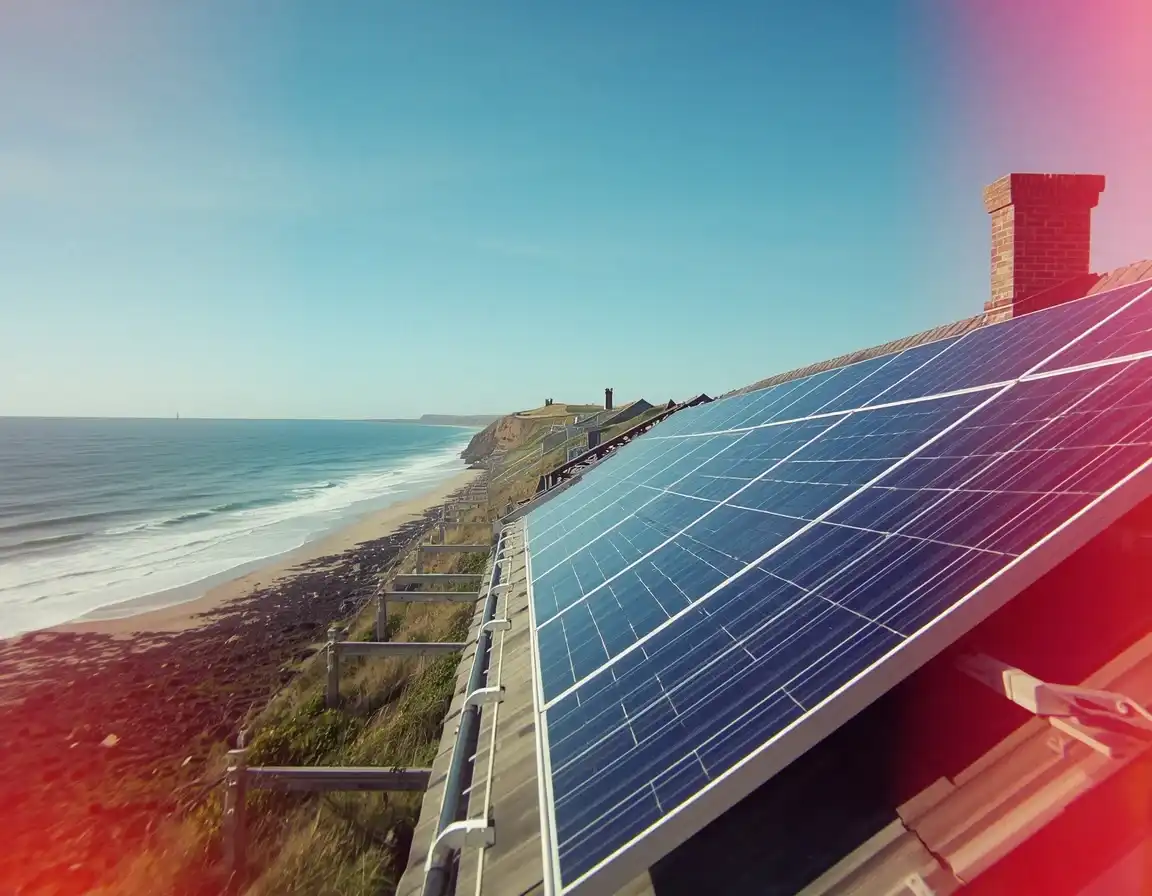
Solar Panels on Coastal Properties in the South East: Salt, Wind & What You Need to Know

Solar Panels on Coastal Properties in the South East: Salt, Wind & What You Need to Know
The South East coast is one of the best places in the UK for solar. But salt mist, wind loading and the wrong mounting hardware can quietly shorten your system’s life. Here’s how to get it right.

When coastal homeowners ask me whether solar makes sense for their property, my answer is always the same: you’re actually in one of the best positions in the country. Towns like Worthing, Eastbourne, Brighton, and Bognor Regis record up to 1,920 sunshine hours per year, and the South East coast’s solar irradiance sits at 1,020 to 1,050 kWh per kWp annually — second only to Cornwall across the whole of England.
But there’s a catch, and it’s a serious one if you ignore it. Salt mist, wind loading, and the corrosive environment that makes coastal living so appealing also make it uniquely demanding for solar equipment. Get the specification wrong and you can end up with corroded mounting hardware, voided warranties, and a system that fails well before its 25-year lifespan. Get it right, and you have one of the most productive residential solar systems in the UK.
Here’s what you actually need to know in 2026.
The South East Sunshine Advantage
The South East coast’s exceptional solar performance comes down to geography. Lewes in East Sussex receives around 1,357 kWh of solar energy per square metre every year — that’s 24% higher than the UK national average. Bognor Regis and Worthing regularly record close to 1,920 sunshine hours, making them genuinely competitive with northern France for solar yield. A well-oriented 4kW system anywhere between Margate and Bournemouth can realistically generate between 3,400 and 4,200 kWh of electricity per year.
☀️ Annual Solar Yield Comparison — South East vs Rest of UK (kWh/kWp, 2026)
Brighton, Worthing, Eastbourne
UK’s sunniest region
All regions blended
Northern England
Lowest in UK
Sources: PVGIS satellite data, Solar Info UK regional map, Met Office climate averages (June 2026). South East coast comfortably outperforms the UK average.
Check out Solar Panel Grants U.K.
The Salt Mist Challenge — and How to Beat It

Salt deposition in high-exposure South East coastal zones — Dorset, Sussex, Kent — typically ranges from 10 to 100 grams per square metre every year. That salty air doesn’t just dirty your panels; it creates an electrolytic film that eats into aluminium frames, pits stainless fasteners that aren’t marine-grade, and can degrade the seals around junction boxes if they carry inadequate ingress protection ratings. Galvanic corrosion — where two different metals in contact corrode rapidly in the presence of salt moisture — is the primary cause of premature mounting system failure on coastal roofs. A system with standard galvanised steel fixings within 500 metres of the South East seafront can deteriorate structurally in under five years.
The good news is the solution is well-understood. There is an internationally recognised salt mist resistance standard for solar panels — IEC 61701 — and on a coastal South East property, you want panels rated at Level 6, the highest classification. Level 6 panels endure the equivalent of 112 days of continuous simulated salt spray with less than 2% power decline. Most Tier 1 panels from brands like Trina, Jinko Tiger Neo, REC Alpha, and SunPower carry this rating. Check the datasheet before agreeing any quote — it should explicitly state “salt mist corrosion resistance” and the IEC 61701 level.
⚠️ Important: Many manufacturers exclude salt-related warranty claims unless the panels are IEC 61701 certified and regular maintenance records are kept. Always check for an explicit ‘salt mist’ clause in your product warranty before installation. Without it, coastal damage may not be covered.
Distance thresholds based on UK installer guidance and coastal spray research. Exposed clifftop or seafront properties should use marine-grade spec regardless of exact distance.
Wind Loading — What It Means for Your Roof
The South East coast isn’t the windiest stretch of Britain, but exposed clifftop and seafront properties in areas like Beachy Head, the Isle of Wight, and parts of Kent can experience significantly stronger gusts than sheltered inland locations. Wind loading on solar panels is calculated per British Standard BS EN 1991, which accounts for your specific postcode and how exposed your roof is.
In practice, this means two things. First, a good MCS-certified coastal installer will perform a wind uplift calculation specific to your property before specifying the mounting system — not just use the standard fixings they’d use in Guildford. Second, panel angle matters: a steeper pitch of around 35–40° on a south-facing coastal roof does two jobs at once: it maximises solar generation and lets rain and sea spray wash salt deposits away more naturally, reducing cleaning frequency. Dual-glass panels (like the Trina Vertex S+), which replace the standard plastic backsheet with a second glass layer, are the most common recommendation for coastal South East homes — the glass is chemically impervious to salt where plastic backsheets can eventually degrade.
Check out Best SEG Tariff Rates UK
What to Specify for a Coastal South East Installation 2026 Checklist
| Component | Inland Standard | Coastal Requirement (within ~5km) | Why It Matters |
|---|---|---|---|
| Panels | Tier 1 PERC or TOPCon | IEC 61701 Level 6, dual-glass recommended | Salt mist resistance; glass impervious to chloride |
| Panel frames | Anodised aluminium | Marine-grade anodised aluminium (15μm+ layer) | Resists galvanic corrosion at contact points |
| Mounting rails | Standard anodised aluminium | Marine-grade anodised aluminium — sealed end caps | Open rail ends allow salt ingress and water pooling |
| Fasteners & fixings | Grade 304 stainless or zinc-coated | 316-grade stainless steel only | 304 SS and zinc coatings corrode within 5 yrs on seafront |
| Junction boxes | IP65 | IP67 minimum | Full salt-spray and temporary immersion resistance |
| Inverter location | Anywhere in house | Indoors only — never exposed to exterior | Salt air ingress degrades inverter electronics |
| Wind assessment | Standard MCS calculation | BS EN 1991 wind uplift calc for your postcode | Exposed coastal sites face higher uplift forces |
| Maintenance | Annual check + clean as needed | Rinse with fresh water every 3–6 months; inspect after storms | Salt deposits reduce output and accelerate corrosion |
Check out Solar panels north facing roof
Coastal Maintenance — Keeping Your System Earning
Salt buildup on panel glass reduces light absorption and, left unchecked, can cut output by up to 6%. The practical maintenance schedule for a South East coastal property is straightforward: rinse your panels with fresh water every three to six months, and arrange a professional inspection annually — with an additional check after any significant storm. Use deionised or purified water where possible (standard tap water can leave mineral deposits of its own once it evaporates). A professional clean costs around £4 to £15 per panel and is easily offset by the generation uplift it restores.
Keep a maintenance log from day one. This matters for warranty purposes — many IEC 61701 manufacturers require documented cleaning records to honour coastal warranty claims.
💡 Pro tip: Check your roof fixings and rail end caps annually, not just the panels themselves. The most common coastal solar failure isn’t panel degradation — it’s the hidden corrosion in mounting hardware that only becomes visible once structural damage has already begun. A quick photo audit each year is cheap insurance.
Check out Solar panels for caravan
Planning Permission — Worth a Check on the South East Coast Note
For most coastal South East homes, solar panels fall under permitted development rights with no planning application needed. However, the South East coast has a high concentration of conservation areas, listed buildings, and Areas of Outstanding Natural Beauty — from the white cliffs of East Sussex to parts of the Kent coast — where the standard rules don’t automatically apply. Front-elevation panels visible from a public highway in a conservation area will typically require formal consent. Always verify your property’s status before installation.
Check out Solar panels for renters uk
Check out the Best Solar Battery in the UK
Costs & Grants for South East Coastal Homes in 2026
The coastal specification premium — marine-grade hardware, dual-glass panels, IP67 junction boxes — typically adds around £500 to £1,000 to a standard installed price. In Sussex, a 4kW system with standard spec costs £5,000 to £7,500. With coastal-grade components, budget for £5,500 to £8,500. The premium is modest given the difference it makes to system longevity. All residential solar installations in England still attract 0% VAT until March 2027 — a saving of around 20% that applies whether your property is coastal or not.
| System | Installed Cost (Coastal Spec) | Annual Generation | Annual Savings (Est.) | Payback |
|---|---|---|---|---|
| 3kW | £4,800–£6,500 | 3,100–3,600 kWh | £600–£750/yr | 8–10 yrs |
| 4kW ⭐ | £5,500–£8,500 | 3,400–4,200 kWh | £800–£1,050/yr | 7–10 yrs |
| 5–6kW | £8,500–£12,500 | 4,200–5,400 kWh | £1,000–£1,400/yr | 8–11 yrs |
| 4kW + 5kWh battery | £9,000–£12,500 | 3,400–4,200 kWh | £1,100–£1,400/yr | 8–10 yrs |
⭐ Most popular size for 3-bed South East coastal homes. Savings include electricity bill reduction + Smart Export Guarantee at 15p/kWh. Based on Ofgem Q2 2026 rates.
So, Should You Go Solar on a South East Coastal Property?

Yes — emphatically. The South East coast’s exceptional sunshine data makes it one of the most financially compelling locations for solar anywhere in the UK. The coastal environment adds specific demands, but they’re entirely manageable with the right specification. The combination of IEC 61701 Level 6 panels, 316-grade stainless fasteners, marine-grade anodised aluminium rails, IP67 junction boxes, and a bi-annual rinse with fresh water gives you a system that will perform reliably for 25 years, not just look impressive for the first five.
The extra cost of coastal-grade components is genuinely small compared to what’s at stake. Skimping on hardware to save a few hundred pounds and then watching a £7,000 system corrode from the inside out is a false economy I’ve seen go wrong for too many coastal homeowners. Specify it properly from the start, use an MCS-certified installer with demonstrable coastal experience, and you’ll have one of the highest-yielding domestic solar systems in England.
⭐ Our Verdict
The South East coast is an exceptional location for solar — near the top of the UK irradiance table with payback periods as short as seven years on a good system. Just ensure IEC 61701 Level 6 panels, 316 stainless fixings, and marine-grade hardware are written into your quote before you sign. The spec difference costs relatively little; the consequences of getting it wrong can cost far more.

5 Comments