
Solar Inverter Replacement UK

Solar Inverter Replacement UK 2026: Repair, Replace or Go Hybrid?
The short version
Most solar “breakdowns” are inverter failures, and the fix isn’t automatic. Under warranty, claim it. Out of warranty under ten years old, a £300-ish component repair often beats a swap. Past that, a like-for-like string swap runs £900–£1,800 — but if a battery is in your plans anyway, stepping up to a hybrid inverter while the chaos is happening can save you paying twice. Diagnose before you buy: half the “dead” inverters I see aren’t dead.
Here’s a truth the brochures skip: your panels will outlive your mortgage, but the inverter won’t outlive your boiler. It’s the one box in the whole system doing real-time electronic work — converting DC from the roof into grid-perfect AC, dozens of times a second — and electronics age. Sooner or later every UK solar owner gets the same sinking moment: the monitoring app flatlines, or a red LED appears where a green one used to be. What happens next is where the money gets decided. Repair? Like-for-like replacement? Or use the disruption to step up to a hybrid inverter and finally add that battery? I’ve been specifying and swapping these units for two decades, so here’s how I’d call it on my own roof.
Why the inverter always goes first
A solar panel is glass, aluminium and silicon with no moving parts — nothing to wear out except slowly, gracefully, at a fraction of a percent of output a year. An inverter is the opposite: capacitors that dry out, relays that pit, fans that seize, firmware that meets a grid condition nobody anticipated in 2013. Ask any operations and maintenance team what they actually spend their money on and the answer is inverters, by a distance. It’s the most-replaced major component in the industry, worldwide.
Heat is the accelerator. Every degree of ambient temperature above the unit’s comfort zone shortens capacitor life, which is why the inverters I see failing at year eight are disproportionately the ones mounted in loft spaces behind stored junk, or in direct sun on a south wall with no shading. UK grids add their own quirk: voltage rise on long rural cables makes inverters here trip on over-voltage far more often than in countries with stiffer networks. More on that below, because it’s the single most misdiagnosed “inverter failure” in the country.
None of this is a reason to feel ripped off, by the way. It’s arithmetic. Panels last 25–30 years; a string inverter doing continuous duty typically manages 10–15. Budgeting for one swap across the system’s life is just part of owning solar, the same way a cambelt is part of owning a car.
Fault, or failure? Read the symptom before you spend
Before anyone quotes you anything, establish whether the inverter is broken or merely reporting a problem elsewhere. Roughly half the “dead inverters” I’ve attended over the years turned out to be something cheaper: a knocked DC isolator, a tripped AC spur, a wet MC4 connector, or a grid fault the inverter was correctly protecting itself from. Photograph the display or app error, note when it trips, and match it against this before you authorise work:
| Symptom | Usual culprit | Repairable, or replace? |
|---|---|---|
| Completely dead: no lights, no app data | AC supply, fused spur, or DC isolator — sometimes the inverter’s internal power supply | Often not the inverter at all; PSU boards are a standard repair |
| Red fault LED, “iso fault” / earth fault code | Insulation breakdown somewhere in the array — typically water in a roof connector | Array fault. A new inverter will trip on it too |
| Trips on hot afternoons only | Over-temperature: poor ventilation, dust-clogged heatsink, direct sun on the unit | Fix the mounting or airflow; rarely a swap |
| “AC V too high” / grid over-voltage trips, often mid-morning | Voltage rise on your local network, not the inverter | DNO voltage-limit application or export management settings — a swap changes nothing |
| Intermittent output, audible clicking or humming | Worn relays or fan — classic component-level failures | Textbook repair candidate if parts exist |
| Display blank but generation normal | Display or comms module only | Cosmetic repair; system keeps earning meanwhile |
⚠️ The over-voltage trap
If your system cuts out around mid-morning on sunny days and recovers later, suspect the grid before the inverter. UK domestic inverters must disconnect above the limits set in the engineering recommendation G98, and on weak rural cables your export can push local voltage past that ceiling. A replacement inverter — any replacement inverter — will trip identically, because it’s obeying the same rule. The fixes are a DNO application to relax the voltage setting, power-export limiting, or both. I’ve seen homeowners pay £1,400 for a new inverter that behaved exactly like the old one, twice.
Repair vs replace: the maths I actually use
Three questions, in order. Is it under warranty, and is the manufacturer still around to honour it? Most of the time, claim it — no decision needed. But don’t assume “still under warranty” and “warranty actually enforceable” are the same thing: GivEnergy, one of the biggest names in UK domestic battery storage, went into administration in April 2026, and owners are now finding manufacturer warranty claims harder or impossible to pursue even on units barely out of the box. Installed hardware carries on working, but if the company behind it has gone, that 10-year warranty is worth exactly what you can still get someone to honour. Standard string inverter warranties run 5–10 years depending on brand and era, often extendable at registration — check before assuming you’re bare, because plenty of owners discover a registered extension they’d forgotten about. How old is it? Component-level repair — capacitors, relays, fans, boards — is genuinely viable on most units under about eight to ten years old, typically £250–£600 through a specialist repair house, and it keeps the original mounting, wiring and paperwork untouched. Do parts still exist? This is the quiet killer. Manufacturers support spares for roughly a decade after a model is discontinued, and the UK market has buried enough brands over the years that some inverters are now unrepairable at any price.
My working rule: if a diagnosed repair costs more than about 40% of a like-for-like replacement on a unit past eight years old, replace. The components that failed have company — the ones still working are the same age and watched the same heat cycles. Past ten to twelve years, I stop quoting repairs entirely unless the fault is trivial and the owner wants one more year out of it before a planned hybrid upgrade.
✅ The one case where “replace” wins early
If your inverter is out of production, out of spares and your monitoring is brand-proprietary, a swap buys you more than hardware: modern units report in open protocols, play nicely with third-party monitoring, and most come with 10-year warranties as standard now. Losing visibility of your generation for years at a time is its own quiet cost — unseen underperformance is unpaid generation.
The hybrid upgrade question
A hybrid inverter is a normal string inverter with a battery port built in. Swap one in and you can add storage later without a second conversion stage: the battery DC-couples straight to the inverter, which is tidier and a few percent more efficient than bolting an AC-coupled battery onto an existing inverter. So the temptation when your old inverter dies is obvious — go hybrid now, battery whenever.
It’s a good call in one specific situation: the inverter was at or near end of life and a battery is genuinely in your two-year plan. Then you’re paying the hybrid premium once, at a moment you were spending anyway, and the battery lands later into a system already expecting it. It’s a bad call when the existing inverter still has years left — replacing working kit purely for future-proofing usually costs more than an AC-coupled battery would have — and it’s a bad call when there’s no battery plan at all, because you’d be paying for a DC port you’ll never plug anything into.
On the money: hybrid swaps run roughly £1,400–£2,500 installed before storage, and a domestic battery adds £3,000–£5,000 on top depending on capacity and brand. Whether that battery earns its keep depends on your usage pattern and tariff — self-consumption typically jumps from around half your generation to four-fifths once storage is in — and our payback guide runs the full numbers for panels-only versus panels-plus-battery households. One timing note: domestic solar work, inverter swaps included on most quotes, sits inside the 0% VAT window until 31 March 2027, after which it reverts to 5%. If a swap and a battery are both coming, that deadline is worth a look before you sequence them — our grants and VAT guide has the current position.
The 2026 cost ladder
These are the ranges I see across live UK quotes this year, labour and commissioning included. Your number moves with system size, access, and whether the new unit mounts where the old one did:
Typical all-in costs, by route (2026)
Bar length set by the midpoint of each range. Typical domestic quoted ranges, September 2026 — get three written quotes, because spreads of 20%+ on identical scopes are normal.
| Route | Typical cost | Downtime | Warranty gained | Best when |
|---|---|---|---|---|
| Component repair | £250–£600 | Days (bench) or one visit | Usually 6–12 months on the repair | Under ~8–10 yrs old, diagnosable fault, spares available |
| Like-for-like string swap | £900–£1,800 | Half a day | 10 yrs on most current models | End-of-life unit, no battery ambitions, simple roof |
| Hybrid swap | £1,400–£2,500 | Half to full day | 10 yrs, battery-ready | End-of-life unit plus a firm battery plan within ~2 years |
| Microinverter retrofit | £130–£220 per panel + labour | 1–2 days at roof level | 20–25 yrs on better units | Shading, complex rooflines, or hatred of single points of failure |
Swap day: the DNO, the paperwork, and the bits quotes forget
An inverter swap is half a day’s work for a competent two-person team: isolate AC and DC, swap the unit, recommission, test, done. The differences between a good job and a regrettable one live entirely in the admin:
- Check the model against the ENA type-compliant register. Every inverter connecting to a UK network must be on the Energy Networks Association’s list of type-approved units. A like-for-like swap of an identical model needs no new connection application; a different model should be verified and, where your network operator requires it, notified. A proper installer does this without being asked — ask anyway.
- Keep the capacity honest. Swapping to a different inverter capacity can change your connection terms and, on FiT systems, needs a line to your licensee so the accreditation record stays accurate. Same-capacity swaps leave your FiT or SEG position untouched; the payments follow the installation, not the box.
- Insist the quote shows VAT at the right rate. Domestic solar installation work sits inside the 0% relief until 31 March 2027 under the government’s VAT energy-saving materials relief. If a replacement quote shows 20%, ask which part of the job they think falls outside it — and get the answer in writing.
- Collect the paperwork pack. MCS-certified installer’s workmanship certificate for the swap, the new unit’s warranty registration (do it yourself if they won’t — extensions are registration-dependent), commissioning sheet with test results, and updated system documentation for your insurer.
- Re-baseline your monitoring. Note the first fortnight’s generation against the same weeks last year. A swap that “fixed” nothing shows up immediately, and so does an undiscovered shading or array fault hiding behind the old inverter’s decline.
- Tell your buildings insurer. A different inverter model is a minor change, but insurers ask about modifications at renewal and “we swapped the inverter in 2026” is a two-minute email now versus an argument later.
The third road: microinverters and optimisers
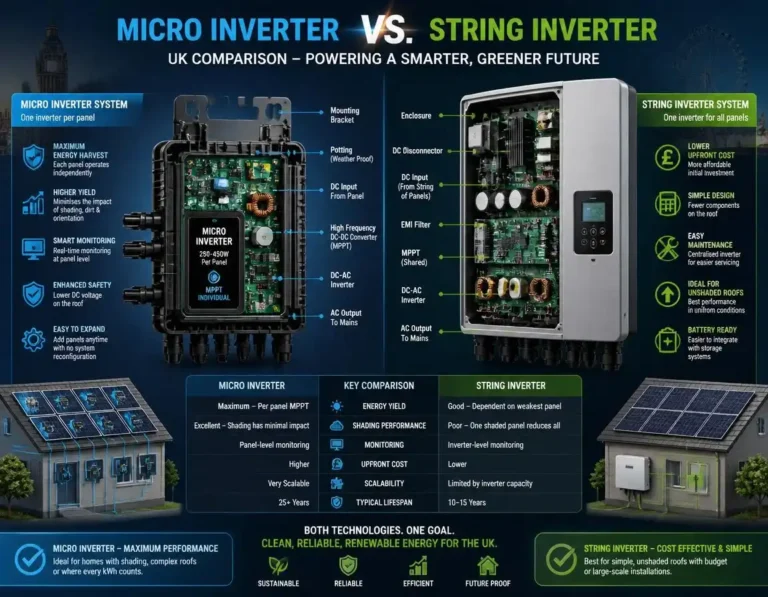
Not every replacement has to be another string unit. If your roof has partial shade — a chimney, a neighbour’s tree that’s grown since 2014, a dormer window — a string inverter’s weakness is that the weakest panel sets the table for everyone. Microinverters put the conversion on each panel, so shade hits one unit instead of the whole array, and failures arrive one panel at a time rather than as a total blackout. Warranties of 20–25 years on the better brands effectively match the panels themselves.
Power optimisers sit in between: per-panel boxes on the roof, but conversion still happens in a central string inverter, so you keep one wall unit to eventually replace. Retrofitting either means roof-level work on every panel, which is why the microinverter route prices per panel rather than per system. My honest steer: choose it for shade and complexity, or for owners who’ve already lived through one string failure and never want a single point of failure again. On a clean, unshaded, single-plane roof, a good string or hybrid inverter remains the cheaper electricity for the next decade.
Mistakes that make people pay twice
New inverter, same mid-morning trips, same red light — because the grid was never the inverter’s problem. Get the trip codes and times logged before any hardware is ordered.
GivEnergy was a market leader when it went into administration in April 2026 — size isn’t a warranty guarantee. Check UK spares and support before price, and don’t treat “well-known” as a substitute for checking who actually stands behind the unit.
No commissioning sheet, no warranty registration, no insurer note: you’ve bought a £1,400 box with a 10-year warranty nobody can prove started. Registration deadlines are real and they pass quietly.
Paying a hybrid premium “just in case” on a household that will never buy storage is spending money to solve a problem you don’t have. Decide the battery question first, then pick the inverter.
Frequently asked questions
How much does it cost to replace a solar inverter in the UK in 2026?
A like-for-like string inverter swap typically lands between £900 and £1,800 all-in for a 3–6 kW domestic system, with the unit itself making up most of that. Hybrid inverters run £1,400 to £2,500 before any battery, microinverter retrofits cost roughly £130 to £220 per panel plus labour, and an out-of-warranty component repair, where parts still exist, usually costs £250 to £600.
Is it worth repairing a solar inverter rather than replacing it?
Usually yes if the unit is under warranty (that’s a claim, not a repair bill), or under about eight years old with a diagnosable component fault like a failed relay, fan or capacitor. Beyond that, parts availability thins out and a repair costing more than roughly 40% of a replacement price is false economy — the components that failed once are ageing alongside the ones that haven’t.
Can I replace my string inverter with a hybrid inverter and add a battery later?
Yes, and it’s a sensible sequence if your existing inverter is at or near end of life anyway. A hybrid inverter sits there working as a normal inverter until a battery arrives, then DC-couples to it without a second conversion stage. If your current inverter still has years left, though, an AC-coupled battery alongside it usually costs less overall than replacing working kit purely for future-proofing.
An inverter failure feels like the system dying. It isn’t. It’s the one component everyone budgets for eventually, arriving on its schedule instead of yours. Diagnose properly, price all three routes before choosing, and keep the paperwork — and the box on your wall goes back to being the boring, money-making object it was always meant to be.