Famous UK Landmarks Gone Solar: The Full 2026 List

Famous UK Landmarks That Have Quietly Gone Solar
A royal castle, two cathedrals and a Premier League stadium roof — solar panels have turned up in some genuinely surprising places across the UK. Here’s the full, fact-checked list, plus what it means if you live somewhere with a bit of history too.

I’ll admit I went looking for this out of pure curiosity, half-expecting to find a couple of vague “eco-friendly” press releases and not much else. What I actually found was better than that — real, working solar installations on some of the most recognisable buildings in the country, several of them added in just the last couple of years.
If a thousand-year-old cathedral or a 900-year-old castle can find a way to fit solar panels without ruining the view, it’s a genuinely useful reality check for anyone who assumes their own period property or conservation-area home is automatically off the table. Here’s exactly what’s been fitted, where, and what it tells us about 2026.
Every landmark, in one table
| Landmark | Type | System size | Status |
|---|---|---|---|
| Windsor Castle | Royal residence | Roof-mounted solar + hydro turbines | Installed |
| Buckingham Palace | Royal residence | Solar + ground source heat pumps | Installed |
| Clarence House | Royal residence | 5.6kW rooftop system | Installed since 2011 |
| Gloucester Cathedral | Cathedral | 150 panels, 38kW | Installed since 2016 |
| Salisbury Cathedral | Cathedral | 93 panels, 37kW | Installed since 2020 |
| London Stadium (West Ham) | Football stadium | 6,500 sqm membrane, 1,256kWp | Switched on 2025 |
| Principality Stadium, Cardiff | Rugby/football stadium | 1.5MW, 3,296 modules | Installed |
| Tottenham Hotspur Stadium | Football stadium | ~3,800 panels, 1.64MW proposed | Planning submitted 2026 |
The Royal residences
King Charles III’s personal interest in renewable energy long predates his reign, and it shows in the Royal Household’s accounts.
🏰 Windsor Castle
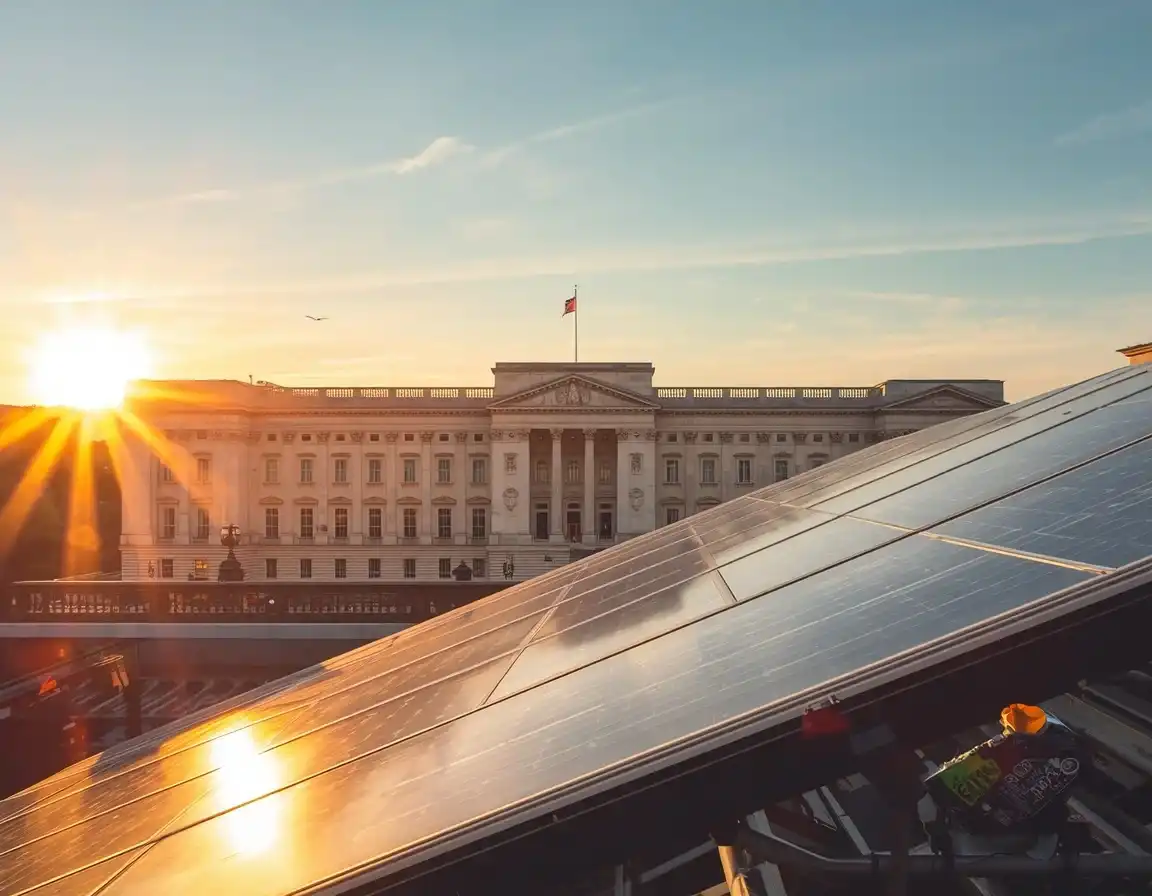
The world’s oldest and largest occupied castle had solar panels fitted to its roof for the first time as part of the Royal Household’s push toward net zero. It already generates a big chunk of its own power from two 40-tonne Archimedes screw turbines on the River Thames at Romney Weir, installed back in 2013, which alone meet around 40% of the castle’s electricity needs.
👑 Buckingham Palace
As part of a £369 million renovation programme, Buckingham Palace had solar panels fitted alongside ground source heat pumps, aiming to save an estimated 554 tonnes of carbon a year. The Palace has also run on combined heat and power technology since the mid-1990s.
🏡 Clarence House
The King’s London residence was actually first out of the gate — a 5.6kW solar system went in back in 2011. By 2015/16, around 84% of the property’s energy came from renewable sources, with roughly a third generated on site.
🌳 Highgrove House
The King’s Gloucestershire home also carries solar panels, working alongside both ground and air source heat pumps — part of the same long-running programme that’s now rolled out across the wider Royal Estate.
Football stadiums
This is where things get genuinely competitive. Premier League and international grounds have started treating roof space as a serious source of income, not just shelter from the rain.
London Stadium, home to West Ham United, switched on a 6,500 sqm solar membrane in 2025 as part of a £4.35 million project — thin, lightweight panels bonded to the roof rather than bulky rigid modules, generating around 850,000 kWh a year and cutting more than 200 tonnes of carbon emissions annually. By 2026, it’s expected to cut the stadium’s draw from the national grid by roughly 3.5 million kWh a year.
Principality Stadium in Cardiff, home to Welsh rugby and regular football fixtures, already carries a 1.5MW array across 3,296 modules — for a while the benchmark for UK sporting venues.
Tottenham Hotspur Stadium could soon beat them both. In July 2026, Spurs submitted a planning application to Haringey Council for around 3,770-3,800 panels on the stadium’s outer roof ring, with a combined capacity of 1.64 MW — which would make it the largest solar installation at any sporting venue in the UK. It’s not approved yet, but if it goes ahead, installer Solivus is pencilled in to start work in September 2026 and finish by December.
Worth noting: none of this is small change for the clubs either. West Ham’s neighbours are watching closely — reports suggest London Stadium’s project alone should cut 10-15% off its electricity costs once fully bedded in.
Cathedrals and places of worship
If a Grade I listed, thousand-year-old cathedral can get solar panels approved, it’s a genuinely useful data point for anyone assuming heritage status rules it out entirely.

⛪ Gloucester Cathedral
Nearly 1,000 years old, and the resting place of King Edward II — it became one of the oldest cathedrals of its kind in the world to fit solar when 150 panels went up on the nave roof in 2016. The 38kW system is tucked behind the parapet and crenellations, invisible from ground level, and cuts the cathedral’s energy costs by around a quarter. It’s also appeared in three Harry Potter films, for what it’s worth.
⛪ Salisbury Cathedral
Local environmental campaigners had been asking Salisbury Cathedral for solar panels since the 1990s and kept being turned down. A community energy group finally got the green light in 2020 — 93 panels now sit on the south cloister roof, generating around 33,708 kWh a year as part of the cathedral’s push to be carbon-neutral by 2030.
Getting there wasn’t automatic in either case — both went through formal heritage consent first. If you’re weighing up whether a listed place of worship near you could do the same, our guide to solar panels for churches and places of worship covers funding routes and the listed-building rules in detail.
Could your own listed or period home go solar?
Every landmark on this list needed sign-off beyond standard planning permission, and the same applies to any listed building or one within a conservation area. The good news is the process is well-trodden.
Listed building consent
Required in addition to planning permission for any listed property. It’s free to apply, and Historic England’s guidance walks through exactly when it’s needed.
Visibility matters most
Gloucester Cathedral’s panels were approved largely because they can’t be seen from ground level. Rear-facing or hidden roof slopes give you the best odds of a smooth approval.
Apply via the Planning Portal
Applications for England and Wales go through the official Planning Portal, run jointly with the Ministry of Housing, Communities & Local Government.
If you’re not sure whether your own home is actually listed, Historic England’s National Heritage List is searchable and free to check. For the full walk-through of costs, timelines and what installers typically need from you, our own guides to solar panels on listed buildings and solar panel planning permission cover it step by step.
How does landmark-scale solar compare to a normal home?
These installations are obviously huge compared with anything on a typical UK roof, but the underlying economics aren’t as far apart as you’d think.
| Installation | Capacity | Roughly equivalent to |
|---|---|---|
| Typical UK home (per MCS 2026 data) | ~4kWp | One household |
| Gloucester Cathedral | 38kW | About 9-10 typical homes |
| Salisbury Cathedral | 37kW | About 9 typical homes |
| London Stadium (West Ham) | 1,256kWp | Over 300 typical homes |
| Tottenham Hotspur (proposed) | 1,640kW | Over 400 typical homes |
A typical 4kWp home system currently costs somewhere in the £6,200-£7,500 range fully installed, with 0% VAT applying to residential solar until at least 31 March 2027. If you’re weighing up your own numbers against a genuine quote, our piece on what MCS’s own pricing data really shows is a useful sanity check, and it’s always worth checking any installer is MCS-certified before you sign anything — the same accreditation that underpins every commercial-scale project on this list.
What else might join the list
- More Premier League grounds. With West Ham’s savings now public and Tottenham’s application in, other top-flight clubs are widely expected to follow the same playbook.
- Schools and universities. Public sector decarbonisation funding has already reached hundreds of council-owned buildings, and school rooftops are a common next target.
- More cathedrals. With Gloucester and Salisbury as working precedents, other Church of England cathedrals pursuing net-zero targets have a clear template to follow.
- Commercial landmarks. Large flat-roofed retail and office buildings remain some of the easiest large-scale solar sites in the country — see our guide to solar panels for commercial property for the practical side of it.
Frequently asked questions
Which famous UK landmarks have solar panels?
Confirmed examples include Windsor Castle, which had solar panels fitted to its roof for the first time as part of King Charles III’s sustainability drive, alongside its existing hydroelectric turbines. Buckingham Palace added solar as part of a £369 million renovation. Gloucester Cathedral and Salisbury Cathedral both carry solar arrays on their naves and cloisters. In sport, West Ham’s London Stadium runs on a 6,500 sqm solar membrane, and Tottenham Hotspur has applied for planning permission for what would be the largest solar installation at any UK sporting venue.
Can listed buildings and historic landmarks get solar panels in the UK?
Yes. Listed building consent is required in addition to standard planning permission, and Historic England assesses each case on how visible and reversible the installation is. Gloucester Cathedral’s array is a good example — it sits on the nave roof and is designed to be almost invisible from ground level, which is typically what heritage bodies want to see. Consent is handled through your local council, usually via the Planning Portal, with guidance available from Historic England.
Is Tottenham Hotspur Stadium getting solar panels?
As of writing, it isn’t confirmed yet. Tottenham Hotspur submitted a planning application to Haringey Council in July 2026 for around 3,770-3,800 solar panels generating up to 1.64 MW, which would make it the largest solar installation at any sporting venue in the UK. If approved, installation is expected to run from September to December 2026.