
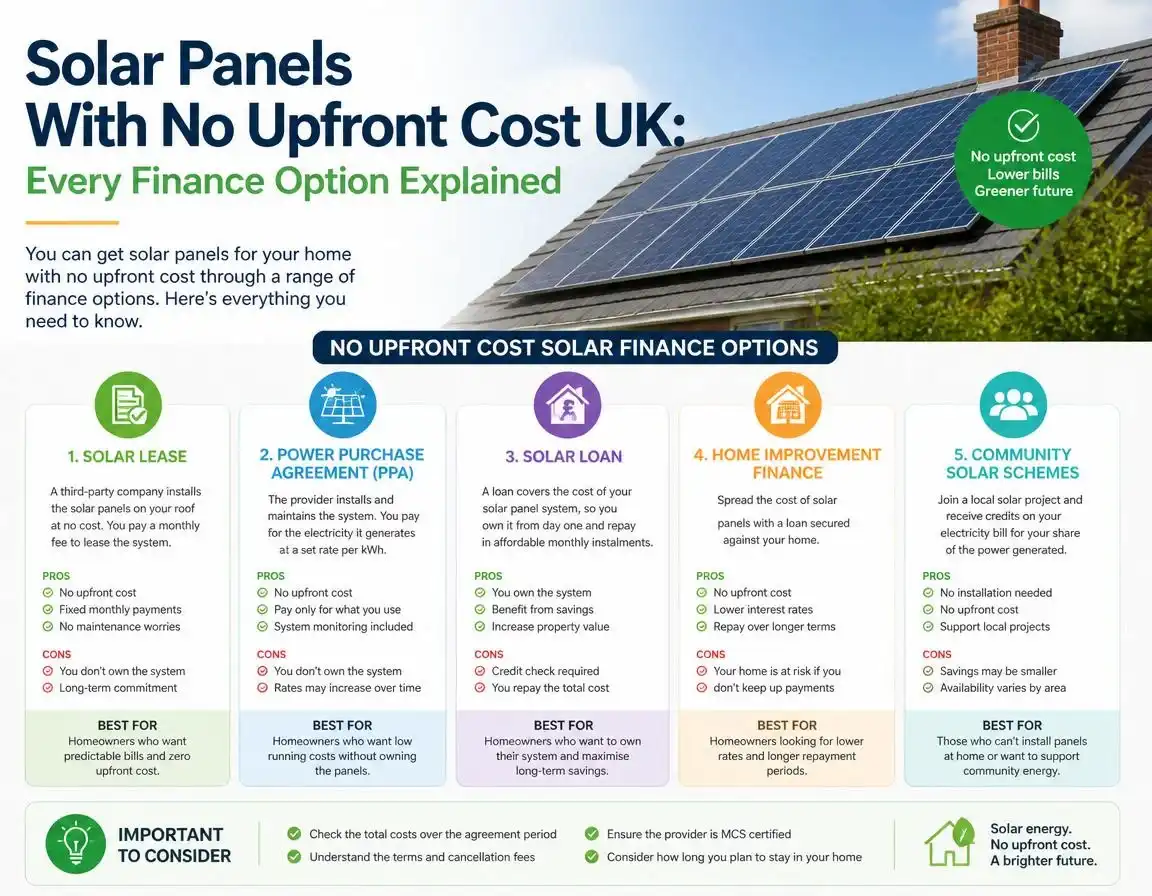
Solar Panels With No Upfront Cost UK: Every Finance Option Explained (2026)

Solar Panels With No Upfront Cost UK: Every Finance Option Explained (2026)
Energy bills keep climbing and solar prices keep falling — but that big number on an installer’s quote still stings. Here’s the truth: most UK homeowners getting solar in 2026 are not paying upfront. Let me show you every legitimate route available right now.
'/%3E%3C!-- Sun --%3E%3Ccircle cx='730' cy='55' r='38' fill='%23fbbf24' opacity='.9'/%3E%3Ccircle cx='730' cy='55' r='52' fill='none' stroke='%23fbbf24' stroke-width='2' opacity='.25'/%3E%3Ccircle cx='730' cy='55' r='66' fill='none' stroke='%23fbbf24' stroke-width='1' opacity='.12'/%3E%3C!-- House body --%3E%3Crect x='220' y='100' width='420' height='120' rx='4' fill='%23ffffff' opacity='.08'/%3E%3C!-- Roof --%3E%3Cpolygon points='180,102 430,32 680,102' fill='%23ffffff' opacity='.06'/%3E%3Cpolygon points='180,102 430,32 680,102' fill='none' stroke='%23ffffff' stroke-width='1' opacity='.2'/%3E%3C!-- Solar panels on roof (left slope) --%3E%3Cg opacity='.9'%3E%3Crect x='222' y='61' width='52' height='30' rx='3' fill='%230d9488' transform='rotate(-19,248,76)'/%3E%3Crect x='224' y='63' width='50' height='1.5' fill='%23ccfbf1' opacity='.4' transform='rotate(-19,248,76)'/%3E%3Crect x='224' y='73' width='50' height='1.5' fill='%23ccfbf1' opacity='.4' transform='rotate(-19,248,76)'/%3E%3Crect x='224' y='83' width='50' height='1.5' fill='%23ccfbf1' opacity='.4' transform='rotate(-19,248,76)'/%3E%3Crect x='248' y='61' width='1.5' height='30' fill='%23ccfbf1' opacity='.4' transform='rotate(-19,248,76)'/%3E%3C/g%3E%3Cg opacity='.9'%3E%3Crect x='280' y='45' width='52' height='30' rx='3' fill='%230d9488' transform='rotate(-19,306,60)'/%3E%3Crect x='282' y='47' width='50' height='1.5' fill='%23ccfbf1' opacity='.4' transform='rotate(-19,306,60)'/%3E%3Crect x='282' y='57' width='50' height='1.5' fill='%23ccfbf1' opacity='.4' transform='rotate(-19,306,60)'/%3E%3Crect x='282' y='67' width='50' height='1.5' fill='%23ccfbf1' opacity='.4' transform='rotate(-19,306,60)'/%3E%3Crect x='306' y='45' width='1.5' height='30' fill='%23ccfbf1' opacity='.4' transform='rotate(-19,306,60)'/%3E%3C/g%3E%3Cg opacity='.9'%3E%3Crect x='340' y='36' width='52' height='30' rx='3' fill='%230d9488' transform='rotate(-19,366,51)'/%3E%3Crect x='342' y='38' width='50' height='1.5' fill='%23ccfbf1' opacity='.4' transform='rotate(-19,366,51)'/%3E%3Crect x='342' y='48' width='50' height='1.5' fill='%23ccfbf1' opacity='.4' transform='rotate(-19,366,51)'/%3E%3Crect x='342' y='58' width='50' height='1.5' fill='%23ccfbf1' opacity='.4' transform='rotate(-19,366,51)'/%3E%3Crect x='366' y='36' width='1.5' height='30' fill='%23ccfbf1' opacity='.4' transform='rotate(-19,366,51)'/%3E%3C/g%3E%3C!-- Label bar at bottom --%3E%3Crect x='0' y='188' width='860' height='32' fill='rgba(0,0,0,0.35)'/%3E%3Ctext x='30' y='208' font-family='Inter,sans-serif' font-size='13' fill='%23fbbf24' font-weight='700'%3E☀ 0% VAT on solar until March 2027%3C/text%3E%3Ctext x='290' y='208' font-family='Inter,sans-serif' font-size='13' fill='rgba(255,255,255,0.7)'%3E·%3C/text%3E%3Ctext x='310' y='208' font-family='Inter,sans-serif' font-size='13' fill='%23ffffff'%3EEarn up to 32p/kWh via Smart Export Guarantee%3C/text%3E%3Ctext x='590' y='208' font-family='Inter,sans-serif' font-size='13' fill='rgba(255,255,255,0.7)'%3E·%3C/text%3E%3Ctext x='610' y='208' font-family='Inter,sans-serif' font-size='13' fill='%23ffffff'%3E£15bn Warm Homes Plan%3C/text%3E%3C/svg%3E)
The big picture
Why 2026 is the year to stop putting this off
I used to think the upfront cost of solar was the story. Type “solar panels UK” into Google, clock a number like £8,000, and scroll straight past. Totally understandable. But that framing misses something important: most people getting solar installed right now in the UK are not paying in a single lump sum. The way we finance solar has changed dramatically in the past two years.
Here’s the uncomfortable truth about energy prices. In October 2025, Octopus Energy — the UK’s biggest energy supplier — warned that domestic bills will likely rise a further 20% over the next four years. Then in February 2026, Centrica’s chief executive made headlines predicting that UK electricity could cost more by 2030 than it did after Russia’s invasion of Ukraine in 2022. That was already painful. Solar panels are one of the best tools you have against that.
At the same time, something big happened in January 2026. The UK government launched the Warm Homes Plan — described as the largest ever public investment in British home upgrades, backed by £15 billion. It fundamentally shifts what’s on offer, particularly for lower-income households. And for everyone else, the combination of 0% VAT (until March 2027), competitive installer finance, and the Smart Export Guarantee means the maths of going solar are better than they’ve ever been.
The core idea in one sentence
A 4kW solar system can save you £500–£900 a year on electricity. If you finance it with no deposit over 5 years, your monthly repayment could be close to — or even less than — your monthly electricity savings. That’s what the industry calls “cash-positive from day one.”
Check out how many solar panels are required in the U.K. Pricing in 2026 Before we get into how to pay for it, let’s be clear about what you’re actually buying. Solar panel prices have fallen roughly 30% since 2021, and with 0% VAT baked in, you’re getting genuinely good value in 2026. According to MCS (Microgeneration Certification Scheme) installer data from April 2026, the average installed 4kW system sits at £7,505 — and that’s with no VAT to add on top. Source: MCS installer data, Ofgem April–June 2026 price cap (£1,641/yr typical). Savings vary by location, usage, and export tariff.What a solar system actually costs right now in the UK
Home size System size Panels only Panels + battery Est. annual saving Payback (cash) 1–2 bed flat / house 3kW £5,000–£6,500 £8,000–£10,000 £400–£600/yr 9–12 yrs 3 bed semi / terrace 4kW £6,500–£8,500 £10,000–£13,000 £600–£800/yr 8–11 yrs 4–5 bed detached 6kW £8,500–£12,000 £13,000–£18,000 £800–£1,100/yr 8–12 yrs 
Check out Best SEG Tariff Rates At a glance There’s no one-size-fits-all answer here. The right route depends on your household income, credit history, where you live in the UK, and how long you plan to stay in your home. Here’s the full menu of options — we’ll dig into each one below. Fully funded free solar panels for qualifying low-income households. No deposit, no loan, no repayments. Must apply before December 2026 — this deadline is real. Up to £30,000 free for eligible households via local councils. Covers solar, battery storage, and insulation. Income threshold typically under £36,000/yr. No deposit required if approved. Monthly repayments spread over 12–60 months at 0% interest. Available through MCS-certified installers right now. Pay a fixed monthly amount for 20 years. Own the panels from day one (with most providers). No large deposit required. Sunsave and Otovo among UK providers. Government-backed 0% or low-interest loans open to all UK homeowners, regardless of income. £5bn confirmed — full details and applications expected in 2027. Up to £6,000 (£1,250 grant + £4,750 interest-free loan) for households earning under £36,000 in Scotland. Call 0808 808 2282 for a free assessment.All your no-upfront-cost routes — quick overview
ECO4 Scheme
Warm Homes: Local Grant
0% Installer Finance
Solar Subscription Plans
Warm Homes Plan 0% Loans
Home Energy Scotland
Check out Solar panels maintenance Free solar for eligible households There are no guarantees of approval, and the assessment and installation process takes time. Don’t risk leaving this until it’s too late. Start the conversation with an energy supplier or approved installer this month. The Energy Company Obligation scheme — ECO4 in its current form — is the most generous solar option available in 2026 because it’s not finance at all. It’s a grant. Eligible households can have solar panels installed at absolutely no cost, funded by the large energy suppliers under government obligation. And yes, it genuinely does mean £0 paid, ever. It’s worth being realistic: solar under ECO4 is usually offered alongside other improvements like insulation or a heat pump, rather than as a standalone panel installation. But getting a fully upgraded, energy-efficient home with solar for free isn’t a bad deal however you look at it. You generally need to tick two boxes: someone in your household receives a qualifying benefit, and your home has an EPC rating of D, E, F, or G. Check your EPC for free on the government’s official EPC register. Not on benefits? There’s also LA Flex — where local councils can approve ECO4 funding for households at risk of fuel poverty even without meeting the standard benefit criteria. It’s worth contacting your local council directly to ask. The worst they can say is no.ECO4: Genuinely free panels — but this window is closing fast
ECO4 closes in December 2026 — if you think you might qualify, apply now
Who qualifies for ECO4?
Qualifying benefits for ECO4 Property requirement Universal Credit EPC rating D, E, F, or G — or borderline cases via Local Authority Flex (ask your council) Pension Credit Guarantee Credit Income Support Income-based Jobseeker’s Allowance Income-related Employment & Support Allowance Child Tax Credit (household income under £16,480) Working Tax Credit (with disability element)
Check out Solar panels grants uk Up to £30,000 free As ECO4 winds down at the end of 2026, the Warm Homes: Local Grant is stepping up as the main free-upgrade route for lower-income households. This scheme is delivered through local councils — around 278 local authorities across England have already secured allocations as of June 2026. This can cover solar panels, battery storage, insulation, and low-carbon heating in one package. Some households are seeing the full system cost covered. Exact thresholds vary by local authority. EPC rating of D or below is usually required. Some councils also apply LA Flex criteria for vulnerable households. More runway than ECO4 — but supply is limited by your local council’s allocation. Check now, as popular councils may fill their allocations ahead of the deadline. You can read the full Warm Homes Plan, including details on the Local Grant, consumer loan plans, and eligibility framework, on GOV.UK: www.gov.uk — Warm Homes Plan (HTML version)Warm Homes: Local Grant — the ECO4 successor you need to know about
Up to £30,000 per household
Income threshold: typically under £36,000/year combined
Running until March 2028
Official government source
Check out the best solar battery If you live in Scotland or Wales If your household income is £36,000 or less, you can access £1,250 as a non-repayable grant and £4,750 as an interest-free loan towards solar installation. Call Home Energy Scotland on 0808 808 2282 for a free assessment — it’s a straightforward process and the interest-free loan element is genuinely good value. Welsh households can access up to £25,000 in loans through Green Homes Wales. The NEST scheme also offers advice and funding for eligible households with an EPC rating of E or lower and combined income of £38,456 or less. If you’re in Wales, this is one of the most generous solar finance routes available anywhere in the UK. If you’re in Northern Ireland, standalone solar grants are more limited — the ECO4 scheme doesn’t operate there. However, the 0% VAT relief still applies on solar installations until March 2027, and some energy suppliers offer voluntary export tariffs for excess generation. It’s worth calling your current energy supplier directly to ask what they can offer. The most popular route for most homeowners This is how the majority of UK homeowners who don’t qualify for grants are going solar in 2026. You apply for finance — either directly through an MCS-certified installer or via a bank or building society — and your monthly repayments sit alongside your electricity bill savings. In many cases, those savings offset most of the monthly cost. Many MCS-certified installers now offer 0% interest finance, typically over 12 to 60 months. No deposit is often required if you’re approved. The catch: you’ll need a decent credit history and proof of sufficient household income to cover repayments. If approved, the finance is usually confirmed within 24–48 hours and installation can be scheduled immediately. If you’d rather arrange your own finance through a traditional lender, banks and building societies now offer dedicated green home improvement loans. Typical APR in 2026 ranges from 5.9% to 14.9% for amounts between £5,000 and £15,000 over three to seven years. Always verify your lender is FCA-authorised before committing — use register.fca.org.uk to check. Estimates based on UK average household energy usage, Ofgem April–June 2026 price cap (£1,641/yr), and Octopus Outgoing 15p/kWh SEG rate. Individual results vary by location, usage patterns, roof orientation, and tariff choice. A 3-year loan at the same APR always costs less total interest than a 7-year loan — even though the monthly payments are higher. If you can comfortably afford higher monthly payments, keeping the loan term shorter is almost always better value overall. Run the numbers both ways before you sign anything. *Subscription total over full 20-year contract at £55/month. Monthly savings offset this considerably. All figures illustrative. Fixed monthly, no lump sum Solar subscriptions are relatively new to the UK market but they’ve been gaining traction quickly, and for good reason. Instead of buying your system outright or taking a traditional loan, you pay a fixed monthly fee — typically over 20 years — and start benefiting from solar-generated electricity from the day of installation. There’s no upfront deposit and, with most providers, no traditional credit check hurdle. How exactly they work varies a bit by provider. With Sunsave, for example, you own the panels from day one, and your monthly fee covers the system, maintenance, monitoring, and insurance for 20 years. With Otovo, you own the panels at the end of the contract. A third model — Effective Home’s Energy Shield — means you never formally own the panels, but you buy the electricity they generate at a fixed unit rate (reviewed every 5 years) that is significantly below the standard grid rate. Most subscription providers allow contracts to be transferred to new owners when you sell your home — but always confirm this in writing before signing.Scotland & Wales — you’ve got extra finance routes
🏴 Home Energy Scotland Grant & Loan
Up to £6,000🏴 Green Homes Wales / NEST Scheme
Up to £25,000Pay-monthly installer finance & green loans — how it really works
Installer 0% finance deals
Green personal loans (banks and building societies)
💰 Does finance make real sense? A worked example (3-bed semi, East Midlands)
Finance tip: shorter term, less total interest
How finance options compare — total cost over 5 years
Solar subscription plans — the no-deposit, no-hassle route
📋 Solar subscriptions: quick pros & cons
What’s good What to consider £0 upfront — no deposit at all Long contract (typically 20 years) Fixed monthly cost — easy to budget Total cost over 20 years is higher than buying outright Maintenance and monitoring often included Check what happens if you sell your home mid-contract Immediately reduces your electricity bill SEG income may differ by provider arrangement
Check out Solar panel for 3 bedroom house What’s coming for everyone This is the headline announcement from the UK government’s Warm Homes Plan that’s worth understanding clearly. A £5 billion Warm Homes Fund has been confirmed to provide low- or zero-interest consumer loans to every UK homeowner, regardless of income level. The idea is straightforward: if you can afford monthly repayments but can’t raise £7,000–£12,000 upfront, the government wants to close that gap. These loans would cover solar panels, battery storage, and heat pumps. They can also be used alongside the existing Boiler Upgrade Scheme (£7,500 towards a heat pump). Martin Lewis at MoneySavingExpert called it a sensible concept, noting that “simple interest-free loans are an easier concept — those who don’t have lump sums but can make savings from these measures can get on with it.” As of June 2026, the interest rates, eligibility criteria, and application process for Warm Homes Plan consumer loans have not been finalised. Most experts expect these to become operational in 2027. If the financial case works for you today using existing 0% installer finance, don’t wait for a scheme that might be 12+ months away. £15bn commitment confirmed. ECO4 extended to December 2026. Warm Homes: Local Grant begins rolling out through local councils. Average £150 taken off annual energy bills as part of early Warm Homes Plan measures. Ofgem price cap for April–June 2026 set at £1,641/yr typical household. Government set to confirm interest rates and eligibility for the consumer loan scheme. Further details to be announced through the year. 0% or low-interest loans open to all homeowners. Warm Homes Agency also begins providing impartial energy upgrade advice nationally. 5 million UK homes upgraded. 1 million families lifted out of fuel poverty. Number of rooftop solar panel systems expected to triple.Warm Homes Plan loans: 0% for all homeowners — but not quite yet
Honest update: these loans aren’t available yet
The Warm Homes Plan timeline — where things stand
January 2026 — Warm Homes Plan formally launched
April 2026 — Energy bill reduction takes effect
Late 2026 — Loan eligibility criteria expected
2027 — Consumer loans expected to launch
2030 — Government targets
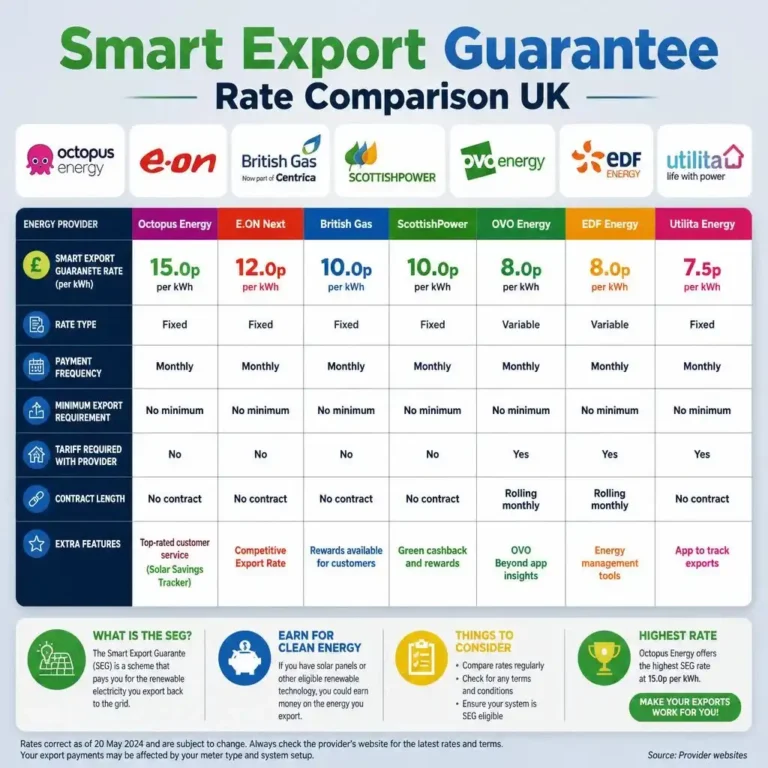
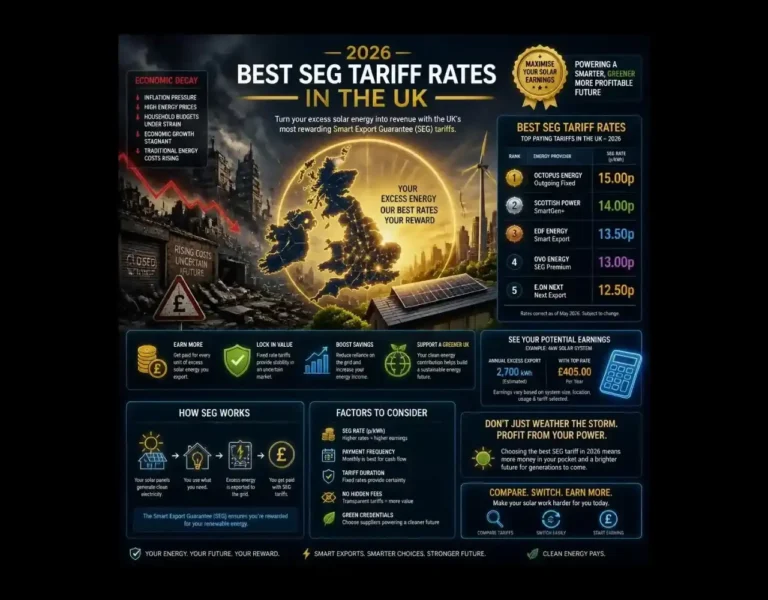
Check out off grid solar systems UK Turn your panels into income Whatever finance route you take, once your panels are installed and MCS-certified, you’re eligible to register for the Smart Export Guarantee (SEG). Your energy supplier pays you for every unit of excess electricity you send back to the National Grid. It’s passive income on top of your bill savings — and it directly reduces the effective cost of your loan or subscription each month. As of June 2026, SEG rates range from around 5p per kWh on standard tariffs to 32.17p per kWh at peak export windows (Octopus Intelligent Flux — requires a battery and Octopus import tariff). The best flat rate available to most homeowners without additional conditions is Good Energy Solar Savings Exclusive at 25p per kWh, while the best no-strings open-market rate is around 15p per kWh via Octopus Outgoing Fixed. On a typical 4kWp system without a battery, you’d export around 1,500–2,000 kWh per year. At 15p per kWh, that’s £225–£300 per year back in your pocket. Over a 5-year finance period, that’s up to £1,500 that effectively reduces your loan’s real cost. Your installation must be MCS-certified. You need a SMETS2 smart meter capable of recording export readings. You can register with any SEG supplier independently of who supplies your import electricity — this means you can keep a cheap import deal and switch only your export contract to the best payer. Rates as of June 2026. SEG rates change — always verify with the supplier before switching. The gap between best and worst common rates is currently 14p/kWh — on a typical 4kWp system, that’s the difference between earning ~£360 and ~£60 per year from the same panels.Smart Export Guarantee — get paid for the solar you don’t use
SEG eligibility: what you need
SEG Tariff Rate (p/kWh) Conditions Type Octopus Intelligent Flux Up to 32p Battery + Octopus import tariff required Time-of-use (peak) Good Energy Solar Savings Exclusive 25p Open to most homeowners Fixed flat rate EDF Export Exclusive (12m) 24p 12-month fixed Fixed flat rate British Gas Export & Earn Plus 15.1p Existing British Gas customers Fixed flat rate Octopus Outgoing Fixed 15p Open market — no supplier switch needed Fixed flat rate OVO Energy Fixed 12p Open to most Fixed ScottishPower SmartGen 6p Open market, no import switch needed Variable
%3C/text%3E%3C/svg%3E)


5 Comments