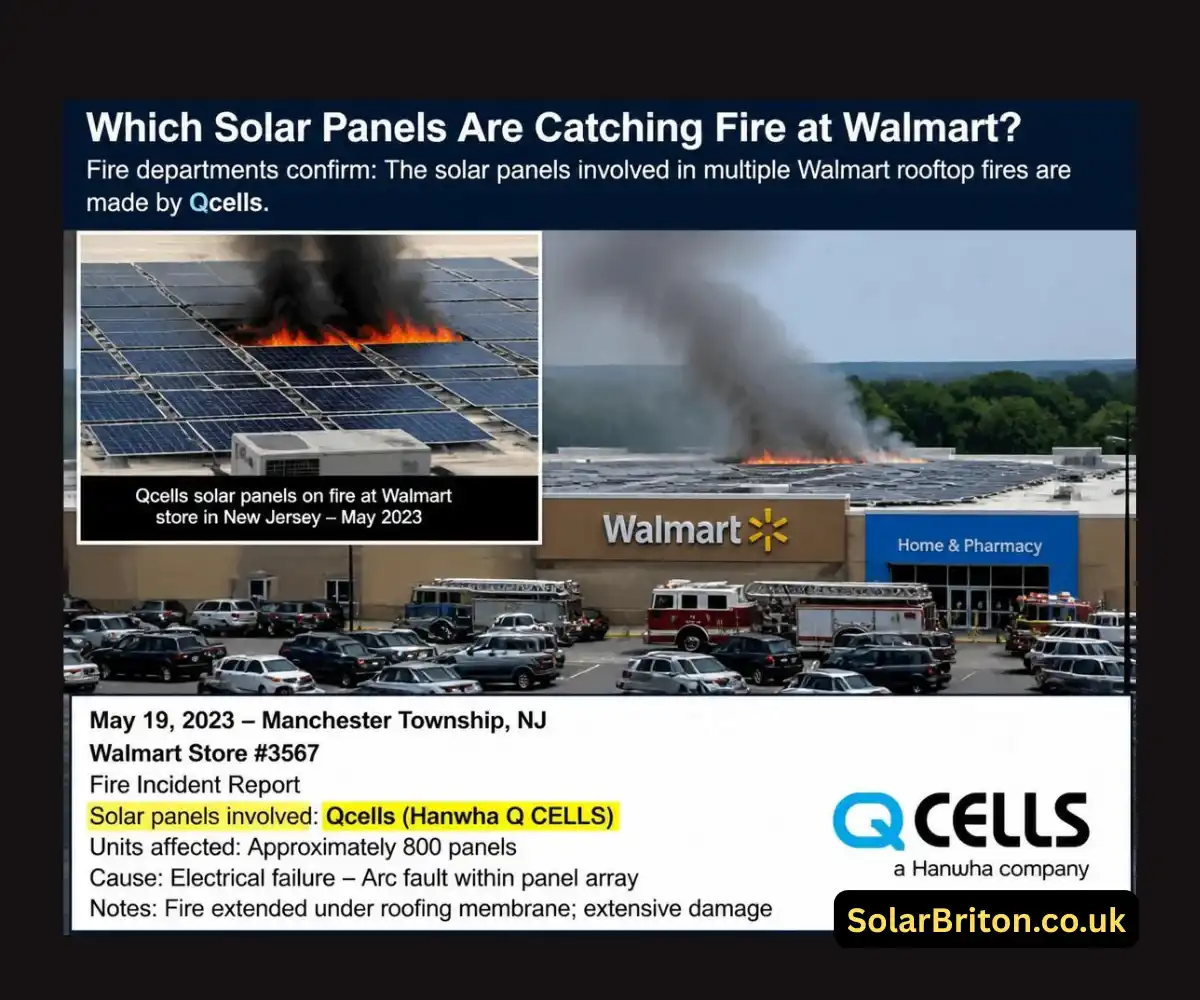
Which Company’s Solar Panels Are Catching Fire at Walmart ?

Which Company’s Solar Panels Are Catching Fire at Walmart — and Could It Happen on a UK Roof?
You’ve probably seen the headlines doing the rounds again. Here’s the full, factual story behind them — the company involved, what actually went wrong, and an honest answer to whether your roof in Leeds, Cardiff or Inverness carries any real risk.

The short version
The fires linked to Walmart’s US stores trace back to Tesla’s rooftop solar arm (which started life as SolarCity). Walmart itself hasn’t run a single shop in Britain since it sold its majority stake in Asda in 2021 — so this exact scenario, on a Walmart roof, can’t repeat in the UK.
But rooftop solar fires do happen here, just very rarely, and almost always down to shoddy installation rather than a faulty panel. We’ve laid out the real UK numbers below.
What actually happened at the Walmart stores
Let’s start with what’s actually documented, because this story gets more dramatic every time it does another lap of the internet.
Between 2012 and 2018, seven or more Walmart stores in the United States caught fire in incidents linked to rooftop solar. Walmart had signed up more than 240 of its stores to host solar arrays that were installed, owned and maintained by Tesla’s energy division — a business that began life as SolarCity before Elon Musk’s company bought it for $2.6 billion in 2016.
The fires weren’t minor. One broke out at a store in Beavercreek, Ohio, in March 2018, followed by others in Denton, Maryland, and Indio, California. One store had already had its solar system switched off entirely for safety — and it caught fire anyway months later in Yuba City, California, with wires reportedly still sparking on a roof that was meant to be dead.
By August 2019, Walmart had had enough. It filed a lawsuit in a New York court accusing Tesla of “gross negligence,” demanding the panels be removed from every one of its 240-plus stores and compensation for the damage. The two firms patched things up publicly within days and settled out of court that November, with neither side formally admitting fault.
- 2012–2018 Fires break out at seven or more Walmart stores fitted with Tesla/SolarCity rooftop solar arrays.
- 20 August 2019 Walmart sues Tesla for “gross negligence”, demanding panels be removed from 240+ stores plus damages.
- 5 November 2019 The two companies settle out of court. Case dropped, no public finding of fault either way.
- 12 July 2026 A new rooftop fire breaks out at a Walmart in Manchester, Connecticut — reigniting the search interest behind this article.
Timeline of the Walmart rooftop solar fire story, 2012–2026. Sources: CNBC, Newsweek, Utility Dive, TechCrunch, WFSB.
So which company was it, really?
Short answer: Tesla, through the solar business it inherited when it bought SolarCity. Slightly longer answer: it’s more nuanced than “one dodgy panel manufacturer.”
Walmart’s own court filing didn’t actually blame the solar panels as a product. It blamed the job done putting them up and looking after them — mismatched electrical connectors, inspectors sent out without proper solar training, and panels left with hotspots, hairline cracks and connections that weren’t even earthed correctly. In plain terms: Walmart’s case was about installation and maintenance failures, not a manufacturing defect in the panels themselves.
That distinction matters a lot, and we’ll come back to it, because it’s the whole reason the UK picture looks so different today.
Why do rooftop solar systems catch fire at all?
Solar panels are about as low-drama as electrical kit gets — until something in the wiring goes wrong. The usual culprit is what’s known as a DC arc fault.
Solar panels produce direct current (DC), which behaves very differently to the alternating current (AC) running through your kettle or telly. AC “switches off” 50 times a second, so a spark at a loose AC connection tends to self-extinguish. DC doesn’t do that. Once an arc strikes across a loose, corroded or badly crimped connector, it can simply keep burning — and a solar array can’t just be switched off from indoors while daylight is hitting the glass.
AC Mains electricity
Alternates direction 50 times a second. A stray spark at a loose joint tends to snuff itself out almost instantly.
DC Solar panel output
Flows in one continuous direction. A spark at a weak connection can keep arcing — and keep heating — for as long as the sun’s up.
Add an overheating inverter, dust-clogged ventilation, or a system that’s never been inspected since installation day, and you’ve got the recipe for the sort of fire that made headlines at Walmart.
| Location | When | What was reported |
|---|---|---|
| Beavercreek, Ohio | March 2018 | Rooftop fire caused substantial store and stock damage |
| Denton, Maryland | May 2018 | Fire badly damaged the roof |
| Indio, California | 2018 | Reported around $3.1m building damage plus roughly $6m in stock |
| Yuba City, California | November 2018 | Wires still found sparking despite the array being switched off since June |
| 240+ stores nationwide | Through 2018 | Walmart said every store with a Tesla-fitted system was potentially at risk |
Figures as reported in Walmart’s 2019 New York State Supreme Court filing and contemporary press coverage (CNBC, Newsweek, ecoportal.net).
A new fire reopened the story in 2026
If you’ve searched for this recently, here’s probably why: on 12 July 2026, several banks of solar panels caught fire on the roof of a Walmart in Manchester, Connecticut. A quick-thinking employee had already knocked the flames back with fire extinguishers before crews arrived; nobody was hurt, and the store reopened within the hour once firefighters made the system safe.
Press reports on the Manchester fire haven’t named the company that installed or currently maintains that particular system, so we won’t guess — that wouldn’t be fair or accurate. But landing so soon after the original Tesla saga resurfaced in search trends, it’s easy to see why “which company’s solar panels are catching fire at Walmart” is back on Google.
Right, but can it happen in the UK?
Here’s the first bit of good news: not like this, no. Walmart hasn’t operated a single shop in Britain since 2021, when it sold its majority stake in Asda to the Issa brothers and TDR Capital. There’s simply no Walmart roof in the UK for a solar system to catch fire on.
But that’s a bit of a cop-out answer, because what people actually mean is: can solar panels on a British roof catch fire? And the honest answer is yes — just very, very rarely.
That’s based on Freedom of Information research covering UK fire services between August and November 2025. Put another way: out of every 100,000 solar systems in Britain, only around six will ever be involved in a fire of any kind.
Ring is stylised, not drawn to true scale — 0.0061% would be all but invisible at this size. The number itself is the real data point.
That said, the raw number of incidents is climbing as more roofs go solar. Analysis of Freedom of Information requests sent to UK fire services found crews attended a fire involving a solar panel roughly once every two days in 2024 — a 60% jump compared with two years earlier. Only 37 of the UK’s 49 fire and rescue services actually responded to those requests, so the true figure could well be higher.
None of that is especially surprising once you see how fast the UK has gone solar. There were roughly 1.49 million solar sites at the end of 2023. By August 2025 that had climbed to around 1.83 million. Britain passed 2 million total solar installations for the first time in March 2026, and 2025 was the strongest year on record for solar deployment — a new rooftop installation going up somewhere in the country roughly every two minutes. More roofs, statistically, means more chances for something to go wrong, even while the odds for any single system stay tiny.
Growth in total UK solar PV installations. Sources: GOV.UK Solar PV deployment statistics; QBE FOI analysis, August 2025.
Most UK solar fire incidents happen on residential roofs, and the systems most often involved tend to be older ones — particularly those installed during the Feed-in Tariff boom from 2010 onwards, before today’s stricter installation standards and safer components became the norm.
Why UK solar is built differently (and generally safer)
This is the part that actually answers the “can it happen here” question properly — and it’s where the UK setup looks quite different from a big US commercial rooftop deal like Walmart’s.
Every solar panel sold in Great Britain has to carry a UKCA mark, confirming it’s been tested against UK safety and performance rules. On top of that, the vast majority of UK installers work to the Microgeneration Certification Scheme (MCS) — not a legal requirement, but close to one in practice, since you need it to claim Smart Export Guarantee payments, most manufacturer warranties, and a smooth house sale down the line.
MCS installations follow the current technical standard, MIS 3002:2025, which lines up with the BS 7671 wiring regulations and IEC 62446 testing rules. Installers also have to belong to a consumer protection code such as RECC (the Renewable Energy Consumer Code). And whoever owns the building is responsible for registering the system with their local electricity network operator using a G98 or G99 form — something a decent installer sorts out for you as standard.
None of that existed in quite the same joined-up way when Walmart’s stores were being fitted out a decade or more ago.
| Aspect | Walmart-style US commercial system | Typical UK domestic system, 2026 |
|---|---|---|
| Installer standard | Contractor-led; inconsistent training alleged in the lawsuit | MCS-certified installer, to MIS 3002:2025 |
| Wiring rules | State/utility-specific | BS 7671 UK wiring regulations |
| Product safety mark | Manufacturer self-certified for US market | UKCA-marked, tested to IEC 61215 / 61730 |
| Ownership & upkeep | Third-party owned, roof leased to installer | Usually homeowner-owned, installer-inspected |
| Grid registration | Utility interconnection agreement | G98/G99 registration with the DNO |
| Consumer protection | Commercial contract dispute | RECC / HIES / GGF consumer code |
Two more UK-specific safety features worth knowing about: DC isolators, which let an installer or firefighter cut the array off quickly, and increasingly common arc-fault detection devices (AFDD), which are built to spot dangerous arcing and cut power before it becomes a fire in the first place.
Further reading from official sources: GOV.UK — Solar photovoltaics deployment statistics · GOV.UK — Smart Export Guarantee · Electrical Safety First — solar panel safety advice · MCS Certified
The simple checklist that actually keeps a UK roof safe
You don’t need to lose sleep over any of this, but a few basics genuinely move the needle:
- Only use an MCS-certified installer — check the public register yourself rather than taking their word for it. Our Find an Installer tool is a good starting point.
- Get DC systems inspected annually, and AC-coupled or low-voltage systems checked roughly every 10 years — see our maintenance & cleaning guides.
- Ask if your inverter has arc-fault detection (AFDD) — it catches dangerous arcing before it can ignite anything.
- Keep the inverter ventilated and free of dust — heat build-up is one of the most common failure points.
- Never ignore a burning smell, a warm isolator switch, or visible sparking — switch off and call a qualified electrician immediately.
- If your system dates from the 2010–2015 Feed-in Tariff boom and hasn’t been checked since, that’s worth sorting sooner rather than later.
Should this put you off going solar?
Honestly? No. Context matters here. A solar panel is far less likely to start a fire than a poorly maintained gas boiler or an ageing fuse box, and the weight of UK safety data points to a low-probability, high-publicity story rather than an emerging crisis. Britain has just passed 2 million solar installations, with the government targeting 70GW of solar capacity by 2035 — and that only works because the overwhelming majority of those systems run for decades without a single problem.
The Walmart story is a genuinely useful cautionary tale about what happens when installation standards slip. But it’s a story about US commercial contracting practices from the 2010s — not a verdict on solar as a technology, and certainly not on the properly regulated, MCS-certified systems going up on British roofs in 2026. If you’d like to see how the UK’s own product-safety rules for smaller systems work in practice, our guide to the BSI Plug-In Solar Standard is worth a read, and if you’re weighing up battery storage alongside panels, we’ve also compared the Tesla Powerwall 3 against the Powerwall 2 for UK homes.
Quick answers
Which company’s solar panels caught fire at Walmart?
Tesla, through its Solar Energy division (originally SolarCity, which Tesla bought in 2016), installed the rooftop systems blamed for fires at seven or more Walmart stores in the US between 2012 and 2018. Walmart sued Tesla for negligence in 2019; the two companies settled later that year without a public finding of fault.
Can solar panels catch fire in the UK?
Yes, though it’s rare. UK fire services attended a solar-related fire roughly once every two days in 2024, and a UK solar installation has around a 0.0061% chance of catching fire, according to Freedom of Information research. Most cases trace back to poor installation, ageing wiring or faulty inverters rather than the panels themselves.
How can I reduce the risk of my UK solar panels catching fire?
Use an MCS-certified installer, register your system with your DNO, and have DC systems inspected annually (AC-coupled or low-voltage systems roughly every 10 years). Fit an inverter with arc-fault detection where possible, keep it ventilated, and get any sparking, burning smells or warm isolators checked immediately.

One Comment