Will Solar Panels Get You From EPC D to C?

UK Solar · EPC & Property Value · Updated 2026
Will Solar Panels Get You From EPC D to C? Worked Examples by Property Type
💡 The short version
Solar panels can lift a D-band home to C, but only sometimes. In our worked examples, a 4kWp array adds 8 to 14 SAP points — enough for a mid-terrace sitting at 60 to clear the 69-point C threshold, not enough for a leaky detached house at 55. Solar works best as the finishing move on an already decent fabric, not a rescue for a cold house. Here’s the maths, property type by property type.
Here’s the question behind about half the emails I get from readers with a D on their energy certificate: “will solar panels get me to a C?” Usually there’s a motive attached — a mortgage lender, a tenant, a sale falling through, or just the nagging feeling that D is the new F. So let me answer it properly, with the actual maths rather than the installer-brochure version. Spoiler: sometimes yes, sometimes no, and the difference is almost never the panels. It’s where your house starts.
EPC bands, SAP points and the 69-point line
An Energy Performance Certificate boils your whole home down to a SAP score between 1 and 100, then sorts that score into bands. The boundaries are fixed and have been for years:
The EPC scale, and the line everyone’s chasing
SAP score bands. Band C begins at 69 — one point above the top of D.
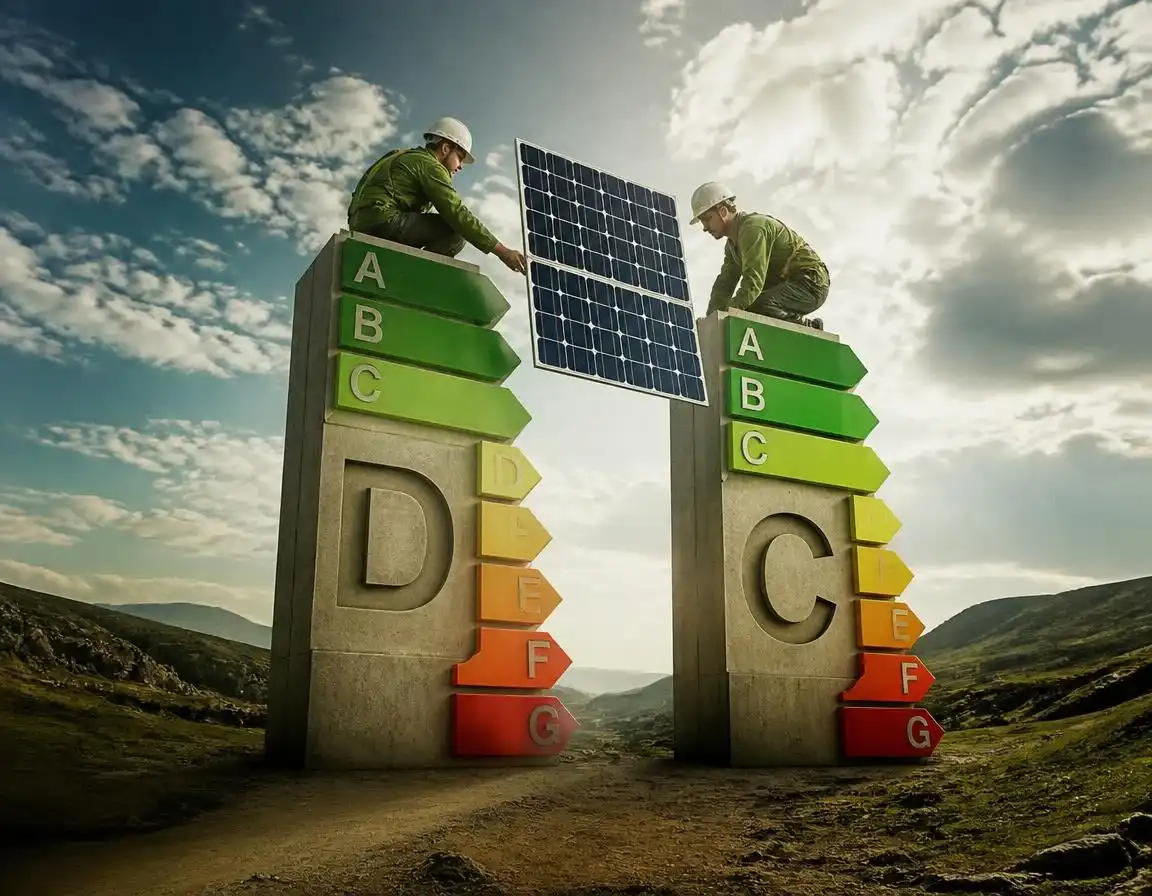
Two things follow from that picture. First, “D to C” is not one job — it’s anywhere from a 1-point nudge to a 14-point climb, depending where in D you sit. Second, because D is 14 points wide and a typical solar array contributes roughly 8 to 14 points, solar alone is a boundary-crosser for some D homes and a near-miss for others. Which brings me to the first free tip of the article: your existing EPC already tells you your answer. The recommendations pages attached to every certificate model specific improvements — including solar PV — for your exact property. Before you price anything, dig out the PDF and read the assessor’s own numbers.
What solar panels actually add to your score
Solar PV enters the SAP calculation as on-site generation that offsets the electricity your home would otherwise buy. The points it earns therefore depend on three things: how much the array generates (size, orientation, shading), how much electricity the dwelling uses (which scales with floor area), and how poor the starting point is (improvements score bigger on inefficient baselines).
That last point is why blanket claims like “solar adds a whole band” are rubbish. On our RdSAP-informed modelling of gas-heated UK homes with a south-facing, unshaded roof, a 3–4 kWp array typically adds:
- +10 to +14 points on a small to mid-size home (mid-terrace, small semi) sitting in band D or E,
- +8 to +11 points on a larger semi or detached house, where the same array spreads over more floor area,
- +4 to +7 points on a flat or a home where roof space limits you to 1–2 kWp,
- and progressively less as the starting score rises — a B-band home gains only a handful of points from the same kit.
Treat those as ±2-point modelling ranges, not promises. Assessor software and property specifics govern the real figure, and only a re-assessment after installation actually changes your certificate. If you’re still sizing the array itself, our guide to how many solar panels you need covers the roof-space and usage maths in full.
Worked examples: five property types, start to finish
Here’s the table I wish someone had shown me years ago. Five common UK property types, each with a plausible starting SAP score for its age and construction, a sensible array size, and our modelled outcome. Starting scores are typical-for-type values; yours will differ, which is exactly why the band-boundary column matters more than the average.
| Property type | Typical start | Array | Modelled uplift | New SAP | Reaches C on solar alone? |
|---|---|---|---|---|---|
| 1930s mid-terrace, 3-bed | D (62) | 3.5 kWp | +9 | 71 | Yes — clears by 2 |
| 1970s semi-detached, 3-bed | D (58) | 4 kWp | +10 | 68 | No — misses by 1 point |
| 1990s detached, 4-bed | D (66) | 4 kWp | +8 | 74 | Yes — starts high enough |
| Victorian mid-floor flat, 2-bed | D (60) | 2 kWp (roof share) | +5 | 65 | No — array too small |
| 2010s new-build semi | C (72) | 4 kWp | +8 | 80 | Already C — locks it in, touches B |
Modelled outcomes, gas-heated homes, south-facing unshaded arrays, ±2 points. Band C begins at 69.
Start vs after solar, against the C threshold
Grey = starting SAP, amber = after the modelled array. Dashed line = 69.
Read the two red rows carefully, because they’re the honest heart of this topic. The 1970s semi does everything right — decent roof, sensible array, professional install — and still lands on 68. A D. One point short. Meanwhile the 1990s detached, a bigger and colder-looking house on paper, sails through purely because it started at 66. Solar rewards a good starting position far more than it rewards enthusiasm.
When solar alone won’t reach C: the package approach
For the near-miss houses, the fix is almost never more panels. It’s buying the cheap points first and letting solar close the gap. Insulation measures score remarkably well per pound because they cut the heat demand that dominates the SAP calculation in a gas-heated home:
| Measure | Typical installed cost | Indicative SAP uplift | Rough cost per point |
|---|---|---|---|
| Loft insulation top-up (to ~270mm) | £300–£600 | +4 to +8 | £60–£150 |
| Heating controls / smart upgrade | £150–£400 | +2 to +5 | £50–£200 |
| Cavity wall insulation | £1,000–£2,500 | +5 to +10 | £100–£500 |
| Solar PV, 3–4 kWp | £5,000–£7,000 | +8 to +14 | £400–£850 |
| Solid wall insulation | £8,000–£15,000 | +12 to +20 | £400–£1,200 |
Indicative ranges from our own modelling and typical 2026 quote levels; your assessor’s software produces the definitive numbers. Grant support can cut the insulation rows dramatically — see our grants and 0% VAT guide.
So the 1970s semi on 58 doesn’t need a bigger array. It needs a loft top-up — perhaps +6 — and then the solar it was always going to fit lands it around 74 instead of 68. Order matters too: do the fabric work first, then size the array, because the assessor models the package as built. And if you’re in the Victorian-flat camp, the constraint is structural (roof access, freeholder consent, array size), which is why our pieces on solar for flat owners and balcony solar exist.
What it costs per point in 2026 — and who pays less
Installed pricing for a 3–4 kWp roof array has been settling in the £5,000–£7,000 zone at 0% VAT, against quotes that still occasionally land above £10k from less competitive firms — our 2026 cost guide and the solar panel calculator will price your specific roof better than any national average, mine included. Two policy sweeteners still apply as I write: the 0% VAT rate on solar and battery installs, currently scheduled to run to 31 March 2027, and export income via the Smart Export Guarantee, which doesn’t move your EPC but does move your payback — our SEG rate comparison tracks what suppliers are paying.
But judge the spend on points-per-pound and the picture changes shape. Solar at roughly £400–£850 per SAP point is a poor pure-EPC purchase. It’s a brilliant purchase when you value what else it does: twenty-plus years of generation, bill savings, export income, inflation cover. The EPC band is a bonus, not the business case. If the band is the only thing you’re buying — say, to satisfy a lender — buy insulation first and solar second.
Landlords, lenders and why everyone wants a C
Three different pressures push people towards C, and they’re worth separating because the rules — and the deadlines — genuinely differ. Landlords: this is the one where the ground has shifted, and it’s worth getting right. The standing minimum for existing private rentals is still band E today, but the government’s Warm Homes Plan, published 21 January 2026, confirmed that all privately rented homes in England and Wales must reach the equivalent of band C by 1 October 2030 — a single deadline for every tenancy, replacing the earlier, messier phased proposal that had new and existing lets on different timelines. That’s a confirmed policy now, not a live consultation, even though the detailed legislation is still being worked through.
The mechanics matter for solar specifically. Compliance under the reformed system (delivered via the incoming Home Energy Model — more on that below) is assessed across three separate metrics rather than one blended score: fabric performance, heating system, and smart readiness. Landlords need to hit the fabric standard plus at least one of the other two. Solar PV is the main lever for the smart-readiness route, typically alongside a smart meter, and it’s the route several landlord bodies point to for anyone who wants to keep a working gas boiler rather than fit a heat pump. Spend is capped at £10,000 per property (up from today’s £3,500), qualifying spend counts from 1 October 2025 onwards, and non-compliance fines can reach £30,000. If your property already holds a genuine C before 1 October 2029, that certificate keeps you compliant until it expires — so there’s a real case for acting early rather than waiting for the deadline to bite.
Our landlord EPC reform explainer and solar for landlords guide go deeper on both the numbers and the exemption routes, and gov.uk’s private-rented energy-efficiency guidance is the page to check for the current official detail before you commit budget. Lenders and valuers: no universal C mandate exists for owner-occupiers, but energy efficiency increasingly shows up in valuation commentary and in some green-mortgage pricing. Sellers: a C simply markets better than a D, and solar that’s owned outright (not leased or rent-a-roof) is the version buyers like — see our guides on whether solar increases house value and selling a house with solar.
If your existing panels are under a rent-a-roof or lease arrangement, they may not even count towards your EPC the way you’d expect, and they can complicate sales and remortgages far more than the band helps. Get the agreement checked before you build any plan around the certificate.
EPC reform: the rules changing under your feet
The certificate itself is mid-reform, and this part is no longer a maybe. The government has confirmed a new calculation engine called the Home Energy Model (HEM), which will replace both SAP (used for new builds) and RdSAP (used for existing homes) as the basis for your certificate. The current timeline has HEM landing for new-build assessments from the second half of 2027, with existing homes — including the private-rental compliance check above — assessed against it from October 2029. Rather than one blended SAP number, HEM produces separate scores across fabric performance, heating and smart readiness, which is exactly the multi-metric system already driving the landlord deadline.
Nothing in this article breaks if that lands on schedule — the physics of what solar contributes doesn’t change, and a well-sized array still does real work on the smart-readiness side — but the band letters and point thresholds quoted today won’t map one-to-one onto the new format forever. Two practical consequences follow: don’t delay fabric measures waiting for a friendlier rulebook, since HEM tends to reward the same insulation-first approach this article recommends; and if you’re comparing a before-and-after assessment, keep the methodology consistent, or you’ll be comparing rulers as well as houses.
FAQs
On our modelling of typical gas-heated UK homes, a 3 to 4 kWp roof array adds roughly 8 to 14 SAP points, with smaller flats and bigger detached houses at the lower end because the uplift scales with generation per square metre of floor area. Your own EPC’s recommendations page shows the assessor’s modelled figure for your specific property, and a re-assessment after install is the only way to bank a new band officially.
Sometimes. Band C starts at 69 SAP points and D covers 55 to 68, so a D-band home sitting at 60 or above will usually clear C with a correctly sized array, while a home in the low 50s typically will not. In our worked examples the 1970s semi at 58 misses C by a single point on solar alone and needs a loft insulation top-up to get over the line.
Yes, and increasingly directly. The standing minimum for existing private rentals is still band E today, but the government’s Warm Homes Plan (21 January 2026) confirmed that all privately rented homes in England and Wales must reach the equivalent of band C by 1 October 2030, assessed across fabric, heating and smart-readiness metrics rather than one blended score. Solar PV is the main lever for the smart-readiness metric specifically, usually alongside a smart meter. The spending cap is £10,000 per property, and qualifying spend counts from 1 October 2025 — check gov.uk’s private-rented energy-efficiency guidance for the current official detail before you commit budget.