
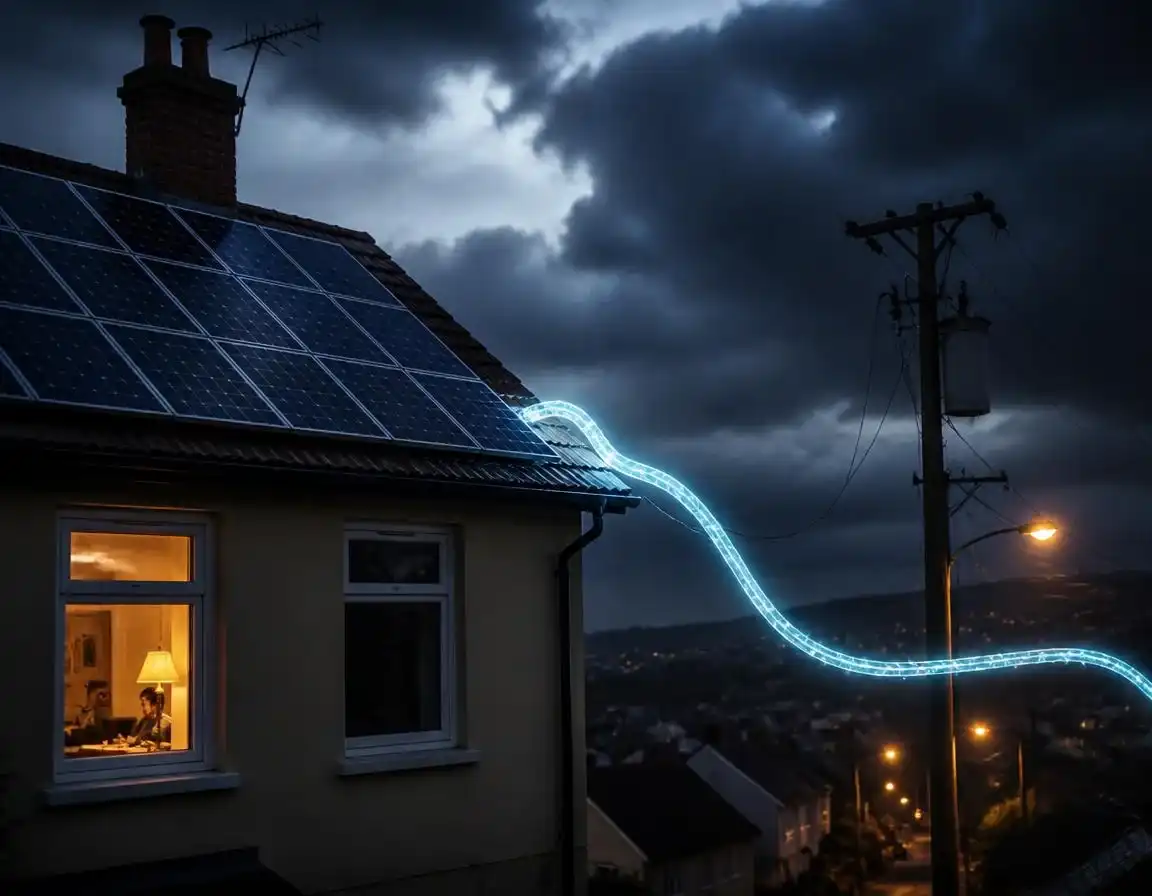
What Happens to Solar Panels During a Power Cut in the UK?

What Happens to Solar Panels During a Power Cut in the UK?
The lights go off, the fridge goes quiet — and your shiny roof panels just sit there. Here’s why that happens, whether your battery will save you, and exactly what to do next, in plain English.
The 30-second answer
- Your panels are absolutely fine. In daylight they keep generating during a cut — but on a standard system the inverter switches off within a fraction of a second. It’s the law, not a fault.
- The reason is safety. Nobody wants live cables while engineers are up a pole fixing a storm-damaged line. Your inverter shutting down is it being a good citizen.
- To keep power in a cut, you need a battery wired for backup (EPS). Fit that and the switchover is so fast your Wi-Fi may not even blink.

Why your solar shuts off the moment the grid dies
Here’s the thing that surprises almost every new solar owner: a power cut doesn’t just stop the power coming in — it stops your solar working too. On a standard grid-tied system, the inverter detects the loss of mains and shuts everything down, typically in well under a second.
This is called anti-islanding, and it’s mandatory in the UK under the Energy Networks Association’s wiring rules, Engineering Recommendations G98 and G99. If your panels kept pumping electricity into a “dead” street cable, they could seriously injure — or worse — a line engineer who believes that cable is safe to touch. So every certified inverter sold here carries built-in loss-of-mains protection that trips almost instantly.
It’s also why plug-in balcony panels stop the instant the grid fails, and why your export payments on the Smart Export Guarantee pause for the duration. The grid operator (NESO) and your local network company need the network de-energised to fix it safely.
🔌 Try it yourself: cut the grid
Pick your setup, then hit the big red button and watch what happens to a typical UK solar home.
Notice the cruel bit in “standard” mode: the sun is still shining and the panels are still generating, yet the house goes dark. That’s anti-islanding doing its job.
What happens to each bit of your setup
| Component | During a power cut | Why |
|---|---|---|
| Solar panels | Keep generating (daylight) | Panels don’t need the grid — but the energy has nowhere to go without a working inverter. |
| String inverter (no battery) | Shuts down instantly | G98/G99 loss-of-mains protection. Protects line engineers. |
| Battery without backup wiring | Also shuts down | Most AC-coupled batteries need a live grid reference to operate. No backup circuit = no power. |
| Battery with EPS / backup | Kicks in <1 second | Dedicated backup circuit or whole-home changeover keeps essentials (or everything) running. |
| Solar diverter & immersion | Dead | No grid, no diversion. A diverter won’t rescue you in a cut — a battery will. |
| EV charger | Stops charging | EV chargers must also disconnect under G99. See our solar + EV charger guide. |
| Heat pump & combi boiler | Heat pump dead; most combis need mains too | Heating is usually the first casualty — plan for it in winter (heat pumps explained). |
| Export income (SEG) | Paused | You can’t export to a dead grid. A few hours’ lost export is pennies, though — don’t lose sleep. |
How to keep the lights on: your 3 real options
Backup socket (EPS)
One or two dedicated sockets wired to the inverter’s emergency output. Runs the Wi-Fi, a lamp, phone and laptop chargers, and the fridge. The budget-friendly safety net.
Often a few hundred £ at installWhole-home backup
A hybrid inverter or battery (e.g. Powerwall 3 with its 11.5 kW continuous output) takes over the whole house. Switchover is typically 10–100 milliseconds — most gadgets never notice.
Roughly £500–£1,500 extra wiring on a retrofitOff-grid system
No grid connection at all — panels, big battery bank and usually a generator backstop. The choice for remote crofts, cabins and park homes.
See our off-grid solar guidePrices below match what we’re seeing across the UK in 2026, with 0% VAT applied automatically until 31 March 2027 under the Government’s VAT relief on energy-saving materials:
| Battery size | Typical installed cost (2026) | Runs in a cut (whole-home backup) |
|---|---|---|
| 5 kWh | £3,000 – £4,500 | Evening essentials: lights, Wi-Fi, fridge, TV |
| 10 kWh | £5,500 – £7,500 | Most of a normal day, including fridge & boiler |
| 13.5 kWh (e.g. Powerwall 3) | £7,500 – £12,000 depending on installer | A full day+ for a typical home; heavy hitters included |
Already have panels but no battery? Retro-fitting storage is straightforward and usually AC-coupled — here’s our guide to adding a battery to existing solar panels, and a reminder that retrofitting typically adds £500–£1,500 over fitting both together.
📊 What a full 10 kWh battery actually runs in a cut
How bad are UK power cuts, really? The 2026 numbers
Day to day, the UK grid is one of the most reliable in Europe — most of us lose power for barely half an hour a year. But “average” is no comfort when a Storm Éowyn rolls in and your street is dark for a weekend while the neighbours’ solar-plus-battery setups carry on watching telly. With more named storms each winter, backup power has moved from “prepper hobby” to “sensible box to tick” on installer quotes.
Power cut right now? Do this
- 1Call 105 free (or use the Powercut 105 website) — it connects you to your local network operator, whoever your supplier is. In Northern Ireland, dial 03457 643 643.
- 2Check your setup, not the fuse box first. If you have backup wired, your app should show “island” or “backup” mode. If not, remember: a dark house with sunny panels is normal, not broken.
- 3Protect the food & the fish. A closed fridge stays safe ~4 hours; a full freezer ~15–24 hours. Keep the doors shut.
- 4Switch off & unplug sensitive kit (and your immersion/heat pump) so a surge on restoration doesn’t fry anything. Leave one lamp on so you know when it’s back.
- 5Note the time. If the cut drags on, compensation may be owed — see below. The GOV.UK Prepare page on power cuts is worth a bookmark before winter.
💷 Compensation: when the grid owes you money
| Situation | You can get |
|---|---|
| Normal weather, cut to <5,000 premises, over 12 hours | £95, +£45 per extra 12 hours |
| Normal weather, cut to 5,000+ premises, over 24 hours | £95, +£45 per extra 12 hours (cap £390) |
| Storm category 1, off 24 hours | £85, + extra per 6 hours (caps run to £2,000+) |
| Storm category 2, off 48 hours | £85, + extra per 6 hours (caps run to £2,000+) |
| 4+ cuts of 3+ hours in a year | Extra £95 |
Thresholds and amounts are reviewed by Ofgem, so always check the current Ofgem compensation rules before claiming. Payments are usually automatic, but claim promptly if they don’t arrive.
Storm’s coming tonight? The 5-minute prep
- ✓Top the battery to 100% — most apps let you force a full charge from the grid before bad weather. Cheap insurance at 7–12p overnight rates.
- ✓Agree your “essentials list” with the family so nobody plugs the air fryer into the backup socket mid-storm.
- ✓Torches charged, candles somewhere sensible — follow the same common sense as our battery fire-safety guide: keep flames well away from kit.
- ✓Fill the kettle early. A hot flask beats a 3 kW kettle on battery power.
- ✓Don’t expect the EV or heat pump to run. They’re the biggest loads in the house and the first to be shed.
Is backup worth paying for? My honest take
After twenty years around this industry, my view is simple: buy a battery for the bill savings; treat blackout backup as the bonus. The money case for storage in 2026 — storing solar and cheap overnight power at 7–12p instead of buying at ~24.5p — is already strong, as we explain in our solar battery storage guide. Backup wiring costs little extra if you ask for it before the install is designed, and one stormy weekend where the fridge stays cold and the kids’ tablets stay charged tends to feel like it paid for itself.
Two final bits of street-smart advice: pick a financially healthy manufacturer (GivEnergy’s 2026 administration showed why warranties are only as good as the company behind them), and compare backup-capable models in our best solar batteries UK 2026 roundup — or the Tesla Powerwall 3 cost guide if you want whole-home muscle. And crucially, ask any installer in writing: “Will this system power my home during a power cut, and for how long?” The silence (or the spec sheet) will tell you everything.
Quick answers (the ones Google loves)
Do solar panels work during a power cut in the UK?
Will my solar battery automatically kick in during a power cut?
Can I claim compensation for a power cut in the UK?
Related reading on Solar Briton
Bottom line? A power cut doesn’t hurt your solar one bit — it just pauses it. The homes that shrug at a storm warning are the ones that planned for it on the quote, not after the candles came out. ☕



One Comment