
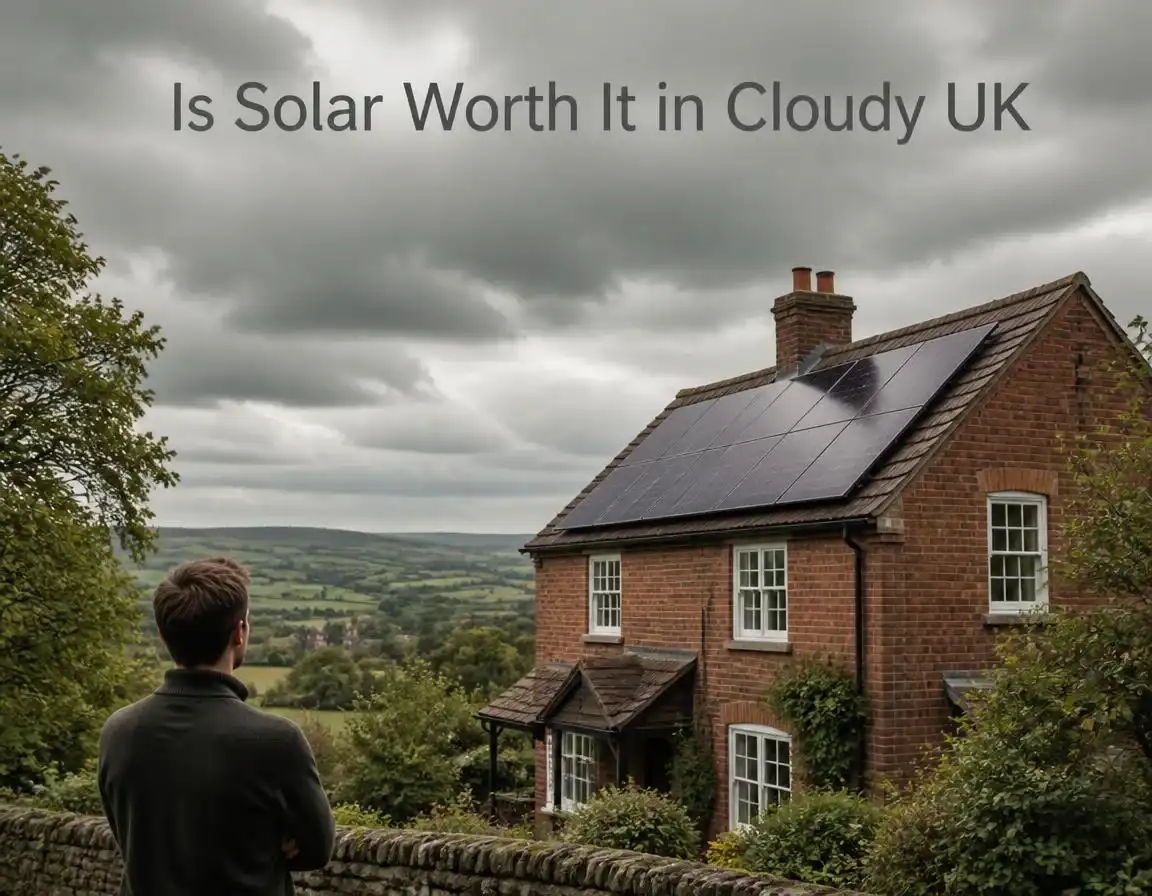
Is Solar Worth It in Cloudy UK?

The short answer is yes — and Germany’s 90GW of solar panels in near-identical weather proves it. Here’s the honest 2026 breakdown.
Here’s one we hear a lot: “What’s the point of solar panels in Britain? It’s grey half the year.” It’s a fair question — and the answer might genuinely surprise you. Solar panels don’t run on heat. They run on light. And the UK, for all its cloud, gets plenty of that. In 2026, hundreds of thousands of British homeowners are generating meaningful savings from solar panels on their roofs through every overcast November and rainy March. Let’s look at what the data actually shows.
The science, simply put
Solar PV cells convert light energy into electricity — not heat. That matters because even on a fully overcast day, a significant amount of daylight still reaches your panels as diffuse light — scattered, not direct, but still packed with usable energy.
On a heavily clouded day, panels typically produce between 10% and 25% of their peak output. In lighter cloud or hazy conditions, that rises to 60–80%. It sounds like a big drop, but here’s what most people miss: your system’s financial return is built on annual total output, not on individual cloudy days.
There’s another bonus that surprises people: cooler temperatures actually improve efficiency. Modern panels lose around 0.35–0.40% of output for every degree above 25°C. On a typical British summer day, your panels are comfortably within their optimal temperature range — performing better than the same panels would in Spain.
| Weather Condition | Typical Panel Output | Performance | Notes |
|---|---|---|---|
| Full sunshine | 90–100% | Excellent | Peak performance |
| Hazy / light cloud | 60–80% | Very good | Common spring & autumn |
| Overcast | 25–50% | Good | Typical grey day |
| Heavy cloud | 10–25% | Reduced | Still generating |
| Rain | 10–30% | Low | Self-cleaning benefit 🌧️ |
The Germany comparison that settles it
If you still need convincing, look north-west. Germany has weather remarkably similar to the UK — similar grey winters, comparable annual sunshine hours, the same North European cloud patterns. It’s one of the world’s largest solar energy producers, with over 90 gigawatts of installed capacity. The technology works in their climate because the same technology works in ours.
90+ GW solar installed capacity
~900–1,050 kWh/m² irradiance
Similar climate — solar works here too
~850–1,100 kWh/m² irradiance
What UK solar actually earns in 2026
With grid electricity at 24.67p/kWh (Ofgem Q2 2026), every kilowatt-hour you generate yourself is worth more than it was even two years ago. A south-facing 4kW system generating around 3,700 kWh per year saves you £500–£900 annually through reduced bills, plus export income via the Smart Export Guarantee (SEG) — where providers like Octopus currently pay up to 27p/kWh for surplus power sent to the grid.
The payback period in 2026 typically sits between seven and ten years for a well-sized system. After that, you’re generating effectively free electricity for the rest of the system’s 25+ year lifespan. Over a full quarter-century, total returns of £12,000–£22,000 above installation costs are well within reach.
| System Size | Cost (inc. 0% VAT) | Est. Annual Saving | Payback Period |
|---|---|---|---|
| 3kW | £5,000–£6,500 | ~£500–£650/yr | 8–12 years |
| 4kW | £6,500–£8,500 | ~£650–£900/yr | 7–11 years |
| 5kW | £7,500–£10,000 | ~£800–£1,000/yr | 8–12 years |
Savings based on Ofgem Q2 2026 rate (24.67p/kWh) + SEG income. Costs include 0% VAT (applicable until March 2027). Payback varies by location, usage, and orientation.
What actually determines whether it’s worth it for you
The weather is not the main variable. What really matters is roof orientation (south-facing is optimal but SE/SW loses only 5–10%), daytime electricity usage (the more you consume while the sun is up, the more you save directly), and whether you add battery storage, which pushes self-consumption from around 40% up to 70%+.
If your household income is below around £36,000 or you receive qualifying benefits, you may be entitled to a free installation through the Warm Homes Local Grant (up to £15,000) or ECO4 (closing December 2026). Check your eligibility directly on the UK Government website at gov.uk/apply-warm-homes-local-grant or read our guide to solar panel grants.
The question people really mean to ask isn’t “is the UK sunny enough?” It’s “do solar panels earn their keep in British conditions?” In 2026, with elevated energy prices, strong SEG rates, and 0% VAT still in place, the data says yes — clearly, and regardless of which postcode you’re in. If you’re ready to take the next step, you can find an MCS-certified installer in your area to get tailored quotes.
Frequently asked questions
Do solar panels work on cloudy days in the UK?
How much can I save with solar panels in the UK in 2026?
Is the UK too cloudy for solar panels to be worth buying?
Disclaimer: Figures are estimates based on Ofgem Q2 2026 unit rate (24.67p/kWh), DESNZ irradiance data, and MCS installer benchmarks as of June 2026. Actual savings depend on system size, location, usage patterns, and installer pricing. Always obtain at least three quotes from MCS-certified installers. This article does not constitute financial advice.

4 Comments