Solar Panels Sunderland

Solar Panels Sunderland: What They Actually Cost and Generate in 2026
I get the same call from Wearside most weeks: “does solar even work up here?” Short answer, yes — the North East is one of the most affordable regions in England to go solar, and Sunderland’s roofs do a perfectly respectable job of it. Here’s the real 2026 picture: costs, output, grants and who I’d actually use.
The short version
Solar panels are a solid bet in Sunderland. A typical 4kWp system costs £4,500–£7,000 fully installed at 0% VAT and generates around 2,900–3,200 kWh a year — enough to cover most of an average home’s usage. Annual savings usually land between £500 and £750, with payback in roughly 8–12 years on kit warranted for 25. The North East is genuinely one of the cheaper regions in England to install in, so the maths works even without Cornwall-level sunshine.
☀️ Why Sunderland actually works for solar
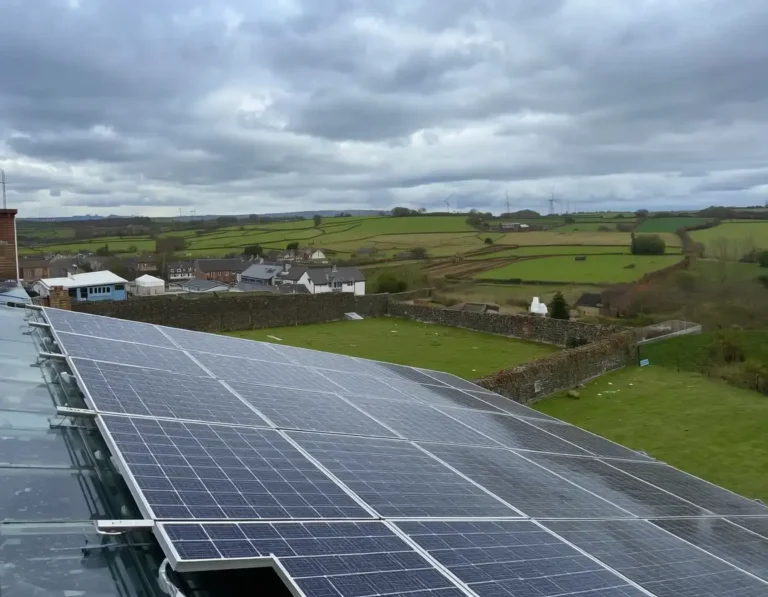
Sunderland doesn’t get sold to itself as a sunny city, and it isn’t one — but “not Cornwall” and “not worth it” are two very different things, and I say that as someone who’s surveyed roofs from Fulwell to Silksworth. Solar panels convert daylight, not heat, so a bright but overcast Wearside afternoon still puts a decent number of kWh through the meter.
The bigger factor working in your favour here is price, not weather. The North East is consistently one of the most affordable regions in England for a solar install, according to MCS installation data — labour and material costs sit below the national average, and that gap is often bigger than the sunshine gap with the south of the country ever costs you.
If your roof is within a mile or so of the sea — Roker, Seaburn, Whitburn — ask your installer about marine-grade fixings and a saltwater-rated frame. It’s a small spec upgrade that matters more here than it does further inland in Washington or Houghton.
📊 How much will your roof actually generate?
Sunderland gets roughly 1,250–1,450 sunshine hours a year — lower than Cornwall or the South East, but not by as much as most people assume. A well-sited, south-facing 4kWp system on a typical Wearside roof produces around 2,900–3,200 kWh annually. For scale, that’s comfortably above what a lot of two-person households use in a year, before you’ve even added a battery to bank the surplus.
Sunderland figure is the midpoint of the 2,900–3,200 kWh regional range. UK average and Cornwall figures are the same benchmarks used across our other regional guides.
Orientation and shade still matter more than postcode. A south-facing roof at 30–40° pitch is the target; east- or west-facing costs you roughly 10–15% of that output, and a terrace with a chimney stack or a taller neighbour casting afternoon shade can eat into it further. If your roof isn’t south-facing, don’t write solar off — just adjust your expectations to the lower end of the range above, or ask your installer about an east-west split array, which is common on Sunderland’s terraced streets.
💷 What solar panels cost in Sunderland in 2026
These are the same regional bands I quote across the North East, all at 0% VAT:
| System size | Suits | Installed cost (0% VAT) | Sunderland annual output |
|---|---|---|---|
| 2–3kWp | Flat, bungalow or 1–2 bed | £3,500–£5,500 | ~1,600–2,200 kWh |
| 4kWp | 2–3 bed semi or terrace | £4,500–£7,000 | ~2,900–3,200 kWh |
| 4–6kWp | 4+ bed, EV or heat pump | £6,000–£9,000 | ~3,500–4,800 kWh |
Add a battery and you’re typically looking at another £2,500–£4,000 for around 5kWh of storage. It doesn’t generate a single extra kWh, but it changes when you get to use the kWh you’ve already made — handy on a street of terraces where most people are out at work while the panels are doing their best work.
0% VAT on solar and battery installs runs until 31 March 2027, then reverts to 5%. On a £6,000 system that’s a few hundred pounds of pure timing — worth factoring in if you’re weighing this up for next spring instead of this one.
📈 Savings, SEG income and the payback maths
For a typical 4kWp system here, annual savings and export income usually land between £500 and £750, giving a payback of roughly 8–12 years on equipment that’s warranted for 25. The Ofgem price cap is currently 24.67p/kWh (July–September 2026), rising to an average of 26.32p from 1 October — every unit you use yourself rather than import is worth that much more from autumn onwards.
Surplus you don’t use gets paid through the Smart Export Guarantee. Rates vary a lot by supplier: standard open tariffs typically pay somewhere in the 4–15p/kWh range, while time-of-use deals that reward exporting into the evening peak — Octopus Intelligent Flux is the one I get asked about most — can push past 30p/kWh if you’re also on a compatible import tariff and have a battery to shift export into that window. It’s worth shopping this properly rather than accepting whatever your installer’s default partner offers.
Without a battery, most Sunderland households land in the 9–12 year bracket. Add a decent export tariff and a battery, and 8 years — sometimes a little under — is realistic. Either way, you’re well inside the 25-year performance warranty most panels now carry.
🏷️ 0% VAT, ECO4 and the grants actually worth checking
Three things to know before you get quotes:
- 0% VAT applies to residential solar and battery installs across the UK until 31 March 2027. It’s already baked into every price on this page.
- ECO4 can fund panels outright for households on qualifying benefits with a poor EPC rating. The scheme is due to close on 31 December 2026, and the North East has historically had strong ECO4 uptake given the region’s fuel poverty rates — if you think you qualify, don’t leave the application until the new year.
- Warm Homes: Local Grant covers solar PV alongside other measures for owner-occupiers and private renters on lower incomes with a poor EPC, delivered through local councils. Contact Sunderland City Council’s energy team directly to check what’s currently being delivered in your ward, since local rollout varies.
Neither scheme is a blanket “free solar for everyone” offer — most Sunderland homeowners will be paying the 0% VAT price, not a grant price — but it costs nothing to check eligibility before you commit to a quote.
🏛️ Planning permission on a Wearside roof
Most houses in Sunderland don’t need planning permission at all. Roof-mounted panels fall under permitted development across England, provided they sit below the ridge line and project no more than 200mm from the roof slope. That covers the vast majority of the city’s terraces, semis and post-war estates without a form in sight.
Where it gets more involved: listed buildings always need listed building consent, and some conservation-area properties — parts of Ashbrooke and stretches of the seafront around Roker included — may need sign-off from Sunderland City Council’s planning team before you fit anything visible from the street. Flat-roofed properties and anything ground-mounted in a conservation area can also need prior approval. A two-minute call to the council’s planning desk before you order kit is cheap insurance against a much more expensive retrofit later.
✅ Usually straightforward
- Standard semis, terraces and bungalows
- Panels below the ridge, under 200mm projection
- Post-war and new-build estates
⚠️ Check with the council first
- Listed buildings anywhere in the city
- Conservation-area properties (parts of Ashbrooke, the Roker seafront)
- Flat roofs or any ground-mounted array
🧰 Picking a Sunderland or wider North East installer
The region’s well served — you’ve got firms based in the city itself alongside others covering the whole of Tyne and Wear and County Durham. Either can do a good job. What I check regardless of who’s quoting:
- MCS certification, verified independently at mcscertified.com — not just a badge on the van. No MCS, no Smart Export Guarantee income, full stop.
- Three written quotes on the same system size and panel tier, so you’re comparing price rather than spec sheets that don’t quite match.
- Local references — a firm that’s fitted panels on the terraced streets around you will know the roof quirks (older slate, narrow eaves, shared party walls) that a national firm quoting from a satellite photo won’t.
- An insurance-backed workmanship guarantee, separate from the panel manufacturer’s own warranty, so you’re covered if the installer itself doesn’t make it to year ten.
Ask who handles your DNO paperwork and Smart Export Guarantee registration — a proper local installer includes both as standard, and it’s a red flag if either is vague on the quote.
🏆 My verdict: is it worth it in Sunderland?
Yes, for most roofs. You’re not chasing Cornwall-level generation here, and I won’t pretend otherwise — but the North East’s lower install costs largely cancel that out, and an 8–12 year payback against a 25-year warranty is a genuinely sound piece of maths, not a marginal one. The households I’d tell to think twice are the ones with heavily shaded, north-facing-only roofs, or anyone planning to move within a couple of years before the payback has had time to work.
For everyone else: get three MCS-certified quotes, check what VAT and any grant eligibility actually does to your number, and don’t let a salty sea breeze or a grey Wearside sky put you off. The panels don’t need a tan — they just need daylight, and Sunderland gets plenty of that.
❓ FAQs
How much do solar panels cost in Sunderland in 2026?
A standard 4kWp system for a typical Wearside semi or terrace costs £4,500–£7,000 fully installed, at 0% VAT. Smaller 2–3kWp systems for a flat or bungalow start around £3,500–£5,500, and larger 4–6kWp systems for bigger homes or an EV charger run £6,000–£9,000. Sunderland sits within the North East’s regional pricing, which is among the most affordable in England.
Is Sunderland too cloudy for solar panels to be worth it?
No. Sunderland gets around 1,250–1,450 sunshine hours a year, which is lower than Cornwall or the South East but still enough for a well-sited 4kWp system to generate roughly 2,900–3,200 kWh annually. Solar panels work from daylight, not direct heat, so a grey Wearside sky still produces meaningful electricity — just less than a cloudless one.
Do I need planning permission for solar panels in Sunderland?
Most houses don’t. Roof-mounted panels are permitted development across England provided they sit below the ridge line and project no more than 200mm from the roof slope. Listed buildings and some conservation-area properties, including parts of Ashbrooke and the seafront around Roker, may need extra sign-off from Sunderland City Council’s planning team, so it’s worth a quick check if either applies to your property.
Keep reading on SolarBriton
Sources checked: MCS installation and irradiance data, Ofgem price cap and Smart Export Guarantee guidance, HMRC VAT Notice 708/6, Sunderland City Council and Planning Portal guidance on permitted development. Regional cost and output figures cross-checked against SolarBriton’s own North East regional guide for consistency. Updated September 2026.