Solar Panels for Garden Shed UK: The Complete 2026 Guide

Solar Panels for Garden Shed UK:
The Complete 2026 Guide
Whether you want a £150 lighting kit or a full off-grid workshop, here’s everything you need to know — 2026 costs, the right panel size, planning rules, and how to fit it yourself in an afternoon.
When I first looked into getting electricity into my garden shed, I pictured trenches across the lawn, an electrician’s van on the drive for two days, and a bill that made my eyes water. What I actually ended up with was a 200W solar panel mounted on a weekend afternoon, a snug LiFePO4 battery under the workbench, and a shed that’s been lit and powered ever since without a single penny going to the grid.
In 2026, with electricity sitting at 24.67p per kWh (Ofgem Q2 rate) and a standard mains cable run costing between £500 and £1,200, solar panels for a garden shed make more financial sense than ever. Let me walk you through everything — from choosing the right wattage to what the planning rules actually say.
Why Solar Beats Mains for Most Garden Sheds
Running a mains cable to a detached shed means burying armoured SWA cable at £10–£25 per metre, fitting a consumer unit with RCD protection, and (unless you’re a qualified electrician) paying someone else to do it. For a modest 15-metre garden run, you’re typically looking at £500 to £1,200 installed — before you’ve turned a single light on. And once it’s in, you’re paying the grid rate for every kWh you use.
A solar system producing the same result — LED lighting, USB charging, and low-load power tool use — costs £150 to £400 and can be set up by any competent DIYer on a Saturday morning. There are no ongoing energy costs, no standing charges, and nothing to dig up. From mid-2026, the arrival of approved plug-in solar kits in the UK makes things even simpler — one panel, one socket-plug, done.
☀️ Important 2026 note: China removed its 9% solar panel export rebate on 1 April 2026. Prices are expected to rise 8–15% over the next 12 months. If you’re considering buying, current UK stock is almost certainly the cheapest window for a while — worth keeping in mind if you’re on the fence.
What Size Solar System Does Your Shed Need?
Getting the wattage right is the most important call you’ll make — too little and you’ll be frustrated when it gets dark, too much and you’ve wasted money. The good news is it’s a pretty simple decision once you know how you use your shed.
What You’ll Need: The Four Key Components
A basic solar shed system is just four parts wired in a simple chain. Here’s what to buy and what to budget for each in 2026:
| Component | Job It Does | 2026 UK Cost | Our Pick |
|---|---|---|---|
| Solar Panel | Converts sunlight into DC electricity | 100W: £40–£70 · 200W: £70–£120 | Mono N-type |
| Charge Controller | Regulates current to protect the battery | PWM: £10–£20 · MPPT: £25–£60 | MPPT |
| Battery | Stores energy for use after dark | Lead-acid: £50–£120 · LiFePO4: £120–£350 | LiFePO4 |
| Inverter (optional) | Converts DC to 230V AC for mains appliances | £25–£80 | If using 230V tools |
| Cables & Mount | Connects everything, secures panel to roof | £20–£60 | Included in kits |
💡 Quick tip: Spend a bit more on an MPPT charge controller over a basic PWM unit. On a cloudy UK afternoon, MPPT extracts 15–30% more electricity from your panel — and as anyone who lives here knows, most afternoons are cloudy UK afternoons.
Do You Need Planning Permission?
The short answer for most people is no. Under Permitted Development Rights (Part 14 of the Town and Country Planning (General Permitted Development) (England) Order 2015), solar panels on outbuildings such as garden sheds are classed as permitted development — you don’t need to make a formal application. The same principle applies in Wales, Scotland, and Northern Ireland with minor regional variations.
The conditions are simple: panels must not protrude more than 200mm from the roof surface, must not exceed the shed’s highest point, and the property must not be a listed building or in a designated area.
Standard shed or outbuilding
Panels flush to roof, under 200mm protrusion. No planning application needed in most cases.
Ground-mounted array
Under 4m tall, under 9m² surface area, not covering more than 50% of the garden area.
Conservation area
Panels visible from the street may fall outside permitted development. Contact your local planning authority before fitting.
Listed building
Listed building consent is required before any installation. Penalties for non-compliance are serious.
Still not sure? A Certificate of Lawful Development (Proposed) from your local council provides written, legally binding confirmation. It costs £103 in England (2026 figure) and is well worth it for peace of mind.
Which Solar Panels Are Best for a Garden Shed in 2026?
This decision is much simpler in 2026 than it was even three years ago. Polycrystalline panels are essentially dead in the UK market — major Tier 1 manufacturers including JA Solar, Aiko, and LONGi have almost entirely switched to monocrystalline N-type cells. These reach 22–25% efficiency and, critically, hold their performance better in overcast, diffuse light — which is what we mostly get here.
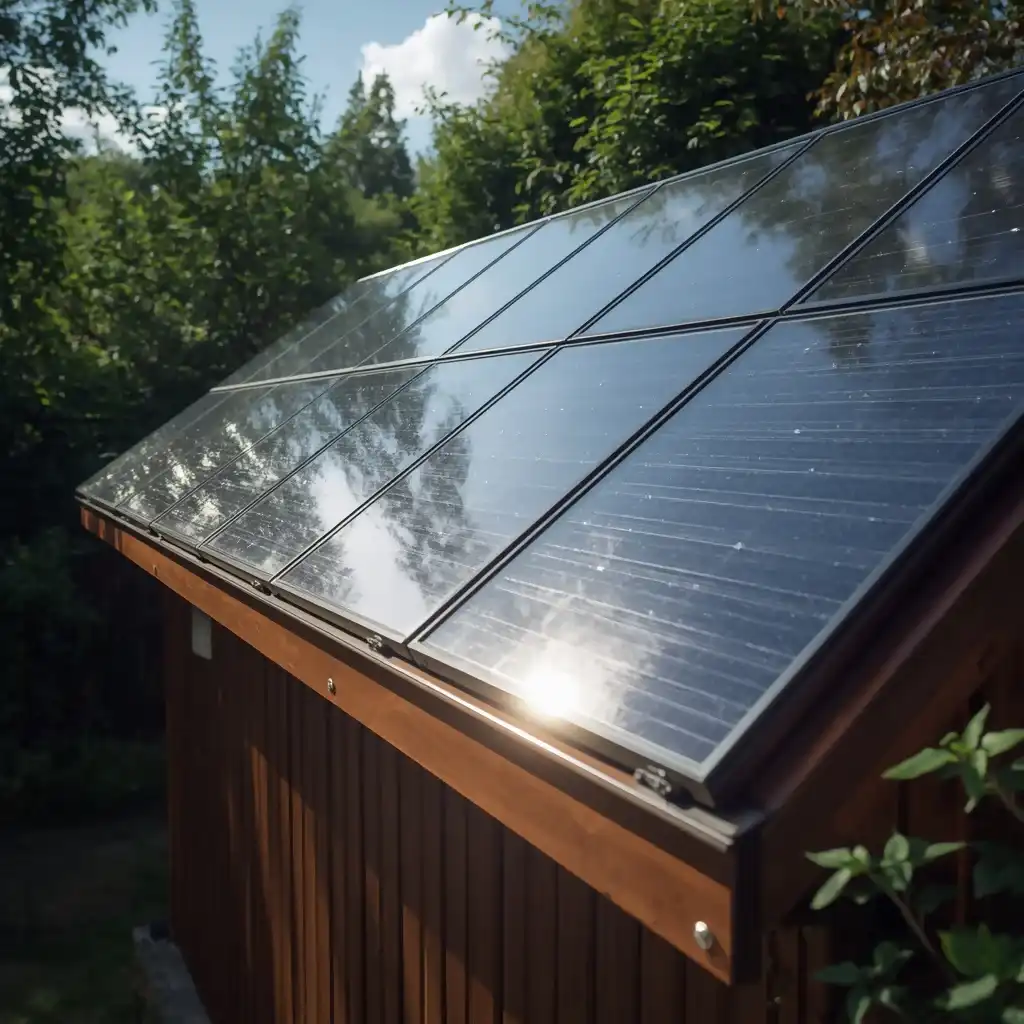
For older or lightweight shed roofs — think standard feather-edge timber or thin felt — flexible monocrystalline panels are worth serious consideration. They weigh a fraction of a rigid frame (a standard rigid 400W panel tips the scales at 20–23 kg), and they bond directly to the roof surface with no mounting brackets required.
Step-by-Step: How to Install Solar Panels on Your Garden Shed
This is the part that puts people off — and really shouldn’t. For a basic off-grid shed system, here’s the process in plain steps:
- 1
Check Your Roof Orientation
South-facing at a 30–45° tilt gives the best output in the UK. Use a compass app to check. South-east and south-west still work well — you’ll see roughly 85–90% of south-facing output. Avoid north-facing if you can.
- 2
Mount the Panel(s) Securely
Rigid panels need aluminium tilt-frame brackets screwed into shed rafters. Flexible panels can be bonded with adhesive. Make sure fixings are solid — UK winds are no joke, and a flying panel is a serious hazard.
- 3
Run Cables to the Charge Controller
Feed the DC cables from the panel through a weatherproof gland in the shed wall or roof. Always connect the battery to the controller first, then connect the solar panel — this prevents voltage spikes that can damage the controller.
- 4
Connect Your Battery
Wire the LiFePO4 (or lead-acid) battery to the controller’s battery terminals using fused cables. Keep the battery off the floor in a ventilated spot — not tucked directly under the panel or in full sun, where heat degrades capacity over time.
- 5
Add Lights, Sockets, or an Inverter
12V LED strip lights can run directly off the battery output — no inverter needed, and incredibly efficient. If you need 230V AC for power tools or a laptop charger, connect a pure sine wave inverter to the battery and plug in as normal.
Costs and Savings: What to Expect in 2026
Here’s how the numbers stack up based on the current Ofgem Q2 2026 electricity rate of 24.67p/kWh:
| System Size | Typical Use | Upfront Cost (2026) | Annual Saving* | Payback Period |
|---|---|---|---|---|
| 100W Kit | LED lights, phone charging | £150–£250 | ~£30–£50 | 3–5 years |
| 200W System | Garden office, laptop, small appliances | £300–£500 | ~£60–£100 | 3–5 years |
| 400W System | Power tools, workshop equipment | £500–£800 | ~£120–£200 | 4–6 years |
| Grid-Tied Shed System | Feed surplus energy to house, earn via SEG | £1,500–£3,000 | £200–£400+ | 5–8 years |
*Based on Ofgem Q2 2026 rate of 24.67p/kWh. SEG export income not included. Results vary by usage pattern, shading, and orientation.
The Smart Export Guarantee: Can Your Shed Earn You Money?
If you connect a larger shed system to your home’s consumer unit and export surplus electricity to the grid, you’re eligible for the Smart Export Guarantee (SEG). In 2026, UK energy suppliers offer SEG rates of 3p to 15p per kWh. That’s not life-changing money on its own, but combined with what you save by not buying grid electricity, it chips away at your payback period nicely. You’ll need a G98 or G99 registration with your Distribution Network Operator (DNO) first — a straightforward process your installer can handle, or that you can submit directly if doing it yourself.
Frequently Asked Questions
Do I need planning permission for solar panels on a garden shed in the UK?
In most cases, no. Solar panels on a UK garden shed are covered by permitted development rights under Part 14 of the Town and Country Planning Order 2015. Key conditions: panels must not protrude more than 200mm from the roof, must not exceed the shed’s highest point, and the property must not be listed or in a protected area. A Certificate of Lawful Development costs £103 in England (2026) if you want official written confirmation.
How many watts of solar panels do I need for a garden shed?
For LED lights and phone charging, 100–160W is ample. For a garden office with a laptop and a few small devices, go for 200–400W. Running power tools regularly means you’ll want 400–800W minimum. A modern 400W panel generates around 1.2–1.6 kWh per day in average UK conditions — enough to run LED lights all evening from a single day’s solar.
How much do solar panels for a garden shed cost in the UK in 2026?
A basic kit — panel, MPPT controller, cabling — starts from around £150. Add a LiFePO4 battery for overnight storage and you’re looking at £300–£800 for a complete off-grid system. Plug-in solar kits available from mid-2026 cost roughly £300–£600 for a 400–800W setup and are the simplest entry point. All solar equipment in the UK is currently VAT-free at 0%.
What type of solar panel is best for a UK garden shed?
Monocrystalline N-type panels are the clear winner in 2026 — 22–25% efficiency, excellent low-light performance, and a smart all-black finish. Polycrystalline panels are effectively extinct in new UK residential installations. For older or lighter shed roofs that might struggle with a heavy rigid panel (20–23 kg each), flexible monocrystalline panels offer a lightweight, frameless alternative.
Is solar cheaper than running mains electricity to a garden shed?
Almost always, yes. Running a mains cable costs £500–£1,200 for a typical 15-metre garden run, plus ongoing electricity costs at 24.67p/kWh. A competent solar system achieving the same result costs £150–£400, with no running costs and a payback under five years. For sheds not attached to the house, solar wins comfortably on both upfront cost and simplicity.
Can I earn money from solar panels on my garden shed?
Yes — if you install a grid-tied system that routes surplus electricity through your home’s consumer unit. You’ll need to register with your Distribution Network Operator (DNO) via a G98 or G99 notification, and you can then earn 3–15p per kWh through the Smart Export Guarantee (SEG). Rates vary by supplier, so it’s worth shopping around once you’re set up.
The Bottom Line
Powering your garden shed with solar panels is one of the most satisfying and cost-effective DIY projects you can take on in 2026. A basic kit starts at £150, no planning permission is needed for most properties, and the system pays for itself well inside five years. Whether you just want a bit of light for late-evening gardening or a full-blown off-grid workshop, there has never been a better time to stop running cables across the lawn and let the sun do the heavy lifting — even on a drizzly Tuesday in November.

2 Comments