

Solar Panels Underperforming?

Solar Panels Underperforming? What to Do (UK 2026 Guide)
Few things sink the heart faster than opening your solar app and seeing a number that looks wrong. I’ve been diagnosing underperforming solar panels for a long time, and here’s the truth that surprises most people: the majority of “broken” systems I’m called to look at aren’t broken at all. It’s the season, a grown tree, a splat of bird mess, or a switch that tripped weeks ago.
But not always. So this is the exact process I use on my own customers’ systems — work out whether it’s normal, find the culprit if it isn’t, and know what the fix should cost before anyone quotes you.
Compare like with like first — UK output swings four-to-one between May and December, so a winter dip is usually nothing. Then check the three cheap things: shading, dirt, and the inverter and its switches. Panels themselves degrade at only around half a percent a year; when output really collapses, it’s almost always the electronics or something blocking the light.
First, the reality check: is it just the weather?
Before you suspect a fault, suspect the British sky. A south-facing UK system generates roughly four times more in May than in December. I’ve had genuinely anxious phone calls in January from people whose systems were working perfectly.
Weather matters within a season too. A grey, drizzly July week can produce half what a bright June week did, and nobody’s system is at fault. Heat is the surprise one: in a proper heatwave, panels actually lose a little efficiency as they get hot, which I’ve covered in my heatwave guide.
Read the numbers properly
Gut feel isn’t diagnosis. Here’s the two-minute method I use before touching a ladder.
- Find your kWh, not your “savings.” Apps love showing pounds and CO₂, but diagnosis needs raw kilowatt-hours. Note the daily and monthly totals.
- Divide by your system size. A healthy UK system makes roughly 850 to 1,000 kWh per kWp per year. The Centre for Alternative Technology puts it at 800 to 1,000. So a 4kWp array should land around 3,400 to 4,000 kWh over a normal year.
- Compare against the same week last year, not last month. Most apps show year-over-year charts for exactly this reason.
- Use the clear-day test. On a properly sunny day, a 4kWp system should be showing 2 to 3.5 kW around solar noon. If it’s bright and you’re seeing a fraction of that, something’s up right now.
- Apply the 5% rule. A sustained drop of 5% or more over two to three weeks of normal weather is my trigger to investigate — clean or check. A consistent 15%-plus shortfall on clear days means a fault, not a mood.
If your app has gone completely quiet, don’t panic about the panels — it’s very often the Wi-Fi dongle or a broadband change, not the hardware. I’ve rounded up what each brand’s app should and shouldn’t look like in my best solar monitoring apps guide, and the wider monitoring system guide explains what good data looks like. And if you want an independent benchmark, the EU’s free PVGIS tool will model your exact roof.
The usual suspects, ranked by how often I see them
| Culprit | The tell | Typical loss | The fix |
|---|---|---|---|
| Season & weather | Output tracks the chart above; app fine on clear days | None — it’s normal | Nothing. Make a cup of tea |
| New or growing shade | Sudden or slow drop; worse morning/evening; one part of the array down in panel-level data | Severe — shading just 10% of one panel can cut a whole string’s output by 30–40% on basic string systems | Prune, trim, or fit optimisers/microinverters |
| Dirt, pollen, traffic film | Slow decline over weeks/months; worse after dry spells | 2–7% on a typical home, more near roads, farmland or the coast | A proper clean |
| Bird droppings | Sudden localised drop; visible from the ground with binoculars | A single dropping can cost 20–30% on a string-inverter system | Clean; consider bird mesh |
| Inverter or tripped switch | Output zero or wildly erratic; blank display; error code | Up to 100% | Reset once, then engineer |
| Normal ageing | Very slow decline, roughly half a percent a year after year one | ~5% over a decade | Nothing — that’s the deal |
Shading deserves a special word because it’s the most misunderstood one. Trees grow. A neighbour’s extension goes up. A chimney you never noticed starts biting the array in winter sun. On a plain string-inverter setup, panels are a chain — weaken one link and the whole string suffers. If shade is permanent and pruning isn’t an option, power optimisers or microinverters take the shaded panel out of the chain; my piece on neighbours’ trees blocking panels covers the pruning and legal side.
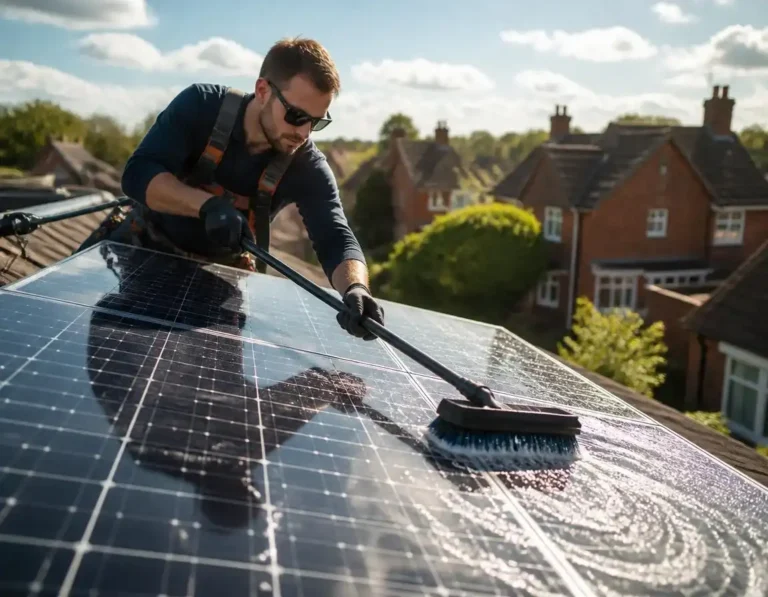
Dirt is the gentle one. Rain handles a lot in the UK, but not traffic film, pollen or salt. If you’re near a busy road, farmland or the coast, or your roof is low-pitch, cleaning moves from annual luxury to genuine maintenance — my step-by-step cleaning guide has the safe method, and the annual maintenance checklist puts it all in one place. Older systems get one more suspect: physical ageing like yellowing or delamination, which I’ve written about here.
Inverter and switch checks you can safely do
When output falls off a cliff rather than fading, I’d bet on the inverter or a switch before I’d bet on a panel. Panels fail slowly; electronics fail on a Tuesday. From ground level, in this order:
- Look at the inverter. Blank screen usually means no AC supply or a dead unit. Error codes and red lights mean it knows what’s wrong — photograph everything with timestamps.
- Check the isolators. The AC isolator beside the inverter fully on? Any tripped breaker or RCD in the consumer unit? (Only touch it if you’re dry, confident and it’s easily accessible.)
- Check the boring stuff. Router on? Wi-Fi dongle seated? Half the “faults” I’ve closed were a broadband change that orphaned the monitoring.
- One controlled reset. AC isolator off, five minutes, back on. Once. If the same code returns, stop resetting.
- Eyes-only roof scan. Binoculars or phone zoom from the ground: lifted panels, dangling cables, connector damage. Never go onto the roof, and never unplug DC connectors up there — a string is live whenever there’s daylight, even with the AC side off.
If the fault is an arc fault, earth fault or RCD trip, don’t keep resetting it. One reset to check for a glitch is reasonable; if it comes straight back, leave the isolators alone and get an engineer out the same day. My inverter fault code guide translates what the display is actually telling you.
What a fault is actually costing you
Here’s the maths that should make you act. Every lost kilowatt-hour is worth somewhere between 15p and 26p depending on whether you’d have used it yourself or exported it — self-use saves you the full cap rate (24.67p at the time of writing, rising to an average 26.32p from 1 October 2026), while export earns your SEG rate, anything from 4p to 15p on the best SEG tariffs.
So put numbers on it. A typical 4kWp system makes around 3,800 kWh a year. A fault that knocks a third off that is losing you roughly 1,250 kWh — call it £200 to £300 a year in vanished savings and export income. Even one quiet panel, silently down 200–600 kWh a year, is worth up to about £150 of your money. That’s why “I’ll keep an eye on it” is an expensive hobby.
The fixes, and what they cost in 2026
| Fix | Rough 2026 cost | Worth it when… |
|---|---|---|
| Professional clean | £60–£180 per visit | Output down 5%+ with visible soiling, or you’re near road, farm or coast |
| DIY clean (pole & soft brush, deionised water) | £40–£120 for the kit, one-off | Single-storey, safe ground access. Never a pressure washer — it voids most warranties |
| Power optimisers retrofitted to shaded panels | £40–£150 per panel plus fitting | Permanent shade you can’t prune or move away from |
| String inverter replacement | £600–£1,500 fitted; a straightforward like-for-like swap often lands £700–£1,100 | Inverter out of warranty and faulting — the single most common paid fix on systems over 10 |
| Drone thermal imaging survey | Roughly £250–£450 for a domestic roof | Output down, nothing visible from the ground, system out of warranty — it spots hot spots and duff cells nothing else can see |
| Independent electrician / MCS call-out | A couple of hundred quid typically | Trips, isolator gremlins, wiring doubts — and it’s Part P notifiable work anyway |
One honest note on inverters: studies of field data have found around a third of string inverters fail by year 15, so if your system is early-2010s and misbehaving, budget for the swap rather than mourning it. If you’ve been eyeing a battery, the repair visit is also the moment to price a hybrid inverter instead and make the repair budget do double duty.
Warranty, MCS and your legal rights
Before you pay for anything, check who already owes you the fix. A UK solar system carries three warranties: the panel product warranty (typically 20–30 years), the performance warranty (25–30 years, usually guaranteeing 87–90% of original output), and the installer’s workmanship warranty. If your output has fallen below the guaranteed performance curve, that’s a claim, not a repair bill. My warranty explainer goes through the small print that decides whether a claim sails through or sinks.
The route when things go wrong runs like this: your installer first, since most claims go through them. If they’ve stopped trading, check for the insurance-backed guarantee or the new MCS-approved financial protection, and remember Section 75 if any of it went on a credit card. If your installer was MCS certified and won’t play ball, the MCS complaints process is your escalation route. And separately from all paperwork, the Consumer Rights Act 2015 gives you up to six years in England, Wales and Northern Ireland (five in Scotland) to claim against the seller for faulty goods — warranty or no warranty. If your installer has gone bust entirely, I’ve written the full playbook here.
Screenshots of the app with dates, your MCS certificate, invoices, serial numbers. Engineers diagnose patterns, and warranty teams diagnose paperwork. Ten minutes of screenshots now can be the difference between a free fix and an argument.
My verdict
Nine times out of ten, an “underperforming” UK system is one of three things: winter, shade, or a switch. Run the reality check, read the raw kWh, do the ground-level checks in the order above, and you’ll either fix it yourself for nothing or walk into a call-out knowing exactly what’s wrong and what it should cost.
The expensive mistake isn’t the fault — it’s the quiet one you never notice. A monthly glance at the app, compared with the same week last year, is the cheapest insurance your system will ever have.
FAQs
Compare your annual generation with your system size. Most UK systems make 850 to 1,000 kWh per kWp per year, so a 4kWp array should land somewhere around 3,400 to 4,000 kWh. If you’re well below that in a normal year and there’s no shading, something deserves a look. For shorter periods, compare against the same week last year — never against last month, because UK seasons swing the numbers around wildly.
Sudden drops are usually the inverter, a tripped isolator or breaker, or a new shade — not the panels themselves. Panels fade slowly; electronics fail on a Tuesday. Check the inverter display for error codes, make sure the AC and DC isolators are fully on, look for anything new casting shade, and check the Wi-Fi dongle if your app has simply gone quiet. One controlled reset is fine; repeated fault codes mean book an engineer.
Usually yes, if your own checks find nothing and the system is out of warranty. A drone thermal survey costs a few hundred pounds and will spot hot spots, duff cells and faulty connections that nothing else can see from the ground. Weigh it against what the fault is costing you: on a typical 4kWp system, a problem that cuts output by a third loses well over £200 a year in saved and exported electricity.




2 Comments