Are Landlords About to Be Forced to Fit Solar Under EPC Reforms?

Are Landlords About to Be Forced to Fit Solar Under EPC Reforms?
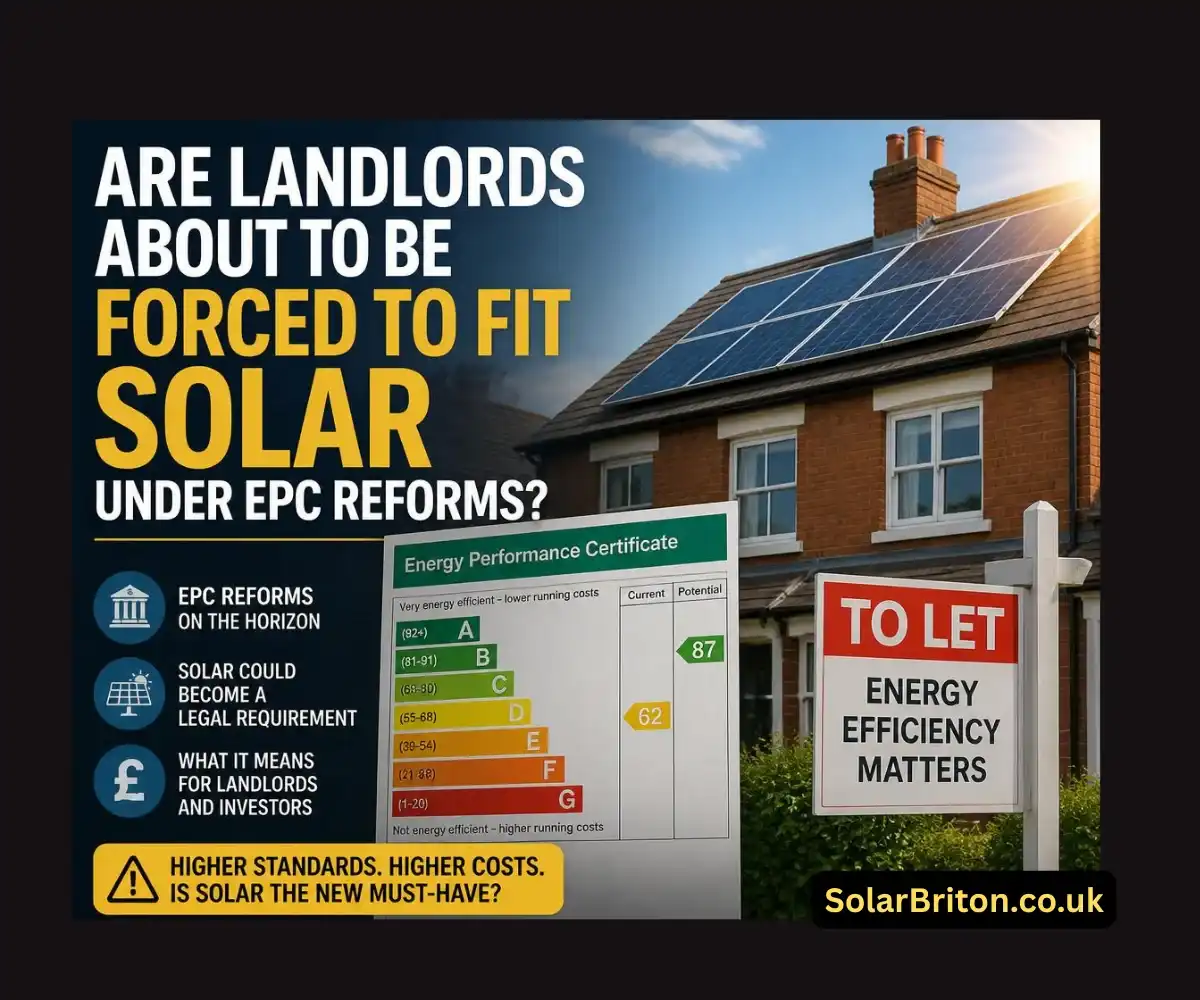
If you let out property in England or Wales, you’ve probably seen the headlines by now. “Landlords forced to fit solar panels.” “EPC crackdown could cost £30k a home.” I read a lot of this stuff for a living, and honestly, most of it skips over the one detail that actually matters: whether solar is genuinely compulsory, or just extremely convenient. So let’s separate the fact from the spin, and work out exactly what you need to do before 1 October 2030 creeps up on you.
No — solar panels aren’t named as compulsory anywhere in the new rules. What is compulsory is reaching EPC Band C, or holding a valid exemption, on every privately rented home in England and Wales by 1 October 2030. Landlords get a genuine choice in how they get there. It’s just that, for a huge slice of the rental sector, solar paired with a battery turns out to be the quickest and cheapest way to tick that particular box — which is probably where the “forced” headlines came from in the first place.
Here’s what I’ll cover: what’s actually changed, whether solar is really required or just the sensible option, what it’s likely to cost you, what help is out there, and exactly what to do about it starting now.
What’s Actually Changing (In Plain English)
Quick bit of history first. Since 2018, landlords in England and Wales have had to hit a minimum EPC rating of E before letting a property, backed by a fairly modest £3,500 spending cap. That rule hasn’t moved since.
That changes thanks to the government’s response to a two-year consultation on private rented sector standards, published on 21 January 2026 alongside the wider £15 billion Warm Homes Plan. The headline: every private tenancy in England and Wales will need to reach the equivalent of EPC Band C, or hold a registered exemption, by 1 October 2030. There’s no earlier cut-off for new tenancies — an earlier draft floated 2028 for new lets, but the final policy dropped that in favour of one single date for everyone.
The spending cap has also gone up, from £3,500 to £10,000 per property. That sounds alarming until you read the small print: the government’s own impact assessment estimates the average landlord will actually spend closer to £5,400, once existing EPC C properties, grants and exemptions are factored in.
| Aspect | Today’s rules (since 2018) | From 1 October 2030 |
|---|---|---|
| Minimum standard | EPC Band E | EPC Band C (or equivalent under new metrics) |
| Spending cap | £3,500 per property | £10,000 per property (avg. spend est. £5,400) |
| How it’s measured | Single cost-based rating | Dual metric: fabric performance + your choice of smart readiness or heating system |
| New vs existing tenancies | Applies to both already | One single deadline for all tenancies — no earlier date for new lets |
| Maximum fine | Varies by breach | Up to £30,000 per property, per breach |
The Clock Is Already Running
1 October 2030 feels a long way off. It isn’t, really — not once you factor in tradespeople, supply chains, and the fact that eligible spending from 1 October 2025 already counts towards your £10,000 cap. Here’s roughly where things stand today, mid-August 2026:
Time remaining until the 1 October 2030 compliance deadline (calculated live from today’s date).
1 October 2025
Eligible energy-efficiency spending from this date already counts towards your future £10,000 cost cap — even though the standard itself isn’t compulsory yet.
H2 2027 (date still to be confirmed)
The new Home Energy Model-based EPCs are due to launch, replacing the current system. This was originally planned for October 2026, pushed back to the second half of 2027 in March 2026, then delayed again in June 2026 while government finalises testing. Worth watching, but it hasn’t moved the 2030 landlord deadline.
1 October 2029
Last date to already hold an EPC C (under the current rating) to be “grandparented” in — meaning you’re treated as compliant until that certificate expires, without further work.
1 October 2030
The hard deadline. Every relevant tenancy must meet EPC Band C under the new metrics, or hold a valid registered exemption, to keep being legally let.
So, Is Solar Actually Compulsory?
This is the bit almost every scare-story headline glosses over, so let’s slow down and get it right.
The new standard isn’t one single score — it’s two separate hurdles, and they’re tackled in order.
Step one — fabric performance — isn’t optional. Before anything else counts, your property needs to meet a baseline for insulation, draughtproofing and glazing. A lot of newer or already-improved stock will clear this without any extra spend.
Step two is where the actual choice sits. Once fabric is sorted (or exempted), you need to hit a secondary standard — and you get to pick which one:
☀️ Smart readiness route
- Solar PV panels
- Home battery storage
- Smart meter
- Other load-shifting tech
🔥 Heating system route
- Heat pump
- Connection to a heat network
- Heating controls upgrade
- Hot water cylinder / solar thermal
Government has been explicit on one point: landlords will never be forced to rip out a working boiler. If a property genuinely can’t take any measures under the smart readiness route — say, planning permission is refused, or there’s no usable roof — it isn’t then pushed onto the heating-system route as a fallback. It’s a real choice either way, and hitting either one satisfies the secondary standard.
Why Solar Ends Up Being the Obvious Choice Anyway
If it’s genuinely a free choice, why does everyone assume solar? A few reasons, and they stack up quickly:
It doesn’t touch the tenant’s heating. Swapping a working gas boiler for a heat pump can mean disruption, bigger radiators, and a system your tenant has to learn to live with mid-tenancy. Solar panels go on the roof and get on with it.
Most rental roofs qualify as permitted development in England, meaning no separate planning application in the vast majority of cases. Leaseholds, listed buildings and conservation areas are the main exceptions — see our guide to solar panel planning permission if you’re unsure.
The points genuinely add up. Under the current scoring system, a well-specified solar PV array typically adds somewhere around 6 to 10 points — often enough on its own to lift a property sitting in the middle of Band D over the line into Band C. The chart below shows roughly how that stacks up against a typical D-to-C gap (worth noting: the new Home Energy Model will recalculate this once it lands, so treat this as directional rather than exact).
Illustrative comparison based on current EPC scoring conventions (Band D = 55–68, Band C begins at 69). Figures will be recalculated once Home Energy Model-based EPCs launch.
It can pay you back twice over. Beyond the EPC uplift, solar exports earn Smart Export Guarantee income in the landlord’s name, and 0% VAT on solar and battery installs (running until March 2027) knocks a meaningful chunk off the upfront bill. There’s also a reasonable case that it helps at resale — see our full breakdown of whether solar panels increase house value.
Government’s own analysis backs this direction of travel: it expects the reform to drive somewhere north of 900,000 additional rooftop solar installations by 2030, a meaningful share of them across the private rented sector.
None of this means solar is automatically right for every property, though. A heavily shaded or north-facing roof changes the maths, and if you manage flats or leasehold blocks, freeholder consent adds a layer that freehold landlords don’t have to think about. In those cases, the heating-system route (or a fabric-only exemption) may genuinely be the better call — see our guide to heat pumps in the UK for the alternative path.
What Will It Actually Cost You?
Let’s talk real numbers, because vague reassurance doesn’t pay a contractor.
The cap is £10,000 per property, and it covers everything: fabric measures, whichever secondary route you choose, and even the EPC assessment fees themselves. If a property is worth under £100,000, there’s a lower cap — 10% of the property’s value — so you’re never asked to spend more than the home itself is worth. Reach the cap and you’re still below Band C? You register a “cost cap” exemption and carry on letting the property, which I’ll come back to shortly.
Government’s impact assessment estimates the average landlord will spend around £5,400 of the £10,000 maximum cap.
Here’s roughly what the solar side of that spend looks like at current 2026 UK installer pricing:
| System | Typical installed cost | Typical EPC points gained | Best suited to |
|---|---|---|---|
| 3kWp solar PV | ~£4,700 | ~5–7 points | Smaller 1–2 bed lets |
| 4kWp solar PV | £6,200–£7,500 | 6–10 points | Typical family rental |
| + 9.5kWh battery | +£5,800–£7,000 | Boosts smart-readiness score further | Strengthening your case / SEG income |
Solar alone typically pays itself back over roughly 10 to 11 years at current energy prices — see our full energy price cap breakdown for how that maths is shifting quarter to quarter. A battery isn’t required for compliance, but it strengthens your smart-readiness case and unlocks stronger battery storage and export income on top.
Grants, VAT Breaks and Other Help
You’re not necessarily paying full price alone. A few things worth knowing:
- 0% VAT applies to solar panels, batteries and installation labour until March 2027 — an automatic saving with no application needed. Full detail in our solar panel grants guide.
- The Boiler Upgrade Scheme offers £7,500 towards a heat pump if you take the heating-system route instead — and usefully, BUS funding doesn’t count against your £10,000 cap, unlike almost everything else.
- ECO4 winds down through 2026, but the Warm Homes Plan commits a further £1.5 billion in grant funding aimed at low-income households — some of your tenants may well qualify. See our ECO4 eligibility guide and the Warm Homes Grant breakdown.
- No spare capital? There are finance routes designed for exactly this — see solar with no upfront cost and our general solar panel finance guide.
- Keep every invoice. Energy-efficiency spend on a rental property can often be claimed as an allowable expense against rental income, or via capital allowances where a property sits inside a company structure — see our note on capital allowances for solar. This isn’t financial advice — check your specific position with an accountant.
If You Genuinely Can’t Comply: Exemptions
Nobody’s expected to spend money on a measure that genuinely won’t work for their property. The rules keep — and expand — a set of exemptions, each typically valid for five to ten years before reassessment:
| Exemption | When it applies |
|---|---|
| High-cost | Even the cheapest recommended measure would exceed the cost cap |
| Cost cap | You’ve spent up to £10,000 (or your reduced cap) and the property is still below C |
| All relevant improvements made | No further measures are recommended or possible, yet the property remains below standard |
| Property value adjustment | Homes worth under £100,000 — cap reduces to 10% of property value |
| Solid wall insulation | Landlord chooses not to install solid wall insulation specifically |
| Negative impacts | A measure would demonstrably harm the building’s fabric or value |
| Third-party consent | A tenant, freeholder or planning authority refuses required consent |
| New landlord | Temporary 6-month grace period after acquiring a tenanted property |
Two extra wrinkles worth flagging. Heritage and listed buildings get particular attention in the guidance, given how fiddly external insulation and visible panels can be on older stock. And short-term lets and holiday homes aren’t currently in scope of any of this — though government has said that position remains under review.
What Happens If You Do Nothing?
From 1 October 2030, a privately rented home without EPC C or a valid exemption simply can’t be legally let. Local authorities can fine landlords up to £30,000 per property, per breach — a sharp jump from the current maximum. With a new PRS Database also on the way under the Renters’ Rights Act, it’s about to get considerably easier for councils to spot who hasn’t complied.
For what it’s worth, government’s own research suggests most landlords intend to comply rather than exit: 59% of those surveyed said they’d carry out improvements once standards rise, and the proportion saying they’d leave the market altogether was the same whether standards changed or not. Read that as useful context rather than a guarantee — it reflects stated intentions, not certainties.
Your Action Plan, Starting Now
- Check where you actually stand. Pull up your current EPC (or renew it if it’s getting old) and see your real starting band before assuming the worst.
- Sort the fabric basics first. Loft and cavity insulation are usually the cheapest points on the table — get these done before spending on anything else.
- Get solar quotes now, not in 2029. Prices and installer availability tend to tighten as deadlines approach. Always confirm any installer is MCS-certified before signing anything.
- Model both routes side by side. Get a real number for solar-plus-battery against a heat-pump-and-BUS-grant scenario before committing — the cheaper option isn’t always the obvious one on paper.
- Start logging spend from 1 October 2025 onward. Keep every invoice; it all counts towards your £10,000 cap.
- Running a portfolio? Prioritise your worst-rated properties first, so you’re not facing a pile-up of work as 2029–2030 approaches.
Common Questions
Policy detail sourced from DESNZ’s “Improving the energy performance of privately rented homes” government response (21 January 2026) and the Warm Homes Plan. Figures correct as of August 2026 and subject to Parliamentary approval — always check GOV.UK’s current landlord guidance before making decisions. This article is provided for general information and isn’t financial or legal advice.