

Solar Panels for Renters UK 2026: Go Solar Without Owning a Home

Solar Panels for Renters UK 2026: You Don’t Need to Own Your Home to Go Solar
Plug-in kits, the Renters’ Rights Act, grants, honest savings, and how to talk to your landlord — everything you need to know, right here.
The Renter’s Solar Problem — And Why 2026 Is the Year It Changes
If you rent your home in the UK, you’ve probably felt the sting of watching energy bills climb while homeowners install rooftop solar and talk about near-zero electricity costs. Around 4.6 million households in England rent privately, and until very recently, almost all of them were locked out of solar entirely.
Here’s the frustrating bit: it’s not that your home can’t handle solar. In many cases it absolutely could. The problem has always been ownership, permission, and a legal framework that just didn’t exist for tenants. Landlords had little reason to spend thousands on a system that primarily saves their tenant money, and tenants couldn’t make permanent electrical changes without consent. It was a deadlock with no obvious exit.
But 2026 has genuinely changed the picture. Three things have arrived at the same time:
1. BS 7671 Amendment 4 (April 2026) — The UK’s wiring regulations now provide a clear legal framework for plug-in solar up to 800W, connected via a standard 13A socket.
2. Renters’ Rights Act 2025 (in force from 1 May 2026) — Landlords in England and Wales can no longer unreasonably refuse tenants’ requests to make reversible energy improvements — including plug-in solar.
3. BSI Product Standard (expected July 2026) — A new British Standard specifically for plug-in solar kits is due imminently, which will open the floodgates to certified off-the-shelf kits in UK retailers.
I’m not going to oversell it — there are still real limits. You’re not going to power your whole home. You can’t access the Smart Export Guarantee with most plug-in setups. But if you’re renting and want to reduce your electricity bill, shrink your carbon footprint, and own something you can take with you when you move? 2026 is the first year you’ve genuinely been able to do it legally and affordably in the UK.
Is It Actually Legal? The 2026 UK Rules, Simply Explained
This is the question I get asked most, and it’s a fair one — because for years the honest answer was “probably not, depending on how you read the wiring regs.” That’s changed.
BS 7671 Amendment 4 — The Wiring Regs Update That Changes Everything
BS 7671 is the IET’s wiring regulations document — the bible of how electricity is supposed to be installed in UK buildings. Amendment 4, published on 15 April 2026, specifically authorises plug-in solar systems for the first time. Systems up to 800W AC output can now be connected to a standard 13A socket under defined conditions, without requiring a full wiring installation by a qualified electrician.
That’s a landmark change. Before April 2026, there was no legal route to simply plug a solar-generating device into a wall socket in the UK — the previous versions of BS 7671 and BS 1363 didn’t cover it. Now they do.
The Renters’ Rights Act 2025 — Your New Leverage With Landlords
The Renters’ Rights Act 2025 received Royal Assent in October 2025 and came into force in its key provisions on 1 May 2026. Alongside abolishing no-fault evictions and rolling out rolling tenancies, it contains an important clause for our purposes: landlords in England and Wales cannot unreasonably refuse a tenant’s request to make energy-related improvements.
A plug-in solar system that requires no structural modification has a very strong case for being considered “reasonable” under the Act. It doesn’t drill into walls, doesn’t affect the building’s structure, and can be completely removed when you leave. If a landlord refuses without a reasonable justification, you may have grounds to challenge that refusal — Citizens Advice can advise you on next steps if it comes to that.
The Act wasn’t written specifically with plug-in solar in mind, and no test cases have gone through the courts yet. The smartest move for now is still to notify your landlord in writing, describe exactly what the system is and confirm it makes no permanent changes, and keep a paper trail. Don’t just plug it in and hope for the best — a short written notification protects you.
Planning Permission — Do You Need It?
For most plug-in solar setups on balconies, walls, or in gardens, you don’t need planning permission under Permitted Development Rights. Solar panels mounted on external walls or fences are generally allowed, provided they don’t protrude more than 200mm from the surface. The exceptions are listed buildings, properties in conservation areas, or any installation visible from a public highway — in those cases, check with your local planning authority first.
DNO Notification — What’s Required
Even though plug-in solar systems are small, you still need to notify your Distribution Network Operator (DNO) within 28 days of installation under G98 rules. Your installer should handle this if you’re using a CPS-registered electrician. If you’re self-connecting via an approved plug-in kit, you’ll need to do this yourself — it’s a simple online form.
| Option | Needs Landlord Consent | Needs Planning Permission | Currently Legal | Renter Can Take It When Moving |
|---|---|---|---|---|
| Plug-in balcony solar (≤800W) | Notify only | Usually No | ✓ Yes (BS 7671 Apr 2026) | ✓ Yes |
| Hardwired fused spur connection | Yes required | Usually No | ✓ Yes (with electrician) | Panels yes, wiring stays |
| Rooftop solar (full install) | Yes required | Usually No (PD) | ✓ Yes (MCS installer) | ✗ No |
| Portable power station (DC only) | Not needed | Not needed | ✓ Yes (always was) | ✓ Yes |
| Community solar subscription | Not needed | Not needed | ✓ Yes | ✓ Yes (subscription based) |
Based on current UK regulations as of 2026. PD = Permitted Development. Always confirm with a qualified professional before installing.
Your Solar Options as a Renter: Four Real Routes
Not everyone’s rental situation is the same. Someone in a ground-floor flat with a courtyard garden is starting from a different place than someone on the eighth floor of a tower block. Here are the four realistic routes available to UK renters in 2026 — and I’ll be straight with you about what each one can and can’t do.
1. Plug-In / Balcony Solar
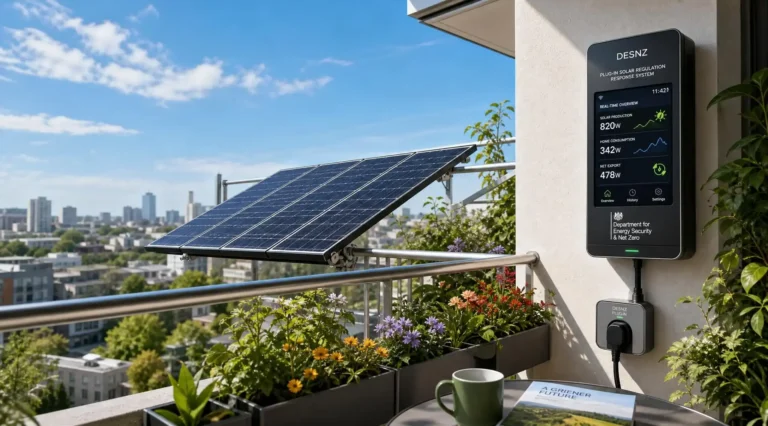
One or two panels (up to 800W) clamped to your balcony rail, mounted on a garden fence, or propped against a south-facing wall — connected via a standard 13A socket.
2. Landlord-Installed Rooftop Solar
You negotiate with your landlord to install a full rooftop PV system — funded by them, potentially supported by ECO4 or Warm Homes grants. Savings go to you via lower bills.
3. Portable Power Station (DC)
A portable battery unit charged by a small panel or overnight on a cheap tariff. Powers specific devices — great for reducing peak grid demand. No permissions needed.
4. Community Solar Subscription
Subscribe to a share of a local or regional solar farm. The energy generated is fed into the grid and credited to your bill. No equipment at home at all.
Plug-In Solar: The Full Breakdown for UK Renters
Let’s go deep on plug-in solar, because this is the option that’s actually new, legally clear, and genuinely accessible to most renters in 2026. Think of it as solar for people who rent — portable, affordable, and increasingly well-supported by UK regulations.
How a plug-in solar kit works for UK renters — generate, convert, plug in, and save. Image: Solar Panels for Renters UK 2026: Your Full Guide to Going Solar Without Owning a Home
What Counts as a Plug-In Solar System?
A plug-in solar system (sometimes called balcony solar or Balkonkraftwerk — the German term for a type that’s been popular in Europe for years) typically consists of:
- One or two solar panels totalling up to 800W peak output
- A microinverter that converts DC electricity from the panels into AC current your home can use
- A cable and UK plug (13A) to connect to a standard socket
- Mounting brackets designed for balcony rails, walls, or garden fences
The system works by generating AC electricity that your home uses immediately — whenever the panels are producing power, you’re drawing less from the grid. The grid seamlessly makes up the difference. There’s no battery storage in basic setups, which is why making the most of daytime generation matters.
Where Can You Mount the Panels?
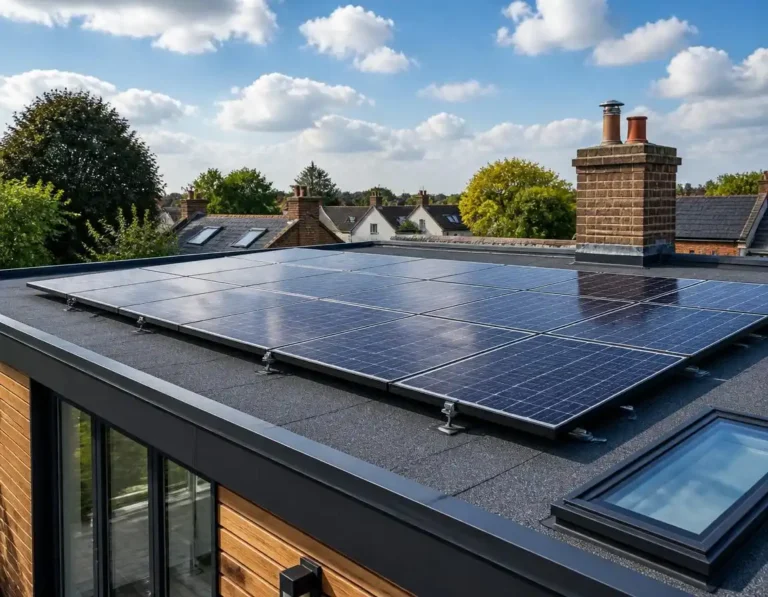
Viable positions for renters include a south or south-west facing balcony (ideal), a garden, an accessible flat roof area, or a south-facing wall or window ledge where panels can be propped at an angle. North-facing positions produce too little to be worthwhile. East or west-facing positions work, but expect output at the lower end of the range.
Use a smart plug and timer to run your washing machine, dishwasher, or tumble dryer during midday hours when your panels are generating at peak output. This shifts your consumption to when solar is flowing — dramatically increasing how much free electricity you actually use, rather than letting it reduce grid demand while you’re out.
The Kit Landscape in 2026
Germany has had over a million households running these systems for years, with dozens of brands competing for shelf space. The UK market is only just opening up in 2026, so choices are more limited — but growing fast.
| Kit | Output | Approx. Price (UK, 2026) | Key Features | Best For |
|---|---|---|---|---|
| EcoFlow STREAM 800W | 800W (2×400W panels) | ~£499 | Wi-Fi app monitoring, modular design, IP67 rated, no-drill balcony mounts | Most renters — best overall starter kit |
| EcoFlow STREAM 800W + Battery | 800W + storage | ~£979 | Everything above plus battery storage, perfect for those out during the day | Renters away from home 9–5 |
| Storm 710W Kit | 710W | ~£420 | Budget-friendly, solid G98-compliant microinverter, saves ~£140/yr | Budget-conscious renters |
| EcoFlow STREAM AC Pro (battery-only) | Battery only | ~£798 | Charge on cheap overnight tariffs, discharge in peak hours — no panel needed | Flats with no suitable outdoor space |
| DIY Hoymiles + Panel | Up to 800W | ~£350–£480 | Hoymiles HMS-800W-2T microinverter (12yr warranty) + separate panels | Tech-confident renters wanting flexibility |
Prices are approximate UK market prices as of 2026. Always check current pricing on Amazon UK or manufacturer websites. The BSI product standard (expected July 2026) will open the retail market to more certified options.
Costs, Savings & Payback: The Honest Numbers
Let me give you the real figures here — not the optimistic best-case-scenario versions. I find it helps to know the range, not just the headline.
Estimated annual bill savings. Figures based on UK electricity rate of ~24p/kWh, south-facing or near-south orientation, mid-England location. Individual results will vary based on consumption patterns and panel placement.
The 2–4 Year Payback Reality
A basic 800W two-panel kit costs roughly £499 in 2026. At average annual savings of around £150–£165, that’s a payback of approximately 3–3.5 years. In energy terms, that’s genuinely good — solar panels last 25 to 30 years, so even if you’re only renting for 3 more years, you break even. Take the kit with you and the savings continue wherever you live next.
Based on £499 kit cost and £165/yr estimated savings (800W, south-facing, mid-England). Actual savings vary. Kit taken to next rental continues earning savings.
What Won’t an 800W System Do?
Let’s be real about the limits. An 800W plug-in system is a supplemental energy source, not a whole-home solar solution. You won’t power your electric shower, your electric cooker, or any heating system through it. What you will do is offset a meaningful chunk of your lighting, phone charging, laptop use, fridge draw, and small appliance use — particularly during daylight hours.
How to Talk to Your Landlord About Solar
This bit trips people up more than any technical question. The good news is that 2026’s Renters’ Rights Act gives you a much stronger position than you ever had before — and most landlords, when approached properly, are more open than you might expect.
Why Landlords Might Actually Say Yes
It’s easy to assume landlords will always refuse. But a plug-in solar kit genuinely makes their property more attractive and more energy efficient — which matters increasingly as the minimum EPC rating for rentals is set to rise to EPC C by 2028 (for new tenancies). A landlord who understands this often sees plug-in solar as a low-cost win for everyone.
Do Your Research First
Know exactly what system you want to install, where you’ll mount it, and confirm it requires no drilling or structural modification. Have the product spec sheet ready. The more specific you are, the easier it is for a landlord to say yes.
Write to Them Formally
Send a written request by email (so you have a paper trail). Describe the system, confirm it makes no permanent changes, reference the Renters’ Rights Act 2025, and mention BS 7671 Amendment 4. Keep it brief and factual — you’re not asking for a favour, you’re making a reasonable request under law.
Wait for a Response
Give them reasonable time to respond — 14 days is fair. If they ask for more information or clarification, provide it. If they refuse without a clear reason, that’s where the Renters’ Rights Act becomes relevant.
If Refused, Seek Advice
An unreasonable refusal may be challengeable. Citizens Advice and Shelter both have guidance on tenant rights under the Renters’ Rights Act 2025. You can also contact your local council’s housing team. Don’t simply ignore a refusal and install anyway — that could jeopardise your tenancy.
“Dear [Landlord Name], I’m writing to request consent to install a small, portable plug-in solar panel system at the property. The system consists of two 400W solar panels mounted on the balcony railing (no drilling required) with a microinverter connected via a standard 13A wall socket. The system requires no structural modification and can be fully removed when I leave. Under the Renters’ Rights Act 2025, I understand that consent for reversible energy efficiency improvements cannot be unreasonably withheld. I’m happy to share the full product specifications if helpful. Kind regards, [Your Name]”
Grants & Financial Help Available to Renters in 2026
The honest truth is that most grant schemes in the UK are built around homeowners. But there’s more available to renters in 2026 than most people realise — particularly if you’re in a lower-income household or in rented accommodation with a poor EPC rating.
Who qualifies: Private renters receiving Universal Credit, Pension Credit, Child Tax Credit, Housing Benefit, or Income-based JSA/ESA. Landlord consent is required.
Deadline: Extended to 31 December 2026 — apply soon, there’s no successor scheme.
Private renters eligible
Who qualifies: Households under ~£36,000 income (threshold varies by council). Social and private renters are eligible.
How to apply: Via your local council — not a direct national application.
Renters eligible Rolling out 2026
Who qualifies: Any UK homeowner or landlord arranging installation — saves £1,000–£2,000 on a typical system.
Expires: 31 March 2027 — after that, standard VAT rates may return.
Via landlord / installer
Who qualifies: Homes with a SMETS2 smart meter and MCS-certified solar installation. Not available for most plug-in systems.
Note for renters: Only accessible if your landlord installs a qualifying system — worth asking about.
Not for plug-in solar
Solar Together — Group Buying for Communities
The Solar Together scheme, run by iChoosr in partnership with local authorities, allows communities — including renters who own their own property or whose landlords participate — to pool buying power and secure solar installations at 30–35% below typical retail prices. It’s primarily aimed at homeowners, but it’s worth checking if your local council runs a scheme, as some landlords take part to improve their rental stock. A 40%+ discount has been achieved in some areas (such as West Yorkshire) through these group purchasing rounds.
The 2026 UK Solar Regulatory Timeline for Renters
Things are moving fast. Here’s a clear picture of where we are and what’s coming:
Frequently Asked Questions
Here are the questions I get asked most — answered as plainly as I can manage.
Yes — and for the first time in 2026, there’s a clear legal framework to do it. BS 7671 Amendment 4 (April 2026) authorises plug-in solar systems up to 800W via a standard 13A socket. The Renters’ Rights Act 2025, enforceable from May 2026, also prevents landlords from unreasonably refusing requests for small energy improvements. You should always notify your landlord in writing before installing.
For a truly portable system with no permanent structural changes, you may not technically need formal permission — but you should always notify your landlord in writing. The Renters’ Rights Act 2025 means landlords in England and Wales cannot unreasonably refuse a request for reversible energy improvements. If your installation involves a hardwired connection to the consumer unit, you’ll definitely need consent and a qualified electrician.
A single 400W panel on a south-facing balcony saves roughly £84–£108 per year (at 24p/kWh). A dual 800W kit saves £150–£180. The government estimates £70–£110 for a standard system. Payback on a £499 kit is around 3–3.5 years. After that, the savings are pure profit — and you take the panels with you when you move.
You take them with you — this is one of the biggest advantages of plug-in solar over rooftop systems. Simply unclip the mounting brackets from the balcony rail, unplug the socket connection, and pack the system up. At your next property, mount and plug in again. The system is entirely portable.
Yes, some. The ECO4 scheme (extended to 31 December 2026) can fund rooftop solar for private renters on qualifying benefits — but you need landlord consent. The Warm Homes: Local Grant (rolling out in 2026) targets low-income households including private renters. All UK residential solar also benefits from 0% VAT until March 2027. Plug-in solar kits are not covered by these grants directly, but the VAT saving applies to any compliant install.
A south-facing balcony is ideal but not essential. If you have a south-facing window ledge, you may be able to prop a panel against it. If you have access to a communal garden or roof (with permission), that works too. If you genuinely have no outdoor space, a battery-only system (charged overnight on a cheap tariff like Octopus Flux) can still save £80–£120/year with no panels at all. Community solar subscriptions are another option — no installation, just bill credits.
It’s unlikely with a standard plug-in setup. The Smart Export Guarantee (SEG) pays 3–15p/kWh for exported electricity but requires an MCS-certified installation — which plug-in systems don’t qualify for. If your landlord installs a proper rooftop solar system via an MCS-certified installer, you could potentially benefit from SEG payments through a bill credit arrangement. Worth discussing if you’re negotiating a larger installation.
For most plug-in setups, no. Solar panels on balconies, walls, and fences fall under Permitted Development Rights, provided they don’t protrude more than 200mm from the surface. The exceptions are listed buildings, conservation areas, and installations visible from a public highway. If you’re in any of those categories, check with your local planning authority before installing.
BS 7671 is the IET’s wiring regulations document — the standard that governs how electricity is installed in UK buildings. Amendment 4, published in April 2026, updated these regulations to specifically accommodate plug-in solar panels for the first time. Before this update, there was no legal route to connect a solar-generating device to a standard UK wall socket. Amendment 4 changes that for systems up to 800W, making plug-in solar finally legal, clear, and safe for UK homes.
As of 2026, the EcoFlow STREAM 800W (around £499) is the most popular and widely reviewed option for UK renters. It includes two 400W panels, a smart microinverter with Wi-Fi monitoring via the EcoFlow app, and no-drill balcony mounting options. It’s also modular — you can add a battery later without replacing the core system. The BSI product standard (due around July 2026) should bring more certified options to the UK market soon.


4 Comments