
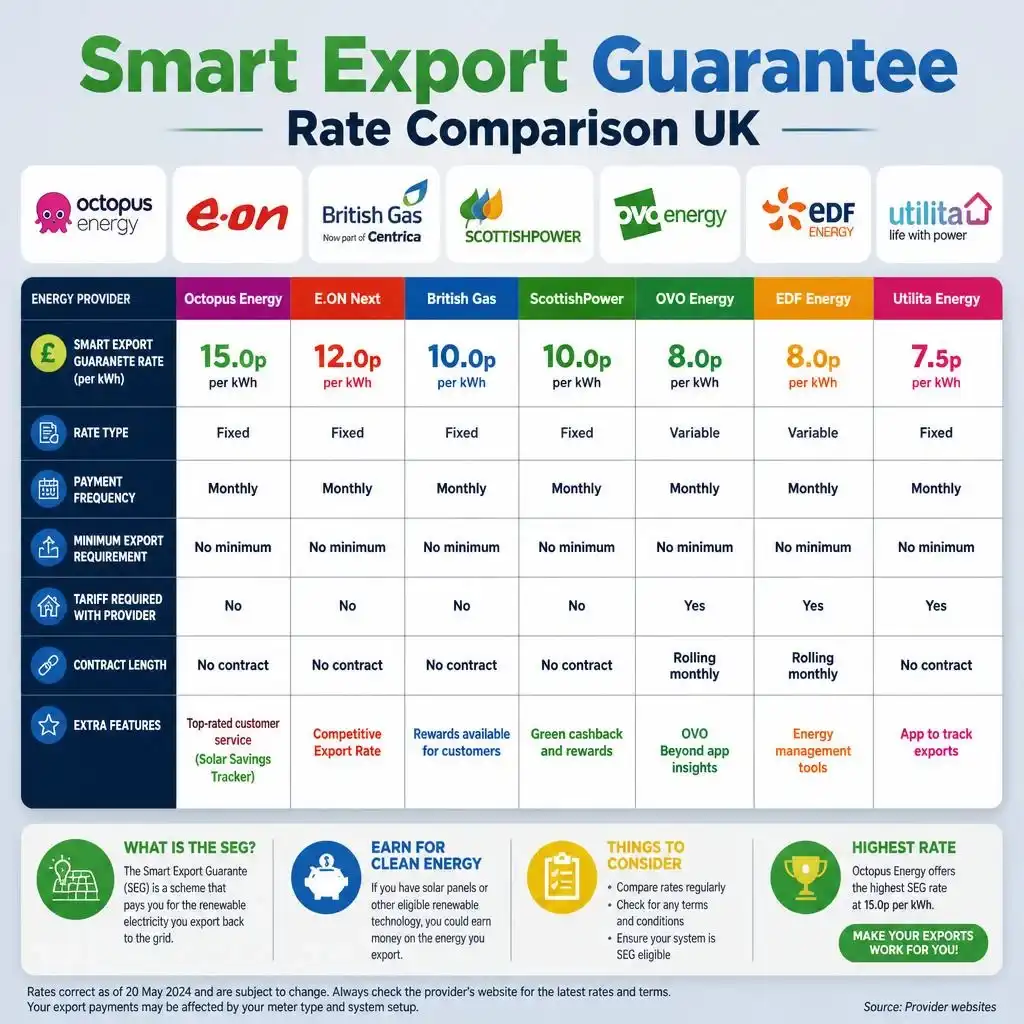
Smart Export Guarantee Rate Comparison 2026

Best SEG Rates in the UK for 2026 (And What They Actually Mean For You)
If your solar panels are still sat on whatever Smart Export Guarantee (SEG) rate your installer signed you up for a couple of years back, you’re very likely leaving money on the table. I check these tariffs regularly, and the gap between the best and worst SEG rate on the market is still huge — often six or seven times over. Below you’ll find the current rates, a free calculator so you can see what your own system could earn, and the bits nobody tells you — like which “best rate” tariffs come with strings attached.
Why your export rate matters more than ever right now
Ofgem’s price cap jumped 13% on 1 July 2026, pushing the typical dual-fuel bill up to £1,862 a year (or £1,663 under Ofgem’s newly revised usage benchmark — same unit rates, just a lower assumed usage figure). Standard variable electricity is now capped at around 26.11p per kWh. That’s the important bit: every unit you export instead of buying back later is worth more than it was twelve months ago, and a poor SEG rate stings a lot more when the alternative has just got pricier. Source: Ofgem price cap, July–September 2026.
Current SEG rates, compared
Fixed rates first — these pay the same pence-per-kWh whatever time of day you export. Variable and time-of-use tariffs are further down, since they suit a different kind of household (see below).
Fixed SEG rates side by side (p/kWh)
The gap between the top and bottom of the market is still enormous — switching from a typical unswitched rate to a top payer can be worth several hundred pounds a year.
Rates checked July 2026 — see the disclaimer above. Full breakdown of every tariff: every UK SEG tariff compared.
So what does that actually mean in pounds?
Take a typical 4kW system, exporting around 2,000 kWh a year (that’s a fairly standard export volume for a home that’s out at work during the day). Here’s what different SEG rates turn that into:
| SEG rate | Example tariff | Annual income (4kW, ~2,000 kWh exported) |
|---|---|---|
| ~3.5p/kWh | Typical unswitched rate | £70 |
| 12p/kWh | Octopus Outgoing Fixed | £240 |
| 15p/kWh | Good Energy / OVO | £300 |
| 15.1p/kWh | British Gas Export & Earn Plus | £302 |
| 24p/kWh | EDF Export Exclusive | £480 |
That’s a swing of £410 a year between the worst and best rate on this list — purely from which SEG tariff you’re on, before you’ve changed anything about your actual panels. Not sure how big a system you need in the first place? Our solar panel calculator and sizing guide can help with that.
☀️ Work out your own SEG income
Pop in your system size and export percentage below to estimate what you’d actually earn
The SEG isn’t a fringe scheme any more — here’s the official picture
Ofgem publishes an annual report on the whole scheme. The most recent one (covering April 2024 to March 2025, “SEG Year 5”) shows just how much this market has grown:
Source: Ofgem Smart Export Guarantee Annual Report, Year 5. Notice how tied tariffs (the ones needing an import contract) have pulled well ahead of untied ones — that gap is exactly why it’s worth checking whether you’re willing to switch your electricity supplier as well as your export tariff.
Fixed rate or variable? Here’s how to choose
If you don’t have a battery, this is an easy one: go fixed. Your exports happen whenever the sun’s out, which you can’t control, so a flat rate like Good Energy’s or Octopus’s usually beats a variable one — because most variable tariffs pay their best rates in the early evening, right when your panels have stopped producing much.
If you’ve got a battery with scheduled discharge (most modern batteries from GivEnergy, Tesla Powerwall, Sonnen and similar do this), variable tariffs like Octopus’s Agile or Flux products get a lot more interesting. You store your midday generation and release it during the expensive 4pm–7pm window instead, when rates can climb well above the best fixed tariffs. It takes a bit of setup, but it’s mostly “set it once and leave it”. Have a read of our best solar battery guide if you’re weighing that up.
SEG vs the old Feed-in Tariff — what’s the difference?
Still get asked this a lot, so here’s the short version:
| Feature | Smart Export Guarantee (SEG) | Feed-in Tariff (FIT) |
|---|---|---|
| Status | ✓ Open, launched January 2020 | ✗ Closed to new applicants since March 2019 |
| Pays for | Metered electricity you actually export | All electricity generated, plus an export bonus (estimated, not metered) |
| Rate guarantee | Must be above 0p, but suppliers set their own rate | Fixed rate, guaranteed by government for 20 years |
| Smart meter needed | ✓ Usually, yes | ✗ No — export was estimated instead |
| Can I have both? | No — you can’t receive FIT and SEG payments for the same installation at the same time | |
| MCS certification | ✓ Required | ✓ Was required |
Does it matter where in the UK you live?
A bit, yes — though probably less than you’d think. Here’s roughly how much a 1kWp of solar generates per year by region, which feeds directly into how much you’ll have left to export:
| Region | Approx. generation | Read more |
|---|---|---|
| Cornwall & South West | ~945 kWh per kWp/yr | Solar panels in Cornwall |
| London & South East | ~918 kWh per kWp/yr | Coastal South East guide |
| East Anglia | ~927 kWh per kWp/yr | Full solar panel guide |
| Midlands (UK average) | ~900 kWh per kWp/yr | Why Birmingham lags on solar |
| Yorkshire & the North | ~873 kWh per kWp/yr | Solar panels in Yorkshire |
| North East England | ~855 kWh per kWp/yr | Solar panels in the North East |
| North West & Manchester | ~855 kWh per kWp/yr | Do solar panels work in Manchester? |
| Wales | ~864 kWh per kWp/yr | Solar panel grants in Wales |
| Scotland | ~837 kWh per kWp/yr | Solar panel grants in Scotland |
Even Scotland only trails the sunniest parts of Cornwall by around 11% — the SEG rate you’re on usually matters far more than your postcode.
Getting set up (or switching) — what you actually need
Three things, and that’s genuinely it:
- An MCS certificate for your installation. Your installer provides this when the system’s commissioned — if you’ve got an older system without one, re-certification is usually possible.
- A smart meter capable of half-hourly export readings (SMETS2, or a compatible SMETS1). Most suppliers will swap you onto one free of charge if you don’t have one.
- An application to your chosen SEG licensee — this doesn’t have to be the company you buy your electricity from. Applications usually take 2–4 weeks, and your first payment normally lands within two billing cycles.
Not sure if your roof and system stack up in the first place? Our VAT and grant savings checker is a good next stop, and our 2026 grants guide covers what financial help is still going.


2 Comments