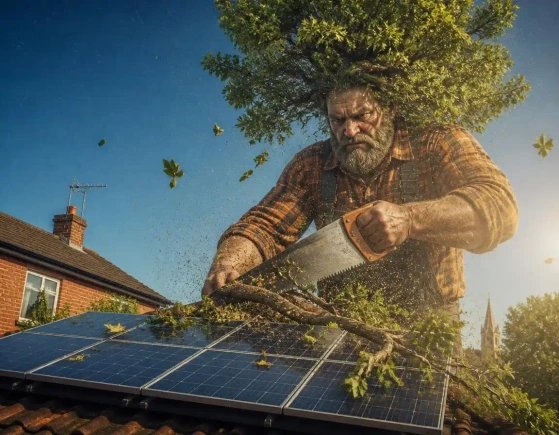
Neighbour’s Tree Blocking Your Solar Panels?

A reader emailed me last month: “Our neighbour’s conifers have grown two metres since we fitted our panels, and our winter generation is basically gone. Can we make him cut them?” I’ve spent the years since my first solar job watching this exact argument simmer on driveways across the UK. Here’s what the law actually says — and what genuinely works.

A shaded panel is the UK’s quietest solar headache — the law on it is thinner than most people expect.
⚡ The 30-second answer
There is no automatic “right to light” for solar panels in UK law. Right-to-light rules protect windows in buildings, not gardens or panels. But you’re not helpless: if the shade comes from a line of two or more trees over 2 metres tall, the high-hedges route under the Anti-social Behaviour Act 2003 can force a reduction; if it’s a new build or extension, the High Court has ruled that overshadowing your panels is a material planning consideration; and if it’s a single old tree, honest negotiation plus clever hardware (microinverters, optimisers) is usually your best play. Below, I’ll walk you through each route, what the shade is costing you in real 2026 pounds, and how to handle the neighbour bit without a feud.
☀️ What ‘Right to Light’ really means in the UK (and what it doesn’t)
Let’s bust the big myth first, because half the internet gets this wrong. The Rights of Light Act 1959 and the older prescription rules protect light coming through defined apertures in a building — essentially windows. They do not protect sunlight falling on a garden, a patio, or a solar array. As solicitors and the RHS both point out, there is no general right to light in a garden under current UK law.
So when your neighbour says “I’m allowed to grow my trees as high as I like,” they’re mostly right — with some important exceptions I’ll come to. The law basically treats sunlight over someone else’s land as a bonus, not a right you own.
What you do have:
- A right to trim branches that overhang your boundary, back to the boundary line, as long as the tree isn’t protected (more on that below).
- The high-hedges complaint route if it’s a line of two or more trees over 2m.
- Planning law, which since a 2019 High Court case treats shading of your panels as a material consideration for new development.
- Private nuisance, if leaves or roots are causing actual physical damage — blocked gutters, cracked drains — not just lost generation.
🌳 Tree or hedge? The distinction that changes everything
Here’s the fork in the road. UK law treats a single tree and a high hedge completely differently, and most shading disputes turn on which one you’ve got.
The high-hedge route (the one with teeth)
Under Part 8 of the Anti-social Behaviour Act 2003, a “high hedge” is a line of two or more trees or shrubs, over 2 metres tall, that’s badly affecting the reasonable enjoyment of your home. If your shade comes from the classic pair of neighbourly leylandii or a row of conifers, you can complain to your council — but only after genuinely trying to settle it informally first, which the GOV.UK guidance on resolving neighbour disputes over high hedges and trees is very clear about. Councils charge a fee (typically a few hundred pounds), and if they agree with you they can issue a remedial notice ordering the hedge reduced to a height worked out using the official hedge height and light-loss formula. Interestingly, you can even complain if the hedge contains protected trees — the council simply assesses it like any other case.
The single tree (the hard one)
One mature oak or sycamore casting a lovely, generation-killing shadow? No statutory shading remedy exists. Your angles are: cutting overhanging branches back to the boundary (check for a Tree Preservation Order or conservation area first — those make cutting an offence); reporting a dangerous or diseased tree to the council’s tree officer; and nuisance claims if debris is causing provable damage. Annoying, I know — but knowing this saves you a solicitor’s letter you can’t win.
⚖️ Planning law: your biggest stick (the 2019 case that changed things)
If the threat is a new extension or building rather than a growing tree, you’re on much stronger ground. In McLennan v Medway Council [2019] EWHC 1738 (Admin), the High Court quashed a planning permission for a house extension because the council had failed to treat the overshadowing of the neighbour’s solar panels as a material consideration. The judge’s reasoning is worth quoting in any objection you write: no matter how small one property’s panels contribute to renewable energy, that contribution is not immaterial — climate change is a legitimate planning issue.
Practically, that means:
- When a neighbour submits plans that would shade your array, object in writing during consultation, citing the case and attaching evidence — your monitoring app’s generation data beats adjectives every time. (Here’s my roundup of the best solar monitoring apps to pull that data from.)
- Developers in London and beyond now increasingly run daylight-and-sunlight assessments that include existing PV, because shading liability is an emerging risk for them.
- The honest caveat: some overshadowing — particularly loft conversions — arrives via permitted development, so there’s no application to object to. The Greater London Authority has openly acknowledged this gap. In those cases, the tech fixes in the next-but-one section become your plan A.
If you’re the one adding panels and worrying about objections, my guide to solar panel planning permission covers where you stand.
📜 The 20-year ‘prescription’ angle — tempting, but untested
You’ll read online that solar panels could acquire a private easement of light after 20 years of uninterrupted sunlight, by analogy with windows under the Prescription Act 1832. Some legal commentators think that argument is genuinely arguable; no reported case has yet established it. And remember the trap: a neighbour can interrupt your 20-year clock by registering a light obstruction notice. My advice: treat prescription as a debating point, not a plan. The first three routes are the ones that actually resolve disputes.
📉 What the shade is really costing you in 2026
Shade is cruel to solar in a non-linear way. Because cells are wired in series, shading a sliver of one panel can drag the whole string down — industry figures suggest shading as little as 5–10% of a panel’s surface can cost that string 30–40% of its output on a string inverter. That’s the physics behind “my panels are fine but my winter is dead”.
Let me put pounds on it. Take a typical 4kWp UK system producing roughly 3,500 kWh a year, and value each kWh at a blended ~20.5p — half saved against the 26.11p/kWh price cap (from 1 July 2026), half exported at around 15p on a tariff like Outgoing Octopus. (Both figures match my site’s live tariff data.)
| Shade severity | Energy lost / yr | Cost / yr | Over 25 yrs (no price rises) |
|---|---|---|---|
| Light — 10% of output | ~350 kWh | ~£72 | ~£1,794 |
| Moderate — 25% | ~875 kWh | ~£179 | ~£4,484 |
| Severe — 50% (tall evergreens) | ~1,750 kWh | ~£359 | ~£8,969 |
💸 Annual loss by shade severity (4kWp example)
SolarBriton worked example, August 2026. Winter matters most: low sun angles mean long shadows exactly when every kilowatt-hour counts — see my piece on solar in winter.
🌅 A day of shade: why morning and evening hurt most
Stylised diagram: long low-angle shadows at the day’s edges are exactly when a tall tree eats your generation.
🔌 Tech fixes to try before any lawyers (usually cheaper than the argument)
In my experience, most tree-shade disputes are won or lost on hardware, not law. In rough order of value:
Microinverters or optimisers
They decouple each panel, so a shaded panel stops dragging its neighbours down. My plain-English comparison of microinverters vs string inverters explains when each wins.
Prove the loss with data
Two weeks of monitoring exports vs a sunny neighbour’s system turns “I think we’re losing out” into a number you can show a neighbour, a council, or a planner.
Re-home or re-string the array
Splitting panels across roof faces, or moving the shaded panel to its own string, can recover most of the loss. Useful if you’re also weighing up what size system you need.
Keep the glass clean
Leaf litter and blossom compound shade losses. My step-by-step cleaning guide covers it safely.
And if your roof is genuinely tricky — north-facing, chimneys, that one stubborn sycamore — don’t assume solar is dead. My guides on north-facing roofs and solar in cloudy UK weather show how much diffuse light is still on the table.
🤝 The neighbour conversation (a script that doesn’t end in a feud)
Twenty years in this industry and I’ll tell you the secret: most hedge disputes end with a crown-lift and a shared cuppa, not a remedial notice. A professional crown lift or side prune — which keeps the tree healthy and your neighbour’s privacy — often costs a few hundred pounds, a fraction of what the shade steals from you. My suggested ladder:
Friendly chat + data
Show the generation graph, not a grievance. “We’re losing about £X a year” lands better than “your tree is out of order.”
Offer to fund the prune
Propose paying for (or splitting) a one-off crown lift, with the cuttings removed. It’s usually cheaper than five years of lost generation.
Put it in writing, politely
A short dated letter summarising what you agreed — or, if refused, that you tried. Councils want to see this paper trail before they’ll touch a high-hedge complaint.
Mediation, then formal routes
Citizens Advice can point you to local mediation. Only then escalate to the council’s high-hedge process or a planning objection.
🧭 Which route applies to you? The cheat-sheet
| Your situation | Realistic route | Strength |
|---|---|---|
| Row of 2+ trees, over 2m, shading home/panels | High-hedge complaint to council (Anti-social Behaviour Act 2003, Part 8) | Strong — can end in a remedial notice |
| New extension/building would shade panels | Planning objection citing McLennan v Medway [2019] EWHC 1738 | Strong — material consideration |
| Single unprotected tree, branches overhang your land | Trim to boundary (check TPO/conservation area first) | Medium — helps edge shade only |
| Single protected (TPO) tree | Urge council tree officer; owner needs consent for works | Weak–medium |
| Dangerous/diseased tree | Report to council — separate from shade issue | Strong on safety, not shade |
| Loft conversion via permitted development | No planning hook — tech fixes + negotiation | Weak legally, fixable technically |
| Leaves blocking gutters / roots damaging drains | Private nuisance claim (needs provable damage) | Medium |
Before you buy a system on a shaded plot, do the boring things: check the council’s TPO map, run a shading survey, and read my payback period guide — shade is the single biggest silent extender of payback. (And if you’re curious how your postcode stacks up for sun, my sunniest vs least sunny postcodes piece is a fun reality check.)
🧭 My honest verdict
The ‘right to light’ headline is mostly a myth for solar — but the law isn’t empty either. High hedges give you a real statutory stick, planning law gives you a real objection, and McLennan gives you a real precedent to quote. For the classic single-tree grumble, skip the solicitor: bring data, offer a crown lift, and put microinverters or optimisers on the quote. The cheapest kilowatt-hour is still the one your panels make in peace — and a five-minute conversation usually protects more of them than a five-year dispute.
❓ Frequently asked questions
Do I have a legal right to sunlight for my solar panels in the UK?
Can I force my neighbour to cut a tree that shades my solar panels?
How much power do solar panels lose from tree shade?
Fact-checked August 2026. Legal position summarised from the Anti-social Behaviour Act 2003 (Part 8), Rights of Light Act 1959, McLennan v Medway Council [2019] EWHC 1738 (Admin), and GOV.UK high-hedges guidance. Money example uses the Ofgem price cap of 26.11p/kWh (from 1 July 2026) and a 15p/kWh export rate; figures are illustrative, not legal advice — for live disputes use Citizens Advice or a solicitor. 0% VAT on qualifying home energy installations runs until 31 March 2027.

One Comment