China’s Solar Supply Chain and Forced-Labour

Supply chain & ethics · 2026
China’s Solar Supply Chain and Forced-Labour Import Concerns
This isn’t a comfortable subject, but it’s one more UK buyers are asking about, so it deserves a straight answer. Here’s what independently published research has actually found, what the UK government is doing about it right now, and what you can realistically check before you commit to a system.
Independent research, most notably from the UK’s own Sheffield Hallam University, has documented forced labour risks connected to Uyghur and other Turkic Muslim populations in Xinjiang’s polysilicon industry, which supplies close to half the raw material behind most solar panels sold worldwide. The Chinese government firmly denies these claims. The US has banned related imports outright since 2022, the EU’s ban takes full effect in December 2027, and the UK currently relies on due diligence rules rather than an outright import ban, though that’s shifting following a 2025 government U-turn on Great British Energy’s own sourcing rules. For everyday buyers, the practical fix is traceability certification, and it’s something you can actually ask your installer about.
Why does this keep coming up specifically about solar panels?
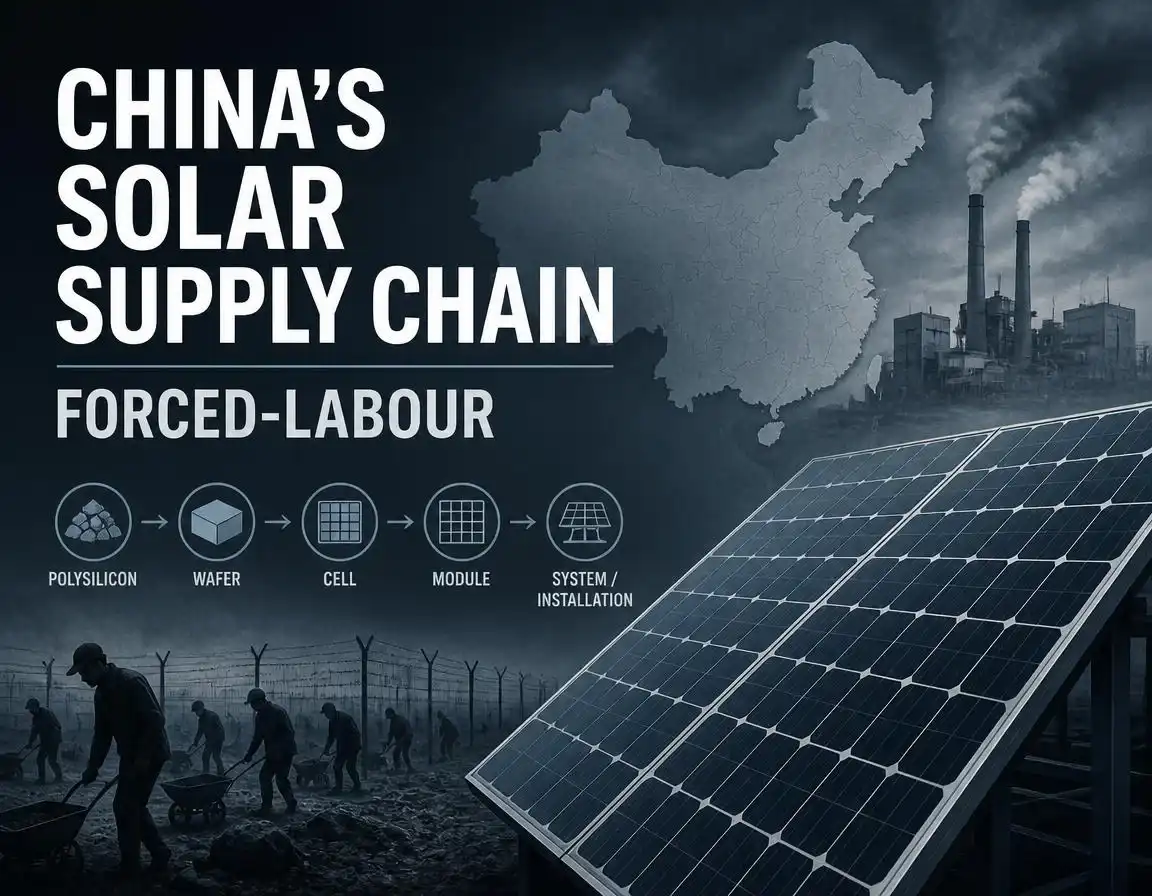
It comes down to one material: polysilicon. It’s the core ingredient in around 95% of the solar panels sold today, and its production is heavily concentrated in one place. China produces roughly half the world’s polysilicon supply, and within China, the Xinjiang Uyghur Autonomous Region alone accounts for an estimated 42-45% of the global total. That’s an unusually high level of concentration for any single raw material behind a mainstream consumer product, which is exactly what’s made it such a focus for researchers and policymakers.
What did the research actually find?
The most cited investigation is “In Broad Daylight,” published in 2021 by researchers Laura Murphy and Nyrola Elimä at Sheffield Hallam University’s Helena Kennedy Centre for International Justice, right here in the UK. It concluded that major Chinese producers of raw polysilicon, ingots and wafers were operating facilities in Xinjiang linked to state-run “labour transfer” schemes, and that this had knock-on effects for solar module makers and buyers further down the supply chain. Later research, including a 2023 report from the Breakthrough Institute drawing on over 200 government documents and academic sources, reached similar conclusions and named specific manufacturers it said were involved.
It’s only fair to note the other side clearly: the Chinese government has consistently and firmly denied these findings, with its Foreign Ministry describing forced labour allegations in Xinjiang as fabricated and accusing Western governments of “weaponising” trade policy. Individual companies named in various reports, including Daqo New Energy, have also publicly denied employing Uyghur workers or using labour-transfer schemes. This remains a genuinely disputed issue between governments, even as the underlying research findings themselves are treated as credible enough to have shaped legislation in the US, EU and UK.
What’s the UK actually doing about it?
This has moved a fair bit in the last two years, and it’s still moving. Here’s the timeline as it stands.
A few specific developments are worth knowing about directly. The Great British Energy Act 2025 is the clearest example: the government initially rejected an amendment barring the state-owned energy company from sourcing solar panels linked to forced labour, then reversed course within days after criticism from campaigners and its own backbenchers, bringing forward its own version of the clause. Separately, a 2025 Court of Appeal ruling opened up the possibility of prosecuting companies under the Proceeds of Crime Act if they knowingly import goods linked to forced labour, which is a notably sharper tool than the reporting-only requirements of the Modern Slavery Act 2015. The government’s own Solar Roadmap dedicates a section to the issue and points to a relaunched Solar Taskforce tasked with building supply chains that are “resilient, sustainable and free from forced labour.”
Worth being realistic about: commitments and implementation aren’t the same thing. Great British Energy pledged a forced-labour-free supply chain by spring 2025, but a widely reported Politico investigation found that five out of seven solar contracts it had issued for schools at that point couldn’t fully guarantee this. It’s a genuine work in progress, not a solved problem.
How the UK compares to the US and EU
| Jurisdiction | Main tool | How it works | Status |
|---|---|---|---|
| United States | Uyghur Forced Labor Prevention Act (UFLPA) | Presumes goods from Xinjiang are made with forced labour unless the importer proves otherwise; goods can be seized | In force since June 2022; billions of dollars in shipments reviewed, including numerous solar consignments |
| European Union | Forced Labour Regulation (EU) 2024/3015 | Bans products made with forced labour from entering or being sold in the EU, from any country or sector | In force Dec 2024, fully enforceable from December 2027 |
| United Kingdom | Modern Slavery Act 2015 + Procurement Act 2023 + GB Energy Act 2025 | Requires due diligence reporting from large firms; blocks forced labour specifically within GB Energy’s own supply chain; no general import ban yet | In force, but parliamentary committees say it doesn’t go as far as the US or EU approach |
So how do you actually check if your panels are “clean”?
This is genuinely the most useful part for anyone about to buy. The solar industry has built an independent traceability scheme specifically to answer this question: the Solar Stewardship Initiative (SSI). Its Supply Chain Traceability Standard, verified by independent auditors like TÜV Rheinland, tracks materials from the quartz mine through to the finished module, and certified sites can’t mix certified and non-certified material without losing the certification. It’s not a perfect guarantee, but it’s currently the clearest independent verification available.
Brands worth knowing: several major manufacturers have already secured SSI certification at specific factory sites, including Trina Solar, Jinko Solar, Canadian Solar and LONGi. Certification applies at site level, not company-wide, so the specific factory matters, not just the brand name on the panel.
- 1
Ask your installer for the exact panel model and manufacturing site, not just the brand name.
- 2
Check whether that specific site holds SSI ESG or Supply Chain Traceability certification.
- 3
If you’re comparing panel technology as well as sourcing, our N-Type TOPCon vs P-Type PERC guide and Jinko vs JA Solar vs Trina Solar comparison cover the leading brands in more depth.
- 4
Ask whether your installer is MCS certified and what due diligence process they follow for panel sourcing.
- 5
Treat vague reassurances with a healthy amount of scepticism, and ask for it in writing where possible.
You can read the UK government’s own position in full on the Solar Roadmap on GOV.UK, and follow ongoing parliamentary scrutiny of this issue via Hansard, the official record of UK Parliament.
Quick questions, straight answers
Not in the same direct way as the United States. The UK relies mainly on the Modern Slavery Act 2015, which requires large businesses to report on due diligence rather than banning specific imports outright. Following a government U-turn in April 2025, the Great British Energy Act 2025 does commit the state-owned energy company to keeping forced labour out of its own supply chains, and a 2025 Court of Appeal ruling opened the door to prosecuting companies that knowingly import goods linked to forced labour under the Proceeds of Crime Act. A parliamentary Joint Committee on Human Rights has said current measures, including the Solar Roadmap, are not yet sufficient.
UK customs and HMRC data cited in Parliament put it at over 40% of solar photovoltaic equipment, with some parliamentary debate figures citing as high as 68% for panels specifically. China also produces roughly half the world’s polysilicon, the core raw material in most solar panels, with an estimated 42-45% of global supply coming specifically from the Xinjiang region.
Ask your installer directly which panel brand and manufacturing site you’ll be getting, then check whether that site holds certification under the Solar Stewardship Initiative’s ESG and Supply Chain Traceability Standards, an independent scheme audited by third parties like TÜV Rheinland. Several major manufacturers, including Trina Solar, Jinko Solar, Canadian Solar and LONGi, have already achieved certification at specific factory sites. No certification scheme can guarantee 100% elimination of risk, but it is currently the clearest independent verification available to everyday buyers.
The short version: this is a real, well-documented concern that UK policy is still catching up on, not a solved problem and not a reason to write off solar entirely. The practical move is the same one that applies to most ethical sourcing questions: ask specific questions, ask for the specific factory site, and check it against independent certification rather than taking a brand name’s word for it.

One Comment