
Solar Panels for Landlords

Landlord compliance · Updated July 2026
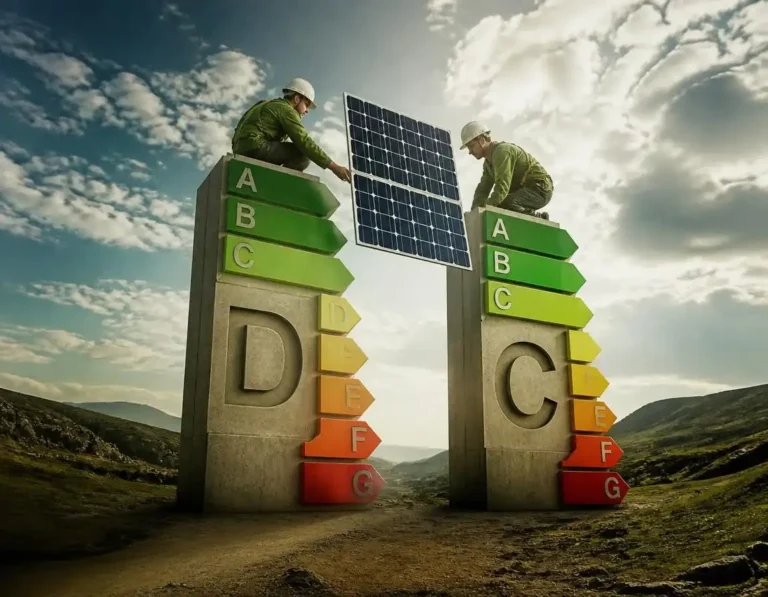
Solar Panels for Landlords: Your Complete Guide to EPC C by 2030
On 21 January 2026, the government finally confirmed it: every privately rented home in England and Wales needs to hit EPC C, or a valid exemption, by 1 October 2030. Here’s exactly where solar panels fit in, what the new rules really cost, and what to do about it this year.
 ·
11 min read
·
Reviewed against the January 2026 Warm Homes Plan
·
11 min read
·
Reviewed against the January 2026 Warm Homes Plan
I’ve had more calls about EPC C this year than about anything else — and in my line of work, that’s saying something. Landlords have been living with a moving target for years: first it was 2025, then a phased 2028-and-2030 split, then that got dropped too. So when the Warm Homes Plan landed in January, a lot of my clients just wanted a straight answer: what’s actually changed, and does solar get me there?
Short version: sometimes, yes — but not on its own, and not for every property. This guide walks through exactly what the new rules say, where solar panels genuinely help, what they don’t fix, and what it’s realistically going to cost you in 2026. No fluff, no scare tactics, just the numbers.
What actually changed on 21 January 2026
For years, landlords have been working off proposals rather than rules. First it was EPC C by 2025. Then a phased approach — new tenancies by 2028, everyone else by 2030. Then the 2028 date for new tenancies quietly got dropped.
The Warm Homes Plan, published on 21 January 2026 as part of a wider £15 billion package, finally settled it. There’s now one compliance deadline: 1 October 2030, for every private tenancy in England and Wales, new or existing. The government’s full response to its 2025 consultation sets out exactly how this will work in practice, and if you own more than one rental property, it’s genuinely worth ten minutes of your time — you can read the full government response on GOV.UK.
A few things worth flagging straight away, because they trip people up:
- This is England and Wales only. Scotland is running its own timetable, based on a new Heat Retention Rating rather than EPC bands. Northern Ireland isn’t covered by this policy at all.
- Grandparenting applies. If your EPC already shows a C or better, and it was issued before 1 October 2029, you’re treated as compliant until that certificate naturally expires. There’s nothing to do early.
- Spending is backdated. Qualifying improvements made since 1 October 2025 count towards your cost cap, even though the deadline itself is years away. Keep every invoice.
Here’s how the next four years actually break down:
Dates reflect the government response published 21 January 2026. The October 2026 EPC launch is described by government itself as an “ambitious” timeline, so treat it as a target rather than a certainty.
The four new EPC metrics (and why solar only ticks one box)
Here’s the part that trips up most landlords I speak to. EPC C isn’t going to be measured the old way.
Right now, your EPC gives you a single score. Under the reformed system — built on a new calculation method called the Home Energy Model, replacing the old RdSAP approach — that one score splits into four separate metrics: energy cost, fabric performance, heating system, and smart readiness.
You don’t need to pass all four. The actual rule is more workable than it sounds: you must hit the fabric performance standard first — that’s insulation, glazing and draught-proofing, essentially the bones of the building — and once you’ve passed that, you choose whether to top it up via the heating system route (a heat pump, broadly) or the smart readiness route (solar panels, battery storage, smart controls).
That’s the single most useful thing to take from this whole article: solar helps with smart readiness, not fabric performance. If damp walls, a draughty loft or single glazing are what’s dragging your rating down, solar alone won’t fix it. If your fabric is already reasonable and it’s your heating and controls holding you back, solar could be exactly the shortcut you need.
Simplified from the government’s dual-metric compliance model. Solar panels satisfy the smart readiness route only — they don’t substitute for fabric performance.
The £10,000 cost cap, properly explained
Cost is the next obvious question, and there’s genuinely good news here: the cap has come down from what was first proposed.
Landlords need to spend up to £10,000 per property over a 10-year period to reach the standard. That’s well below the £15,000 floated during consultation, and the government’s own impact assessment reckons the average landlord will spend closer to £5,400 once you exclude the worst-case properties.
Three details that actually matter:
- Spend the full £10,000 and still short of EPC C? You can register a 10-year exemption and keep letting the property as-is.
- There’s a lower cap for cheaper properties — if £10,000 would represent 10% or more of your property’s value, the cap is reduced to match (the “Property Value Adjustment”).
- Anything spent since 1 October 2025 counts towards the £10,000, even though the deadline itself doesn’t bite until 2030.
Where do solar panels actually fit in?
Assuming your fabric performance is sorted, or close to it — what does solar actually buy you?
Government analysis puts the typical uplift from a well-sized solar PV system at 5 to 15 EPC points, which is often enough on its own to lift a property a full band — from D to C, say. It’s not a guaranteed fix for every home, but for a large chunk of UK rental stock, it’s one of the more cost-effective ways into the smart readiness column.
Here’s how solar stacks up against the other options landlords are weighing right now:
| Measure | Typical cost (2026) | Route it satisfies | What it actually does |
|---|---|---|---|
| Loft insulation top-up | £300–£600 | Fabric | Cuts heat loss through the roof |
| Cavity wall insulation | £500–£1,500 | Fabric | Cuts heat loss through solid or cavity walls |
| Double glazing (from single) | £3,000–£7,000+ | Fabric | Reduces draughts and window heat loss |
| Air source heat pump | £7,000–£13,000 (before BUS grant) | Heating | Replaces gas boiler with efficient electric heat |
| Solar PV, 3–4kWp | ~£5,500–£7,000 (0% VAT) | Smart | Generates your own electricity, cuts tenant or void-period bills |
| Solar PV + battery | ~£9,500–£11,000 (0% VAT) | Smart | Stores surplus for evening use, stronger smart readiness uplift |
Cost ranges reflect typical UK installed prices in 2026 and match our wider solar panel cost breakdown. Actual EPC point uplift depends on roof orientation, system size and your property’s existing rating.
Worth saying plainly: if you’ve got a solid-wall Victorian terrace with single glazing, no amount of solar is going to get you to fabric performance standard on its own — you’ll likely need insulation first, with solar as the finishing touch. If you’re already double-glazed and reasonably insulated, solar might genuinely be the only extra step you need. Run your own numbers through our solar panel calculator before committing to a system size.
Paying for it: what’s available to landlords in 2026
You don’t have to fund all of this from your own pocket, and a few of the current schemes genuinely stack together.
- 0% VAT. Since April 2022, residential solar, battery and heat pump installations across Great Britain have carried 0% VAT rather than the standard rate — a saving of up to £2,850 on a typical system. This applies whether you live in the property or let it out, and it’s due to end on 31 March 2027, so there’s a real reason to move before then.
- The Boiler Upgrade Scheme. If you’re going the heating system route instead of, or alongside, solar, the BUS grant currently offers £7,500 towards an air source heat pump, or £5,000 for a biomass boiler. Landlords in England and Wales remain eligible.
- The Warm Homes Plan loan offer. Once fully running — expected from 2027 — this will provide 0% interest loans covering the upfront cost of solar and battery installations, open to all homeowners including landlords, regardless of income.
- ECO4 has ended. If you were banking on ECO funding for a lower-income tenant’s property, that scheme closed in March 2026. Its replacement is being folded into the wider Warm Homes Plan, but landlord-specific detail is still emerging — check GOV.UK rather than assuming last year’s rules still apply.
On tax: whether HMRC treats this spending as an immediately deductible expense or as capital expenditure you can only offset when you sell genuinely depends on your circumstances. This isn’t tax advice — speak to an accountant before assuming either way.
If upfront cost is the real blocker, our guide to solar panels with no upfront cost walks through every finance route in more detail, and our grant and VAT savings checker takes two minutes to tell you what you personally qualify for right now.
Your 2026 landlord action checklist
- 1Check your current EPC rating and its issue date. C or above, dated before October 2029? You can relax for now.
- 2D or below? Plan to get a fresh assessment against the new metrics once they launch, expected from October 2026, so you know exactly what fabric performance requires of your property.
- 3Use the free VAT & grant checker to see what you qualify for before speaking to anyone selling you a system.
- 4Get quotes from at least two MCS-certified installers before committing — start with our Find an Installer page.
- 5Keep every invoice from October 2025 onwards. It all counts towards your £10,000 cost cap.
- 6Adding solar? Check your landlord insurance covers the new asset — see our solar panel insurance guide.
- 7Factor in export income when weighing the numbers. Our SEG income estimator shows what a typical system earns on top of bill savings.
A quick honest note before you go: this article covers domestic private rented properties in England and Wales. Commercial landlords face a separate, and as of writing less firmly confirmed, expectation of EPC B by 2030 — a different conversation for another day. And none of this is financial, legal or tax advice; it’s a plain-English summary of a genuinely complicated policy area, and your own circumstances might change the answer. When in doubt, check GOV.UK directly or speak to a qualified adviser.