
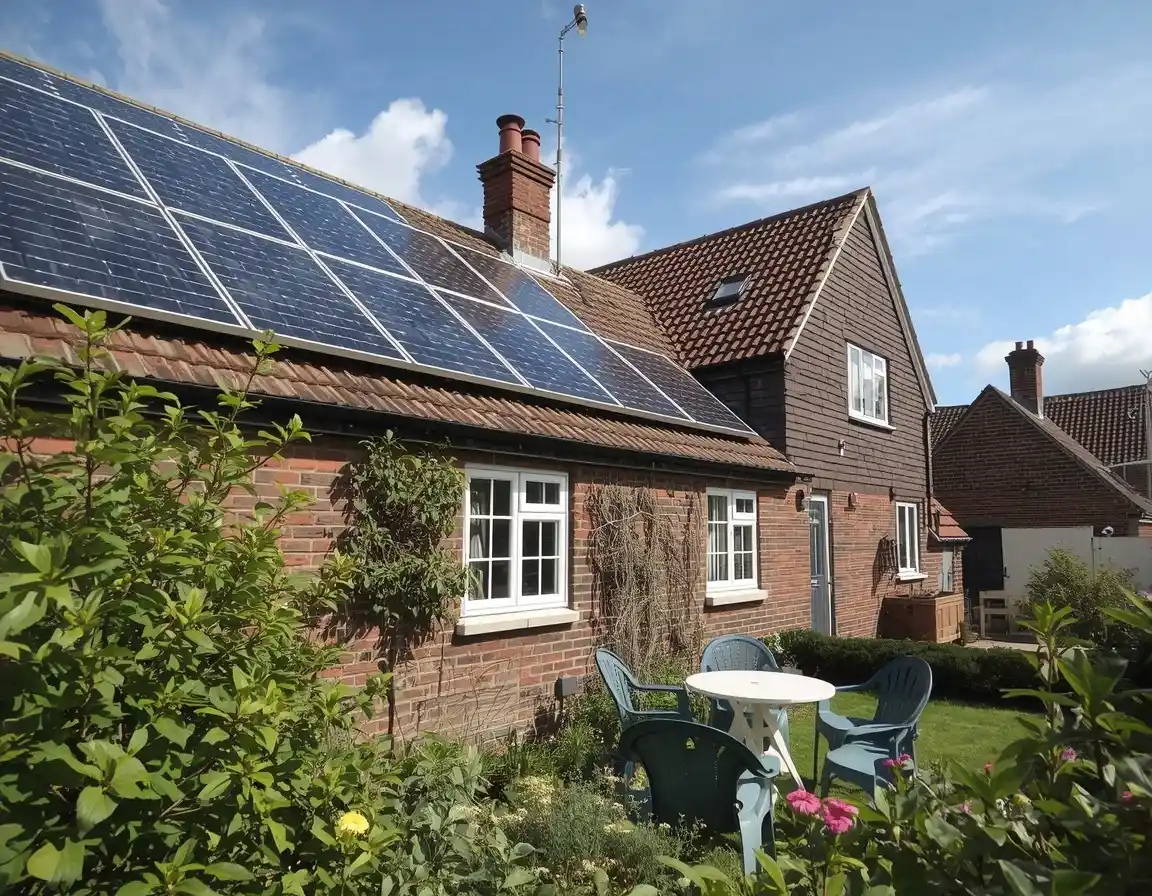
Solar panels for holiday lets & Airbnb UK

Whether it’s a coastal cottage, a converted barn, or a spare-room Airbnb, solar works differently for a property that sits empty half the time. Here’s what’s actually true in 2026 — the tax perk that’s gone, the VAT relief that mostly isn’t, and the export income trick most owners never think about.
Let’s Deal With the Tax Question First
For years, a furnished holiday let (FHL) was treated more like a trading business than an ordinary rental for tax purposes — which meant owners could claim capital allowances on kit like furniture, fittings, and yes, solar panels, on top of normal running costs. That’s what made solar such an easy sell for holiday-let owners: the panels effectively paid part of themselves back through the tax return.
That perk is gone. The FHL tax regime was abolished from 6 April 2025 for Income Tax and Capital Gains Tax (1 April 2025 for companies), confirmed in HMRC’s own policy paper. From that date, income from a holiday let is taxed exactly the same as any other residential letting — no matter how business-like your booking calendar looks.
| What changed | Before 6 April 2025 | Now |
|---|---|---|
| Capital allowances on new solar/battery kit | Could be claimed | No longer available |
| Mortgage interest relief | Deducted in full | Restricted to basic-rate credit, like any landlord |
| Sale of the property (CGT relief) | Business Asset Disposal Relief available | Taxed as an ordinary residential sale |
| Counts toward pension relief | Yes, as relevant earnings | No longer counted |
If you already had a capital allowances pool running before the cut-off, transitional rules protect that existing claim — but anything installed from April 2025 onwards can only go through as a normal running cost, not a capital deduction. It’s worth flagging to your accountant either way, since the rules around what still qualifies as an allowable expense on an ordinary letting business aren’t quite the same as the old FHL rules were.
Straight from the source: HMRC’s policy paper on this exact change is worth five minutes if you want the full detail — see GOV.UK: Abolition of the furnished holiday lettings tax regime.
One thing that trips people up: the old FHL qualifying test (available 210 days, actually let 105 days a year) no longer has any tax relevance at all — it’s gone along with the regime. Don’t confuse it with the completely separate business-rates test further down this page, which still very much applies and uses different numbers.
So What About the Famous 0% VAT?
Here’s the bit that actually is still good news, and it’s easy to muddle up with the tax relief question above — they’re not the same rule at all.
The 0% VAT rate on solar panels and battery storage (VAT Notice 708/6) is due to run until 31 March 2027, then step up to 5% rather than jumping straight to the full 20%. Whether you get it has nothing to do with how your holiday let is taxed — it comes down to whether the property itself counts as residential accommodation, and self-catering holiday accommodation used as somewhere guests actually live for their stay generally qualifies, same as an ordinary rental home.
- Governs VAT on what your guests pay you
- Holiday accommodation is standard-rated (20%) if you’re VAT-registered
- Has nothing to do with your solar installer’s invoice
- Governs VAT on energy-saving materials at the property
- 0% until 31 March 2027 for qualifying residential accommodation
- This is the one that decides your panel and battery invoice
Get it in writing. If your place edges closer to serviced accommodation — daily housekeeping, turndown, reception-style extras — it can start to look more like a hotel for VAT purposes, which sits outside this relief. A good VAT-registered installer will want written confirmation of your property’s status before zero-rating the invoice, because it’s their liability if HMRC later disagrees, not just yours.
Read the two notices side by side on GOV.UK: VAT Notice 708/6 (energy-saving materials) and VAT Notice 709/3 (hotels and holiday accommodation).
The Bit Nobody Talks About: SEG Income While Nobody’s Staying
This is genuinely the most useful thing to understand if you’re weighing up solar for a holiday let, and it barely gets a mention anywhere else.
The Smart Export Guarantee (SEG) pays you per kWh for whatever your panels generate that you don’t use yourself — set up once through an MCS-certified installer and a licensed supplier, and it runs regardless of who’s staying, or whether anyone is. In an ordinary occupied home, a fair chunk of what the panels make gets used on the spot — the fridge, the kettle, the telly — so only the surplus gets exported. In an empty holiday cottage between bookings, there’s almost nothing drawing power beyond the fridge-freezer ticking over and the wifi router. Nearly everything the panels generate on a sunny void week has nowhere to go but out to the grid.
Practically, this flips the way you think about your quiet weeks. The between-guest days and off-season stretches that once felt like pure downtime become your best-value generating days, because there’s barely any competing demand at the property. During a guest stay, export share often drops below a normal home’s, since visitors tend to run the hot tub, extra showers, tumble dryer and lights more freely than you would — swings and roundabouts, and no different in principle to how export ratios move for any home.
SEG is regulated at GOV.UK level: GOV.UK: Smart Export Guarantee (SEG) — worth a read for eligibility and how registration works, alongside SolarBriton’s own SEG Income Estimator for putting numbers to your own system size, and our SEG tariff comparison if you want to shop around suppliers once it’s registered.
Setting It Up: What’s Actually Different for a Holiday Let
The install itself works the same way as any home. What’s different is the handful of things that matter more when nobody’s around most of the time.
- 1
Remote monitoring earns its keep here
Most nights, nobody’s there to spot a tripped inverter, a fault, or a bird’s nest quietly cutting output for six weeks straight. Proper app-based monitoring — not just a wall display nobody will ever look at — is genuinely worth paying for on a property you don’t visit often. Our guide to solar panel monitoring in the UK covers what’s available and roughly what it costs.
- 2
Check the mobile signal before you assume the meter will “phone home”
SEG relies on your export meter reporting readings, usually over mobile signal or broadband. Classic remote holiday-cottage spots — coastal coves, Highland glens, hill farms — can have patchy 4G. Worth checking before you commit to a system that assumes good connectivity.
- 3
Battery storage: think twice, not automatic yes
Batteries earn their keep by shifting your own daytime generation into evening use — strong logic for a family home, weaker for a holiday let, where empty weeks are usually better served by exporting everything through SEG rather than storing it for nobody. It still makes sense with a genuinely weak grid connection or consistently high occupancy. See our pick of the best solar batteries or our guide to off-grid solar systems if the cottage is genuinely remote.
- 4
Planning permission needs a closer look on period and rural properties
Most roof-mounted solar counts as permitted development with no application needed — but listed buildings always need Listed Building Consent, and in National Parks, AONBs, conservation areas and World Heritage Sites, panels visible from the road or a public viewpoint may need permission even when the same panels round the back wouldn’t. A quick call to the council’s conservation officer before you fix a mounting plan saves a lot of grief.
- 5
Tell your lender and your insurer
A specialist holiday-let mortgage lender may want notice of a solar installation, and holiday-let insurance is usually a different policy to standard home cover — get it updated to reflect the new kit on the roof, and check the installer’s own warranty position via our guide to what a solar panel warranty actually covers.
- 6
Get a proper MCS-certified quote for the actual property
Holiday cottages vary hugely in size and roof shape — there’s no substitute for a site visit. Our installer finder and typical 3-bedroom house sizing guide are a reasonable starting point for what a similarly sized cottage might need.
The Other 2026 Change Worth Knowing: Business Rates, Not Just Tax
While you’re sorting the solar side, it’s worth having this on your radar too, since it’s easy to confuse with the FHL tax test that no longer exists.
Whether your holiday let pays business rates or council tax is a completely separate, still-live test. In England, a property qualifies for business rates if it’s available for letting for at least 140 days a year and actually let for at least 70 days (Wales uses higher thresholds — 252 days available, 182 actually let). Miss the threshold and you’re back on council tax, often with the second-home premium of up to 100% that many councils now apply. Many small cottages that do qualify pay nothing at all, thanks to Small Business Rate Relief giving 100% relief on a rateable value under £12,000.
There’s also a national short-term let registration scheme expected to launch in England during 2026 — not yet live at the time of writing, but worth keeping half an eye on alongside any planning or rates conversation you’re already having with the council over solar.
A Rough Worked Example
Purely illustrative — get an actual survey before you take any of this as a quote — but it helps to see the shape of the numbers for a typical UK holiday cottage.
| Item | Illustrative figure | Notes |
|---|---|---|
| Property | 3-bed coastal cottage | Booked roughly 26 weeks a year, empty or off-season the rest |
| System size | ~4kWp | Broadly comparable to a similarly sized family home |
| VAT treatment | 0%, if confirmed with installer | Under VAT Notice 708/6 — see caveat above |
| Tax relief on the install | None (capital allowances) | FHL regime abolished April 2025 |
| SEG income, occupied weeks | Broadly comparable to a family home | Guest usage often runs higher than a typical household |
| SEG income, empty/off-season weeks | Noticeably higher export share | Minimal background consumption at the property |
The Honest Summary
- The old tax perk (capital allowances on solar) is gone from April 2025 — don’t plan around it.
- The 0% VAT relief is a different, still-live rule, and generally still applies — but get it confirmed in writing.
- Your empty weeks aren’t wasted — they’re often your best export-earning days through SEG.
- Remote monitoring and a signal check matter more here than for almost any other type of home.
- Battery storage isn’t an automatic add-on for a property that’s empty half the year — weigh it up properly.





3 Comments