
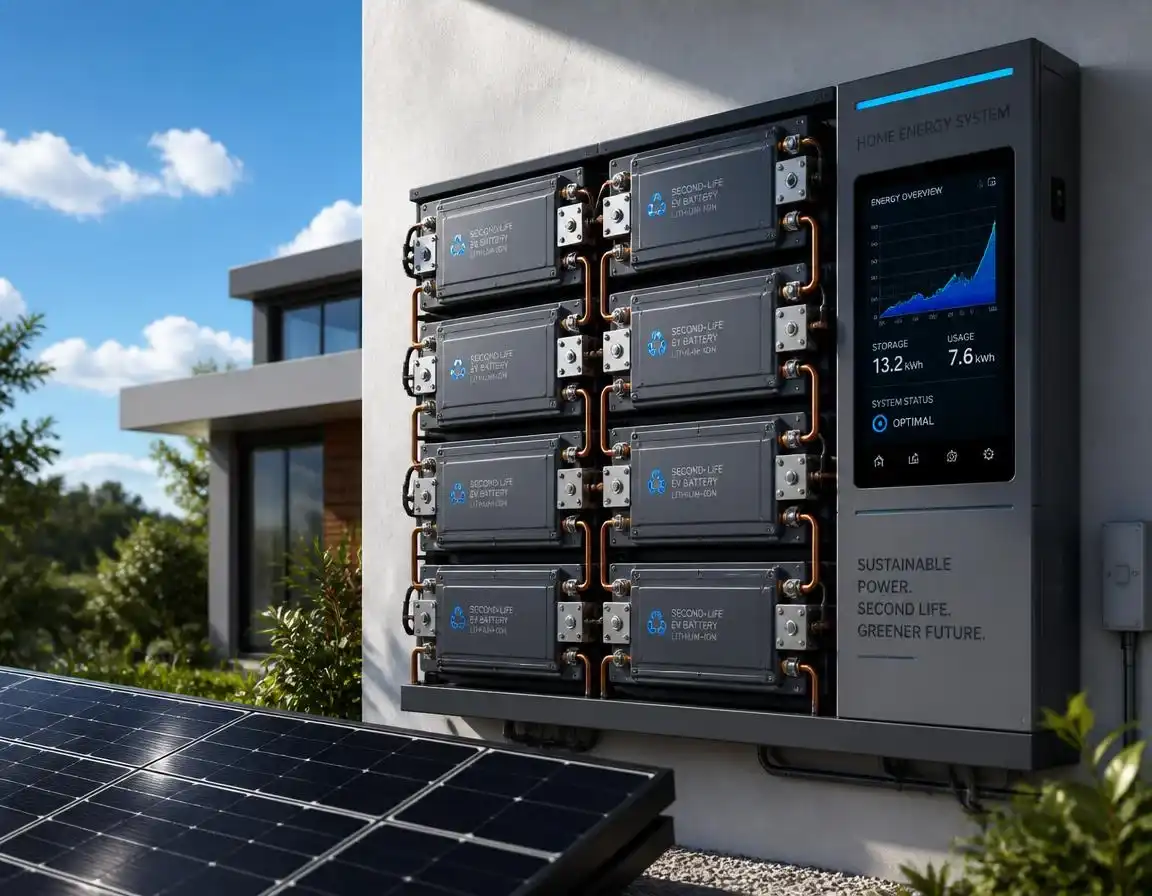
Second-Life EV Batteries for Home Solar Storage

I went looking for a UK homeowner who’d actually bought one of these. It’s a genuinely brilliant idea, but here’s what’s real, what’s still years away, and whether it’s worth waiting for.
Second-life EV batteries, old car battery packs given a new job storing solar power at home, sound like a perfect idea: cheaper storage, less waste, happier planet. The reality in 2026 is more complicated. There’s genuine UK innovation happening (Powervault’s long-running Renault partnership, Allye Energy’s commercial repurposing work), but there’s still no simple, clearly-priced product you can just order for your house. On top of that, a UK government safety study found experts genuinely split on whether these batteries can ever be made fully safe for home use. For most people, a new battery remains the sensible choice today, but it’s worth understanding why, and worth keeping an eye on.
When I started digging into this, I expected to find a handful of UK companies quietly selling second-life battery packs to homeowners at a nice discount. That’s not really what’s out there. What I found instead is a genuinely interesting, slow-moving story about circular economy ambition running into some very real technical and safety hurdles. Here’s the whole picture, honestly.
What actually is a “second-life” EV battery?
When an electric car’s battery drops to around 70–80% of its original capacity, it’s usually no longer good enough for the demanding job of powering a vehicle, quick acceleration, long range, thousands of fast-charge cycles. But that’s still a lot of usable energy left over. Sitting still in a box on your wall, just charging up from solar panels during the day and releasing power in the evening, is a far gentler job than being a car battery. So instead of being recycled straight away, the pack gets tested, sometimes stripped down into individual modules, rebuilt with a new battery management system, and given a second career as home or grid storage.
It’s a genuinely sound idea environmentally. Every EV battery that gets a second job before recycling is one that isn’t manufactured twice, and one industry estimate puts the carbon saving from repurposing a single large EV pack at more than seven tonnes of CO2 versus building a new battery from scratch.
So can I actually buy one for my home?
This is the question that matters most, and the honest answer is: not really, not as a standard product with a price tag next to it.
Powervault and Renault have been trialling second-life EV batteries in UK home storage units, originally announced as a 30% cost reduction versus a standard Powervault, tested in a run of homes with existing solar panels.
Powervault has continued working with Loughborough University on speeding up the process of testing and grading second-life cells, describing it as genuinely time and cost intensive to disassemble, grade, and rebuild packs at scale.
Powervault’s current mainstream product line is sold and reviewed as a standard battery, without second-life cells clearly marketed as a distinct, separately priced option. It’s fair to call this an active area of development rather than a finished consumer product.
You’ll see UK company Allye Energy mentioned a lot in this space, including a real partnership with Jaguar Land Rover using second-life Range Rover batteries. Its product is a mobile, shipping-container-scale unit built for EV charging sites and commercial use, not a home battery. It’s genuine UK innovation, just not something you can install in your garden.
There’s also a small but real DIY community building their own storage systems from salvaged EV modules bought through third-party sellers, this is much more established in the US than the UK. It’s a legitimate hobbyist pursuit for someone with real electrical engineering knowledge, but it sits well outside anything a normal homeowner should attempt, and it’s the part of this story where the safety concerns below matter most.
The safety question nobody’s fully answered
In 2023, the UK’s Office for Product Safety and Standards commissioned Newcastle University to study exactly this question, and the results were refreshingly honest rather than reassuring. Consulted experts landed in two camps.
“It can be done safely”
Provided the full history of a battery is known, its state of health properly tested, and it’s fitted with a certified battery management system, a safety framework is achievable.
“It can never be guaranteed”
Some respondents held that the safety of used cells simply can’t be fully guaranteed, and that second-life batteries shouldn’t be used in home energy storage under any circumstances.
Part of the challenge is that a battery pack’s health can degrade unevenly between the point it leaves a car at 75–80% health and the roughly 50–60% point considered true end of life, that’s a genuinely tricky window to certify consistently across packs from different manufacturers, ages, and accident histories. You can read the full government safety study here.
Lithium-ion battery storage fires are rare but documented in the UK, including incidents in Liverpool and Essex. Newer certified systems have suppression measures and safer chemistries built in from the start. An unverified, home-built pack from an unknown source is exactly the situation UK fire and safety bodies are most cautious about.
Would it actually save you money?
In principle, yes. Industry analysis puts second-life cells at 30–40% cheaper than equivalent new LFP cells. In practice, that gap has been shrinking fast, because the price of new batteries keeps falling too. Here’s how the theoretical saving stacks up against what you’d actually pay for a new battery on the UK market right now.
Rough cost per usable kWh, home battery storage
Illustrative comparison. New battery prices reflect typical UK installed costs; second-life figure is a theoretical 30–40% saving before certification overheads.
The trouble is that theoretical £250–£350/kWh assumes the repurposer’s testing, grading and rebuilding process is cheap and fast, and as Powervault has openly said, it currently isn’t. Once you add proper certification, a new battery management system and a decent warranty, a lot of the headline saving gets eaten up. That’s a big part of why this hasn’t scaled into a mainstream UK product yet, the economics only really work at volume, and the volume of graded, traceable EV packs coming through UK channels is still building.
Where second-life sits on the “ready to buy” scale, 2026
Genuine UK companies are actively working on this, the direction of travel is real, but it’s closer to “promising and developing” than “buy it this weekend.” Expect that marker to keep moving right over the next few years as EV fleets age and certification standards mature.
The honest pros and cons
✅ In favour
- Genuinely lower environmental footprint than a new battery
- Real cost-saving potential once the market matures
- UK-based innovation (Powervault, Allye) with serious backers
- Puts a genuinely useful asset to work instead of early recycling
❌ Against, for now
- No clearly priced, widely available consumer product in the UK yet
- UK safety experts are openly split on the risk
- Warranty terms are far less established than on new batteries
- Falling new-battery prices are shrinking the cost advantage
What we’d actually suggest doing in 2026
If reducing waste and cost both matter to you, and honestly, they should, the most practical move today is choosing a new LFP battery from an installer who’s upfront about their supply chain, rather than chasing a second-life product that isn’t reliably available yet. If you’re set on the second-life route, only consider a fully certified system from an established company with a proper warranty, and never a DIY build using unverified salvage cells for anything connected to your home’s electrics.
Zero-rated 0% VAT already applies to battery storage installed by a qualified installer in Great Britain, and there’s no indication this treatment would differ for a certified second-life system, the relief applies to the class of installation, not the battery’s history. It’s still worth confirming with your installer at quote stage.
For a proper look at what’s actually available and sensibly priced right now, our solar battery storage guide covers the current new-battery market in detail, including warranty terms explained in full in our solar panel and battery warranty guide. If you’re weighing up a larger off-grid setup where second-life cells are sometimes used at bigger commercial scale, our off-grid solar systems guide is worth a read too. And whichever route you go, always work through a proper MCS-certified installer, not a private seller of unverified cells.
Frequently asked questions
Keep reading on SolarBriton
More on batteries, storage and what’s actually available right now.



We added six 660-watt panels here at our 4-unit guest house in Cozumel, Mexico. This small system will pay for itself in 2.1 years.