
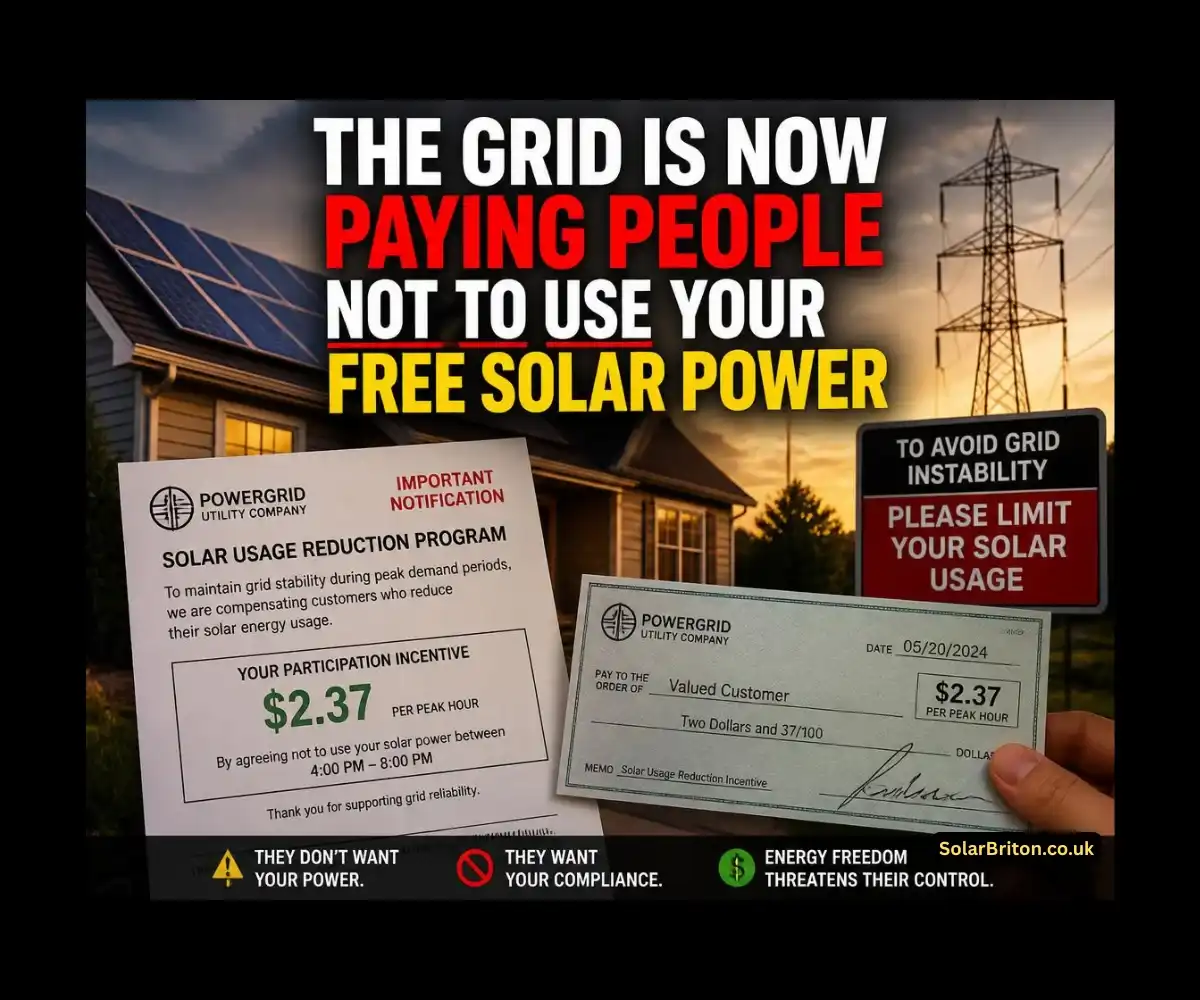
The Grid Is Now Paying People NOT to Use Your Free Solar Power

The Grid Is Now Paying People NOT to Use Your Free Solar Power
Sounds mad, doesn’t it? But on a growing number of sunny days this year, that’s more or less what’s happening across Great Britain’s electricity grid — and it isn’t a scam, a glitch, or your supplier trying to short-change you. Here’s what’s actually going on, and what it means for the panels on your own roof.
Britain now builds wind and solar faster than the grid can move or absorb it. On the sunniest, windiest days, the National Energy System Operator pays big generators to switch off rather than overload the network — and your own export tariff can fall to 0p per kWh at the exact moment your panels are working hardest. It isn’t a fault or a fiddle. It’s a Victorian-era grid trying to keep up with a solar boom nobody quite planned for.
Illustrative pattern showing how a dynamic export rate (like Octopus’s Agile Outgoing) tends to move on a high-generation day — not a specific date’s real figures.
Peak export windows (typically 4–7pm) reward you handsomely; the midday trough on a sunny weekend often pays nothing at all. Rates vary daily — always check your supplier’s app for live figures.
Hold on — the grid pays people NOT to generate electricity?
Genuinely, yes. Britain has built wind and solar capacity so quickly that on the sunniest, windiest, quietest days, the country now generates more electricity than it can use or physically move to where it’s needed. Rather than risk destabilising the network, the National Energy System Operator, or NESO, either pays large generators directly to switch off — known in the industry as a constraint payment — or lets the wholesale price fall below zero, meaning generators pay to offload their power instead of getting paid for it.
Either way, the practical effect is the same. On those days, the grid is quietly saying “no thank you” to more electricity, including, increasingly, the free solar power coming off your own roof.
Think of it a bit like a motorway at rush hour, except in reverse. Instead of too many cars trying to get somewhere, it’s too much electricity trying to get somewhere at once, and the transmission cables connecting windy Scotland and sunny southern rooftops to the rest of the country simply aren’t wide enough to carry it all in one go.
The numbers behind the headline
Negative electricity pricing used to be a rounding error. In 2021, the N2EX day-ahead market — the main exchange where Great Britain’s wholesale electricity is traded — spent roughly 25 hours below zero all year. By 2025, that had ballooned to around 310 hours, and 2026 is running well ahead of that pace: more than 200 hours in the first half of the year alone, including a run of nine hours in a row one Saturday in June where prices sank as low as minus £25 per megawatt-hour on the Epex Spot exchange. Analysts at BloombergNEF reckon Britain will clear 1,000 negative hours a year by 2027.
*2026 covers January–June only and is already tracking ahead of 2025’s full-year total. Figures compiled from N2EX day-ahead and Epex Spot exchange data.
Why solar is now part of the story
Wind has always been the bigger culprit, mainly because Scotland’s wind farms sit a long way from the transmission capacity that would let their power reach southern England. But 2026 has been the year solar properly joined the party. On 22 April, Great Britain’s solar fleet generated a record 15.2 gigawatts — enough, at that exact moment, to cover roughly half the country’s entire electricity demand. The following day it edged past 15 GW again, making up 42% of the entire generation mix at midday. For half an hour that same week, the grid ran at 98.8% zero-carbon, with gas power stations barely needed at all.
That’s a genuinely brilliant outcome for the climate. It’s also exactly why exporting into the grid at 1pm on a sunny Saturday has become the least valuable thing you can do with your solar power. The UK now has around 22 GW of installed solar capacity, heading towards 24 GW by the end of the year, and every single one of those systems tends to peak at the same time as yours. When millions of roofs are all pushing spare electricity onto the network within the same two-hour window, on a weekend when offices, schools and factories are quiet, the maths simply doesn’t add up — there’s nowhere for it all to go.
Who’s actually footing the bill
In 2025, Britain spent around £1.46 billion managing this problem, up from £1.23 billion the year before, according to figures reported against NESO’s own balancing cost data. Only a slice of that, roughly £380 million, went directly to wind farm owners as payment for switching off. The much larger chunk, about £1.08 billion, went on firing up gas power stations elsewhere in the country to replace the electricity that had just been turned away — which is the part that tends to get missed in the headlines.
Seagreen, Scotland’s largest offshore wind farm, alone received around £65 million in 2024 while sitting curtailed roughly 71% of the time.
NESO’s own broader constraint data show costs running about 37% higher in the first eight months of 2026 than over the same period in 2025, and without further grid reinforcement, official projections put the annual bill at somewhere between £4 billion and £8 billion by 2030. Here’s the bit that catches most people out: this cost lands on every household bill through balancing charges baked into your standing unit rate, whether you have solar panels or not, whether you’re on a dynamic tariff or not, and whatever supplier you’re with. It’s why understanding your own energy price cap and unit rate matters just as much as understanding your export tariff.
What this actually means for your Smart Export Guarantee payment
The good news first: none of this breaks the economics of home solar. A well-sized system still pays for itself comfortably within its warranty period, as we cover in our solar panel payback guide. What’s changed is which hours of the day are worth exporting into, and that depends entirely on which type of export tariff you’re on.
| Tariff type | Example rate | Affected by oversupply? |
|---|---|---|
| Fixed SEG rate | 3.5p–24p/kWh flat, e.g. Octopus Outgoing at 12p | No — same rate every hour, every day |
| Dynamic export (e.g. Agile Outgoing) | ~9.4p average, up to 20–40p at 4–7pm peak | Yes — can fall to a 0p floor at midday |
| Time-of-use + battery (Flux, Intelligent Flux) | Up to 29.32p–32.17p at peak (paused to new joiners) | Indirectly — rewards shifting export to the evening |
If you’re on a flat-rate SEG tariff, none of this changes your day-to-day income at all — you’re paid the same rate whether the grid is drowning in electricity or crying out for it. If you’re on a dynamic tariff like Octopus’s Agile Outgoing, your rate genuinely can fall to zero during an oversupplied midday window. Worth being precise here: Octopus builds a 0p per kWh floor into both its SEG and Agile Outgoing tariffs, so your payment can flatline, but you will not be charged for exporting. Compare that with the evening peak, typically 4–7pm, where the same tariff can pay 20p, 30p, or more.
Take a typical 4kW system exporting around 2,000 kWh a year. On a flat 12p rate, that’s roughly £240 a year, unaffected by any of this. On a dynamic tariff, the same household might export a similar volume but see a growing share of it land in a near-worthless midday window rather than the far more lucrative evening one — which is exactly why timing, not just tariff choice, is becoming the real skill in 2026. Our SEG tariff comparison and Octopus export tariff breakdown both go through the full rate ladder if you want to check where you currently sit.
How to actually come out ahead
The households doing best out of all this aren’t the ones exporting the most. They’re the ones exporting the least — because they’re using or storing their own solar power instead of sending it into a market that, at that exact moment, doesn’t want it.
Solar diverter
Instead of exporting spare daytime power for close to nothing, a diverter routes it straight into your hot water cylinder. No battery needed, and it’s usually the lowest-cost upgrade on the table.
From ~£300–£500 fittedBattery + time-shift tariff
Store midday generation and either use it yourself in the evening instead of paying ~26p/kWh, or discharge into a peak export window worth 20–32p/kWh on tariffs like Flux or Agile Outgoing.
£600–£1,000+ a year in combined savingsVirtual power plant
Lend your spare battery capacity to the grid during genuine stress events through schemes like Axle, Kraken, or Tesla’s UK VPP — free money for capacity you weren’t using anyway.
£120–£300 a year on topIf a battery is already on your radar, our guides on the best solar batteries for 2026 and adding a battery to an existing system cover real installed costs and payback. If you’re leaning towards the market leader, our Tesla Powerwall cost guide is worth a read too, and our wider solar battery storage guide ties the whole picture together. For the full rundown on virtual power plants specifically, including who pays what and what you’re actually signing up to, see Get Paid by Tesla, Octopus or Axle to Share Your Solar Battery. Weighing up a diverter against a battery first? Our Solar Diverter vs Battery guide and full solar diverter guide break down which to buy first.
Is anyone actually fixing this?
Slowly, yes — though nothing here is a quick fix. In July 2025, the Department for Energy Security and Net Zero ruled out splitting Great Britain into regional “zonal” electricity prices, the approach some other countries use to reflect local oversupply, deciding instead to keep a single national wholesale price alongside a package of reforms known as Reformed National Pricing. In practice, that means every UK household keeps paying the same unit rate regardless of how much spare solar is sitting on a Cornish rooftop that afternoon.
NESO is turning its Demand Flexibility Service bi-directional, rewarding households and businesses for using more electricity during oversupply, not just less during winter peaks — a direct response to solar-driven surplus.
The Viking Link, a 1.4 GW interconnector to Denmark, is already giving surplus British power somewhere new to go during negative-price events.
Eastern Green Links 1 and 2, subsea cables carrying Scottish offshore wind power south, are due to ease the north-to-south transmission bottleneck behind most curtailment.
The wider Great Grid Upgrade, Britain’s biggest transmission overhaul since the 1950s, aims to more than double transfer capacity between generation and demand.
None of this happens overnight, which is exactly why the smartest move right now isn’t waiting around — it’s making sure your own system is set up to work with an increasingly lumpy, oversupplied grid rather than against it.
My take
I don’t think any of this is a reason to regret going solar, or to think twice about it if you’re still deciding. It’s a sign the UK’s clean power transition is working faster than the network was built to handle — a nice problem to have, even if it doesn’t always feel that way when your export app shows 0p at 1pm. The households who’ll do best from here aren’t necessarily the ones with the biggest arrays. They’re the ones who’ve stopped treating exporting as the only way to make solar pay, and started treating storage and smart timing as part of the deal.
Quick questions
Why is the grid paying people not to use their solar power?
Because on sunny, low-demand days Great Britain now generates more wind and solar than the grid can absorb or move to where it’s needed. Rather than risk the network becoming unstable, NESO pays large generators to reduce output, known as a constraint payment, while wholesale electricity prices can fall to zero or below at the same time. Dynamic export tariffs track that wholesale price, so your own export payment can fall to nothing at exactly the same moments.
Will I be charged for exporting solar power to the grid?
Not under the UK’s main routes. The Smart Export Guarantee and Octopus’s dynamic Agile Outgoing tariff both work with a 0p per kWh floor, so your payment can drop to zero on an oversupplied day but you won’t be billed for exporting. A standard fixed SEG rate isn’t affected day to day at all — you’re paid the same flat rate no matter what the grid is doing.
How can I stop losing solar income when the grid is oversupplied?
Store the power instead of exporting it into a saturated market. A home battery lets you use your own solar in the evening instead of buying it back at around 26p per kWh, or discharge into a time-of-use tariff’s peak window when rates are highest. A solar diverter sending spare power to your hot water cylinder is a cheaper first step, and joining a virtual power plant scheme can add a further £120 to £300 a year in dispatch payments on top.



One Comment