
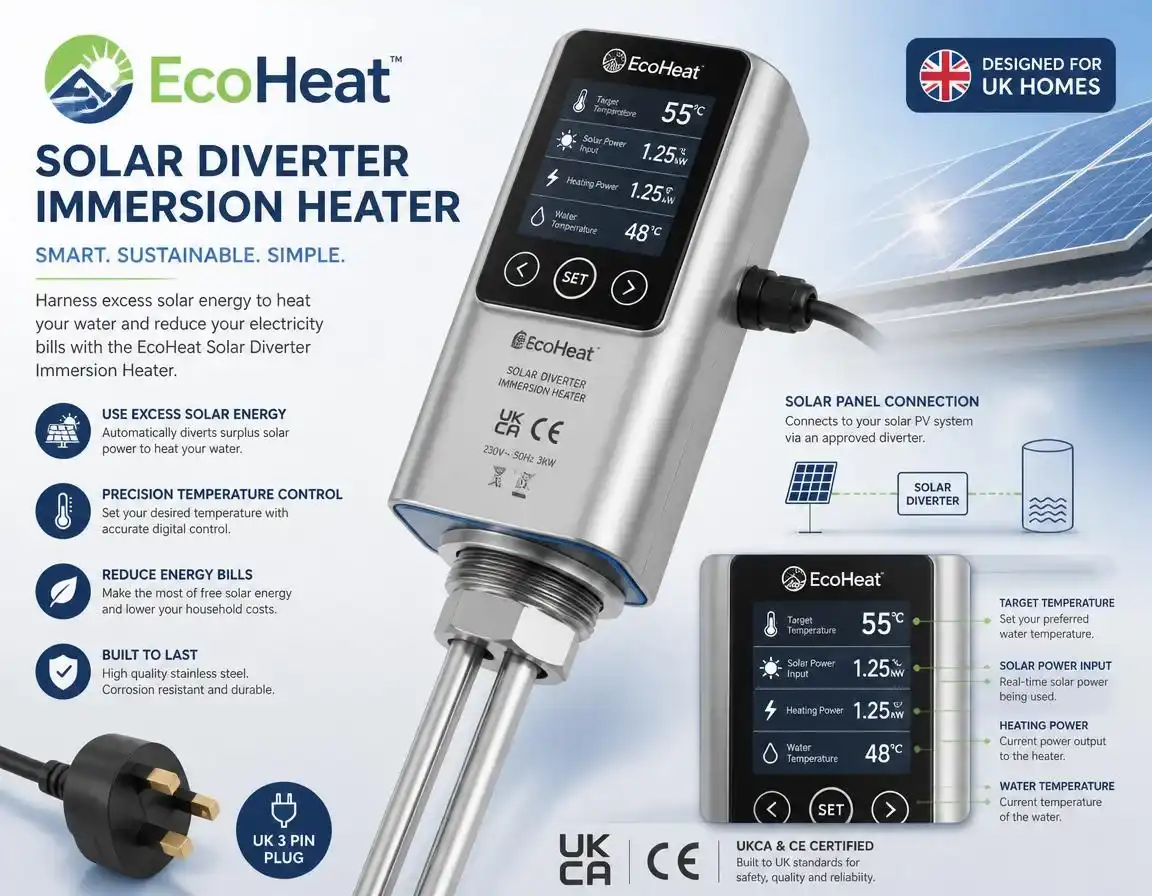
Solar Diverter Immersion Heater UK: Your 2026 Complete Guide to Free Hot Water

Still exporting surplus solar electricity for peanuts? A solar PV immersion controller could be the smartest — and cheapest — upgrade your solar system makes this year.
If you’ve got solar panels on your roof, there’s a good chance you’re giving away a fair chunk of free electricity to the National Grid every single day — and getting very little back for it. I know, because I’ve been there.
The Smart Export Guarantee (SEG) currently pays anywhere from 6p to 18p per kilowatt-hour for surplus electricity you export in 2026. But here’s the kicker: every unit you import from the grid costs around 24.5p — that’s the Ofgem Q2 2026 rate. That gap is quietly costing solar panel owners real money every day.
Enter the solar diverter immersion heater — a compact device that closes that gap by redirecting your surplus solar power straight to your hot water cylinder instead of handing it to the grid at a loss. In this guide, I’ll walk you through everything: how they work, the top brands, realistic costs, savings, installation, and whether it’s genuinely worth it in 2026.
What Is a Solar Diverter Immersion Heater?
A solar diverter immersion heater — also called a solar PV immersion controller or PV diverter — is a smart device that sits between your solar PV system and your hot water cylinder. When your panels produce more electricity than your home is using, instead of that surplus flowing to the grid at a low export rate, the diverter intercepts it and sends it to your immersion heater element, warming your hot water tank for free.
It continuously monitors generation versus household consumption using current transformer (CT) clamps fitted to your electricity meter and PV inverter. The moment surplus is detected, it activates automatically. No manual switching. No fuss. Just free hot water, day after day.
How Does a Solar Diverter Work?
Your solar panels generate DC electricity, which your inverter converts to AC power. Your appliances take what they need. Any surplus would normally spill to the grid at a low SEG rate. Two CT clamps — one on your PV inverter cable, one on your incoming mains — constantly measure generation against demand. When generation exceeds demand, the diverter routes that excess to your immersion heater. Modern units like the myenergi Eddi use PWM (pulse width modulation) technology, modulating exactly how much power flows to the element rather than simply switching it on or off — so every watt of surplus is used productively.
💡 Key insight: A diverter turns your surplus solar export — worth just 6–18p/kWh via SEG — into hot water that would otherwise cost you 24.5p/kWh to heat. That’s up to 4× the value from the same electricity.
Is Your Home Compatible?
There’s one non-negotiable requirement: you need a hot water cylinder with an immersion heater. Without one, there’s nowhere for the surplus energy to go.
- ✅ System boiler + hot water cylinder
- ✅ Oil or LPG boiler + hot water cylinder
- ✅ Air source heat pump + thermal store
- ✅ Electric immersion as primary heat source
- ❌ Combi boilers — no storage cylinder
- ❌ Homes with no immersion heater installed
Have a combi boiler? You can still benefit, but you’d need to install a separate hot water cylinder and immersion heater first — which adds cost but opens the door to years of free hot water thereafter.
Best Solar Diverters Available in the UK Right Now
Three brands dominate the UK market. Here’s how they compare on the features that actually matter.
| Brand / Model | Unit Price | App Control | Heater Outputs | Battery Ready | Best For |
|---|---|---|---|---|---|
| myenergi Eddi 🏆 Top Pick | £400–£450 | ✅ myenergi app | 2 sequential | ✅ Yes | Smart homes & EV owners |
| Marlec Solar iBoost+ 💚 Best Value | £250–£300 | ❌ No | 1 | ✅ Yes | Simplicity & reliability |
| SOLiC 200 💙 Budget Pick | ~£229 | ❌ No | 1 | ⚠️ Limited* | Budget buyers, no battery |
What Does a Solar Diverter Cost — and How Much Can You Save?
A solar PV immersion controller is one of the most cost-effective solar upgrades available in the UK in 2026. The average household spends £200–£350 per year heating hot water — and a well-matched diverter can cover the majority of that.
(device + labour)
hot water savings
period
product lifespan
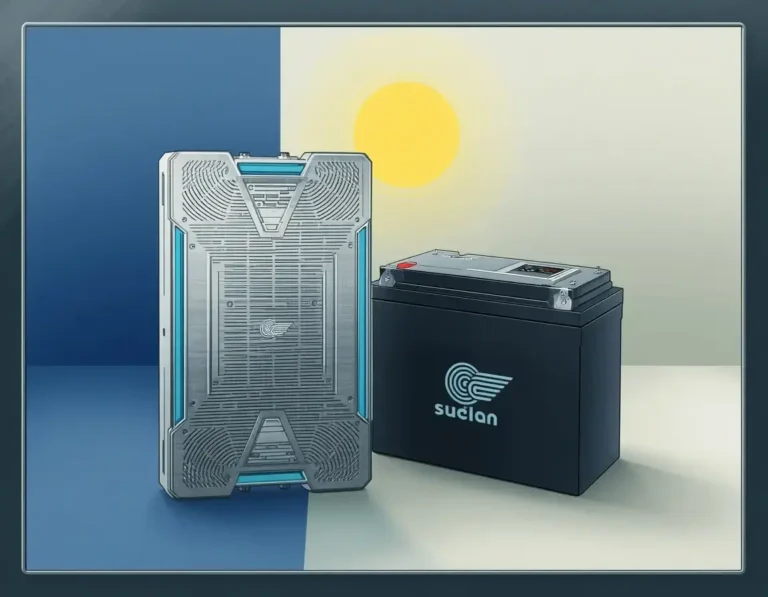
Solar Diverter vs Battery Storage: Which Should You Choose First?
Both increase solar self-consumption — but at very different price points and with different strengths. Here’s the honest comparison for 2026.
| Factor | ☀️ Solar Diverter | 🔋 Battery Storage |
|---|---|---|
| Installed cost | £300–£900 | £3,500–£9,500 |
| Typical annual saving | £220–£380 (hot water) | £300–£600 (whole home) |
| Payback period | 1.5–3 years | 6–12 years |
| Needs hot water cylinder | ✅ Yes | ❌ No |
| Powers evening loads | ❌ No | ✅ Yes |
| Choose first if… | You have a hot water cylinder | You want full energy independence |
💡 Our recommendation: If your home has a hot water cylinder, install the diverter first. The payback is faster and the upfront cost is a fraction of a battery. You can always add battery storage once the diverter has paid for itself.
Installation: What to Expect
Installing a solar diverter is Part P notifiable electrical work in the UK, so it must be done by a qualified electrician or MCS-accredited solar installer. No plumbing is needed — it’s a neat, low-disruption job that typically takes 2–3 hours from start to finish.
What Happens to My Smart Export Guarantee Payments?
When you install a solar PV immersion controller, you’ll export less electricity to the grid because you’re using more of it yourself. Your SEG payments will reduce slightly as a result.
But the maths strongly favours the diverter: you’re swapping 6–18p/kWh in SEG income for 24.5p/kWh in savings on electricity you’d otherwise import to heat your water. The self-consumption saving wins by a comfortable margin in almost every scenario.
Is a Solar Diverter Immersion Heater Worth It in 2026?
Yes — if you have a hot water cylinder with an immersion heater and your solar panels generate surplus electricity during the day. In 2026, with imports at around 24.5p/kWh and SEG rates remaining modest, the solar diverter immersion heater is arguably the best-value solar upgrade available to UK homeowners. Most households recover their investment within two years. After that, it’s essentially free hot water from a device with no moving parts, minimal maintenance, and a lifespan of well over ten years.
If you have a combi boiler, you’ll need to address the compatibility issue first. But for the millions of UK homes with a system boiler and a separate hot water cylinder, this is a genuinely compelling upgrade — and one I’d recommend without hesitation.
Frequently Asked Questions
Here are the questions that come up most often — answered straight.

One Comment