
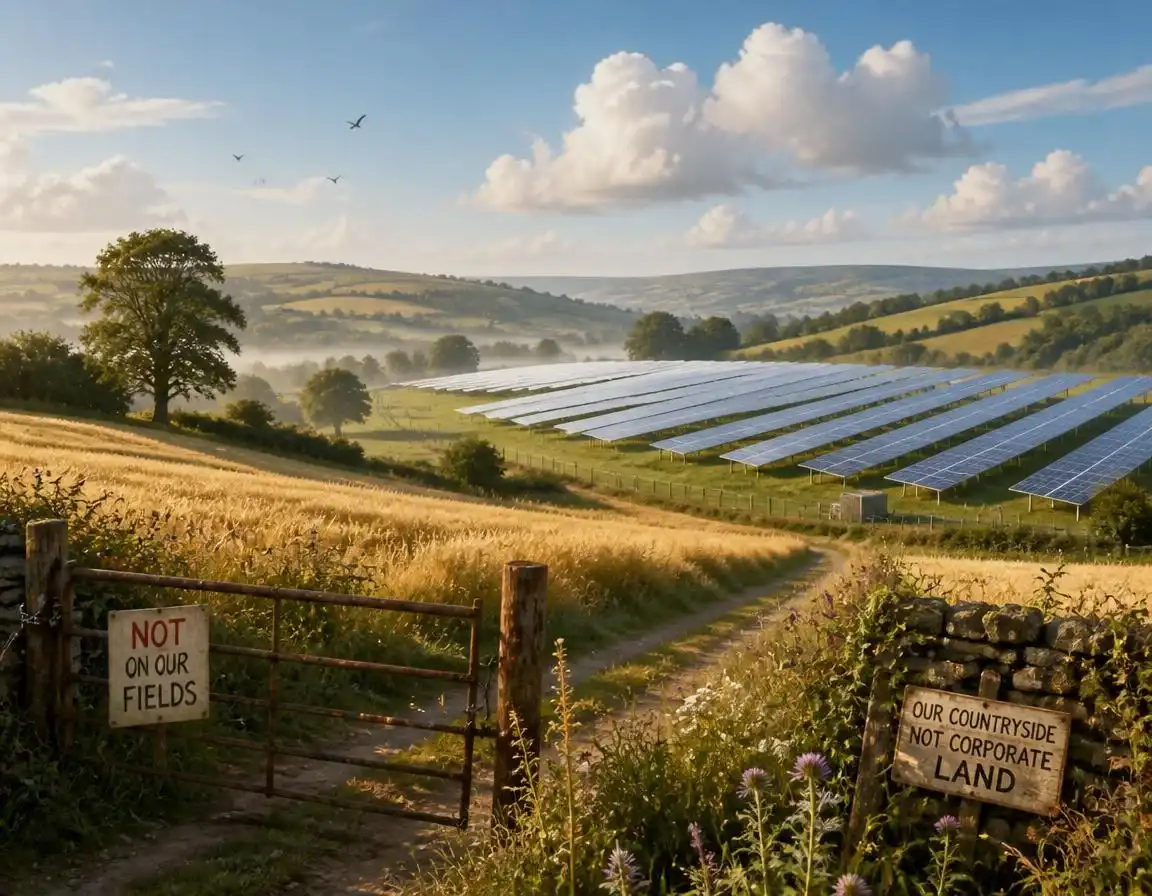
UK Solar Farms vs Farmland

UK Solar Farms vs Farmland: The Countryside Backlash 2026
Drive through Lincolnshire, Suffolk or Wiltshire this summer and you’ll see the same story playing out in village hall after village hall: a solar developer with a map, a parish council with objections, and a lot of people arguing about a field. Here’s what’s actually true about how much land is involved, who decides, and why it’s got so heated.
 rotate(-8)'%3E%3Crect width='120' height='70' rx='4'/%3E%3Cline x1='0' y1='23' x2='120' y2='23' stroke='%232A1E00' stroke-width='2'/%3E%3Cline x1='0' y1='46' x2='120' y2='46' stroke='%232A1E00' stroke-width='2'/%3E%3Cline x1='40' y1='0' x2='40' y2='70' stroke='%232A1E00' stroke-width='2'/%3E%3Cline x1='80' y1='0' x2='80' y2='70' stroke='%232A1E00' stroke-width='2'/%3E%3C/g%3E%3Cg transform='translate(300,262) rotate(-8)'%3E%3Crect width='120' height='70' rx='4'/%3E%3Cline x1='0' y1='23' x2='120' y2='23' stroke='%232A1E00' stroke-width='2'/%3E%3Cline x1='0' y1='46' x2='120' y2='46' stroke='%232A1E00' stroke-width='2'/%3E%3Cline x1='40' y1='0' x2='40' y2='70' stroke='%232A1E00' stroke-width='2'/%3E%3Cline x1='80' y1='0' x2='80' y2='70' stroke='%232A1E00' stroke-width='2'/%3E%3C/g%3E%3Cg transform='translate(480,250) rotate(-8)'%3E%3Crect width='120' height='70' rx='4'/%3E%3Cline x1='0' y1='23' x2='120' y2='23' stroke='%232A1E00' stroke-width='2'/%3E%3Cline x1='0' y1='46' x2='120' y2='46' stroke='%232A1E00' stroke-width='2'/%3E%3Cline x1='40' y1='0' x2='40' y2='70' stroke='%232A1E00' stroke-width='2'/%3E%3Cline x1='80' y1='0' x2='80' y2='70' stroke='%232A1E00' stroke-width='2'/%3E%3C/g%3E%3C/g%3E%3Ccircle cx='860' cy='90' r='46' fill='%23E8B54A'/%3E%3Cg stroke='%233D5A73' stroke-width='4' stroke-linecap='round' opacity='0.55'%3E%3Cline x1='60' y1='250' x2='60' y2='120'/%3E%3Cline x1='40' y1='150' x2='60' y2='170'/%3E%3Cline x1='80' y1='150' x2='60' y2='170'/%3E%3C/g%3E%3C/svg%3E)
If you only read the headlines, you’d think Britain was about to be paved over with glass. If you only read the solar industry’s press releases, you’d think the whole row was manufactured by a few noisy nimbys. The truth, as usual, sits in the middle — and it’s a lot more interesting than either side lets on. This piece walks through the actual land-use numbers, the planning rules that decide where a solar farm can and can’t go, what it means for the farmers being offered a lease, and why 2026 has turned into such a pivotal year for the argument.
So how much farmland are we actually talking about?
This is the bit that gets lost in every shouting match. According to the House of Commons Library, working from Department for Energy Security and Net Zero (DESNZ) figures, ground-mounted solar covered around 21,200 hectares of the UK at the end of September 2024 — roughly 0.1% of the country’s total land area. A separate peer-reviewed land-use study put the figure at a similarly tiny 0.06–0.07%. Either way, we’re talking about a rounding error on the map, not a takeover.
The forward-looking numbers are more revealing still. In response to a Freedom of Information request, DESNZ confirmed that even under its own most ambitious scenario — where every last watt of new solar capacity needed to hit the government’s targets is built on the ground rather than on roofs — ground-mounted solar would still occupy no more than 0.4% of total UK land, or around 0.6% of the UK’s utilised agricultural area, by 2030.
Today (late 2024)
2030, most ambitious scenario
2030, same scenario
Source: House of Commons Library, “Planning for solar farms”; DESNZ FOI release on ground-mounted solar predicted land use (December 2025).
The mega-farms making the headlines
Small percentages don’t stop a village worrying about the field over the hedge, and a handful of genuinely enormous projects are doing most of the heavy lifting in this debate. Sunnica Energy Farm, straddling the Suffolk-Cambridgeshire border, was approved by the Secretary of State in July 2024 despite the government’s own planning inspectors recommending it be refused — a 500MW, roughly 2,500-acre scheme that campaigners are still fighting through the courts. Down the road, Mallard Pass on the Rutland-Lincolnshire border was consented the same day: 350MW, stretching over four miles end to end, though it does come with 72% biodiversity net gain and more than 20km of new hedgerow and tree planting.
Those are the nationally significant ones. Underneath them sits a constant churn of smaller, equally fierce local fights. In 2026 alone, residents in Radford Semele, Warwickshire saw a 212-acre proposal thrown out after more than 300 objections and a 1,200-name petition; a 185-acre scheme near a conservation village at Norwell, Nottinghamshire was rejected on heritage grounds; and in Shropshire, developers walked away from a 600-acre plan near Much Wenlock after an MP told Parliament he “hadn’t found a single constituent” in favour. Meanwhile the Lime Down Solar Park appeal in Wiltshire — four miles wide, opposed by nearly 5,000 written objections — is still working its way through a planning inspector.
| Project | Location | Capacity | Status |
|---|---|---|---|
| Cleve Hill | Kent | 373 MW | Operational — UK’s largest working solar farm |
| Botley West | Oxfordshire | 840 MW | Decision pending — would be the largest ever if consented |
| Cottam | Notts / Lincs | 600 MW | Consented, pre-construction |
| Sunnica | Suffolk / Cambs | ~500 MW | Consented 2024, contested in the courts |
| Gate Burton | Lincolnshire | 500 MW | Consented, pre-construction |
| Mallard Pass | Rutland / Lincs | 350 MW | Consented, construction due 2026 |
Who actually decides where a solar farm can go?
Unlike a rooftop array, a solar farm on agricultural land almost never counts as permitted development — it needs a proper planning application, full stop. What changed in 2026 is who makes that decision. From 31 December 2025, the threshold at which a solar scheme becomes a Nationally Significant Infrastructure Project (NSIP) — decided by the Secretary of State for Energy Security and Net Zero rather than your local council — rose from 50MW to 100MW. It’s a genuinely big shift: projects that would have gone through a lengthy, expensive Development Consent Order process a year ago now go through the ordinary local planning system instead.
The other rule that matters most is land quality. National planning policy protects what’s known as Best and Most Versatile (BMV) land — Grade 1, 2 and the better parts of Grade 3a — with a strong presumption against solar development on it. Grade 3b, 4 and 5 land is generally considered fair game. It’s exactly this rule that campaigners point to when a scheme like Mallard Pass gets approved despite using some BMV land: the planning inspectorate’s own examiners flagged it as a negative in the balance, but ministers judged the wider benefits outweighed it.
If you’re weighing up your own solar panel planning permission requirements — whether that’s a modest garden array or something closer to farm scale — the rules are very different depending on size and location, so it’s worth checking the specifics before you get your hopes up on a quick approval.
| Scale | Who decides | Route |
|---|---|---|
| Under 100 MW | Local Planning Authority | Town and Country Planning Act 1990 |
| 100 MW and above | Secretary of State (DESNZ) | Nationally Significant Infrastructure Project / Development Consent Order |
| Wales, up to 350 MW | Welsh Ministers / local authority | Devolved planning system |
The Land Use Framework: Defra’s answer to “not enough room”
The most significant policy document of 2026 landed on 18 March, when Defra published England’s first ever Land Use Framework. Environment Secretary Emma Reynolds set out the government’s central argument plainly: housing, food, nature and clean power “are not competing demands” if land is used well. The framework estimates that by 2035, an extra 129,000 hectares of English land — combining solar and onshore wind — could be needed, equivalent to about 1% of England’s land area, or 2% of the UK’s farmed area. Even that figure, the report notes, is a deliberately conservative upper estimate that assumes almost nothing new is built on rooftops.
The framework leans heavily on the idea of multifunctional land — sheep grazing beneath panels, wildflower strips for pollinators, even peatland restoration underneath solar arrays, so the same acre is doing more than one job at once. Updated Agricultural Land Classification maps, due later in 2026, will sharpen exactly which fields count as BMV and which don’t — and are likely to become the next battleground in planning appeals.
What campaigners say
CPRE, the countryside charity, has found that nearly two-thirds of England’s largest solar farms sit on productive agricultural land, with a third on the very best of it. Its long-running “rooftop-first” campaign argues the UK has around 250,000 hectares of suitable commercial roof space still sitting bare.
What farmers say
The NFU’s position is narrower than the headlines suggest: it backs solar in principle and says individual farms don’t threaten national food security, but insists BMV land should stay off-limits wherever there’s a lower-grade alternative nearby.
Why farmers keep saying yes anyway
Here’s the part that rarely makes it into the protest placards: for a lot of landowners, a solar lease is simply the best-paying thing their land has ever done. Typical 2026 UK lease rates sit around £850–£1,300 per acre per year, index-linked and running for 25 to 40 years, with no capital outlay, no crop risk and no weather to worry about. Compare that with arable margins of roughly £100–£250 an acre, or livestock grazing at £50–£150, and it’s easy to see why marginal or difficult-to-farm land in particular keeps getting offered up.
 rotate(-6)'%3E%3Crect width='170' height='16' rx='3'/%3E%3C/g%3E%3Crect x='95' y='134' width='6' height='70' fill='%233D5A73'/%3E%3Crect x='245' y='128' width='6' height='76' fill='%233D5A73'/%3E%3Cg transform='translate(360,120) rotate(-6)'%3E%3Crect width='170' height='16' rx='3'/%3E%3C/g%3E%3Crect x='365' y='134' width='6' height='70' fill='%233D5A73'/%3E%3Crect x='515' y='128' width='6' height='76' fill='%233D5A73'/%3E%3C/g%3E%3Cg transform='translate(150,235)' fill='%23FCFBF6' stroke='%231B2420' stroke-width='3'%3E%3Cellipse cx='30' cy='18' rx='30' ry='17'/%3E%3Ccircle cx='58' cy='10' r='9' fill='%231B2420' stroke='none'/%3E%3Cline x1='10' y1='34' x2='10' y2='44' stroke='%231B2420'/%3E%3Cline x1='46' y1='34' x2='46' y2='44' stroke='%231B2420'/%3E%3C/g%3E%3Cg transform='translate(430,235)' fill='%23FCFBF6' stroke='%231B2420' stroke-width='3'%3E%3Cellipse cx='30' cy='18' rx='30' ry='17'/%3E%3Ccircle cx='2' cy='10' r='9' fill='%231B2420' stroke='none'/%3E%3Cline x1='14' y1='34' x2='14' y2='44' stroke='%231B2420'/%3E%3Cline x1='50' y1='34' x2='50' y2='44' stroke='%231B2420'/%3E%3C/g%3E%3Ccircle cx='860' cy='70' r='38' fill='%23E8B54A' opacity='0.9'/%3E%3C/svg%3E)
Agrivoltaics in practice: sheep grazing beneath a ground-mounted array, a now-routine way of keeping land in food production alongside generation.
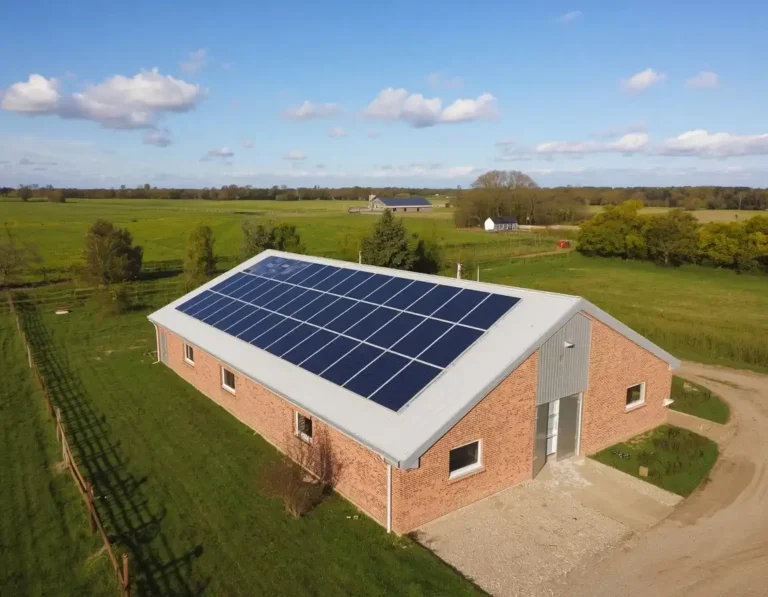
It’s also not necessarily a permanent goodbye to farming. Sheep grazing under the panels is now routine on most large sites, the land keeps its agricultural classification, and leases typically include decommissioning clauses that return the field to full farming use once the panels come down. For farms weighing up smaller-scale options instead of handing over whole fields, putting panels on existing barn or shed roofs is often the more straightforward route — our guide to solar panels for agricultural buildings covers what that looks like in practice.
Bars scaled to indicative upper figures. Source: 2026 UK solar farm land-lease market data; typical arable and livestock gross margin ranges.
The backlash is loud — but is it representative?
This is where it gets genuinely surprising. Despite the placards and the parish council motions, national polling consistently shows solar is one of the most popular forms of energy infrastructure in Britain. Three-quarters of people say they’d support a solar farm being built in their own local area. A More in Common poll for the Energy and Climate Intelligence Unit in April 2026 found 60% of voters in English local election areas would choose a solar farm over fracking on their doorstep, against just 10% who’d pick fracking — and even among Reform UK voters, solar beat fracking by nearly two to one.
None of that makes local objections illegitimate — a specific 4-mile scheme next to your village is a very different thing to “solar energy” as an abstract idea, and plenty of people who support renewables in general still think a particular site is the wrong one. But it does explain why ministers keep approving projects that generate fierce local opposition: the national mood music and the local placards are, more often than not, telling two different stories.
Sources: YouGov (nationally representative, GB adults); YouGov for CPRE; More in Common for the Energy & Climate Intelligence Unit (April 2026).
Why “rooftops first” keeps gaining ground
If there’s one idea that both sides of this argument can mostly agree on, it’s this: a warehouse roof or a car park canopy generates almost no objections at all. The government’s own Solar Roadmap, published in June 2025, leans into exactly that logic — mandating solar on the vast majority of new-build homes through the Future Homes Standard, extending business rates relief for on-site commercial rooftop solar through to March 2035, and funding rooftop installs across hundreds of schools and hospitals via Great British Energy.
Businesses sitting on unused roof space have never had a stronger financial case to act — our guide to solar panels for commercial property walks through the numbers. And if it’s your own domestic ground-mounted setup you’re weighing up rather than anything on an industrial scale, our ground-mounted solar panels cost guide breaks down what that looks like for a typical UK garden. None of this makes utility-scale solar farms redundant — the grid genuinely needs both — but it’s the single biggest lever available for taking the heat out of the farmland argument.
Thinking about solar on your own land or roof?
Whether it’s a barn roof, a commercial unit or a spare corner of a paddock, the funding landscape changes fast. See what’s currently available before you sign anything.
So — good thing, or bad thing?
Both, honestly, depending which field you’re standing in. Nationally, the numbers are unambiguous: solar farms use a genuinely tiny sliver of UK land, even under the most solar-heavy scenario the government has modelled, and most of that land keeps producing food or grazing livestock alongside the panels. Locally, a handful of enormous NSIP-scale projects really are reshaping specific parishes for a generation, and it’s entirely reasonable for the people living next to them to want a say in how and where that happens. The honest answer is that 2026’s row isn’t really “solar vs farming” — it’s a fight over which fields, decided one planning application at a time, while rooftops sit there mostly unused.
Common questions
How much of the UK’s land do solar farms actually use?
Ground-mounted solar covers roughly 21,200 hectares of the UK — about 0.1% of the country’s total land area — based on House of Commons Library figures drawn from government data. Even in the government’s own most ambitious scenario, ground-mounted solar would reach no more than 0.4% of total UK land, or around 0.6% of the UK’s farmland, by 2030.
Do you need planning permission for a solar farm on farmland?
Yes. Ground-mounted solar on agricultural land almost always needs full planning permission, since permitted development rights don’t cover commercial-scale arrays. In England, schemes below 100MW are decided by the local council, while anything 100MW or larger goes to the Secretary of State for Energy Security and Net Zero as a Nationally Significant Infrastructure Project.
Do farmers earn more from a solar lease than from farming the land?
Usually, yes, in pure income-per-acre terms. Typical 2026 UK solar lease rates run from about £850 to £1,300 per acre a year, index-linked over a 25 to 40 year term, compared with roughly £100 to £250 per acre from arable farming. That gap is the main reason solar has become such a popular diversification option, even though it ties up the land for decades.
Key sources: House of Commons Library (Planning for solar farms, cbp-7434); Defra, The Land Use Framework for England (March 2026); GOV.UK, Overarching National Policy Statement for Energy EN-1 (2025); GOV.UK, Ground mounted solar energy plants: predicted land use (FOI release, December 2025).

One Comment