

Balcony Solar UK 2026: The 800W Rule for Renters & Flats

I’ll be honest, most of what’s written about this online is already a bit behind. The real law that makes plug-in solar legal only landed a fortnight ago. Here’s exactly where things stand today, and what changes on 27 August.
Balcony solar is legal in the UK today, but only if a CPS-registered electrician hard-wires it in for you, under rules that took effect on 15 April 2026. The bit everyone’s been waiting for, plugging a certified kit straight into a normal wall socket yourself with no electrician, only becomes law on 27 August 2026, once certified kits actually reach shops. Either way, the system is capped at 800W.
I’ve spent the past few days going through the actual regulations rather than the press coverage of them, because most of what’s circulating right now is either a few months stale or quietly conflates two different rule changes. If you’re renting, or you own a flat with a balcony and no roof to call your own, this is the bit of the story that actually affects you: what you can legally do this week, what changes at the end of August, and whether your landlord can say no.
So what’s actually changed?
Two separate things happened, and mixing them up is where most of the confusion online comes from.
The first was BS 7671 Amendment 4, the update to the UK’s wiring regulations, which came into force on 15 April 2026. It created a legal route for a qualified electrician to hard-wire an 800W solar kit into your consumer unit. That route has been usable since April, and it’s the only fully legal way to get balcony solar connected right now.
The second, and the one that actually matters for “can I just plug it in myself”, is a piece of secondary legislation called SI 2026/848, made by the government on 16 July 2026. It amends the rules that currently stop you from wiring a generator, including a solar panel, into a standard three-pin plug. It comes into force on 27 August 2026. From that date, a fully certified plug-in kit can legally go straight into a wall socket, with no electrician needed for the connection itself.
As things stand, no kit has actually been certified against the new specification yet. Most “plug-in solar” kits sold in the UK today include a battery, and the new simplified socket route is solar-only, batteries are excluded from it by definition. So even after 27 August, check carefully before assuming the kit in your basket qualifies.
How we got here, and what’s still to come
Five real dates, in order. Source: DESNZ and legislation.gov.uk.
Energy Secretary Ed Miliband confirms plug-in solar will be made legal for UK households for the first time.
Opens the hard-wired route: a CPS-registered electrician can now legally connect an 800W kit to your consumer unit.
DESNZ publishes the Interim Product Specification (IPS v2). The statutory instrument that enables socket connection is signed into law.
The electrician route is live. Certified plug-and-play kits don’t exist on shelves yet, they’re still being tested against the new spec.
Certified 800W kits become legal to plug into a normal socket yourself. No electrician required for the connection, once compliant kits exist.
The BS 7671 Amendment 4 transition closes out, tidying up the legal framework around both routes.
The 800W rule, in plain English
The number everyone quotes is 800W, but it’s worth knowing exactly what that covers, because it trips people up.
| What the rule says | What it means for you |
|---|---|
| 800W AC output cap | Your inverter, the box that turns panel output into usable mains power, can’t put out more than 800W. This is the hard limit. |
| Up to 2,000W of panels allowed | You can fit more solar panel than the inverter needs (called oversizing), useful on cloudy UK days, but the inverter still won’t exceed 800W output. |
| Solar only | Battery storage is written out of the simplified socket route at the legal definition stage. A kit with a battery has to go through the standard hard-wired electrician route instead. |
| Complete certified kits only | You can’t buy a panel and inverter separately and call it compliant. It has to be sold as a whole tested product, panel, inverter, cable and plug together. |
| One device, effectively per household | The spec allows one per circuit, but your network operator’s own connection rules still cap total generation at 800W per household until those are updated too. |
| G98 notification still required | You (or your installer) must tell your electricity network operator you’ve connected a generator, free, online, within 28 days. It’s a notification, not a permission request. |
It’s not an arbitrary number. Germany set the same 800W cap for its wildly popular “Balkonkraftwerk” scheme, and it’s now standard across several EU countries. The UK has essentially adopted the European benchmark rather than inventing its own.
Germany’s equivalent scheme has driven well over a million households to fit balcony solar since rules were relaxed there. It’s the closest thing the UK has to a working precedent for how this plays out at scale.
Today vs 27 August: what you can actually do right now
The hard-wired route
- Buy an 800W-capped kit (panel + microinverter)
- Book a CPS-registered electrician to connect it to your consumer unit
- They (or you) submit a G98 notification, free, online
- Expect to pay roughly £150–£300 for the connection on top of kit cost
- Fully legal today, no waiting required
The plug-and-play route
- Buy a kit certified to the new Interim Product Specification
- Check it’s listed on the industry’s G98 Type Test Register
- Plug it into a standard 13A socket yourself, no electrician
- Still notify your network operator under G98 within 28 days
- No certified kits exist yet, prices should fall once they do
Renting or in a flat? Here’s where you stand
This is the question I get asked most, and the honest answer is: it depends what you’re fixing the kit to.
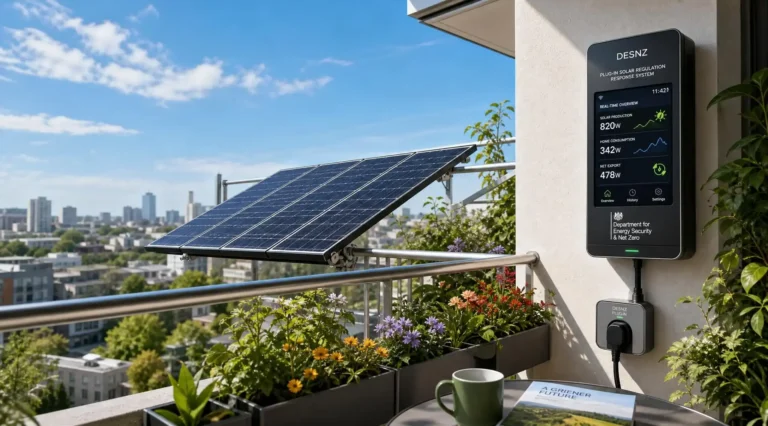
A kit that clamps to a balcony railing, or sits freestanding on a weighted stand, doesn’t touch the building structure and is easy to remove without a trace. That’s a very different request to drilling brackets into brickwork. The Renters’ Rights Act 2025 strengthens tenants’ position when asking for reasonable, reversible improvements like this, and makes it harder for a landlord to refuse simply because they’d rather not deal with it. It doesn’t hand you an automatic right to fit anything you like without asking.
Send your landlord or letting agent a short written request before you buy anything, describe exactly how the kit mounts (clamp, not drill), and keep their reply. Most landlords say yes to something this low-risk once it’s in writing, and having it on record protects you either way.
Rail clamp mount
Clips onto a standard balcony railing. No drilling, fully reversible, the most renter-friendly option by far.
Freestanding stand
Sits on a weighted ground-level frame. Ideal for a ground-floor patio, courtyard, or small garden.
Wall-mounted bracket
Fixed with screws for the best angle to the sun. Needs written landlord consent, since it’s a permanent alteration.
What it actually costs, and what you’ll actually save
This is the part where a lot of marketing copy oversells things, so let’s be straight about it. An 800W kit generates roughly 650–900 kWh a year on a decent south-facing spot in the UK. Without a battery, you only save money on the electricity you use while the sun’s out, anything generated while you’re at work just gets wasted since these kits don’t currently earn export payments. That’s why realistic savings land in a fairly wide range depending on your daily routine.
Typical annual saving by circumstance
800W kit, south-facing balcony, no battery. Figures vary by household usage pattern and location.
Kit prices today, for the hard-wired route, typically run £200–£600 for a straightforward panel-and-microinverter kit, plus the electrician’s fee. All-in-one units with a built-in battery cost considerably more, often £700–£1,250, but remember: a battery means it won’t qualify for the simplified plug-in-yourself route once that opens, it’ll always need the hard-wired path.
The government’s own safety testing found the plug-in kits on the market today are electrically safe to use when properly connected, but none currently meet the emissions standard the new spec requires. Buying now and connecting via an electrician is fine. Buying now expecting to legally self-install from August is not guaranteed, wait for a kit explicitly marketed as IPS v2 certified.
What to actually do this week
Check your tenancy agreement
Look for a clause on alterations, and note whether it only covers permanent changes (most do).
Email your landlord or agent
Describe the kit, confirm it clamps rather than drills, and ask for written confirmation. Keep the reply.
Decide: electrician now, or wait for August
If you want power today, budget for a CPS-registered electrician. If you can wait five weeks, plug-and-play kits should start appearing.
Submit your G98 notification
Free, online, and required either way, within 28 days of your system being connected.
Frequently asked questions
One last honest note: if you own your home and have a roof that gets decent sun, a full rooftop system will always deliver far more electricity, and far better returns, than an 800W balcony kit ever can. Balcony solar is genuinely useful if a roof isn’t an option for you, not a substitute for it when it is.
Keep reading on SolarBriton
For the full technical picture, kit-by-kit comparisons, and battery pairing options.



One Comment