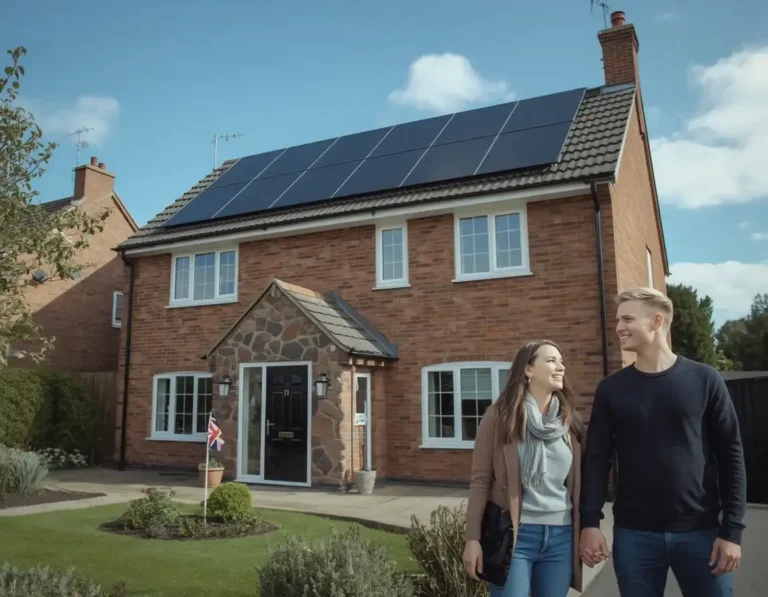
Selling a House With Solar Panels

Selling a House With Solar Panels: The Document Pack Your Buyer’s Solicitor Will Ask For
I’ve sat on both sides of this table — advising sellers whose sale sailed through in six weeks, and others whose buyer’s solicitor spent three months chasing a single missing certificate. The difference is never the panels. It’s the folder. Here’s exactly what goes in it.
Selling with solar is straightforward when the paperwork sits in one folder, and slow when it doesn’t. Your buyer’s solicitor will want the MCS certificate, electrical and Building Regulations certificates, DNO approval, warranties, your FIT or SEG contract — plus the roof lease if the panels were “free”. Most delays come from missing paper, not the panels themselves. Here’s the exact pack, and how to replace anything you’ve lost before it stalls your sale.
⚖️Why your buyer’s solicitor cares about your roof
It’s not curiosity. Two formal obligations put solar panels squarely in the conveyancing file.
First, the TA6 property information form — the 5th edition, in use since 2024 — includes renewable energy enquiries, so you must disclose the installation, who owns it and what subsidy arrangements sit on it. Second, your buyer’s mortgage lender works to the UK Finance Lenders’ Handbook, which requires consent to any lease over roof space and sets minimum protections a solar lease must contain before a lender will lend against it. Between those two, solar stops being a selling point and becomes a legal item — and legal items run on documents.
The good news: for an owned system with tidy paperwork, this adds almost nothing to the timeline. Solicitors and conveyancers I speak to say the same thing — friction is nearly always missing paper or a lease, never the panels themselves.
📁The nine-document pack, in the order they’ll ask
Print this table, stick it on the fridge, and gather one row per weekend. You’ll be ready before the photos are taken.
| # | Document | Who issues it | Why the solicitor wants it | If you can’t find it |
|---|---|---|---|---|
| 1 | MCS certificate | Your installer, via the MCS scheme | Proves certified products and installer; without it the buyer cannot register for SEG export payments | Duplicate from the installer or the MCS helpdesk (small admin fee) |
| 2 | Electrical Installation Certificate (BS 7671) + Building Regulations compliance certificate | Installer and their competent-person scheme (NICEIC, NAPIT etc.) | Evidence the electrical work is safe and legally compliant; lenders’ valuers check it | Duplicate from the scheme provider; regularisation via the council as a last resort |
| 3 | DNO connection approval (G98/G99 confirmation) | Your district network operator | Confirms the system was legally connected to the grid at the right capacity | Request a confirmation letter from the DNO, quoting your address and install date |
| 4 | Planning permission — or confirmation none was needed | Local planning authority | Only bites on listed buildings, conservation areas or large ground mounts; solicitors ask anyway | A certificate of lawfulness from the LPA settles it |
| 5 | Panel product & performance warranties, inverter warranty (battery too if fitted) | Manufacturer and installer | Shows the buyer how many years of cover remain — typically 25-year performance on panels | Manufacturers reissue from serial numbers; see our guide to how long solar panels last |
| 6 | Maintenance and service records | Installer or your own logs | Evidence the system was cared for; supports the valuation and the buyer’s confidence | Export your monitoring history instead — see our monitoring systems guide |
| 7 | FIT or SEG contract + recent statements | Your energy supplier | Shows the income the buyer inherits (FIT) or can re-register for (SEG) | Supplier can reissue statements; the contract reference is what matters |
| 8 | Roof lease / rent-a-roof agreement + any Deed of Variation | Solar company and your solicitor | Only if panels are leased — the lender’s Handbook check hinges on this document | Copy from the leaseholder, or the registered lease from HM Land Registry |
| 9 | EPC + buildings insurance schedule naming the panels | Assessor and insurer | EPC shows the band uplift the buyer is paying for; insurance proves the array is covered | Book a fresh EPC; ask your insurer for a schedule extract |
It’s the single document everything else hangs from: proof the system was installed to MCS standards by an MCS-certified business, which is what our MCS certification explainer calls the backbone of UK domestic solar. Lose every other page and the sale survives; lose this and the buyer’s export income disappears with it.
💷FIT vs SEG: what actually transfers on completion
Sellers mix these up constantly, and the difference changes what you hand over.
If your system earns the old Feed-in Tariff — closed to new applicants from 1 April 2019, but existing contracts run 20 to 25 years — the payments transfer with the installation. The buyer completes the supplier’s change-of-ownership form and picks up the payments from completion date. Your job is to hand over the FIT contract, the supplier’s account reference and a couple of recent statements so they can do it without chasing you post-completion.
The Smart Export Guarantee works differently: it doesn’t transfer at all. The buyer registers fresh with whichever supplier they like, and the MCS certificate is their ticket in. That’s worth saying out loud to your buyer’s agent, because it turns your paperwork into their income — and it’s why our SEG tariff comparison is a genuinely useful link to pass on with the keys.
🏠If your panels are leased: a different sale entirely
Rent-a-roof leases from roughly 2010–2015 are registered against the title and follow the house. This is the one solar issue that can genuinely stall a transaction.
The mechanics — and the fixes — are covered in depth in our guide to the free solar panels that could stop you selling your house, so I won’t repeat it all here. What belongs in this pack is the paper trail: the original lease, every Deed of Variation signed since, the current leaseholder’s name (portfolios get sold on), and written confirmation of who receives the FIT income. If the lease predates lender-standard clauses, budget for a Deed of Variation before you market, not during:
| Route | Typical cost | Typical timescale |
|---|---|---|
| Deed of Variation (bring the lease up to lender standard) | ~£500 + VAT solicitor fee, plus £180–£250 solar-company admin fee | 2–6 weeks |
| Switch to a less fussy lender | No extra fee, possibly a worse rate | Days to a few weeks |
| Buy the system outright | Varies hugely; can reach five figures with many lease years left | Negotiation-dependent |
| Do nothing | Free | Until it surfaces mid-mortgage-application |
Ten minutes on GOV.UK’s property and land information search (or Registers of Scotland north of the border) tells you whether a lease sits over your roof space. Doing it before you instruct an agent turns a six-week mid-sale crisis into a pre-listing admin task.
🔍Missing paperwork? The fix routes, and how long each takes
Every gap has a route. The only real variable is how early you start.
Start with the MCS certificate, because it’s the one with a formal route: request a copy from your original installer, or from MCS directly if they’ve stopped trading — the scheme keeps an installation database and issues duplicates for an admin fee, with proof of address. Their certificate request service is the official channel. Electrical and Building Regulations certificates come back quickly from scheme operators like NICEIC or NAPIT, who archive certifications. DNO letters are slower simply because they’re manual requests into archive systems.
One honest caveat: if a document can’t be produced at all, solicitors sometimes settle for a missing-document indemnity insurance policy instead. It’s a legitimate tool, but it’s a sticking plaster — buyers’ lenders don’t love it, and it’s always cheaper to find the paper.
✅The pre-market checklist I give my own clients
Assemble the pack 8–12 weeks out
Before the agent’s valuation, not after the first offer. Every replacement route above fits inside that window comfortably.
Export 24 months of generation data
A PDF from your monitoring app is the cheapest marketing asset you own — it turns “has solar” into “saves £X a year, proven”.
Book an overdue service now
A fresh service report in the pack answers the buyer’s “was it maintained?” enquiry before it’s asked. Our maintenance checklist shows what a proper visit covers.
Search your own title
GOV.UK’s Land Registry search confirms owned-vs-leased beyond argument, and catches any registered charge you’d forgotten.
Refresh the EPC if it’s stale
The band uplift is half your value story; an expired certificate wastes it. Solar plus battery scores well under the smarter-readiness metrics arriving with the 2026 EPC reforms.
Brief the estate agent properly
Give them the pack summary and the generation PDF. An agent who can answer “is it owned, and what does it earn?” on day one filters out time-wasting enquiries.
🔋Batteries, diverters and other extras join the pack too
If you added storage later, its paperwork rides along: battery warranty, the installer’s electrical certification for the storage circuit, and any evidence of how it was configured. Buyers’ solicitors treat a battery as a separate asset with its own compliance trail, so a retrofit done on a handshake will generate enquiries even when the panels themselves are spotless. Our guide to adding a battery to existing solar panels lists the certification a proper retrofit should have handed you — check you’re holding all of it before you list.
📈What all this paperwork is actually protecting
It’s easy to file this whole exercise under “conveyancing boredom”, so here’s the number that should keep you at it: the peer-reviewed 2024 Swansea University and University of Birmingham study, which matched around five million Zoopla listings against HM Land Registry’s official Price Paid Data, found solar homes selling for 6.1–7.1% more — roughly £14,000–£16,000 on an average UK home — with other, less recent studies ranging from around 1% up to 14% in strong markets. That premium applies specifically to owned systems; the same body of research and conveyancing practice both note leased “rent-a-roof” systems can drag on a sale rather than lift it. Our house-value analysis breaks down why the EPC band jump does much of the heavy lifting.
That premium only crystallises if the sale completes cleanly. Every week of solicitor churn is a week your buyer has to reconsider — and reconsidering buyers negotiate. The pack isn’t bureaucracy; it’s the fence around your uplift. And on the flip side, if you’re the one buying rather than selling, our guide to buying a house with solar panels is the mirror image of this one: same nine documents, demanded rather than supplied.
🧭 My honest verdict
- Owned system, papers in order? Expect solar to be a non-event in conveyancing — a selling point, a better EPC, and a measurably higher price. Spend one weekend building the folder and forget about it.
- Owned system, papers scattered? Start replacements 8–12 weeks before listing. The MCS certificate first, always — everything else is recoverable faster.
- Leased system? Get the lease reviewed against current lender requirements before marketing, and price a Deed of Variation into your plans. Discovering it at mortgage-application stage is how sales die.
- The one habit worth keeping: store the pack digitally as well as on paper, and hand the buyer a copy at completion. It’s the kindest thing one solar owner can do for the next — and it’s exactly what I’d want in the envelope.
❓Frequently asked questions
What documents do I need to sell a house with solar panels in the UK?+
The core pack is nine items: the MCS certificate, the electrical installation certificate and Building Regulations compliance evidence, the DNO connection approval (G98 or G99), planning permission if it was ever needed, panel and inverter warranties, maintenance and service records, your FIT or SEG contract and recent statements, the roof lease plus any Deed of Variation if the panels are leased, and your EPC. Owned systems rarely need anything beyond the first seven.
Do FIT or SEG payments transfer to the buyer when I sell?+
FIT payments do, with a bit of admin: the scheme closed to new applicants on 1 April 2019 but existing contracts run for 20 to 25 years and transfer to the new owner via the supplier’s change-of-ownership form, usually from completion date. SEG does not transfer automatically — the buyer re-registers with a supplier of their choice using the MCS certificate, so keeping that certificate safe directly protects their export income.
Can missing solar paperwork stop my house sale?+
Rarely stops it, often slows it. A missing MCS certificate or electrical certificate usually triggers extra enquiries and sometimes a buyer’s lender asking for indemnity insurance or retrospective certification, adding weeks rather than killing the deal. The genuine sale-stopper is an unregistered or non-compliant rent-a-roof lease, which is why checking your title before you list is the single most valuable hour you can spend.
Key sources: MCS certificate request and queries pages (mcscertified.com) and the MCS installation database; Ofgem Feed-in Tariffs generator guidance (scheme closure 1 April 2019) plus supplier change-of-ownership processes (OVO, Good Energy) and Which? FIT and rent-a-roof guidance; UK Finance Mortgage Lenders’ Handbook, solar panels and roof-space lease requirements; TA6 Property Information Form, 5th edition (2024) renewable-energy enquiries; conveyancing guidance on solar documentation (Muve, Propelr, MJP, Lexology practice notes, 2025–26); Asproudis, Gedikli, Talavera & Yilmaz, “Returns to solar panels in the housing market,” Energy Economics (2024), via Swansea University / Urban Big Data Centre, and HM Land Registry Price Paid Data; GOV.UK Land Registry property search guidance. Site figures cross-checked against our own leased-solar, buyer’s guide and house-value pages, September 2026.