
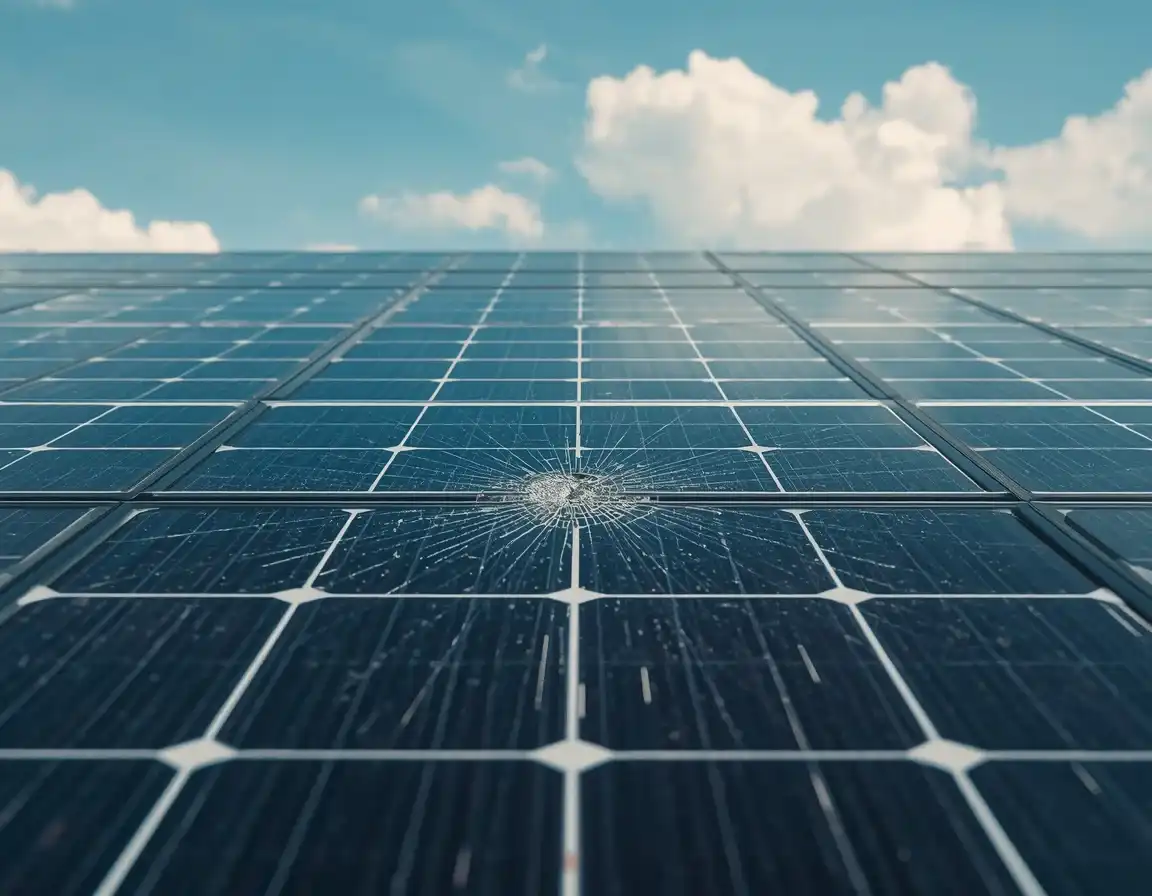
Cracked Solar Panel: Is It Safe, Is It Covered, and What Does Replacement Cost?

Cracked solar panel UK: is it safe, is it covered, and what does replacement cost?
The short version
A cracked panel rarely stops working — it starts losing value and, sometimes, safety. Switch off at the AC side first, then the DC isolator, and keep clear: the panel and the roof cabling stay live in daylight. Photograph everything and call your insurer before anyone climbs a ladder. Storm, hail, falling-branch and vandalism damage is usually a buildings-insurance claim; accidental damage often isn’t covered unless you’ve added it; and manufacturer warranties cover defects, not impacts. The panel itself costs £70–£150. A fitted swap is typically £250–£500 without scaffolding and roughly £550–£1,400 with it. Micro-cracks are the silent ones — a panel-level test or thermal survey finds them.
A cracked solar panel is one of those faults that looks small from the ground and isn’t. I’ve seen plenty over the years — hail nights, scaffold poles dropped by roofers, a gull with terrible aim, and once a garden trampoline in a storm — and the pattern is always the same: the homeowner worries about the glass, while the real issues are electricity, paperwork and access costs. Here’s the full picture in the order you actually need it: is it safe, what kind of crack is it, who pays, and what the fix costs in 2026.
Is a cracked solar panel safe? Do these five things first
- Keep clear, and keep others clear. Don’t touch the crack, don’t peel glass shards, don’t spray it with a hose to “clean it up”, and don’t let anyone walk across the roof or stand beneath loose glass. Water getting into a breached panel is exactly what turns a cheap swap into a fault-finding job.
- Switch off AC first, then DC. Flip the solar breaker at the consumer unit and the AC isolator beside the inverter, then turn the DC isolator on or under the inverter to OFF. Check the display goes dark. If you have a battery, follow its manual for its own isolator. Our step-by-step shutdown guide shows where each switch usually sits.
- Remember the roof side stays live in daylight. This is the bit that surprises people. Switching off protects the inverter side, but the panels and the cable running down to the DC isolator keep generating whenever light hits them. A cracked panel with exposed conductors is a live component, and fully isolating the array is a qualified installer’s job.
- Photograph everything. Wide shot of the roof, close-ups of the crack, the inverter display and any fault code, a screenshot of your monitoring app, and any obvious cause (fallen branch, hail dents elsewhere, recent works next door). Insurers and installers both run on photos.
- Book an inspection, not a repair. Tell your insurer first if an event caused the damage, then call an MCS-certified installer to assess whether it’s one panel, a string issue or hidden damage elsewhere. If your original firm has vanished, use the MCS installer finder or our find an installer page, and keep the paperwork trail: it matters for both warranty and export income.
⚠️ When to treat it as an emergency
If you see smoke or flames, or smell burning, get everyone out and call 999. Don’t go on the roof, and don’t restart anything until an installer has inspected it. Scorch marks, buzzing or clicking from the array, or a cracked backsheet (the layer on the underside) all point towards arcing rather than simple breakage: switch off if it’s safe to do so and get same-day professional attention. It’s rare, but it’s the case that makes the rest of this article worth reading calmly. Our guides to UK solar panel fires and the insurance small print after a solar fire cover what follows.
Crack types: what each one actually means
| What you see | Likely cause | Risk level | Sensible action |
|---|---|---|---|
| Hairline crack across the glass, panel still producing | Impact, thermal stress or load (snow, foot traffic) | Medium to high — the seal is breached, so moisture and hot spots develop over weeks to months | Get it inspected promptly and plan a replacement rather than waiting years; watch output weekly |
| Small edge chip or corner flake | Ladder contact, debris, handling | Low to medium — matters if moisture can reach the cells or backsheet | Professional assessment, with the finding in writing |
| Shattered or spider-webbed glass | Hail, falling object, vandalism | High — water entry is guaranteed with the next rain | Isolate, keep clear and replace; report to your insurer today, not someday |
| Burn mark, brown spot or bubbled backsheet | Cell hot spot, arc damage, delamination or a manufacturing fault | High — fire-risk territory | Isolate if safe and get a same-day inspection; smoke or burning smell means leave and call 999 |
| Bent frame with intact glass | Snow load, impact, mounting stress | Medium — structural and seal risk | Inspect the mounting and neighbouring fixings, then replace; see our snow and ice damage guide |
The unifying principle: glass is the panel’s waterproofing. Once it’s breached, every rainfall pushes moisture towards live circuitry, and moisture plus DC voltage is how hot spots and tracking faults start. That’s why “it’s still working fine” is never the end of the conversation. Storms are the commonest trigger; our guide to what happens to panels in a major storm explains what to expect.
The cracks you can’t see: micro-cracks
Micro-cracks are hairline fractures in the silicon cells themselves, invisible from the roof and often from the ground too. They arrive through foot traffic during installation or cleaning, snow loads, transport shocks and years of thermal cycling — and they can grow. A micro-cracked cell loses output gradually and can become a hot spot, so the usual symptom is a panel or string that slowly falls behind its neighbours with nothing visibly wrong.
Detection is a job for instruments, not eyes. Panel-level data from optimisers or microinverters shows a lagging module straight away. On a plain string system, an installer can run a performance test (our repair guide puts a microcrack diagnosis at roughly £100–£250), and thermal imaging picks out hot cells when the array is working under bright, steady sunlight. Electroluminescence imaging, usually done off the roof with specialist kit, shows the fracture map directly. If your monitoring shows output dipping since a storm or a roof visit, ask for a test before you accept “panels degrade, it’s normal”. Our guide to solar panels underperforming walks through the same diagnostic ladder from the other direction.
Who pays depends on the cause. Micro-cracks from a manufacturing defect fall under the product or performance warranty, and cracks made by an installer’s foot traffic are a workmanship matter, but damage from your own cleaning or a roofer’s boots is not covered by either. That’s one more reason to photograph your array and keep monitoring screenshots from the first week of installation.
What one cracked panel costs you in lost generation
Panels wired in series behave like a chain: current is set by the weakest link. On a conventional string-inverter system, a damaged panel can pull down the panels it shares a string with — how much depends on its bypass diodes and the layout. On systems with power optimisers or microinverters, the loss stays local to the affected panel, which is one of the quiet arguments for that hardware on bad-luck days. Our micro inverter vs string inverter guide compares the two properly.
The money is easy to underestimate because a string inverter only measures what arrives at the unit, so a silently underperforming panel triggers no alarm. As our string monitoring ranking explains, one such panel can cost 200–600 kWh a year, roughly £150 at current prices. For scale, a mainstream 450 W panel generates around 400–450 kWh a year on a typical UK roof, in line with the 3,500–4,000 kWh we quote for a 4 kW system; our panel-count guide has the per-panel maths if you want to price your own array’s exposure. A “small” crack left for a year is therefore real money, before you count the safety side.
Who pays: insurer, manufacturer, installer or you?
| Cause | Usual route | Watch-outs |
|---|---|---|
| Storm, hail, falling branch | Buildings insurance (panels are treated as part of the property) | Check how your policy defines “storm” — some insurers only pay above a set wind speed, often around 55 mph — and whether the excess exceeds a one-panel repair |
| Vandalism or theft damage | Buildings insurance, with a police crime reference | Report to the police first; roof theft cover varies by policy. See our theft and vandalism guide |
| Accidental damage (ladder, window cleaner, a dropped tool) | Only if your policy includes accidental damage, or the tradesperson’s liability insurance | Roughly one in five UK buildings policies includes accidental damage as standard; the rest charge extra. Get contractor admissions in writing on the day |
| Cracked by your original installer or their subcontractor | The installer’s workmanship warranty | Only valuable if the installer still trades, or the guarantee is insurance-backed |
| Spontaneous glass breakage, delamination, hot spots or cracked cells with no impact | Manufacturer product warranty | Needs install records and photos; claims usually run through the installer. Consumer Rights Act rights against the seller can also apply for up to 6 years (5 in Scotland) |
| Output falling below the guaranteed curve | Manufacturer performance warranty | Covers generation, not impact damage; you’ll need monitoring data |
| Age-related wear, no single event | Usually you | Weigh a one-panel swap against the economics of the whole string |
| Panels owned by a finance or lease company | Check your agreement | The owner may carry the repair and insurance duty, and may need to approve who does the work |
The distinction that catches everyone out: product warranties cover defects; insurance covers events. A long product warranty is worthless against a hailstone, because impact, hail and vandalism are excluded from manufacturer terms — they are buildings-policy perils instead. And “impact” isn’t automatically an insured event either: a branch brought down by a storm is one thing, while your own ladder or a roofer’s dropped tool is accidental damage, which many policies treat as an optional extra. Our solar panel insurance guide and warranty guide go deeper on both sides of that line.
Three practical points. First, if you never told your insurer about the panels, tell them now: failing to declare a significant change can put your whole policy at risk, not just this claim. Second, notify the insurer before repairs are booked, keep the installer’s damage report, and photograph the cause as well as the crack; insurers frequently ask for your MCS certificate and warranty paperwork. Third, on warranty claims, go to your installer first, because most claims are processed through them — and if they have closed, our installer gone bust guide explains the fallback routes.
🧾 The excess arithmetic
If your policy excess is £250 and the all-in repair is £450, claiming saves you £200 but puts a claim on your record and may affect renewal prices. Run the numbers before dialling the insurer — but do dial them if there’s any chance of further damage (more hail, water ingress into the roof structure) or if scaffolding makes the bill large, because consequential loss is where policies earn their keep.
What replacing a cracked solar panel costs in 2026
Single cracked panel: typical UK cost bands, 2026
Bands from our solar repair cost guide: module £70–£150, fitted swap with roof access £250–£500, scaffolding £300–£900 (so £550–£1,400 all-in), diagnosis £100–£250, call-out £80–£150. Bar length shows the top of each range. Removing and refitting a whole array for a re-roof is a different job at £1,300–£2,500 (see our removal cost guide).
Three drivers decide where you land in those bands. The module: a mainstream 400–450 W panel retails at roughly £70–£150 in 2026, while premium ranges such as REC and Maxeon run higher, as our panel pricing guide shows — the cheap part, always. Labour: a like-for-like swap is a couple of hours’ work for a two-person team, including isolation, swap, recommissioning and testing. Access: the swing factor. Ground-floor or single-storey arrays can sometimes be reached without scaffold; two-storey roofs usually can’t, and that’s when the £300–£900 scaffold line appears. Working at height on a pitched roof without proper protection is a leading cause of serious injury in UK trades, so scaffold isn’t really optional on most homes.
If roof work is already planned, sharing one scaffold hire between the roofer and the solar installer is the single biggest saving available, often £300–£700. The same goes for any removal: a panel found cracked during roof work typically costs £100–£300 to repair before refit.
Two wrinkles affect price and paperwork. First, matching: if your panel model is discontinued, a true like-for-like may be impossible, and mixing electrically mismatched modules in one string can cost output, so installers sometimes recommend swapping a pair or adding optimisers — get the reasoning in writing. Second, VAT: the 0% rate (5% after 31 March 2027) applies to installing new energy-saving materials, not to repairing a system that’s already running. A single-panel swap is therefore generally standard-rated at 20%. Some installers treat a brand-new replacement module as qualifying material and apply the lower rate, but that isn’t guaranteed, so ask for the VAT treatment in writing before you book. HMRC sets out the rules in VAT Notice 708/6, and our grants and VAT guide has the wider picture.
Replace, repair or monitor? The honest decision tree
- Shattered glass or breached backsheet: replace. No repair restores the seal, and every week of delay is water into live circuitry.
- Any crack through the front glass: treat it as replace-soon, not replace-eventually. The seal is breached, so give yourself weeks, not years, and watch generation weekly in the meantime.
- Small edge chip: get a professional assessment. A chip that lets moisture reach the cells or backsheet means replace; one that doesn’t can be recorded and rechecked at your next service.
- Micro-cracks found by a test or thermal survey: weigh the lost generation against the replacement cost. On unoptimised strings the maths often favours swapping sooner, and if the cause was a defect, the warranty may cover it.
- Resin or DIY crack kits: skip them. They obscure the damage, can void warranty positions, trap moisture behind the sealant and turn a simple swap into a forensic job for the next engineer.
Whichever route you take, keep the paperwork chain unbroken: the installer’s damage report, photos, insurer correspondence, the replacement module’s serial number and warranty registration, and an updated system document set. If your system’s capacity changes as part of the work, tell your SEG supplier rather than waiting for an odd-looking payment. The old panel is electrical waste, so it must not go in a skip: the installer should take it away, and our guide to what happens to old solar panels explains the recycling side.
✅ The one-paragraph summary
Isolate it, keep clear, photograph it, work out whether it’s an insurance or a warranty matter, then replace it with an MCS-certified installer. A cracked panel is typically a £250–£500 job without scaffolding and £550–£1,400 with it, and your insurer’s excess and policy wording decide how much of that is yours. The only genuinely expensive cracked panel is the one left on the roof for two years, quietly dragging down generation and letting water in.
Frequently asked questions
Is a cracked solar panel safe to leave on the roof?
Usually stable but not risk-free. A cracked panel keeps generating and can develop hot spots, arcing or water ingress once the glass or backsheet is breached. Switch off at the AC side first and then the DC isolator, keep people away from the damaged area and book a professional inspection. Don’t tape, hose or walk on it. Isolating protects the inverter side only: the panel and the cable to the DC isolator stay live in daylight. If there is smoke or a burning smell, leave and call 999.
Will insurance or the manufacturer’s warranty pay for a cracked panel?
It depends on the cause. Storm, hail, falling-branch and vandalism damage is normally a buildings-insurance claim, but accidental damage, such as a dropped tool or a ladder strike, is often an optional extra. Manufacturer product warranties cover defects in materials and workmanship, and exclude impact, hail and vandalism. Check your policy schedule, keep photos and the installer’s report, and notify your insurer before arranging repairs.
How much does it cost to replace one cracked solar panel in the UK?
The panel itself is the cheap part, roughly £70 to £150 for a mainstream module in 2026. A fitted like-for-like swap with roof access typically costs £250 to £500. If scaffolding is needed, which adds £300 to £900, expect roughly £550 to £1,400 all in. Sharing scaffold with other roof work can save £300 to £700. A diagnosis or performance test adds £100 to £250.
Should I keep using my solar system with a cracked panel?
If the glass is shattered, the backsheet is breached or there is any scorching, buzzing or burning smell, keep the system switched off until an installer has inspected it. For a minor crack, switching off and arranging a prompt inspection is the safest course, because water ingress can turn a stable crack into a hot spot over weeks. Either way, watch your monitoring app for output drops and don’t go on the roof yourself.
Can you repair a cracked solar panel?
In practice, no. Once the front glass or backsheet is breached, no sealant restores the waterproofing, and resin or DIY kits can trap moisture, hide the damage and complicate warranty claims. The reliable fix is to replace the module. Ask your installer whether an exact match is still available, or whether swapping a pair or adding optimisers makes sense for your string.
How much electricity does a cracked solar panel lose?
It varies from almost nothing to a large share of that panel’s output, and on a string without optimisers it can pull down its neighbours too. A single silently underperforming panel can cost 200 to 600 kWh a year, roughly £150 at current prices, with no alarm to warn you. Check your monitoring data for a panel or string that lags behind, and ask for a performance test if output has dipped since a storm or roof visit.
Do I pay VAT on a replacement solar panel?
Usually yes, at 20%. The 0% VAT rate on domestic solar, which becomes 5% after 31 March 2027, applies to installing new energy-saving materials, not to repairing a system that’s already running. Some installers treat a brand-new replacement module as qualifying material and apply the lower rate, but that isn’t guaranteed, so ask for the VAT treatment in writing before you book.
Sources: SolarBriton’s repair cost, removal cost, insurance, warranty and panel pricing guides (2026); HMRC VAT Notice 708/6; GOV.UK consumer rights guidance. Costs are indicative UK 2026 ranges, not quotes: get written quotes that itemise scaffolding, labour, VAT and disposal separately, and confirm cover with your own insurer.


One Comment