Solar Panel Removal Cost UK 2026

Solar Panel Removal Cost UK 2026: The Hidden Cost of Removing Solar Panels — What Installers Won’t Tell You Before You Buy
Nobody quotes you for the day the panels come down. I’ve spent two decades around solar kit, and the removal bill is the single most surprised I’ve ever seen a homeowner look. Here’s every number, in plain English, before it catches you out.
Here’s a story I hear at least once a month. A homeowner gets a tidy little quote — “£380 to take the panels down” — and six weeks later they’re staring at a bill four times that size, because nobody mentioned the scaffold, the roof make-good, the new mounting kit or the disposal run. The removal job is the solar industry’s quiet blind spot: installers sell you a 25-year marriage and quietly hope you never ask about the divorce settlement.
So let’s ask. Every figure below is a real 2026 UK trade price, checked against installer quotes and scaffolding rate guides this month — and cross-checked so it lines up with what we publish elsewhere on SolarBriton.
01.💷 The 60-second cost snapshot (2026)
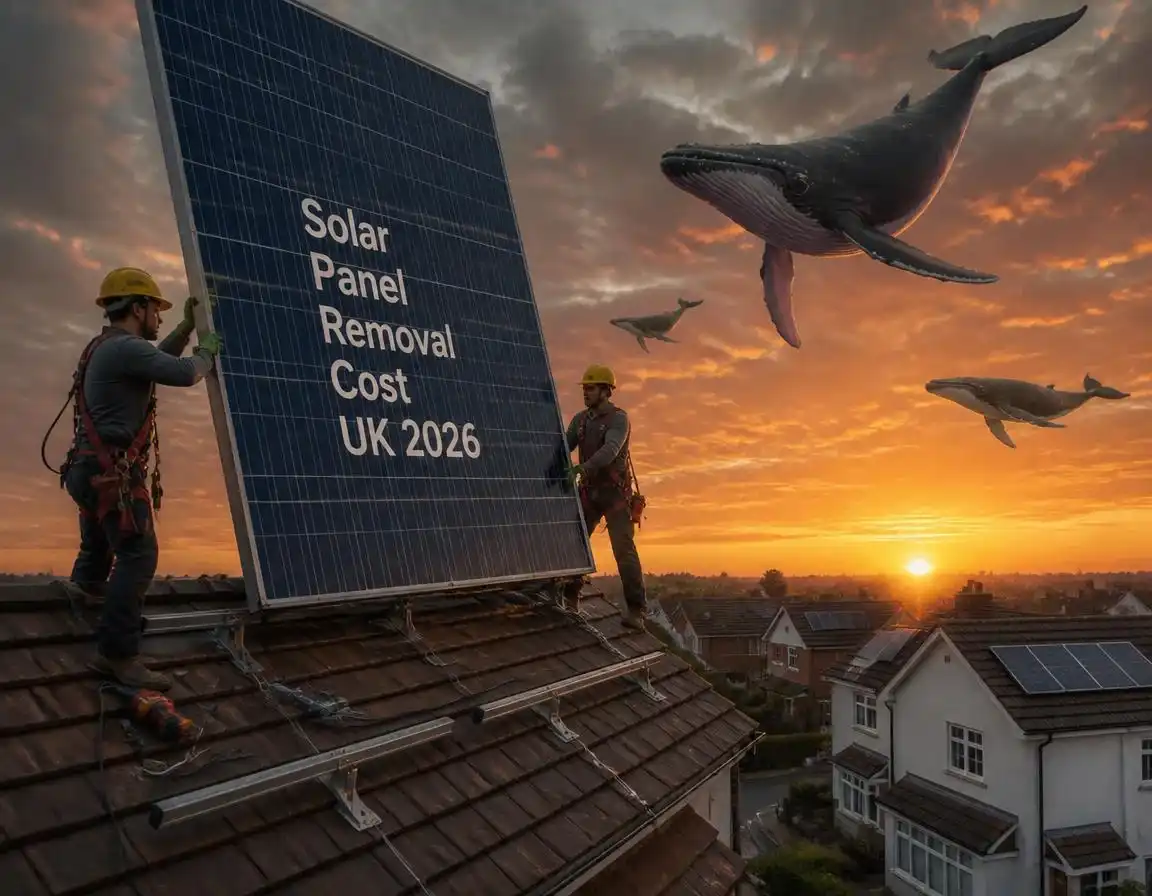
Professional solar panel removal in the UK typically costs £300–£600 for labour alone on a standard home system, and £700–£1,500 once access equipment joins the party. If you’re removing and refitting for a new roof, budget £1,300–£2,500 all-in. Here’s the full picture:
| Job | What’s included | Typical cost |
|---|---|---|
| Removal only, ground/single-storey access | Disconnection, panel & mount removal, no scaffold needed | £300–£600 |
| Removal with scaffolding | As above, plus scaffold hire & erection for upper-storey access | £700–£1,500 |
| Remove, store & reinstall (re-roof job) | Removal, temporary storage, new fixings, reinstallation, recommissioning | £1,300–£2,500 |
| Permanent decommission, small commercial | Removal, disconnection, WEEE-compliant collection coordination | £2,000–£4,500 |
| Recycling itself, under WEEE Extended Producer Responsibility | £0 | |
02.🧾 What you’re actually paying for
A removal quote isn’t one job, it’s five smaller ones stitched together. Here’s roughly how a typical £900 scaffolded removal actually splits:
- Scaffolding hire & erection — ~39%
- Panel & mount removal labour — ~28%
- Electrical disconnection by a qualified person — ~21%
- Roof tile check & minor repair — ~12%
Illustrative split for a typical scaffolded domestic removal — your own job’s proportions will shift depending on roof access and whether repairs are needed.
Disconnecting the inverter from your consumer unit is the same “notifiable work” under Part P of the Building Regulations that applies when a system’s first installed — it needs a registered competent person or Building Control sign-off, whichever end of the job you’re doing. That’s true for taking a system apart as much as putting one together.
03.🏠 Real-life scenarios & total bills
Cost guides quote ranges; real jobs have specifics. Here’s how four common situations tend to land:
Scaffold shared with the roofer, panels removed and stored on-site for two weeks, reinstalled on new tiles with fresh fixings, recommissioned.
Old 250W panels swapped for 400W+ units without adding roof area — removal, disposal of the old panels, and new install rolled into one visit.
Full removal, safe transport, and a fresh install at the new address — plus a new MCS certificate and DNO application, since the old one doesn’t transfer.
Straightforward removal and WEEE-compliant collection for a 20-year-old system that’s reached the end of its working life, with no reinstall.
04.✂️ How to cut your removal bill
Combine it with roofing work. Sharing one scaffold hire between the roofer and the solar installer is the single biggest saving available — often £300–£700 off the total, since scaffold hire is charged once instead of twice.
Get three quotes, not one. Removal pricing varies more than installation pricing, because there’s less standard pricing data for installers to benchmark against — quote spreads of 20%+ on the same job aren’t unusual.
Sell panels that still work. A functioning 10-year-old system still has real value to off-grid, shed and outbuilding buyers — recovering even £200–£400 meaningfully offsets the removal bill.
Book outside peak season. Installers and scaffolders are quieter in autumn and winter; some will shave 5–10% off a removal-only job when it isn’t competing with their busy spring and summer install schedule.
05.🕵️ 7 hidden costs installers rarely mention
Roof tile replacement
Older tiles often crack when mounting brackets are unbolted. Budget £100–£300 for like-for-like replacement if your roof covering is more than 15 years old.
New mounting hardware
Old rails and hooks are rarely reused on a reinstall — most installers fit new ones as standard, and it’s frequently not itemised separately until the invoice.
Storage while roof work happens
If panels sit off the roof for more than a few days, some installers charge £0–£200 for secure storage — worth asking upfront whether it’s included.
Fresh DNO notification
Reinstalling isn’t always a simple “switch back on” — depending on your network operator, a fresh G98 or G99 notification can carry a £0–£420 admin fee.
Recommissioning & MCS re-certification
Getting a fresh Electrical Installation Certificate and MCS paperwork after reinstallation typically runs £100–£200, and it’s what keeps your SEG eligibility intact.
Difficult access surcharges
Steep pitches, awkward parking for the scaffold lorry, or a listed building needing extra care can add 10–25% to the base quote.
Panel repair before refit
Cracked glass or a damaged junction box found during removal needs fixing before reinstallation — typically £100–£300 per panel affected.
06.🛠️ DIY removal: legal, safe, sensible?
Same split as installation, really. You can legally handle plenty of the physical work yourself — unbolting accessible ground-floor panels, for instance — but two things push most people towards a professional for a full removal:
Disconnecting the inverter from your consumer unit is notifiable electrical work under Part P, requiring a registered competent person or Building Control sign-off — exactly the same rule that applies when a system’s first installed. And working at height on a pitched roof without proper edge protection is one of the leading causes of serious injury in UK trades, which is precisely why scaffolding isn’t really optional on most homes.
The realistic middle ground: many homeowners handle the panel unbolting and cable coiling themselves to shave labour hours off the quote, then bring in a qualified electrician purely for disconnection, and a scaffolder for safe access. Ask any installer upfront whether they’re willing to price just the electrical and access-safety portion of the job — not all will be, but plenty are.
07.♻️ Disposal: the law & the free bit
Solar panels are classed as WEEE (Waste Electrical and Electronic Equipment) under UK law, so they legally can’t go in a skip, a general waste bin, or off with a scrap dealer. Under the WEEE Regulations’ Extended Producer Responsibility rules, the company that originally placed your panels on the UK market — the manufacturer or importer — is financially responsible for collecting and recycling them, usually through a Producer Compliance Scheme such as Recolight or a Solar Energy UK-affiliated scheme. In practice, that means the recycling itself should cost you nothing.
What you do pay for is getting them off your roof and to a licensed collection point — labour, transport, and coordination. If your original installer has since gone out of business, which isn’t unusual given panels can outlast a small installer by decades, you can contact a Producer Compliance Scheme directly or use any licensed WEEE waste carrier; check the Environment Agency’s public register if you want to verify a carrier’s licence before booking them.
The UK currently generates a relatively small amount of solar panel waste — estimated at 650–1,000 tonnes a year — because most UK installations are still under 15 years old, well short of a typical 25–30 year lifespan. That volume is expected to climb sharply from the mid-2030s as the early Feed-in Tariff-era boom reaches end of life.
08.📦 Moving house: leave them or take them?
Nine times out of ten, the answer is: leave them. Panels bolted to the roof and wired into the property’s electrics are generally treated as a fixture in UK property law, the same category a fitted kitchen or a boiler falls into — meaning they’re assumed to transfer with the house on sale unless the contract specifically says otherwise. Buyers also increasingly see solar as a value-add rather than clutter to strip out, so there’s rarely a financial incentive to take them with you.
Taking a system with you to a new property means paying full removal cost, plus a fresh install, plus a brand new MCS certificate and DNO application at the new address — your existing paperwork doesn’t transfer. Unless the system is brand new, high-spec, and the new property is a close match for roof orientation and size, the sums rarely work out in your favour.
09.✅ 6 questions to ask before you buy
Does the quote include scaffolding, or is that a separate line I need to source myself?
Who’s doing the electrical disconnection, and are they a registered competent person?
If I’m reinstalling, does the price include new mounting hardware, or will you reuse the old rails?
Will I get a fresh Electrical Installation Certificate and MCS paperwork afterwards?
If panels are coming off permanently, how are they being recycled, and can I see the WEEE carrier’s licence?
What happens to my warranty once someone other than the original installer has touched the system?
10.❓ Frequently asked questions
How much does it cost to remove solar panels in the UK in 2026?
Do I have to pay to recycle old solar panels in the UK?
Does removing solar panels void the warranty?
Costs & installation
Buying, selling & protecting your system
Sources: UK solar removal and scaffolding trade pricing guides (2026); Checkatrade roof replacement cost data; WEEE Regulations guidance from Solar Power Portal, Waste Experts and Recolight-affiliated compliance schemes; Environment Agency public carrier register. Cross-checked against SolarBriton’s own published VAT, MCS and DNO figures. This article is general information, not a formal quote — always get written quotes itemising scaffolding, electrical work and disposal separately before booking.