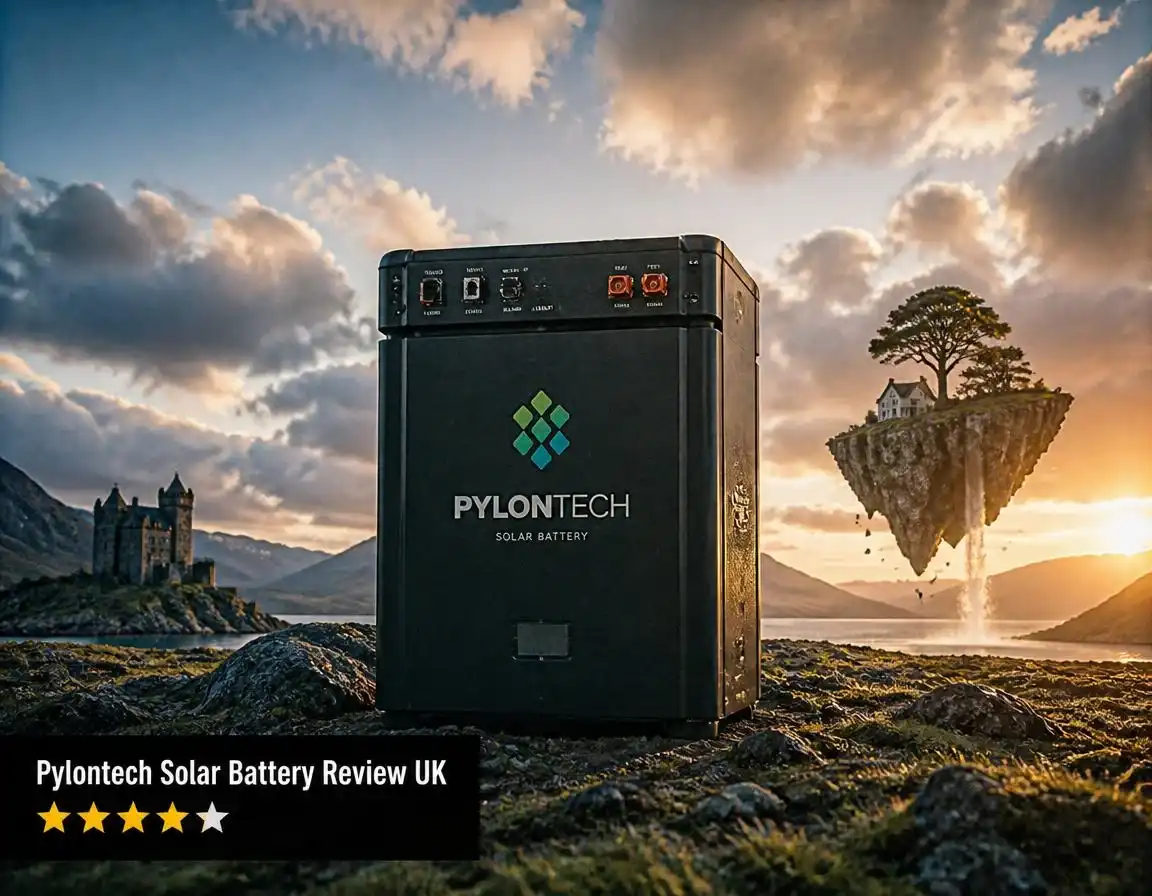
Pylontech Battery Review UK 2026

Pylontech Battery Review UK 2026: US5000 Specs, Price, Warranty & Verdict
⚡ The short version
The Pylontech US5000 (sold in the UK today as the US5000-1C) is still the default modular 48 V battery for UK retrofits: 4.8 kWh nominal and 4.56 kWh usable per module, LiFePO4 chemistry, 6,000+ cycles at 95% depth of discharge, and roughly £640–£900 ex VAT per module. It only works with low-voltage hybrid inverters such as Sunsynk/Deye, Solis, Growatt SPH, Victron and Lux Power, not with high-voltage or closed systems (Sungrow, Fox ESS H3, Tesla, Enphase). The warranty is 7 years, rising to 10 only if you register the battery. It is IP20, so it needs a dry, fire-separated indoor space, and none of the inverters it pairs with are on Octopus’s Intelligent Flux list, so you will run Agile and Flux by hand. For retrofits and engaged owners it is still a safe pick. For new installs where Octopus should run the battery, or where it must live outdoors, look elsewhere.
In the UK, the boring battery often wins, and the boring battery usually has one name: Pylontech. The US5000 is the module most often specified for retrofit stacks, largely because it speaks to so many low-voltage inverters. This review is built from Pylontech’s datasheet, its UK and EU consumer warranty, its official inverter compatibility list and live UK retailer listings, checked in October 2026. We have not load-tested a module ourselves, so performance figures here are datasheet figures, and prices are indicative.
Specs that matter (and two that don’t)
| Specification | Pylontech US5000 | Why it matters to you |
|---|---|---|
| Chemistry | LiFePO4 (lithium iron phosphate) | The safest mainstream lithium chemistry and the UK default for home batteries |
| Nominal / usable energy | 4.8 kWh (100 Ah) / 4.56 kWh at 95% depth of discharge | Budget on the usable figure, not the nameplate |
| Voltage | 48 V nominal (45–54 V range) | Pairs only with low-voltage (LV) inverters; high-voltage inverters need Pylontech’s separate Force-H range |
| Current and power | Recommended 50–80 A depending on datasheet revision; 100 A maximum continuous; 200 A peak for 15 seconds | Roughly 2.4–4.8 kW per module, so stacks share the load: one module cannot feed a 5 kW inverter at full power |
| Cycle life | Over 6,000 cycles at 25 °C, 95% DoD | The figure that sets lifespan, but only at 25 °C: heat shortens it |
| Design life | 15+ years at 25 °C (datasheet) | Longer than the warranty, which ends at 7 or 10 years |
| Scalability | Up to 16 modules in one group (72.96 kWh usable) | Start with two modules and grow later, if your inverter supports the group size |
| Communications | CAN, RS485 and RS232 (no wireless interface listed) | The module itself is not cloud-connected; any internet exposure comes from your inverter’s dongle |
| Operating temperature | Charge 0–50 °C; discharge −10 to 50 °C | An unheated garage in a hard frost can stop charging |
| Enclosure | IP20, 19-inch rack format, 442 × 420 × 161 mm | Indoor, dry space only; no outdoor wall mounting without a weather-rated enclosure |
| Weight | About 40 kg per module | Plan a two-person lift or a proper floor rack |
| Certifications | IEC 62619, UN38.3, CE | Ask your installer for the PAS 63100 statement of conformity for the installation as a whole |
US5000, US5000-B or US5000-1C?
All three are 4.8 kWh, 48 V modules with 4.56 kWh usable. The US5000-B adds a built-in circuit breaker. The US5000-1C is the revision UK retailers now stock: it raises the operating logic from 0.8C to 1.0C, so each module can deliver more continuous power. Ask your installer before mixing revisions in one stack.
Two figures on the brochure to treat with caution: peak (15-second) current, because your inverter lives on the continuous figure, and cycle-life claims quoted at different depths of discharge or temperatures. Compare batteries at the same DoD and temperature, otherwise you are comparing apples with oranges. Our best solar battery UK 2026 guide uses the same usable-kWh yardstick.
How many modules do you need?
| Modules | Usable energy | Typical fit (from our sizing guide) |
|---|---|---|
| 1 | 4.56 kWh | 1–2 bed, 1–2 people; low evening use. Limited power for a 5 kW inverter |
| 2 | 9.12 kWh | 3–4 bed family home; the usual retrofit starting point |
| 3 | 13.68 kWh | Larger homes, EV owners and heat pumps (similar capacity to a Powerwall 3) |
| 4+ | 18.24 kWh and up | Heavy users; check your inverter’s maximum battery group size |
What a US5000 costs in the UK in 2026
Module prices have fallen. UK retailer listings in October 2026 put a single US5000-1C at roughly £640–£900 ex VAT (about £770–£1,080 including 20% VAT), which is £140–£197 per usable kWh before brackets, cables and installation. Stock moves daily, so treat the table as a snapshot.
| Retailer listing | Ex VAT | Inc VAT | Stock when checked |
|---|---|---|---|
| Powerland | £640.83 | £769.00 | In stock |
| ITS Technologies | £678.00 | ~£813.60 | In stock |
| The Eco Supermarket | £700.00 | £840.00 | Out of stock |
| Plugin Solar | £730.00 | £876.00 | In stock |
| Renew Store | £899.00 | £1,078.80 | Sold out |
From module price to installed price
A US5000 is half a system. The other half is a compatible low-voltage hybrid inverter, mounting, cabling and fusing, and an MCS installer. Here is how a typical two-module stack (about 9.1 kWh usable) with a new 5 kW hybrid builds up:
| Item | Typical range |
|---|---|
| 2 × US5000-1C modules (ex VAT) | £1,280–£1,800 |
| Brackets, interconnect cables and DC fusing (brackets alone are about £42 a pair) | £150–£300 |
| 5 kW low-voltage hybrid inverter (ex VAT) | £900–£1,200 |
| Installation, commissioning, DNO paperwork and installer margin | £1,200–£2,200 |
| Estimated installed total | £3,500–£5,500 (about £385–£600 per usable kWh) |
Indicative installed cost per usable kWh, including inverter
Alpha ESS (9.6 kWh, £3,800–£5,200), Fox ESS (10 kWh, £4,800–£6,200) and Tesla (13.5 kWh, £8,500–£10,500) use the installed ranges in our best solar battery guide, divided by usable kWh. *The Pylontech bar is the £3,500–£5,500 estimate above divided by 9.12 kWh. Unlike the others, it needs manual tariff control (see below).
Two price facts that matter
VAT: installer-fitted battery storage in Great Britain is zero-rated until 31 March 2027, then 5% (HMRC notice 708/6). The “inc VAT” retail prices above include 20% VAT and apply to supply-only purchases, so do not compare them directly with an installed quote. See our grants and VAT guide.
Retrofit premium: adding a battery to an existing system typically costs 10–20% more than fitting it with the panels. If you already own a compatible LV hybrid, you only pay for modules and an installer’s visit; our retrofit guide costs the routes.
Inverter compatibility: low-voltage only, and check the model
The US5000’s strength is that Pylontech publishes a long compatibility list and the module talks to inverters over CAN or RS485. The catch the headline hides is voltage. The US5000 is a 48 V battery, so it only works with low-voltage battery inverters. Hybrid models with high-voltage battery inputs, and closed ecosystems, cannot use it, even when the brand name appears on the list for a different Pylontech battery.
| Inverter brand | US5000 support | What to check |
|---|---|---|
| Sunsynk / Deye | Yes | Low-voltage SUN-SG01LP1 and SG03LP1 families (the Sunsynk-badged versions). A very common UK retrofit pairing; confirm firmware and set the Pylontech lithium protocol |
| Solis | Yes (L-series) | Low-voltage models such as S5-EH1P-L, S6-EH1P-L / L-PLUS, S6-EA1P-L, S6-EO1P-48 and S6-EH3P-LV/NV-YD-L. Solis high-voltage “H” hybrids are not for the US5000 |
| Growatt | Yes (SPH 3000–6000) | The low-voltage SPH 3000–6000 family. Growatt’s high-voltage MIN-XH and ARK systems are a different product line |
| Victron | Yes | MultiPlus and Quattro 48 V via a GX device (CAN). An off-grid and backup favourite; mind the PV-charger notes on Pylontech’s list |
| SMA | Partly | Sunny Island battery inverters (off-grid and backup). Sunny Boy Storage needs Pylontech’s Force-H range instead |
| Lux Power | Yes | Low-voltage hybrids; a budget-friendly pairing |
| GoodWe, Sofar, SolaX | Model-specific | Only certain low-voltage models are listed. GoodWe’s EH/ET and Sofar’s three-phase HYD hybrids are high-voltage products |
| Sungrow SH (RS, RT, T) | No | High-voltage, and limited to Sungrow’s own SBR and SBH batteries. See our Sungrow review |
| Fox ESS H3, Tesla, Enphase, SolarEdge Home Battery | No | High-voltage or closed ecosystems; third-party modules are not accepted |
Before you order: three checks
1. List. Find your exact inverter model on Pylontech’s current compatibility list. 2. Firmware. Check the minimum firmware on both the inverter and the battery. 3. Cable and switches. Use the inverter maker’s specified comms cable and set the DIP switches exactly as their battery guide says. These three things are the usual suspects when a new stack will not communicate, and a few minutes of care beforehand is cheaper than an engineer’s call-out.
If you already own a Sunsynk or Solis system, the US5000 is often the lowest-friction way to add storage; our Sunsynk review and Solis review cover those platforms. On security, the module has no wireless interface of its own, but your inverter’s dongle does; our inverter security checklist walks through locking it down.
Octopus tariffs: manual control, not Intelligent Flux
This is where the US5000 is often oversold. Any battery whose inverter lets you set charge and discharge times can run Octopus Agile and standard Flux by hand. Flux uses fixed daily bands (cheap import 02:00–05:00, a premium peak 16:00–19:00), so you set the windows once. Agile follows half-hourly prices and needs daily attention or a control app such as Predbat, which can automate supported inverters.
The limit is Intelligent Octopus Flux, where Octopus schedules the battery for you. Octopus connects through the manufacturer’s cloud, so only listed brands qualify. Sunsynk, Growatt, Solis, Luxpower and SolaX, which is where most US5000 stacks end up, are not on Octopus’s integration lists, and Intelligent Flux was also limited to Octopus-installed solar and battery packages when our Agile and Flux compatibility guide was last checked on 23 September 2026. Availability has flipped twice this year, so check Octopus’s own pages before you budget around a rate.
Size matters more than brand on Flux. At a common 3.68 kW export limit, a three-hour peak window can export about 11 kWh, so two US5000 modules (9.12 kWh usable) cover most of it and one module empties in well under two hours. Our guide estimates manual Flux arbitrage on a 10 kWh battery at roughly £280–£330 a year and manual Agile arbitrage at £350–£550, before solar. Also see whether Octopus is draining your battery if you also smart-charge an EV, and make money from home battery storage for the earning side.
Longevity and warranty: the 6,000-cycle maths, and what the paper actually says
Cycle life is where the US5000 earns its reputation. The datasheet rates it for more than 6,000 cycles at 25 °C and 95% depth of discharge. Turned into years, the cells outlast the warranty comfortably:
Simple division of 6,000 cycles by cycles per year. Most solar self-consumption homes sit near one cycle a day; aggressive Agile arbitrage pushes towards two. Heat shortens real-world life, and the datasheet figure is at 25 °C.
What the Pylontech warranty actually says
| Term | What it says |
|---|---|
| Standard period | 7 years from installation, or from six months after manufacture if that is earlier |
| Extended period | 10 years, free, if you register the battery on Pylontech’s website |
| Capacity guarantee | At least 70% of rated energy during the warranty; not less than 60% at the end of the 10-year extension |
| Remedy | Repair or replacement; a time-value replacement applies if the module cannot be repaired |
| Conditions | Bought from Pylontech or an authorised reseller; claims within 48 hours of discovering a defect, with the battery’s log data |
⚠️ Register it the week it is commissioned
Our battery guide treats 10 years as the minimum acceptable warranty. The US5000 only meets that bar once you register it, so ask your installer to do it at commissioning, and keep the confirmation with your MCS certificate. Compare the 60% end-of-term floor with BYD’s 60% retention, 10-year terms in our BYD vs GivEnergy comparison: similar, though BYD adds a throughput cap.
Two further caveats. The 7-year start date can begin before your installation if the stock sat on a shelf, so note the manufacture date on the label. And a manufacturer warranty is only one of four layers of protection; your installer’s workmanship warranty and your consumer rights against the seller survive a manufacturer problem. Our warranty explainer maps all four. Pylontech is a listed company (Shanghai STAR Market) that was reporting a profit and a large cash balance in its latest filings, but claims still run through your reseller or Pylontech directly, so choose a reseller and installer who will still answer the phone in year five.
US5000 vs BYD, Fox ESS, Alpha ESS and Powerwall 3
| Battery | Format | Inverter freedom | Placement | Warranty | Octopus Intelligent Flux |
|---|---|---|---|---|---|
| Pylontech US5000 | 4.56 kWh usable LV modules; est. £385–£600 per kWh installed | Excellent among LV hybrids; none on HV or closed systems | Indoor only (IP20) | 7 yr, 10 if registered; 70% / 60% floor | Not via the inverters it pairs with |
| BYD Battery-Box (HVS/HVM) | Modular HV stack; HVS 10.2 about £5,500–£7,500 installed | Good, via partner HV inverters | IP55; indoor, or outdoors under cover | 10 yr, 6,000 cycles, 60% retention, throughput cap | Not listed |
| Fox ESS H3 | 10 kWh all-in-one; £4,800–£6,200 installed | Sold as a Fox system | See Fox review | 10 yr | In the sign-up list |
| Alpha ESS Smile G3 | 9.6 kWh; £3,800–£5,200 installed | Sold as an Alpha system | IP65 outdoor | 10 yr, unlimited cycles | In the sign-up list |
| Tesla Powerwall 3 | 13.5 kWh sealed unit with inverter; £8,500–£10,500 installed | None: closed system | Indoor or outdoor | 10 yr | Named in Octopus’s FAQ |
The structural trade-off is openness against integration. Pylontech’s openness hedges against vendor risk: because the battery talks to dozens of low-voltage inverter brands, your stack is not hostage to one company’s fortunes. That matters in a year when GivEnergy Ltd entered administration on 9 April 2026 and no longer honours hardware warranties. We would not specify GivEnergy for a new install; see our BYD vs GivEnergy comparison for what existing owners should do.
BYD wins if the battery has to live outdoors; our BYD Battery-Box review covers the range, and BYD’s low-voltage line is the nearest like-for-like rival to the US5000 (check current UK availability). Alpha ESS suits budget buyers who want IP65 and an integrated system (Alpha ESS review); Fox ESS is our value pick (Fox ESS H3 review). The Powerwall 3 wins for one-box simplicity and whole-home backup, and you pay for that tidiness.
Installation, siting and the 2026 rules
Every new home-battery installation in the UK must comply with the new siting rules by 15 October 2026, three days from now. Chapter 57 of BS 7671 Amendment 4 sits alongside PAS 63100:2024 and rules out lofts, bedrooms and escape routes. None of it is retrospective. Our battery fire safety guide has the full table; here is how it applies to an IP20 rack stack:
| Location | Allowed for a US5000? | Why |
|---|---|---|
| Attached garage, fire-separated | Yes | Dry and ventilated, away from habitable rooms; mind winter temperatures |
| Utility or plant room with fire separation | Yes | Needs proper separation, ventilation and a smoke alarm |
| Detached garage or outbuilding | Yes, with care | Counts as outdoor-equivalent, but must stay dry and frost-free enough to charge (0 °C minimum) |
| External wall | No | IP20 is not weatherproof; only inside a weather-rated enclosure, at least 1 m from doors, windows and vents |
| Loft, bedroom, landing or escape route | No | Not permitted for new installs under PAS 63100 and BS 7671 A4 |
| Sealed internal cupboard | No | Ventilation is required; roughly 30 cm clear space around the stack |
Three practical points. A two- or three-module stack weighs 80–120 kg before the rack, so plan the floor and a two-person lift. Tell your home insurer before installation, not after, and keep your MCS certificate and PAS 63100 paperwork together. And use an MCS-certified installer who has commissioned your specific inverter and Pylontech combination before; our installer checklist applies doubly here. If a new stack will not charge, our battery not charging guide is the first stop.
Who should buy it (and who shouldn’t)
The retrofitter
You have panels and want storage without ripping out a compatible LV hybrid (or you are fitting a new Sunsynk or Solis). The US5000’s inverter freedom makes this the lowest-friction route.
The hands-on tariff user
You are happy to schedule Agile or standard Flux yourself, or run Predbat. Two modules cover most of a Flux peak, and 6,000 cycles absorbs two-a-day use for about eight years.
The gradual grower
Start with two modules and add more as an EV or heat pump arrives, up to your inverter’s group limit.
The Intelligent Flux household
If you want Octopus to run the battery, look at Fox ESS, Sigenergy, Tesla or Enphase, and confirm eligibility in your Octopus account first.
The outdoor-only home
No garage or utility space? IP20 rules you out. Look at IP55 BYD stacks or the IP65 Alpha ESS Smile G3.
The high-voltage owner
If you have a Sungrow, Fox H3, Huawei or similar HV inverter, a 48 V Pylontech will not connect. Buy the manufacturer’s own battery.
Bottom line: the US5000 is not the flashiest, cheapest or most powerful battery on the UK market. It is a proven, openly documented 48 V module that costs less than it used to, and for a retrofit or a hands-on owner on a compatible low-voltage inverter it remains a sensible, low-risk choice. Register the warranty, check the model against Pylontech’s list, and have it sited and signed off to the 2026 rules.
Frequently asked questions
Is the Pylontech US5000 still worth buying in the UK in 2026?
Yes, for the right buyer. It is a proven 48 V LiFePO4 module with 4.56 kWh usable, 6,000+ cycles at 95% depth of discharge and a wide list of compatible low-voltage inverters, at roughly £640–£900 ex VAT per module. Weigh the limits: the warranty is 7 years unless you register for 10, it is indoor-only (IP20), and the inverters it pairs with cannot join Octopus Intelligent Flux.
Which inverters work with the Pylontech US5000?
Only low-voltage (48 V) hybrid and battery inverters on Pylontech’s compatibility list, including Sunsynk and Deye low-voltage models, Solis L-series hybrids, Growatt SPH 3000–6000, Victron MultiPlus and Quattro 48 V via a GX device, SMA Sunny Island and Lux Power. High-voltage inverters and closed systems such as Sungrow SH, Fox ESS H3, Tesla, Enphase and SolarEdge cannot use it. Check the latest list and firmware before ordering.
How much does a Pylontech US5000 cost in the UK?
UK retailers listed the US5000-1C at about £640–£900 ex VAT per module in October 2026 (roughly £770–£1,080 including VAT), with brackets and cables extra. A complete two-module stack of about 9 kWh usable with a new low-voltage hybrid inverter typically costs around £3,500–£5,500 installed at 0% VAT, by our estimate. VAT is 0% on installer-fitted batteries until 31 March 2027, then 5%.
What is the Pylontech warranty in the UK?
Pylontech’s UK and EU consumer warranty for US-series batteries runs 7 years from installation (or six months after manufacture, if earlier), extended to 10 years for free if you register the battery on Pylontech’s website. The battery must keep at least 70% of its rated energy during the warranty, and not less than 60% at the end of the 10-year extension. Claims must be reported within 48 hours of discovering a defect.
How long will a Pylontech US5000 last?
Pylontech rates the US5000 for more than 6,000 cycles at 25 °C and 95% depth of discharge, with a design life of 15+ years. At one cycle a day that is about 16 years and at two cycles a day about 8 years, but the warranty ends at 7 or 10 years, and heat shortens real-world life. Keep the stack cool and register the warranty.
Can I add more US5000 modules later, or mix them with older Pylontech batteries?
You can add modules, up to 16 per group on the datasheet (72.96 kWh usable), if your inverter supports that many. Pylontech documents some mixing of US-series models with the US5000 acting as master, but the stack is limited by its weakest module and older modules age differently. Ask your installer and check Pylontech’s current guidance before mixing, and prefer new modules of a similar age and revision.
Does the Pylontech US5000 work with Octopus Agile and Flux?
Yes, manually. Any inverter that lets you set charge and discharge times can run Agile and standard Flux, and apps such as Predbat can automate supported inverters. The inverters that pair with the US5000, such as Sunsynk, Solis, Growatt and Lux Power, are not on Octopus’s Intelligent Octopus Flux lists, so Octopus cannot control the battery for you. Check eligibility in your Octopus account before buying.
Where can a Pylontech US5000 be installed in a UK home?
In a dry, ventilated, fire-separated indoor space such as an attached garage or utility room. It is rated IP20, so it cannot go on an external wall unless it is inside a weather-rated enclosure. Under BS 7671 Amendment 4 and PAS 63100, new installations from 15 October 2026 cannot put batteries in lofts, bedrooms or escape routes. It charges only between 0 and 50 °C, so avoid unheated spaces.
What is the difference between the US5000, US5000-B and US5000-1C?
All three are 4.8 kWh, 48 V modules with 4.56 kWh usable. The US5000-B adds a built-in circuit breaker, and the US5000-1C is the current UK revision, raising the operating logic from 0.8C to 1.0C for more continuous power per module. Ask your installer before mixing revisions in one stack.
Sources and what changed
What changed in this update
- Corrected the nominal voltage to 48 V, and the usable energy to 4.56 kWh (4.8 kWh is the nominal figure).
- Corrected the warranty to 7 years standard, 10 only on registration, with the 70% and 60% capacity floors.
- Rebuilt the compatibility table around low-voltage model families and removed high-voltage models that cannot use the US5000.
- Updated pricing to October 2026 UK listings and added the installed-cost build-up.
- Removed GivEnergy as a recommended alternative (administration on 9 April 2026) and clarified that Pylontech-based systems run Octopus tariffs manually.
- Aligned siting advice with our battery fire safety guide and fixed the HMRC VAT link.
Primary sources
- Pylontech: US5000 datasheet (distributor-hosted copy), consumer warranty for the US series in Europe and the UK, and the inverter compatibility list (v2.40).
- UK retailer listings, October 2026: Powerland, ITS Technologies, The Eco Supermarket, Plugin Solar and Renew Store.
- HMRC VAT notice 708/6; HSE battery energy storage guidance; MCS.
- SolarBriton guides used for prices and rules: best solar battery, Octopus Agile and Flux, battery fire safety and BYD vs GivEnergy.