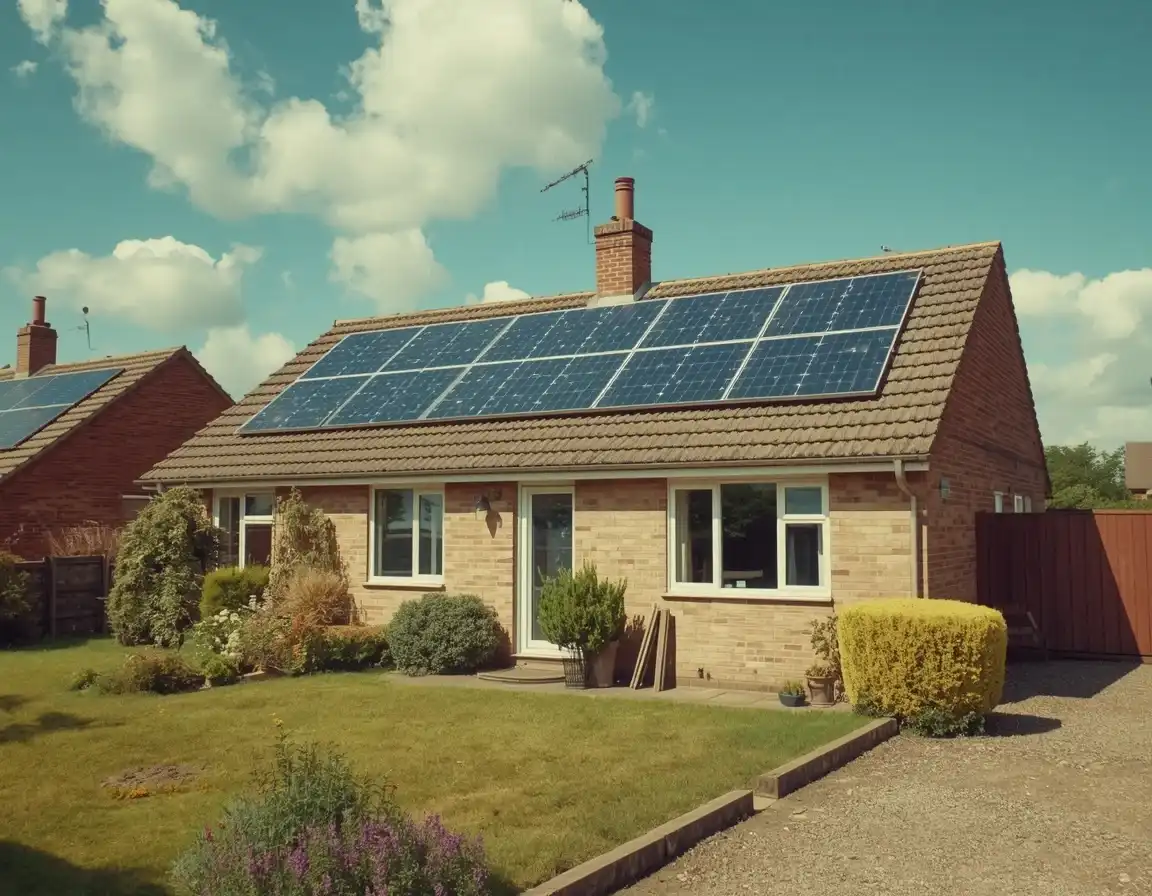
Solar Panels for a Bungalow in the UK

Solar panels for a bungalow in the UK: roof space, scaffolding, cost and output
A typical bungalow system is 3.5 to 5 kWp, which is 8 to 12 panels of 400 to 450 W. Expect roughly £5,500 to £7,500 fully installed for 4 kWp, with 0% VAT until 31 March 2027 and the scaffolding built into the quote. A south-facing 4 kWp array in the Midlands makes about 3,700 kWh a year. Three things decide how well a bungalow does: roof shape (in our worked example a hipped roof fits 6 panels on its south face and a gabled roof of the same size fits 15), shade from neighbours and trees, and whether the survey and scaffold are done properly. We take each in turn below.
Figures last checked on 12 October 2026 against our own cost and output guides, HMRC VAT Notice 7086 and published MCS-based output tables. Your quote will vary with your roof, region and installer.
How much roof space does a bungalow have for solar panels?
Less than a house, as a rule, but often enough. A modern panel is about 1.76 m by 1.13 m (close to 2 m²) and rated 400 to 450 W, so each kilowatt-peak needs 4.5 to 5 m² of clear roof once you allow for rails and gaps. As a rule of thumb, 4 kWp wants 18 to 20 m² and 5 kWp wants 22 to 25 m². Our guide to how many solar panels you need has the full sizing table.
The number that matters is the usable area on the faces that point the right way, not the total. Installers leave about 300 mm of clearance round the eaves, ridge, hips, chimneys, roof windows and vents (the exact figure depends on the mounting system and the wind exposure), and they will not run panels across a valley or a dormer cheek. On a low bungalow roof those margins take a bigger bite than they do on a large two-storey slope.
A worked example: one bungalow, a hipped roof and a gabled roof
Roof shape is the part most guides skip, so we worked it through. Take a 10 m by 7 m bungalow with a 30° pitch, 440 W panels (1.76 m by 1.13 m, laid landscape) and 300 mm of clearance everywhere, then pack panels into each face with a short script. This is a geometry check on one example roof, not a survey of real homes, but the pattern holds for any roof with hips.
| Same 10 m × 7 m bungalow | Hipped roof | Gabled roof (ridge runs east to west) |
|---|---|---|
| South-facing roof area | 26 m² (a trapezoid) | 40 m² (a rectangle) |
| Panels on the south face | 6 (2.64 kWp) | 15 (6.6 kWp) |
| Panels on the east and west hips | 2 + 2 (1.76 kWp at about 80%) | None, the gable ends are walls |
| Total panels | 10 (4.4 kWp) | 15 (6.6 kWp), all on one face |
| Yearly output at 920 kWh per kWp | About 3,700 kWh | About 6,100 kWh |
| If the installer needs 400 to 500 mm of clearance | 4 + 1 + 1 = 6 panels | 10 panels |
Panels 1.76 m × 1.13 m, 440 W, landscape. Output uses 920 kWh per kWp (south-facing, 35°, Midlands) and 80% for the hips.
The hips take more than half the panels off the south face: 6 instead of 15. They give a third of the output back, because the east and west hips each take 2 panels at around 80% of south-facing output. In this example the hips supply roughly 1,300 of the 3,700 kWh a year. So if your bungalow is hipped, do not size it from the south face alone. Ask the installer for a layout drawing of every face, with panel counts.
The last row of the table is the other question to ask. Move the clearance from 300 mm to 400 to 500 mm and the hipped roof drops to 4 + 1 + 1 panels while the gabled roof drops to 10. Ask what clearance the design uses, and why.
What your roof shape means for panels
| Roof type | What it does to your roof space | What to watch for |
|---|---|---|
| Gabled, long slope faces south | One big clear plane, the easiest layout to design | Chimney stack, roof windows, a front dormer |
| Gabled, ridge runs north to south | Two long faces, east and west, at about 80% each | Needs a dual-input string inverter, optimisers or microinverters |
| Hipped | Four smaller faces, so fewer panels per face (see the example above) | Hip clearances, and a layout that uses the east and west hips |
| Chalet or dormer bungalow | Dormers and roof windows break up the faces | Shade from your own dormer cheeks, and flashing detail |
| Low pitch or flat roof | Panels sit on tilt frames, or flat to the roof at a lower yield | Different permitted development limits, see our flat-roof guide |
| Slate or old tile | Same space, more fiddly fixing | Extra time and special hooks, see our slate roof guide |
Orientation and pitch: what each face of a bungalow roof gives you
Output depends on which way the panels face. The MCS output tables, as published by Expert Reviews, give south at 35° as the benchmark (100%), south-east or south-west at 95%, east or west at 80%, and north at 55% (60% if the pitch is a shallow 10°). A south roof at 10° pitch gives 90%. Our own north-facing roof guide covers when a north face is worth using at all.
What that means on a bungalow:
- South-east and south-west faces are almost as good as due south, so use them freely. A hipped roof often has one.
- East and west faces make about four-fifths of a south face over the year. An east–west split with half the panels on each side makes about 80% of a south array, but it spreads the power across the morning and the evening. That can raise the share you use at home, which our table in the output section does not count.
- Pitch matters less than direction. A pitch of 25° to 45° is the sweet spot, and at 10° a south roof still gives 90%, so a low-pitched bungalow roof is not a deal-breaker. A phone inclinometer app, or a protractor held against a rafter in the loft, will tell you your pitch.
- North faces are usually the ones to leave bare. At 55% of the best case, the payback in our table stretches to nearly 17 years.
Shade on a low roof: why a bungalow needs a closer look
A bungalow sits low, so things that would clear a tall roof (a neighbour’s two-storey house, a garden tree, a fence) can sit in front of it. The sun is also low in winter: at noon on 21 December it is only 14.6° above the horizon in the Midlands (about 52°N). The shadow of any obstacle is its height divided by the tangent of the sun’s height, which gives a rule you can use on your own plot.
| Noon, 52°N | Sun height | Shadow length ÷ obstacle height | A 6 m tree shades |
|---|---|---|---|
| 21 December | 14.6° | 3.9 | about 23 m |
| March or September equinox | 38° | 1.3 | about 8 m |
| 21 June | 61.4° | 0.5 | about 3 m |
Further north the winter shadow is longer: about 5.4 times the height in Edinburgh (56°N). Calculated from the sun’s noon height, so mornings and afternoons are longer still.
Here is the good news. Winter-only shade costs far less than the diagram suggests, because December and January make a small slice of the year’s generation. The shade that hurts is the kind that reaches into March to September: a tree or building that still shades the roof at the equinox, or a chimney stack that throws its shadow across the same panels every afternoon.
Shade also hits a normal string system harder than you would expect, because one shaded panel can pull a whole string down. Our comparison of microinverters and string inverters puts a heavily shaded 4 kWp roof (chimney plus a tree) at about 2,500 kWh a year with a string inverter, 3,000 with optimisers and 3,200 with microinverters. The extra equipment adds roughly £800 to £2,000 installed, so it is worth pricing on a shaded or multi-face roof and hard to justify on a clear south one.
Two practical steps. First, check the roof at about 10 am, noon and 3 pm on a sunny spring day and note what shades it. Second, ask for the shade assumption in writing in the installer’s output estimate. If the problem is a neighbour’s tree, read what you can do about a neighbour’s tree blocking your panels before you sign.
Scaffolding on a bungalow: do you need it, and what does it cost?
Do you need it?
Nearly always, yes. A bungalow eaves line is only 2 to 3 m up, so it feels like a ladder job, but an installer working on a pitched roof still has to provide safe access and edge protection under the Work at Height Regulations 2005. On a pitched roof that means scaffolding. Our guide to how long an install takes treats any offer to skip scaffolding as a red flag, and we agree. If a quote says ‘no scaffold needed’, ask what the alternative access method is and get it in the written method statement. A DIY ladder job also puts you outside the MCS route, which is what unlocks export payments (see whether DIY solar installation is legal).
What it costs
Published guides put scaffolding for solar at about £700 to £2,000, depending on height, width, how many sides of the roof it covers and how easy the plot is to reach (Sunsave’s scaffolding guide is one). A single-storey roof tends to sit towards the cheaper end because there is less height to cover. A hipped roof (more sides to scaffold), a long frontage or a scaffold that has to stand on the pavement push the price up, and a pavement licence can add a few hundred pounds. You normally do not pay it separately: scaffolding sits inside the quoted system price, and on our cost guide roughly a quarter of a £7,000 quote goes on scaffolding, grid notification, building regulations and MCS certification together.
How long it is up
The scaffold usually goes up a day or two before the crew arrive and comes down within a few working days of the handover; some firms leave it longer. The panel work itself takes one to two days for a 4 kWp system, and the whole process from survey to switch-on is typically 4 to 8 weeks. Ask for the dates in the quote, because a scaffold that stays up for weeks is a sign of a delayed job.
What solar panels for a bungalow cost in 2026
Most bungalow roofs suit systems of 3 to 5 kWp, so those are the prices to compare. They come from our UK solar panel cost guide and include scaffolding, the inverter, installation and certification, with 0% VAT.
| System | Panels (400–450 W) | Typical installed cost, 0% VAT | Bungalow note |
|---|---|---|---|
| Up to 3 kWp | 6–8 | £4,000–£5,500 | About what the south face of our hipped example holds (2.64 kWp) |
| 4 kWp | 9–10 | £5,500–£7,500 | A common bungalow size |
| 5 kWp | 11–12 | £7,500–£9,000 | Needs about 22 to 25 m² of clear roof |
| 6 kWp | 13–14 | £8,500–£11,500 | Usually means a 5 kW inverter and G99 approval |
| Add a 5 kWh battery | n/a | +£2,500 to £4,000 | 4 kWp plus 5 kWh comes to about £8,000 to £11,500 |
| Add a 10 kWh battery | n/a | +£4,000 to £6,000 | Suits a household with high evening use |
Ranges from our cost guide, 18 August 2026 update. London and the South East run 10 to 30% above the national average.
What moves a bungalow quote up or down:
- Number of roof faces. Every extra face means another mounting kit and more time on the roof, so a hipped roof costs more per panel than a plain gable.
- Roof covering. Slate and some older tiles need special hooks and extra time.
- Inverter choice. Optimisers or microinverters add about £800 to £2,000 installed, which suits shade or several faces.
- Scaffold. £700 to £2,000, plus any pavement licence.
- System size. Scaffold, grid paperwork and MCS certification cost much the same for 3 kWp as for 6 kWp, so small systems tend to cost more per kilowatt.
If a quote for 4 kWp lands well above £8,500, read what MCS data says about a £10,000 quote for 4 kW before you reply.
VAT: the date that matters
Installing solar panels in a home is zero-rated for VAT from 1 May 2023 to 31 March 2027, and from 1 April 2027 the rate goes back to 5%, according to HMRC VAT Notice 7086. Our cost guide says a battery fitted with the panels is zero-rated too. On a £7,000 job, 5% is about £350. If your install could slip towards spring 2027, ask the installer in writing what VAT rate each payment carries. Our VAT savings checker shows what you would save.
How much a bungalow system produces and saves
A south-facing roof at 35° in the Midlands makes about 920 kWh per kWp a year. The range runs from about 1,050 in the South East to 810 in Scotland and 750 in the far north (south-facing, 35°, from our sizing guide). So 4 kWp gives about 3,680 kWh in the Midlands. The table below uses that figure and the MCS direction factors from earlier.
| 4 kWp bungalow system, Midlands | Yearly output | Yearly value | Payback on £6,500 |
|---|---|---|---|
| Due south, 35° (100%) | 3,680 kWh | £699 | 9.3 years |
| South-east or south-west (95%) | 3,496 kWh | £664 | 9.8 years |
| Due south, shallow 10° (90%) | 3,312 kWh | £629 | 10.3 years |
| East or west, or an east–west split (80%) | 2,944 kWh | £559 | 11.6 years |
| North (55%) | 2,024 kWh | £385 | 16.9 years |
Assumes 50% of the power is used in the home at 26p per kWh (the July to September 2026 price cap was 26.11p) and the rest is exported at 12p per kWh. £6,500 is the middle of the £5,500 to £7,500 range for 4 kWp.
Two caveats. A house that is empty during the day uses less than half of its solar power directly, and one with someone home all day uses more; a battery lifts the share to roughly 80% but adds £2,500 to £4,000 (see solar battery storage). Export rates vary from about 4p to 15p per kWh, so compare tariffs in our SEG rate comparison. For the wider picture, our payback period guide puts typical systems at 7 to 12 years, and the table above sits inside that range. To run your own roof, try the solar panel calculator.
Planning, grid and paperwork rules for a bungalow
Planning permission (England)
Most bungalows in England can fit roof panels under permitted development, with these limits: panels on a pitched roof must not stick out more than 200 mm from the roof slope, and they must not rise above the highest part of the roof (not counting the chimney). Listed buildings need listed building consent, and if you are in a conservation area it is worth a call to the council before you order. Flat roofs have their own limits, covered in our flat-roof guide. Full details are in our solar panel planning permission guide.
These rules apply to England. Scotland, Wales and Northern Ireland have their own planning rules, so check with your local planning authority first (our Northern Ireland guide covers the differences there).
Building regulations and the roof itself
Roof-mounted panels fall under building regulations, which means the roof structure has to be able to carry them. Ask the installer to confirm in writing that your rafters and tiles can take the panels and rails, and who is responsible for the building regulations paperwork. If the building or an outbuilding roof dates from before 2000, ask who checks for asbestos cement sheeting before anyone fixes into it.
Grid connection: G98 or G99
The inverter rating decides this, not the panel total. An inverter up to 3.68 kW per phase is covered by G98: you install first and the network operator is told within 28 days of commissioning. Anything bigger needs G99, which means approval before installation and up to 45 working days of waiting, so the project runs 6 to 10 weeks instead of 4 to 8. On a gabled bungalow that can fit 6 kWp, that is the trade-off to weigh against the extra panels.
MCS certificate and export payments
The installer should issue your MCS certificate within 10 days of commissioning, and you need it to get paid for exported power under the Smart Export Guarantee, which then typically takes one to four weeks to approve. Our guide to what MCS certification actually means explains why this matters.
Quote checklist for a bungalow
Whatever the roof, put these eight questions to every installer. Our guide to choosing an installer goes deeper, and the seven red flags in solar sales are worth a read before the first call.
- Did someone visit the roof? A fixed price with no site survey is a warning sign.
- Is there a layout drawing of every roof face, with panel counts and the edge clearance used?
- Are panel and inverter named by make and model, with wattage and warranty years?
- Is the scaffold in the price, and is any pavement licence included?
- What inverter size and grid route? G98 or G99, and whether there are two roof faces on separate inputs, optimisers or microinverters.
- What yield and shade assumption? You want a yearly kWh figure in writing that states the shade.
- Which VAT rate and which install date? Especially if the job could run past 31 March 2027.
- Who signs off the roof and the paperwork? Roof loading, building regulations and the MCS certificate.
The honest summary
A bungalow can work very well for solar, but the roof shape and the shade decide more than the size does. If you have a gabled roof with a clear south, south-east or south-west slope, a 4 to 5 kWp system on that one face is the simplest and cheapest design, and the payback is around nine to ten years. If the roof is hipped, expect fewer panels on the south face than you hoped for, and make sure the installer uses the east and west hips; in our example they supplied a third of the output. If trees or neighbours shade the roof into spring and autumn, budget for optimisers or microinverters, or think again.
Get at least three quotes from MCS-certified installers, insist on a drawing of every face, and keep scaffolding and VAT visible in the price. Compare your own roof with the numbers above in the solar panel calculator.
FAQs: solar panels for a bungalow
How many solar panels can you fit on a bungalow?
A typical bungalow system is 8 to 12 panels, which is 3.5 to 5 kWp with 400 to 450 W panels. Each panel needs about 2 m², so 4 kWp wants roughly 18 to 20 m² of clear roof. Roof shape sets the limit: in our worked example, a 10 m by 7 m gabled bungalow fitted 15 panels on its south slope, while a hipped one of the same size fitted 6 on the south face and 2 on each of the east and west hips.
Do you need scaffolding to install solar panels on a bungalow?
Nearly always. A bungalow roof is low, but the installer still has to provide safe access and edge protection on a pitched roof under the Work at Height Regulations 2005, and a quote that offers to skip scaffolding is a red flag. Scaffolding is normally built into the quoted price. Published guides put it at about £700 to £2,000, and a single-storey roof tends to sit towards the lower end. It usually goes up a day or two before the crew arrive and comes down within a few days of finishing.
Are solar panels worth it on a bungalow?
Usually, if the roof has a clear south, south-east, south-west, east or west face. A south-facing 4 kWp system in the Midlands makes about 3,700 kWh a year. At 26p per kWh, with half the power used at home and the rest exported at 12p, that is worth about £700 a year, so a £6,500 install pays back in around nine to ten years. North-facing and heavily shaded roofs are the exceptions, and 0% VAT on installation ends on 31 March 2027.