
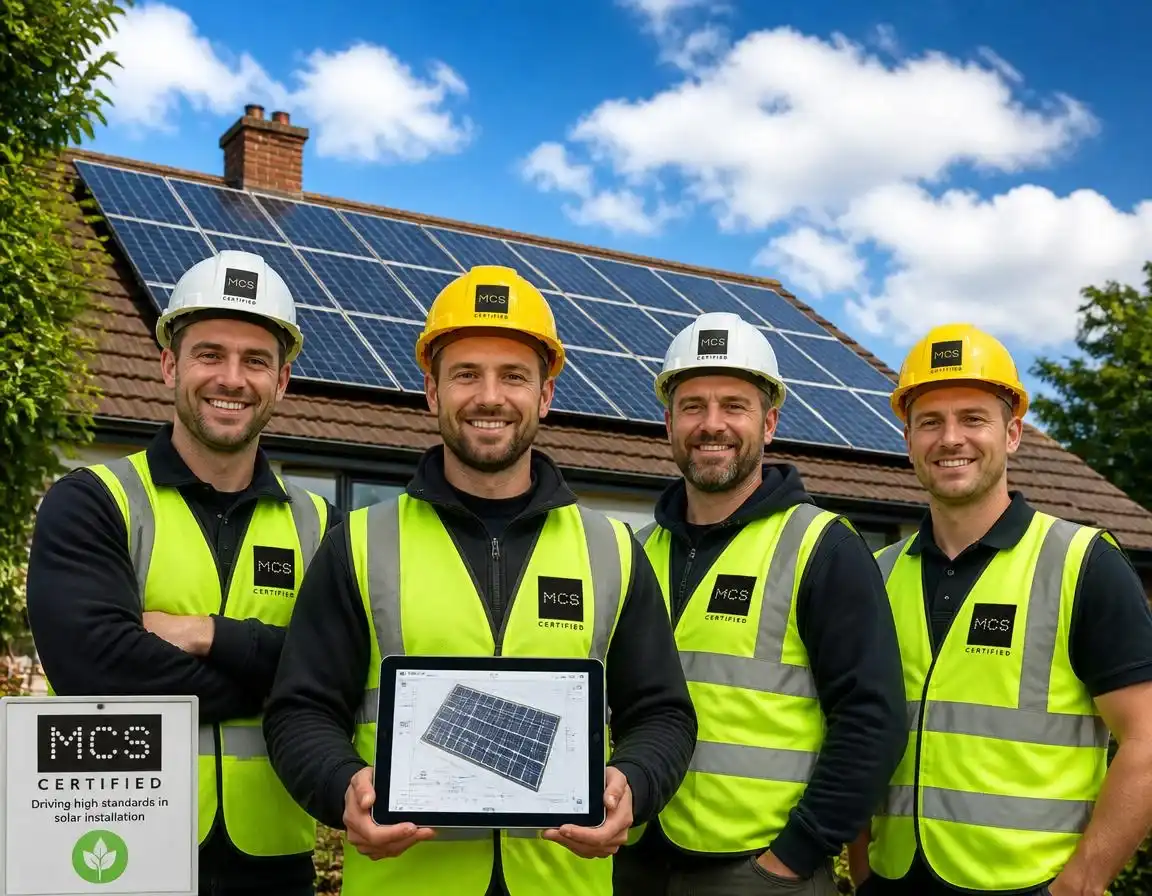
MCS Certified Solar Installers: What This Badge Actually Means in 2026

MCS Certified Solar Installers: What This Badge Actually Means in 2026

Last updated: 26 June 2026 · 6 min read
If you’ve been pricing up solar panels for your home, you’ve probably already seen the letters MCS plastered across every installer’s website and brochure. I get asked about this badge more than almost anything else here on SolarBriton, so let’s clear it up properly: what MCS certified actually means, why it matters more than ever now the whole scheme has had its biggest shake-up since 2007, and exactly how to check a certificate is genuine before you sign anything.
Quick answer: MCS certified means an installer and their work have been checked against the UK’s official Microgeneration Certification Scheme standards — covering training, safety and installation quality. Without it, you can’t claim Smart Export Guarantee payments, and you’ll miss out on most government solar grants too.
Check out Solar panels grants uk
So, what does “MCS certified” actually mean?
MCS stands for the Microgeneration Certification Scheme. It’s a government-backed quality mark covering solar panels, battery storage and heat pumps, and it’s been running since 2007. Here’s the bit people often get wrong: MCS doesn’t assess installers itself. It licenses a set of certification bodies — NICEIC among them — to do the actual checking on its behalf, and every one of those bodies must be accredited by UKAS, the UK’s national accreditation service. In practice, an MCS certified installer has proven their staff are properly trained, their paperwork is in order, and a sample of their real installations has been inspected on site, not just rubber-stamped from an office somewhere.
Using an MCS certified installer isn’t a legal requirement, and nobody will stop you hiring an uncertified firm. But skip it and you’ll lock yourself out of nearly every financial benefit that makes solar worth doing, which is exactly why it’s worth five minutes of checking before you commit.
The scale of this is genuinely hard to ignore now. 2025 was a record year on its own, and the UK has just passed a major milestone for certified renewables overall.
What does MCS certification actually unlock for you?
Here’s what that little badge actually does for you as a homeowner:
- ✓Smart Export Guarantee (SEG) payments — you only get paid for the electricity your panels send back to the grid if your installation is MCS certified, or covered by an equivalent recognised scheme such as Flexi-Orb.
- ✓Government grant eligibility — schemes including ECO4, the Boiler Upgrade Scheme, the Home Upgrade Grant and the Social Housing Decarbonisation Fund all require MCS certified work as a condition of funding.
- ✓A proper workmanship guarantee — currently a two-year legal minimum, rising to at least six years’ cover once your installer moves onto MCS’s new financial protection rules.
- ✓An independent complaints route — a formal process to escalate problems, rather than just hoping your installer answers the phone.
Comparison platforms such as Checkatrade and Which? Trusted Traders also filter heavily on MCS status, so it shapes who even gets shortlisted in the first place.
UK solar PV installations: 2011 record vs 2025 record
To put the recent growth into context: 2025’s total of 267,032 certified solar PV systems beat the previous annual record, set back in 2011, by 31%. The 2011 figure shown is calculated from that reported increase, since an exact published total for 2011 wasn’t available.
Check out how many solar panels are required in the U.K.
The big 2026 shake-up: MCS’s redeveloped scheme
Here’s the part most other guides on this topic haven’t caught up with, because it’s genuinely new for 2026. MCS has spent the past two years quietly redesigning how the entire scheme works, and the rollout is happening right now, with every certified installer expected to be fully transitioned by 31 March 2027. The redeveloped scheme shifts the focus away from drowning installers in paperwork and towards what’s actually built on your roof. It’s significant enough that the Department for Energy Security and Net Zero (DESNZ) has formally recognised it as a Code of Practice for the Boiler Upgrade Scheme, and MCS is now confirmed as the only certification scheme accepted for government-funded clean heat work.
Here’s what’s actually changing for you as a customer:
| What changes | Current scheme | Redeveloped scheme (2026) |
|---|---|---|
| Assessment frequency | Site assessment roughly every year | Risk-based — every 3 years for installers with a clean record |
| Certificate creation window | 14 days from commissioning | 30 days from commissioning |
| Complaints handling | Via the installer’s own Consumer Code | Centralised — MCS is now a single point of contact |
| Financial protection | Insurance-backed guarantee, 2-year minimum cover | MCS-approved product, minimum 6 years’ cover |
| Consumer Code membership | Mandatory for every certified installer | Optional once transitioned across |
How to check a solar installer is genuinely MCS certified
A logo on a website tells you nothing on its own, since logos get copied constantly. Before you sign anything, run through this instead:

| Check | What to do |
|---|---|
| 1. Certificate | Search the installer on the official finder at mcscertified.com — confirm it’s shown as active, not expired or pending |
| 2. Body | Ask which certification body issued their MCS certificate, and confirm it’s UKAS-accredited |
| 3. Protection | Ask for proof of an MCS-approved financial protection product, not just an older insurance-backed guarantee |
| 4. Products | Confirm the panels and inverter quoted appear on the MCS Product Directory |
| 5. Quotes | Get at least three written quotes before committing to anything |
If you’re the installer, not the homeowner
Becoming MCS certified yourself typically costs between £500 and £1,500 in initial assessment fees, with the whole process taking six to twelve weeks. It’s worth doing properly. Lead-generation platforms and comparison sites used right across the UK solar market filter heavily on MCS status, so missing it shuts you out of a large slice of genuine enquiries before you ever get the chance to quote.
The bottom line
MCS certified isn’t a guarantee of a perfect installation, and it never has been. But it remains the single best filter available for separating proper, accountable tradespeople from the cowboys chasing a quick sale before disappearing. Check the certificate yourself, ask about financial protection, and you’ll be in a far stronger position than most people starting this journey in 2026.
Frequently asked questions
What does MCS certified mean for solar panels?+
It means the installer and the system have both been checked against the UK’s official Microgeneration Certification Scheme standards, covering training, safety and installation quality. It’s the same mark required for Smart Export Guarantee payments and most government solar grants.
Do I need an MCS certified installer to get the Smart Export Guarantee?+
Yes. Energy suppliers will not register your system for Smart Export Guarantee payments unless your installation is MCS certified, or backed by an equivalent recognised scheme such as Flexi-Orb. You will need your MCS certificate number to apply.
How do I check if a solar installer is genuinely MCS certified?+
Search the company’s name on the official finder at mcscertified.com and confirm the certificate shown is active rather than expired. You can also ask which certification body issued it and check that body is UKAS-accredited.


27 Comments