Is 0% Solar Finance a Debt Trap?

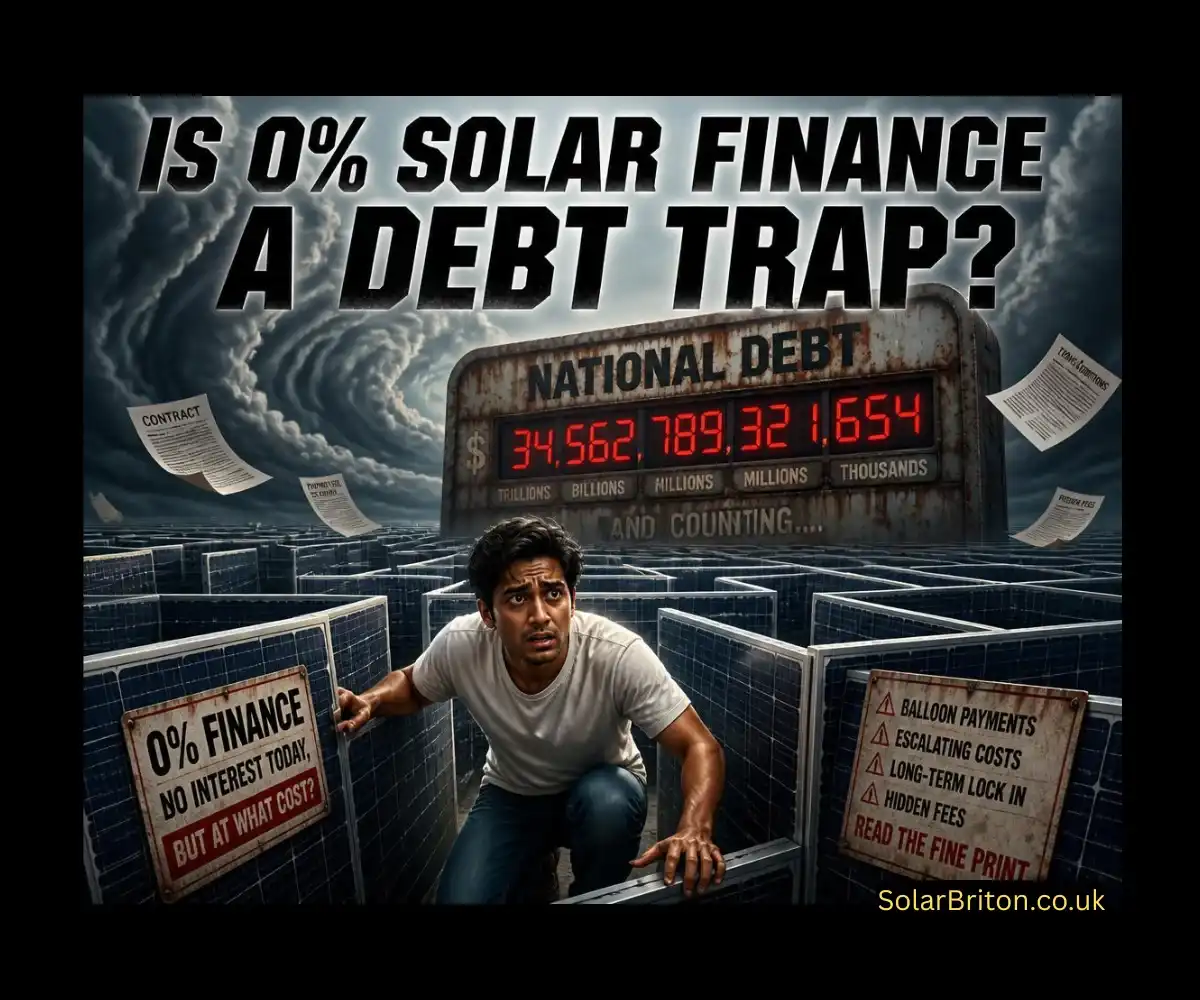
Is 0% Solar Finance a Debt Trap?
The honest UK answer for 2026, once you strip away the sales pitch.
The headline question before anything else, because you didn’t click through for waffle. No, 0% solar finance isn’t automatically a debt trap. It’s a normal, regulated way to pay for solar that a large chunk of UK homeowners now use. But it can turn into a bad deal, and whether it does usually comes down to three things: whether the price you’re financing matches the cash price, whether the lender is genuinely FCA-authorised, and whether your monthly repayment actually sits below what the panels save you. Get those right and 0% finance is often one of the cheapest ways to go solar right now. Get them wrong and, yes, you can end up worse off than if you’d never picked up the phone.
0% solar finance itself isn’t a scam, it’s a real form of credit used across the industry. The trap risk comes from a small number of installers quietly padding the cash price to cover the cost of the “free” credit. Check the cash price separately, confirm the lender on the FCA register, and you’re almost certainly fine.
“0% Finance” and “0% VAT” Are Two Completely Different Things
Half the confusion around solar finance starts right here. People search for “0% solar” and get a jumble of results mixing up a tax relief with a credit product, as if you’re choosing one of the two. You’re not. One is a discount on the price. The other is a way of paying it. They stack on top of each other, and understanding the difference is the first step to spotting whether a deal is fair.
A tax relief, not a loan
Residential solar panels, batteries and the labour to fit them have carried 0% VAT since April 2022, confirmed by HMRC until 31 March 2027, after which the rate is due to rise to 5%. It applies automatically the moment an MCS-certified installer supplies and fits your system, no forms, no application. It’s baked into the price before you’ve even thought about how you’re paying for it.
A credit agreement, not a discount
This is a promotional, interest-free loan, usually offered by a finance company working alongside your installer, that lets you spread the (already VAT-free) price over months or years without paying interest on top. It’s a regulated consumer credit product with its own rules, and it’s this part, not the VAT, where a bad deal can hide.
So when someone asks “is 0% solar a trap”, they almost always mean the finance, not the tax relief. The VAT saving is safe, automatic, and the same whoever you borrow from. The finance is where you need to do some checking.
Where the Catch Actually Hides
Here’s the bit most people miss: “0% APR” is a legal claim about interest, not about the price. It means you won’t be charged interest on top of the amount you borrow. It says nothing about whether that amount is a fair one to start with. Lenders don’t hand out free credit for the good of their health, somebody pays for it, and it’s rarely the installer quietly eating the cost out of goodwill.
The usual mechanism, and this holds across home improvement finance generally, not just solar, is that the finance company charges the installer a fee for offering interest-free credit to you, often a percentage of the total contract value. That fee then gets folded into the headline price you’re quoted. It’s exactly why, if you ask a few installers offering “0% finance” for a separate cash price, some will suddenly find one that’s meaningfully lower.
That’s the whole trap in one chart. The interest rate printed on the credit agreement can say 0% and still be misleading, because the number it’s 0% of was inflated first. This isn’t a fringe issue either, several independent UK solar finance guides flag installer mark-ups in roughly the 10–15% range on “free finance” quotes as something to actively check for.
The fix is simple and takes one phone call: ask for a cash price in writing, separately from the finance quote, before you agree to anything. Our guide on what MCS data actually shows about 4kW solar quotes is a useful benchmark if you want to know what a fair cash price looks like for your size of system.
Britain’s Already Been Burned Once, Here’s What It Taught Us
If you want a genuine reason to take this question seriously, it isn’t hypothetical. The UK ran an energy finance scheme that went badly wrong, and it’s worth knowing the story before you sign anything.
The Green Deal and the HELMS scandal
Launched in 2013, the Green Deal let households get solar panels, insulation and boilers fitted with nothing to pay upfront, funded by a loan repaid through the electricity bill. It ran on a “golden rule”: your bill savings were supposed to match or beat your repayments. The government withdrew the scheme just two years later, in 2015.
One installer, Home Energy and Lifestyle Management Ltd (HELMS), based near Glasgow, signed up thousands of households, many in Scotland, before going bust in 2016. Homeowners were left on repayment terms stretching 21 to 25 years, with some owing more than £11,000, in a few reported cases over £17,000, for systems that underperformed or were faulty from the start. Because the debt was tied to the electricity meter rather than to the person, many couldn’t withhold payment even while disputing the mis-selling, and some struggled to sell their homes with the debt still attached. Redress cases were still being worked through years later.
This wasn’t a one-off, either. The Financial Ombudsman Service has, over the years, handled thousands of separate complaints about mis-sold solar finance arranged through mainstream lenders, most commonly overstated savings promises rather than the deal being fake outright. So the honest position is: solar finance mis-selling is a real, documented pattern in the UK, not a scare story.
✅ Why today’s mainstream 0% deals are a different animal
What made the Green Deal dangerous wasn’t the idea of spreading the cost, it was the structure. The debt was tied to the property and the meter, savings estimates weren’t independently checked, and the provider collapsed with no proper safety net for existing customers. Mainstream solar finance in 2026 is built differently: it’s personal, unsecured credit (or in some cases a Nationwide-style mortgage add-on), regulated by the FCA, with a legal cooling-off period and access to the Financial Ombudsman Service if something goes wrong. That doesn’t make every deal safe automatically, but it changes what happens when one goes wrong, and it gives you somewhere real to complain.
Your Protections Today, in Plain English
This is the bit most solar finance guides skip, and it’s arguably the most useful part if you’re nervous about signing anything. Here’s what actually protects you on a regulated UK credit agreement in 2026.
| Protection | What it actually means | Where to check it |
|---|---|---|
| FCA authorisation | The lender (and often the broker) must be legally authorised to offer consumer credit. Unauthorised lending is a criminal offence. | register.fca.org.uk |
| 14-day cooling-off | A statutory right to cancel most regulated credit agreements within 14 days, no reason required, no penalty. | Consumer Credit Act 1974 (as amended) |
| Section 75 protection | For credit-financed purchases between £100 and £30,000, the lender is jointly responsible if the installer misrepresents the deal or stops trading. | Consumer Credit Act 1974, s.75 |
| Right to early settlement | You can repay early at any point, and any early-settlement charge is capped by law. | FCA Consumer Credit sourcebook (CONC) |
| Financial Ombudsman Service | A free, independent complaints route if the lender won’t resolve a dispute directly with you. | financial-ombudsman.org.uk |
Section 75 is worth pausing on, because it’s the single biggest practical difference from the Green Deal era. It’s the same rule that protects a big credit card purchase: if your installer goes bust mid-job or the system doesn’t do what was promised, the finance company shares the liability, so you’re not left arguing with a company that no longer exists. We’ve written a full breakdown in what to do if your solar installer goes bust mid-install, worth bookmarking before you sign, not after.
What’s Actually New for 2026
A few genuinely fresh developments change the picture this year, and most competing guides on this topic haven’t caught up with them yet.
The FCA closed a real gap. Short-term, interest-free “buy now, pay later”-style credit (technically Deferred Payment Credit, repaid in 12 or fewer instalments over 12 months or less) came under full FCA regulation for the first time on what the regulator calls “Regulation Day”. Before this, that specific short-form of 0% credit could sit outside FCA oversight. Most solar 0% deals run longer than 12 months and were already regulated, but this closes the loophole for shorter offers, and brings affordability checks and Ombudsman access to a corner of the market that didn’t have them before.
Electricity got more expensive again. Ofgem’s price cap rose 13% for the July to September quarter, to around £1,862 a year for a typical household (or £1,663 under Ofgem’s newly updated usage benchmark). That doesn’t change your finance repayment, but it does increase the bill savings side of the sum, which is what actually decides whether financed solar is cash-positive. See our Energy Price Cap October 2026 update for the next quarter’s outlook.
The Bank of England held rates at 3.75% for a fifth consecutive meeting, the benchmark most green mortgage add-ons and personal loan pricing tracks against. Stable rates mean the APR gap between a genuine 0% deal and a typical green loan (roughly 5–15% APR) has stayed fairly consistent through the year.
The 0% VAT deadline is getting closer. This isn’t finance-related but it does affect the total you’d be borrowing, once the relief lifts to 5%, the same system costs more to finance either way. It’s a genuine reason not to sit on a decision indefinitely.
The Real Monthly Numbers
Enough theory, let’s put actual figures against a typical UK install. Take a 4kWp system at a realistic installed price of £7,000–£7,500, 0% VAT already included, spread over 5 years with no deposit.
| Line item | Typical monthly figure |
|---|---|
| 0% finance repayment, 60 months | ≈ £120 |
| Electricity bill saving | £55 – £90 |
| Smart Export Guarantee income | £15 – £25 |
| Net monthly position | Roughly break-even to about £45 net cost |
For most well-sized systems, that puts a genuinely priced 0% deal somewhere between break-even and a modest net monthly cost, well within most households’ comfort zone, before you even factor in that electricity prices have risen again this year. For the full picture on how long it takes to come out ahead overall, see our dedicated Solar Panel Payback Period UK 2026 guide, and check current export rates in our Best SEG Tariff Rates UK 2026 comparison.
🧮 Would your deal be cash-positive?
Pop in your quoted monthly repayment and your expected monthly saving (bill saving plus any export income). No data is stored or sent anywhere, it’s just maths, done on this page.
Red Flags vs Green Flags
If you only take one thing from this whole guide, make it this checklist. Ten minutes of checking here saves years of regret.
🚩 Likely a bad deal
- ✕The installer won’t give you a cash price separately, in writing
- ✕You can’t find the lender’s name on the FCA register
- ✕Pressure to sign same-day, “this price only stands today”
- ✕The agreement is tied to your property or meter, not to you
- ✕Nobody mentions your 14-day cooling-off period
- ✕Savings figures are a verbal promise, not a written MCS-standard estimate
- ✕The finance broker’s commission isn’t disclosed anywhere
✅ Likely a genuine deal
- ✓Cash price and 0% finance price match, in writing
- ✓Lender is FCA-authorised, checkable in under a minute
- ✓Installer is MCS-certified, needed for 0% VAT and SEG anyway
- ✓You’re given a written 14-day cooling-off notice as standard
- ✓Your savings estimate is based on your actual roof and usage
Worth a wider read before you commit to any installer, not just on finance: our Solar Panel Scams in the UK: 7 Red Flags guide, and a genuinely candid account in I regret my solar panels, worth reading precisely because it isn’t a sales pitch.
So, Is It a Debt Trap?
Mostly, no. For the majority of UK homeowners financing solar through an MCS-certified installer and an FCA-authorised lender, with a cash price that matches the finance price, 0% solar finance in 2026 is a genuinely useful, well-protected way to spread a £7,000-plus cost without paying a penny extra for the privilege. You get a 14-day right to change your mind, Section 75 cover if things go wrong, and an Ombudsman to complain to if the lender won’t listen.
Where it turns into something closer to a trap is narrower than the headlines suggest: a price quietly marked up to fund the “free” credit, a lender you can’t verify, or a promise of savings that doesn’t survive contact with your actual roof. Ask for the cash price, check the FCA register, and do your own monthly sums. If those three things check out, you’re not looking at a trap, you’re looking at a fairly ordinary bit of household finance, with better legal protection behind it than almost anything else you’ll sign this year.
Frequently Asked Questions
No, not on its own. 0% solar finance is a mainstream, FCA-regulated form of consumer credit used by a large share of UK homeowners going solar in 2026. The risk isn’t the 0% itself, it’s a minority of installers who quietly raise the cash price to cover the cost of offering interest-free credit. Ask for the cash price in writing and compare it to the finance price before you sign anything.
Three checks, done in under ten minutes. First, ask your installer for a cash price in writing and compare it to the finance price, they should match. Second, look up the lender’s name on the Financial Conduct Authority register at register.fca.org.uk. Third, confirm your paperwork mentions a 14-day cooling-off period, a legal right on regulated credit agreements.
If you financed a system worth between £100 and £30,000 through a regulated credit agreement, Section 75 of the Consumer Credit Act 1974 makes the lender jointly liable alongside the installer. You can usually claim against the finance company directly if the installer stops trading before finishing the job, or if the system doesn’t match what was promised.
Keep Reading on SolarBriton
Official Sources
- HMRC VAT Notice 708/6, energy-saving materials
- FCA Financial Services Register, check any lender
- FCA: Buy Now Pay Later regulation, from 15 July 2026
- Financial Ombudsman Service, free complaints route
- GOV.UK: Warm Homes Plan
- Ofgem, energy price cap updates
- Bank of England, current Bank Rate
- MCS, certified installer register
This article is general information, not financial advice. SolarBriton doesn’t provide, arrange or broker credit, any finance agreement is between you and an FCA-authorised lender. Figures are illustrative and based on typical 2026 UK market data, always get a personalised quote and read your credit agreement in full before signing.