
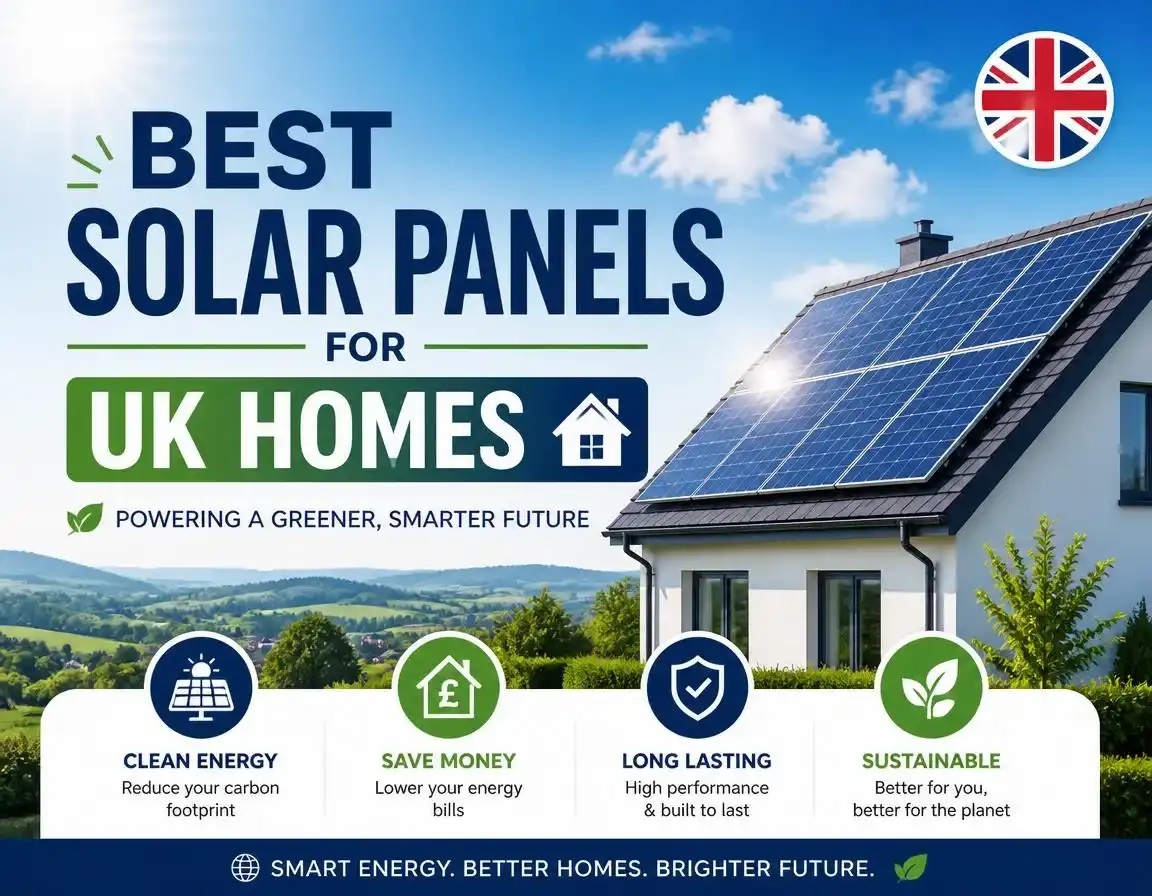
Best Solar Panels for UK Homes in 2026

The market has transformed. N-type panels now dominate, efficiencies are up, and prices have dropped. Here’s exactly what to buy — and why.
Ask any solar installer what the UK market looked like two or three years ago versus today, and you’ll hear the same word: transformed. By mid-2026, N-type cell technology has completely replaced the older P-type PERC panels that once dominated British rooftops. Efficiencies that used to sit at 19–20% now comfortably reach 22–25%. If you’re choosing the best solar panels for your UK home in 2026, even a mid-range option is significantly better than what was available in 2022.
What actually matters for a UK roof
Before jumping into our top picks, here’s what really counts for a British rooftop — because it differs from warmer markets. Low-light performance is the single most important metric. Your panels spend most of their working life in diffuse, cloud-scattered light rather than direct sunshine. N-type panels — particularly HJT (heterojunction) types — handle this considerably better than older P-type technology. Roof orientation, shading from chimneys or neighbouring trees, and choosing a reputable MCS-certified installer will all have more impact on your actual output than which brand of panel you select.
Best Solar Panels UK 2026 — At a Glance
| Panel | Efficiency | Technology | Price / panel | Product Warranty | Tier |
|---|---|---|---|---|---|
| AIKO Neostar | 24.0–24.4% | ABC (back-contact) | £90–£130 | 15 years | Premium |
| LONGi Hi-MO X10 | 23.8% | HPBC (back-contact) | £80–£100 | 15 yrs product · 30 yrs performance | Premium |
| REC Alpha Pure-RX | 22.6–23.5% | HJT (bifacial) | £120–£160 | 25 years | Premium |
| SunPower Maxeon | 22.8–24.1% | IBC (back-contact) | £150–£200+ | 40 years (industry record) | Premium |
| Jinko Tiger Neo | 22.3–24.5% | N-type TOPCon | £75–£100 | 12 years | Mid-tier |
| JA Solar DeepBlue 4.0 | 20.5–22% | N-type TOPCon | £70–£90 | 12 years | Value |
Prices are panel-only retail in mid-2026, before installer markup and labour. All listed panels carry 0% VAT on UK residential installations until March 2027. All are BNEF Tier 1 and MCS product directory eligible.
Our top 5 picks for UK homes in 2026
Both are Bloomberg BNEF Tier 1 manufacturers offering solid N-type TOPCon panels at £70–£100 per panel. Efficiencies sit at 20.5–22.5% and product warranties are 12 years — shorter than premium brands, but fully adequate for most homeowners. These are the panels you’ll be offered by the majority of UK installers, and for good reason. See how they stack up against each other in our Jinko vs JA Solar vs Trina Solar comparison.
TOPCon, HJT or IBC: which technology is right for you?
In 2026, virtually every panel on the market uses N-type cells — the question is which flavour. Here’s the quick guide:
Before you buy: the things that matter most
Here’s a buying truth most comparison articles skip: the installer matters more than the panel brand. A brilliant panel installed badly — wrong orientation, poor cable routing, no optimisers on a shaded roof — will consistently underperform a decent panel installed well. Always use an MCS-certified installer who’s also signed up to the Renewable Energy Consumer Code (RECC), and get at least three quotes before committing.
Every panel in this guide is listed on the MCS Certified Product directory, meaning you’re eligible for the Smart Export Guarantee (SEG) — the government-backed scheme that pays you for surplus electricity you export to the grid. Some suppliers currently pay up to 27p/kWh. Run your own numbers with our SEG income estimator, or check eligibility and find a certified installer at gov.uk/sell-energy-back-to-grid.
Solar panels, batteries, and installation on UK residential properties carry 0% VAT — confirmed until 31 March 2027. On a typical 4kW installation, this saves you £1,000–£2,000 compared to the standard 20% rate. It applies to all panel types including premium HJT and IBC models, so there’s no VAT advantage to choosing budget over premium.
The best solar panels for UK homes in 2026 are better value than at any point in the technology’s history. For most households, the LONGi Hi-MO X10 or a comparable N-type TOPCon panel from a Tier 1 manufacturer delivers the right combination of efficiency, warranty, and payback. Upgrade to AIKO or REC Alpha if your roof is small, shaded, or north-facing. And if you’re planning to stay put for decades, Maxeon’s 40-year warranty is genuinely unrivalled.
Frequently asked questions
What are the best solar panels for UK homes in 2026?
The LONGi Hi-MO X10 is the best overall pick for most UK homes — 23.8% efficiency, £80–£100 per panel, and a 30-year performance warranty. For maximum efficiency in a tight space, the AIKO Neostar reaches 24.4%. For shaded or complex roofs, the REC Alpha Pure-RX offers unique quadrant shade tolerance and a 25-year product warranty. For the ultimate warranty peace of mind, SunPower Maxeon offers 40 years — an industry record. For budget-conscious buyers, Jinko Tiger Neo and JA Solar DeepBlue 4.0 offer strong Tier 1 quality at £70–£100 per panel.
What type of solar panel technology is best for the UK in 2026?
N-type panels — specifically N-type TOPCon, HJT (heterojunction), or IBC/ABC/HPBC (back-contact) designs — are the clear recommendation for 2026. They perform significantly better in the UK’s diffuse, cloud-scattered light conditions, degrade more slowly (typically 0.4–0.5%/year versus 0.5–0.7% for older P-type panels), and are resistant to Light-Induced Degradation (LID). P-type PERC panels are largely obsolete in new UK installations. If you’re quoted a P-type panel in 2026, ask why.
Do I need MCS-certified solar panels in the UK?
Yes, if you want to receive payment for surplus electricity through the Smart Export Guarantee (SEG). Your panels must be installed by an MCS-certified installer using products listed on the MCS Certified Product directory. All brands in this article — LONGi, AIKO, REC, Maxeon, Jinko, JA Solar — meet this requirement. Verify your installer at mcscertified.com and always get at least three quotes before signing anything — our guide to solar panel scams and red flags is worth a read first.
Disclaimer: Panel specifications and pricing are based on manufacturer published data and MCS installer market data as of June 2026. Prices are per-panel retail estimates and will vary by system size, installer, and location. All efficiency figures refer to STC (Standard Test Conditions) module efficiency. Always obtain a minimum of three quotes from MCS-certified installers. This article does not constitute financial or installation advice.
Can I Sell Electricity From My Solar Panels in the UK?
A plain-English look at the Smart Export Guarantee — what it pays in 2026, who qualifies, and the tax rule that’s catching some solar owners out.

Quick answer: yes, you can. If you’ve got solar panels on your roof, there’s a government-backed scheme that pays you for the electricity you don’t use. It’s called the Smart Export Guarantee, or SEG, and plenty of homes are still missing out simply because nobody’s pointed them to it. I’ve gone through the latest 2026 rates and rules so you don’t have to.
The basicsHow does selling your solar power actually work?
Here’s the part most explainer pages skip. Your panels generate electricity whenever there’s daylight, but your house can’t always use it all — maybe you’re out, or it’s a bright afternoon and the kettle’s not on. Whatever’s left over flows down the cable and out onto the National Grid, where it powers somebody else’s home nearby. Under the SEG, your supplier has to pay you for every exported unit (kWh). You’re only paid for what you send out, not what you use yourself — but that’s still money for electricity that would otherwise go to waste.
EligibilityAm I eligible?
You don’t need anything exotic. Most homes with panels already tick these boxes — you can check the full official rules on GOV.UK:
- ✓An MCS-certified installation (your installer should have given you this certificate)
- ✓A smart meter that records exports every half hour
- ✓A supplier willing to take you on for SEG — it needn’t be the one billing you for power
How much could I actually earn?
A typical 4kW system generates around 3,500–4,000 units (kWh) a year. Without a battery, you’ll usually export roughly half of that. So a home exporting 1,750 kWh a year could earn anywhere from £70 to £350 — purely depending on the rate it’s signed up to:
What rates are actually on offer in 2026?
Rates shift constantly, and comparing them properly pays off. Through 2026, fixed tariffs have ranged from a few pence per kWh up to around 16p, with familiar names like Octopus Energy, British Gas, E.ON Next, EDF and Good Energy all offering at least one SEG tariff. Battery or EV owners can often do better with time-of-use rates.
| Tariff type | Typical 2026 rate | Best for |
|---|---|---|
| Fixed flat rate | ~3p–16p/kWh | No battery, want simplicity |
| Time-of-use / variable | Up to 20p+ at peak | Battery storage or an EV |
| Requires switching supplier | Usually highest | Moving your whole account |
| No switch required | ~3p–9p/kWh | Keeping current supplier |
These figures show the shape of the market, not a quote — always confirm the live rate with the supplier before signing up; Ofgem keeps an official list of every licensed SEG supplier if you’d like to check.
Tax — 2026 updateWill I have to pay tax on it?
Most domestic solar income is tax-free, but HMRC gives everyone a £1,000-a-year trading allowance for casual extra income, and SEG payments count towards that limit alongside any other side earnings. With well over 1.6 million UK homes now generating their own power, more people are bumping into this than ever. If your total side income — SEG included — goes over £1,000 in a tax year, you’ll need to register for Self Assessment and declare it, even if no tax is actually owed.

Similar Posts
Solar Panels for Flat Roof UK Cost 2026
| SolarBriton Solar Guide · Updated June 2026 Solar Panels for Flat Roof UK Cost 2026: The Complete Honest Guide 29 June 2026 7 min read SolarBriton Research Team Sources: MCS · Ofgem Q2 2026 · FMB If you’ve got a flat roof and you’re wondering whether solar panels are a viable option, the short…
Solar Panels for Flat Owners UK
Home/Guides/Solar Panels for Flat Owners UK Solar Panels for Flat Owners UK: 2026 Costs, Rules & Options Last updated: 19 June 2026 · Read time: 6 minutes · By the SolarBriton team If you live in a flat in the UK, you’ve probably thought about solar panels and then remembered you don’t actually own the…
5 Comments