
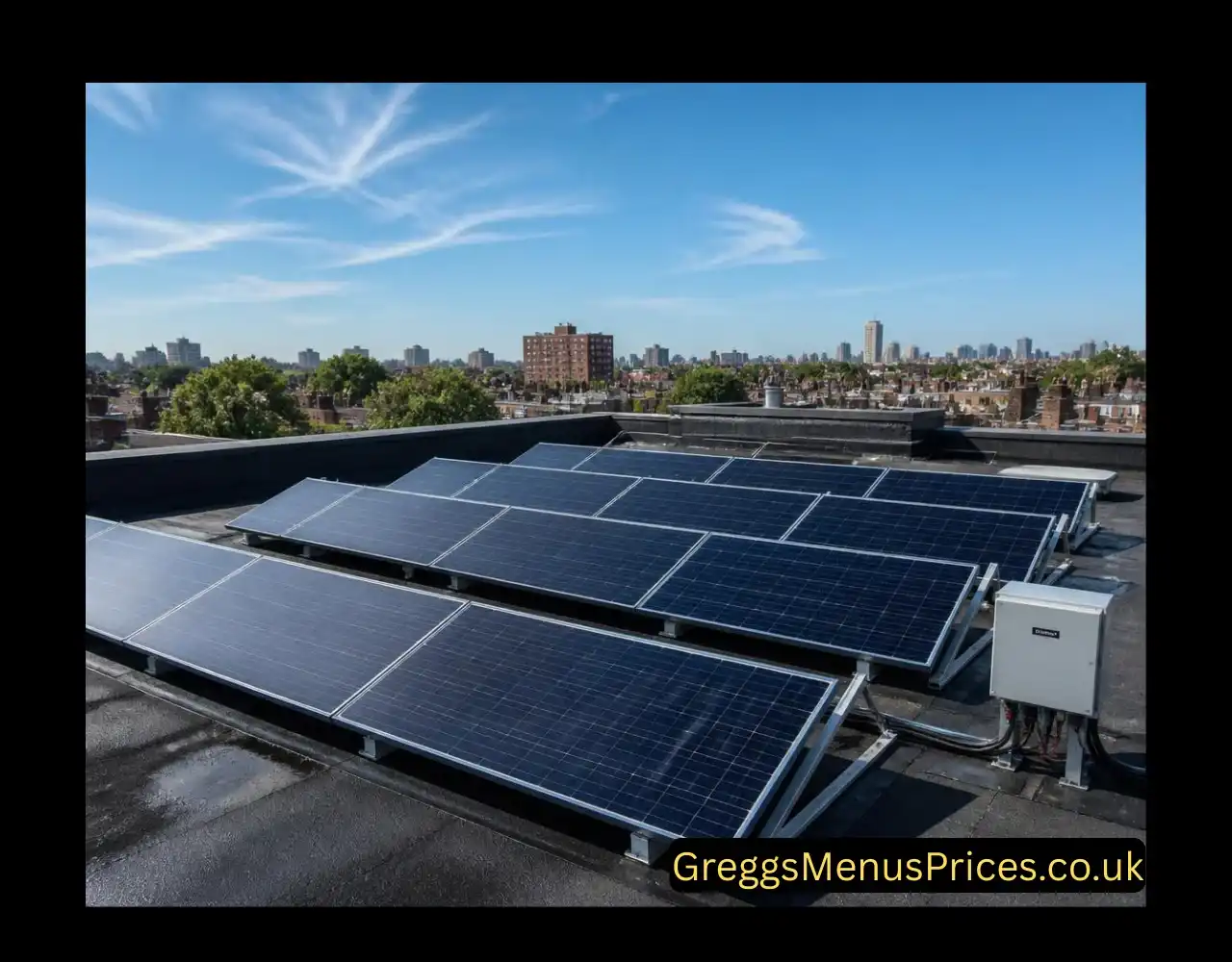
Solar Panels for Flat Roof UK Cost 2026

Solar Panels for Flat Roof UK Cost 2026: The Complete Honest Guide
If you’ve got a flat roof and you’re wondering whether solar panels are a viable option, the short answer is yes — they are. The fuller answer is that flat roof solar works a bit differently to a pitched installation, tends to cost a little more, and needs the right mounting system to perform properly. This guide covers what you can realistically expect to pay in 2026, what the different mounting options mean for your roof warranty, how tilt angle affects your output, and whether the numbers genuinely stack up for your property.
How Much Do Flat Roof Solar Panels Cost in the UK in 2026?
The extra cost of flat roof solar versus a standard pitched installation comes almost entirely from the mounting hardware. On a pitched roof, panels clip onto brackets fixed between roof tiles — a fairly quick job. On a flat roof, you need an angled frame to tilt the panels toward the sun, and whether that frame is weighted down or bolted in place, it adds time, materials, and in some cases a structural engineer’s assessment.
In 2026, a fully installed flat roof solar system costs roughly £500–£1,500 more than the equivalent pitched roof system. That said, labour is often cheaper on flat roofs because access is much safer and easier — so the total difference is smaller than many people expect. With 0% VAT on residential solar installations until at least March 2027, here are the current going rates:
| System Size | Ballasted Mount Cost | Mech. Fixed Cost | Est. Annual Output | Est. Annual Saving | Est. Payback |
|---|---|---|---|---|---|
| 3 kWp (6–8 panels) | £5,000–£7,500 | £4,800–£7,200 | ~2,550 kWh | ~£445/yr | 11–17 yrs |
| 4 kWp (10–12 panels) | £6,000–£9,000 | £5,800–£8,600 | ~3,400 kWh | ~£590/yr | 10–15 yrs |
| 5–6 kWp (12–16 panels) | £9,000–£12,000 | £8,600–£11,500 | ~4,200–5,100 kWh | ~£730–£900/yr | 10–16 yrs |
Prices include panels, hybrid-ready inverter, mounting frame, all electrical work and MCS certification, at 0% VAT. Battery adds £2,500–£4,000 extra. Annual savings based on Ofgem Q2 2026 rate (24.67p/kWh) and 50% self-consumption. The FMB estimates a typical 3-bed flat roof system with battery at around £10,700 (June 2026).
Check out how many solar panels are required in the U.K.
Three Mounting Systems — and Which One Suits Your Roof
The mounting system is the decision that’s unique to flat roof solar. Get it right and you’ll have a clean, low-maintenance install that doesn’t compromise your roof. Get it wrong and you risk voiding your roof warranty or creating leak points that only show up years later.
1 — Ballasted (Weighted) Mounting
The most widely used method across UK flat roofs, both residential and commercial. Angled frames sit directly on the roof membrane and are held in place by concrete paving slabs or purpose-made ballast blocks. No fixings go through the roof, so there’s no penetration risk and your roof warranty stays intact — the installer should use rubber or EPDM pads between the feet and the membrane to protect the surface. The catch is weight: expect an added load of 15–25 kg/m², which means the roof structure needs a structural engineer’s sign-off before installation. That assessment typically costs £100–£300 and is money well spent.
2 — Mechanically Fixed (Penetrating) Mounting
Brackets bolt directly through the roof deck and into the structural frame below. This system weighs significantly less than a ballasted approach — useful if the roof structure has limited load capacity — and is more resistant to wind uplift, making it a good choice for exposed or coastal locations. Every fixing point requires a waterproof flashing kit compatible with your specific membrane type (EPDM, GRP, felt, etc.). When done correctly by an experienced installer the results are extremely reliable; when done sloppily, each bolt hole becomes a potential leak path years down the line.
3 — East–West Layout
Not strictly a different mounting type, but a different panel orientation that changes everything. Panels are arranged in back-to-back pairs at a low angle of around 10°: one row tilted east, the next row tilted west. Because adjacent rows face away from each other there’s no inter-row shading, which means rows can be placed much closer together — fitting up to 30% more panels per square metre than a south-facing arrangement. Output per panel is slightly lower, but the more even generation across morning and afternoon suits households with spread-out daytime electricity use. Particularly effective on larger flat roofs.
Check out Solar panels maintenance
| Type | Roof Penetration | Typical Extra Cost | Weight Added | Roof Warranty | Best For |
|---|---|---|---|---|---|
| Ballasted (weighted) | ✓ None | +£400–£800 | 15–25 kg/m² | Intact | Most residential & commercial |
| Mech. Fixed (penetrating) | ✗ Yes — flashed | +£300–£600 | 3–6 kg/m² | Check terms | Exposed / coastal / low load roofs |
| East–West Layout | Either above | +£300–£700 | Depends on mount | Same as above | Large roofs, spread daytime use |
Check out Solar panels north facing roof
Why Flat Roof Panels Must Never Actually Lie Flat
This is the part that surprises a lot of people. Solar panels on a flat roof should not be laid flat against the roof surface. A flat panel generates around 30% less electricity than a correctly tilted one in UK conditions, and it accumulates debris — leaves, moss, bird droppings — that rain can’t wash away, gradually degrading output further. Every flat roof solar installation uses a frame to tilt panels toward the sun; the question is which angle to choose.
Most MCS-certified installers recommend 10–15° south-facing for UK flat roofs. Going steeper — say 30–35° — sounds tempting because that’s the optimal angle for a pitched roof, but on a flat surface it creates two problems: significantly more wind uplift (requiring heavier ballast or more fixing points) and much greater inter-row shading, which forces larger gaps between panel rows and means you can fit far fewer panels on the same roof area. The 10–15° range is where output, wind resistance, and efficient use of roof space converge.
Check out Best SEG Tariff Rates
Flat Roof vs Pitched Roof Solar — The Key Differences
| Factor | Flat Roof (4 kWp) | Pitched Roof 30–40° South (4 kWp) |
|---|---|---|
| Typical installed cost | £6,000–£9,000 | £5,500–£7,500 |
| Annual generation | ~3,200–3,500 kWh | ~3,500–3,800 kWh |
| Panel tilt | 10–15° via mounting frame | 30–40° (natural roof pitch) |
| Annual saving (no battery) | ~£420–£600 | ~£450–£650 |
| Estimated payback | 10–15 years | 8–12 years |
| Row spacing needed | ✗ Yes — reduces panel count | ✓ Not required |
| Structural assessment | ✗ Usually required | ✓ Rarely needed |
| Maintenance access | ✓ Walk-on (easier, cheaper) | ✗ Scaffolding often required |
Check out Solar panels for renters uk
📋 Planning Permission for Flat Roof Solar — What Changed in December 2023
Since December 2023, flat roof solar on residential properties in England falls under Permitted Development rights — meaning no planning application is needed, provided:
- Panels do not protrude more than 1 metre above the roof surface
- They are set at least 1 metre back from the roof edge
- The property is not a listed building (always needs full consent)
- Panels are not visible from the street in a conservation area (may need prior approval)
Flats and apartments: shared roof access is a lease matter, not a planning one — freeholder or management company approval is typically required. Scotland and Wales operate under slightly different Permitted Development rules; always confirm with your installer.
Check out Solar panels for caravan
What Every Flat Roof Solar Quote Must Include
Ask for these items specifically. If anything is missing from a quote, question it before you commit.
- ✓Structural loading assessment — confirms the roof can carry the weight of ballast, frames and panels safely
- ✓Ballast or waterproofing specification — either the ballast calculation for a weighted system, or a detailed flashing plan for a penetrating mount
- ✓Row spacing and shading analysis — shows how panels are laid out to prevent inter-row shading at low winter sun angles
- ✓Panels, inverter and all mounting hardware — itemised with brand and model numbers
- ✓All electrical work and cable runs — from roof to inverter and consumer unit
- ✓DNO G98 notification — required for systems up to 16A per phase; your installer submits this
- ✓MCS certificate and registration — without MCS you cannot access the Smart Export Guarantee (SEG)
- ✓Scaffolding or access equipment — if needed for safe roof access, this should be included in the quote, not added later
What You Can Realistically Expect to Save
Using the Ofgem unit rate for April–June 2026 (24.67p/kWh) and a Smart Export Guarantee rate of 10p/kWh, here’s what a south-facing flat roof system typically delivers across common system sizes:
| System Size | Annual Output | Bill Saving (50% self-use) | SEG Income (50% export) | Total Annual Benefit | Est. Payback |
|---|---|---|---|---|---|
| 3 kWp | ~2,550 kWh | ~£314 | ~£128 | ~£442 | 11–17 yrs |
| 4 kWp | ~3,400 kWh | ~£419 | ~£170 | ~£589 | 10–15 yrs |
| 5 kWp | ~4,200 kWh | ~£518 | ~£210 | ~£728 | 12–16 yrs |
| 4 kWp + 5kWh battery | ~3,400 kWh | ~£629 (80% self-use) | ~£68 | ~£697 | 14–19 yrs |
Annual savings are estimates based on Ofgem Q2 2026 rate (24.67p/kWh). Battery system modelled at 80% self-consumption. SEG rate at 10p/kWh. Payback range reflects regional installation cost variation across the UK. Output assumes 15° south-facing tilt at England average irradiance.
💡 One thing many people miss
The biggest risk with flat roof solar isn’t the install itself — it’s installing solar on a roof membrane that will need replacing in the next few years. Removing and reinstalling a ballasted solar system to re-roof underneath typically adds £800–£2,000 to the roofing job. If your flat roof is nearing the end of its life, address the roof first or combine both projects in one go.
Our Honest Verdict
Flat roof solar costs a bit more, generates a touch less per kWp, and needs a few extra checks that pitched roof installs don’t. None of those things are dealbreakers — they’re just variables to factor into your decision properly rather than ignore.
If your flat roof faces broadly south, is structurally sound, and isn’t nearing the end of its membrane life, the economics work in most cases. The same 25-year panel lifespan applies, the same 0% VAT saving applies until at least March 2027, and the same Smart Export Guarantee payments apply as with any other UK solar install.
Get at least three quotes from MCS-certified installers with specific flat roof experience, ask each one for a row spacing calculation and a structural loading assessment, and compare what each quote actually includes — not just the headline price.
Flat Roof Solar Panels — Frequently Asked Questions
How much do solar panels on a flat roof cost in the UK in 2026?
A fully installed 4 kWp flat roof solar system costs approximately £6,000–£9,000 in 2026 at 0% VAT — around £500–£1,500 more than the same system on a pitched roof. A 3 kWp system starts at around £5,000–£7,500, and a 5–6 kWp system runs to £9,000–£12,000. The FMB puts the average cost for a typical 3-bed system with battery at around £10,700 as of June 2026.
What is the best tilt angle for solar panels on a flat roof in the UK?
Between 10° and 15° south-facing is the recommended range for most UK flat roof installations. Panels lying flat generate around 30% less electricity and accumulate debris that degrades output further. Steeper angles of 30–35° work well on pitched roofs but on a flat surface they create excessive wind uplift and require very large row spacing — reducing the number of panels you can fit significantly.
Do I need planning permission for flat roof solar panels in England?
Since December 2023, flat roof solar is covered by Permitted Development rights for most residential properties in England — no planning application is required, provided panels stay within 1 metre of the roof surface height and 1 metre from the roof edge. Listed buildings still need full consent. Flats and apartments need freeholder approval. Scotland and Wales have slightly different rules.
What is the difference between ballasted and mechanically fixed flat roof solar?
Ballasted (weighted) mounting uses concrete blocks to hold frames in place with no holes in the roof — the roof warranty stays intact. It adds 15–25 kg/m² of load so a structural check is usually needed. Mechanically fixed mounting bolts brackets through the roof into the structure below, which is lighter and better for exposed locations, but every fixing point needs proper waterproof flashings.
What is an east–west solar panel layout and is it worth it on a flat roof?
An east–west layout places panels in back-to-back pairs — one facing east, one facing west — at a low 10° tilt. Because the rows face away from each other there is no shading between rows, so panels can be placed much closer together, fitting up to 30% more panels per square metre than a south-facing arrangement. Total daily generation is more evenly spread and overall capacity is higher, making it a good choice for larger flat roofs or households with consistent daytime electricity use.


6 Comments