
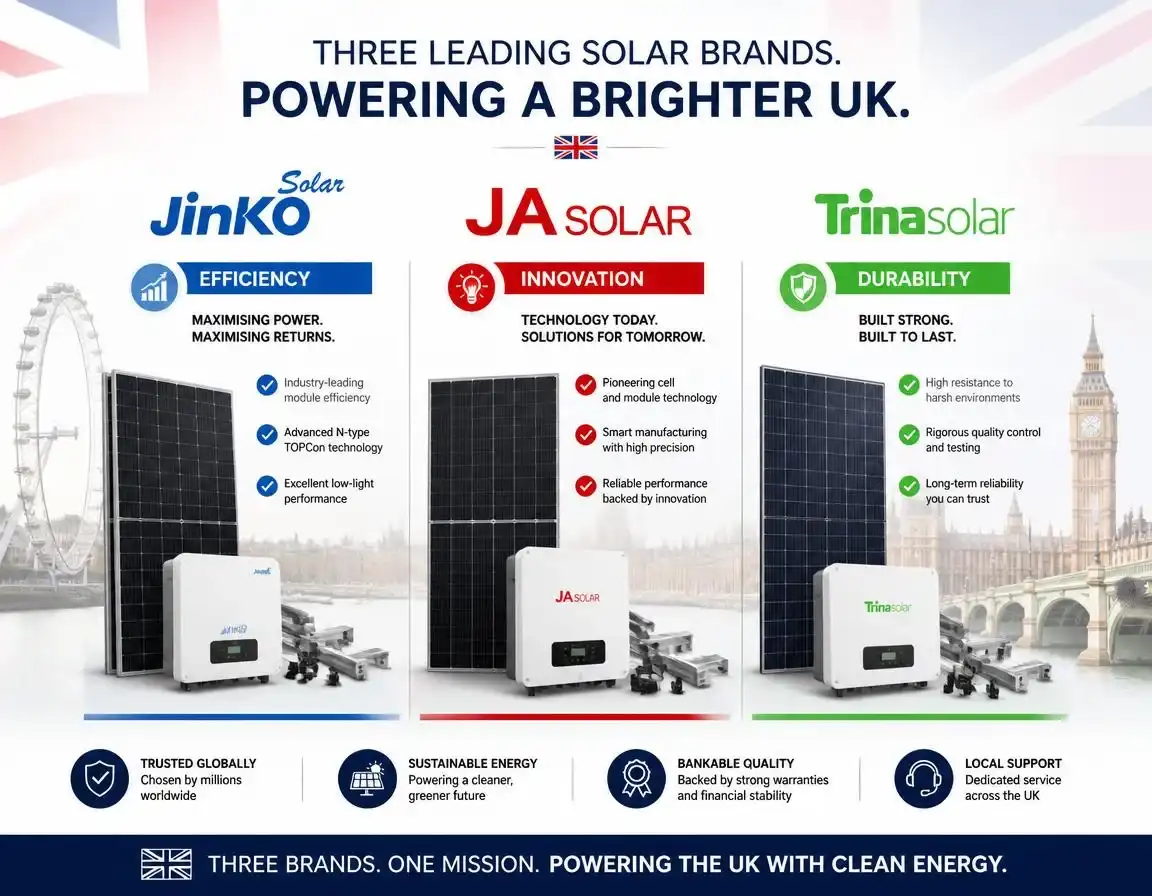
Jinko vs JA Solar vs Trina Solar

Jinko vs JA Solar vs Trina Solar: Which Is Actually Best for Your UK Roof in 2026?

If you’ve had a couple of solar quotes land in your inbox this year, you’ve probably noticed the same three names keep turning up: Jinko, JA Solar and Trina Solar. Between them, this trio supplies a huge slice of the panels going onto British roofs right now, and it’s easy to see why people get stuck comparing them — they’re all Chinese-made, all “Tier 1”, and all claim near-identical efficiency and warranties on paper.
I’ve spent the past couple of weeks pulling apart the actual datasheets, checking UK trade pricing, and digging into independent reliability testing rather than just repeating manufacturer marketing. Here’s the honest, no-sales-pitch version of how Jinko, JA Solar and Trina Solar really compare for a UK installation in 2026 — and which one is worth asking your installer about.
The quick answer
- Jinko Tiger Neo is usually the most affordable of the three and the most commonly quoted brand by UK installers, with a market-leading 30-year power warranty.
- Trina Vertex S+ often has a small edge on raw efficiency and wattage, with a proven 25+ year manufacturing track record.
- JA Solar DeepBlue 4.0 Pro sits neatly in the middle on price and performance, and is the second most popular brand with UK installers.
- On paper, all three are within a fraction of a percent of each other. In the real world, your installer’s stock and total system price matter more than the badge on the panel.
Before we get into the numbers, a quick bit of context. Solar panel technology in the UK has converged hard around N-type monocrystalline panels over the past couple of years, specifically TOPCon cells, and Jinko, JA Solar and Trina are three of the manufacturers who pushed that shift the hardest. According to the UK government’s own solar photovoltaics deployment statistics, the UK passed two million solar installations and 22GW of total capacity in early 2026 — and a good chunk of that rooftop growth has been built on panels from these three manufacturers.
Meet the three manufacturers
All three companies are large, publicly listed, Chinese-headquartered manufacturers that have been through multiple solar technology cycles — polycrystalline, PERC, and now N-type TOPCon. None of them is a fly-by-night operation, and all three have a genuine UK sales and distribution presence.
| Manufacturer | Founded | HQ | Global position | UK flagship panel |
|---|---|---|---|---|
| Jinko Solar | 2006 | Shanghai, China | World’s largest module maker by shipments | Tiger Neo (N-type TOPCon) |
| JA Solar | 2005 | Beijing, China | World’s second-largest module maker | DeepBlue 4.0 Pro (N-type TOPCon) |
| Trina Solar | 1997 | Changzhou, China | Top-three module maker, longest track record | Vertex S+ (N-type i-TOPCon) |
Full spec comparison: efficiency, warranty and price
This is the table most people actually want. I’ve used each brand’s mainstream 2026 UK residential panel — the one your installer is most likely to actually quote you — rather than niche commercial variants.
| Spec | Jinko Tiger Neo | JA Solar DeepBlue 4.0 Pro | Trina Vertex S+ |
|---|---|---|---|
| Cell technology | N-type TOPCon | N-type TOPCon (Bycium+) | N-type i-TOPCon, dual glass |
| Module efficiency | 22.0–22.3% | 21.8–22.5% | 22.0–22.5% |
| Residential wattage range | 420–480W | 415–460W | 425–450W |
| Product warranty | 25 years | 25 years | 25 years* |
| Performance warranty | 30 years (87.4% @ Y30) | 30 years (87.4% @ Y30) | 30 years* (87.4% @ Y30) |
| Year-1 / annual degradation | 1% / 0.4% p.a. | 1% / 0.4% p.a. | 1% / 0.4% p.a. |
| Temperature coefficient | −0.30%/°C | −0.29%/°C | −0.30%/°C |
| Typical UK trade price (ex VAT, per panel) | £45–£70 | £70–£110 | £85–£140 |
| Bifacial option available | Yes | Yes | Yes |
*Some specific Trina Vertex S+ batches are sold with a shorter 15-year product warranty rather than 25 — always check the exact datasheet against your quote before signing anything.
Module efficiency, side by side
Standard 54-cell residential panel, 2026 mainstream models
The gap between all three is smaller than the manufacturing tolerance printed on most datasheets. Don’t let a 0.2% efficiency claim decide your purchase.
The “Tier 1” label: what it actually means in 2026
Every one of these three brands gets called “Tier 1” in marketing material, and most competing review sites repeat that badge uncritically. It’s worth knowing what it actually is, because it’s changed a lot recently.
The BloombergNEF Tier 1 list was never a quality score. It’s a bankability snapshot — a list of manufacturers whose panels have been used on at least six utility-scale projects, financed by six different commercial banks. It tells lenders which brands are safe bets for big solar farms, not which panel is best for your semi in Leeds.
And the list has tightened sharply. The qualifying project size rose from 1.5MW before 2024, to 5MW in 2024, to 10MW from mid-2025 — shrinking the list from more than 40 manufacturers down to roughly 20. BloombergNEF itself now explicitly tells buyers and banks not to treat the list as a measure of module quality. Jinko was even briefly dropped from one 2024 quarterly list over a minor unrelated legal dispute at a subsidiary company, worth a few hundred pounds, which it resolved shortly after. That’s a good illustration of how little a single quarter’s Tier 1 listing actually tells you about the panel on your roof.
How they hold up over 25–30 years
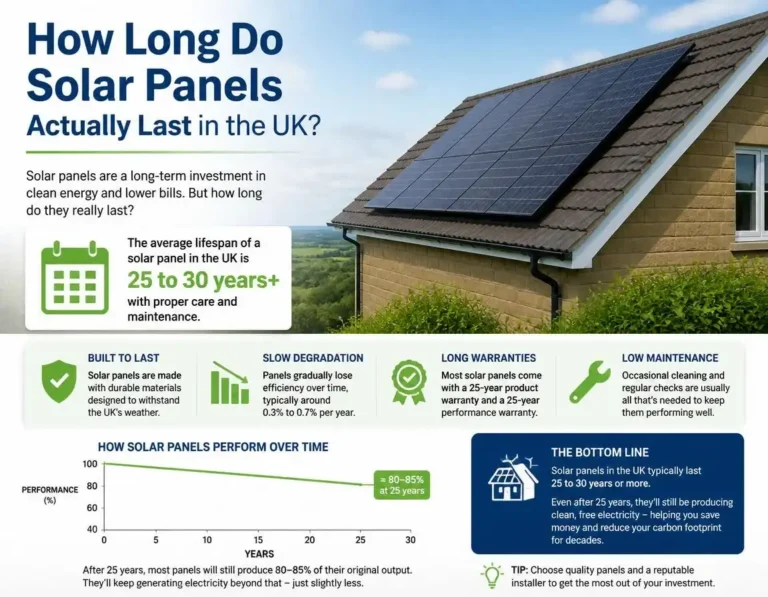
This is where the “big three” genuinely pull away from older panel technology, rather than from each other. All three brands’ current N-type TOPCon panels follow essentially the same degradation curve: around 1% output loss in year one, then roughly 0.4% per year after that. Compare that with older P-type PERC panels, which typically lose closer to 2% in year one and 0.5–0.7% annually thereafter.
25-year power output: N-type TOPCon vs older P-type PERC
% of original rated output remaining, by year
Jinko, JA Solar and Trina’s current panels track almost the same line here — the real-world difference over 30 years is a rounding error between the three, but a meaningful gap versus older PERC stock.
The three panels, one by one
Jinko Tiger Neo Best value
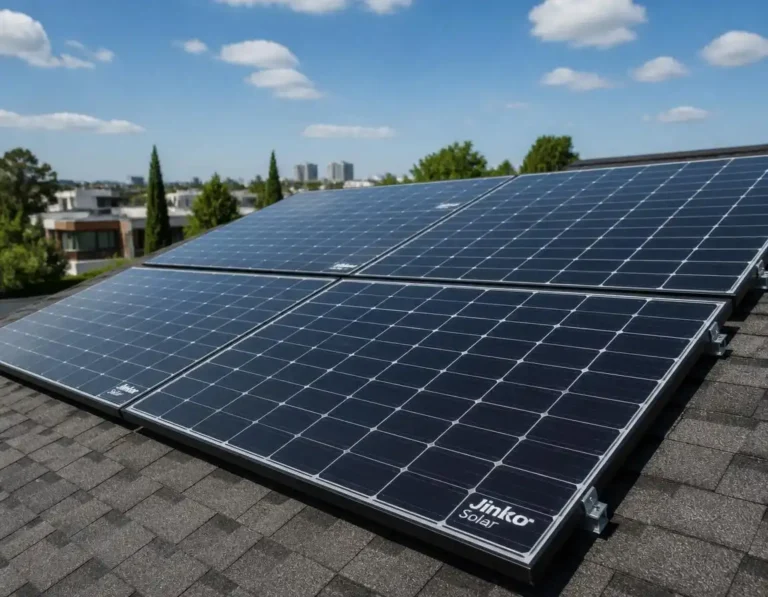
Jinko ships more solar panels than any other company on Earth, and the Tiger Neo is its bread-and-butter residential range in the UK. It’s usually the cheapest genuine Tier 1 TOPCon panel your installer can quote, without giving up much on paper against pricier alternatives.
Strengths
- Typically the most competitively priced of the three
- 30-year linear performance warranty as standard
- 12 consecutive years as a PVEL Scorecard Top Performer
- Widest UK trade stock availability, so faster lead times
Watch out for
- Efficiency sits at the lower end of the trio on some SKUs
- Brand recognition among homeowners is lower than the specs deserve
- Counterfeit/grey-market Jinko panels exist abroad — verify the QR code with any UK-sourced panel
JA Solar DeepBlue 4.0 Pro Solid middle ground
JA Solar is the world’s second-largest manufacturer and the second most commonly quoted brand by UK installers. The DeepBlue 4.0 Pro uses JA’s own “Bycium+” cell passivation tech, and it’s a genuinely dependable, unremarkable-in-a-good-way panel.
Strengths
- Strong low-light and warm-weather performance (−0.29%/°C)
- Wide model range from 415W residential up to 670W commercial
- 25-year product plus 30-year performance warranty as standard
Watch out for
- Sits at a small price premium over Jinko for very similar real-world output
- Fewer UK installers stock JA as their default brand than Jinko
Trina Solar Vertex S+ Longest track record
Trina has been making solar panels since 1997 — longer than either competitor — and the Vertex S+ is currently one of the most-installed panels on UK roofs. Its dual-glass build gives it a slight durability edge for exposed or coastal sites.
Strengths
- Often the highest wattage and efficiency of the three on a like-for-like panel
- Dual-glass construction adds mechanical and moisture resistance
- Nearly three decades of manufacturing history and financial stability
Watch out for
- Warranty terms vary more by SKU — some batches carry a shorter 15-year product warranty
- Trina had well-documented quality issues on panels made between 2011–2014 (PID, backsheet degradation); current-generation panels are unaffected but it’s worth knowing the history
- Tends to sit at the top of the price range of the three

What this actually costs on a UK roof
Panel brand alone rarely swings a full installed quote by much — labour, scaffolding, the inverter and mounting kit make up most of the bill. But it’s still useful to see the indicative spread. Here’s the rough installed-price impact of brand choice on a typical 10-panel, ~4.4kW system, on top of the baseline costs covered in our full 2026 UK solar panel cost and grants guide.
Indicative trade price range per panel (ex VAT)
2026 UK trade pricing, typical 420–450W residential SKU — varies by retailer, volume and exact wattage
Always get three quotes from MCS-certified installers — the spread between installers is usually bigger than the spread between panel brands.
Which panel suits which situation
Jinko Tiger Neo
Usually the cheapest genuine Tier 1 TOPCon panel per watt in the UK, with the 30-year warranty included as standard, not an upsell.
Trina Vertex S+ G3 or JA DeepBlue 5.0
The newer, higher-wattage variants squeeze slightly more output from fewer square metres — useful if your roof space is genuinely tight.
Any brand’s bifacial, dual-glass SKU
All three offer bifacial variants. Ground mounts and light-coloured flat roofs benefit most from the rear-side gain, whichever brand you choose.
Trina Vertex S+ (dual glass)
The dual-glass build adds a little extra resistance to salt mist and moisture. Check IEC 61701 certification on any brand you’re quoted regardless.
Whichever brand’s commercial range fits your inverter string
See our guide to solar panels for commercial property in the UK for sizing beyond a standard home array.
Whatever your installer stocks
Given how close these three are on paper, the fastest, best-value route is usually whichever Tier 1 brand your chosen installer already has on the shelf.
How they perform in real UK weather
The UK doesn’t get much direct, intense sunshine compared with southern Europe, so two figures matter more here than raw peak efficiency: low-light performance and temperature coefficient. All three brands’ N-type TOPCon cells handle diffuse, overcast light meaningfully better than the older P-type panels many installers were still fitting a few years ago, which matters given how many UK roofs aren’t perfectly south-facing. And because UK summers rarely push panel temperatures as high as, say, southern Spain, the small differences in temperature coefficient between Jinko (−0.30%/°C), JA Solar (−0.29%/°C) and Trina (−0.30%/°C) barely register across a typical British year. If you’re still working out how many panels your roof needs in the first place, our guide to sizing a UK solar system is a good next stop.
Making sure you’re getting the real thing
Because all three brands are so widely copied and re-badged in some markets, it’s worth doing two quick checks before you sign off on an installation. First, ask your installer to confirm the exact model number and check it against the MCS Certified Products directory — if it isn’t listed, ask why. Second, once panels are on site, genuine Jinko, JA Solar and Trina panels all carry a scannable QR code or serial number that verifies against the manufacturer’s own database. If your installer can’t produce a verifiable serial, treat that as a red flag in exactly the same way we cover in our solar panel scams guide.
Our honest bottom line
If you’d asked me to pick an outright winner, I couldn’t give you an honest one — and I’d be suspicious of any article that does. Jinko, JA Solar and Trina Solar are all genuinely well-established, independently tested manufacturers making panels within touching distance of each other on every metric that matters for a UK rooftop. Jinko generally wins on price and availability. Trina generally wins on raw efficiency and track record. JA Solar sits comfortably between the two. Run the actual numbers for your roof with our solar panel calculator, get quotes from a couple of MCS-certified installers, and let the total installed price and your installer’s stock make the final call rather than the logo on the panel.

Frequently asked questions
Which is better: Jinko, JA Solar or Trina Solar?
Honestly, there’s no outright winner — all three are established Tier 1 manufacturers making N-type TOPCon panels within a fraction of a percent of each other on efficiency, and all three offer 25-year product plus 30-year performance warranties on their mainstream UK residential ranges. Jinko Tiger Neo tends to be the most competitively priced and is the most commonly quoted brand by UK installers in 2026. Trina Vertex S+ often edges ahead very slightly on wattage and efficiency. JA Solar DeepBlue 4.0 Pro sits comfortably in between on price and performance. For most UK homes, the deciding factor should be your installer’s stock, your exact roof space, and the total system price, not the badge on the panel.
Are Jinko, JA Solar and Trina Solar still genuinely Tier 1 in 2026?
Yes, based on recent quarterly listings, though it’s worth understanding what Tier 1 actually measures. BloombergNEF’s Tier 1 list has tightened significantly, with the qualifying project size rising from 1.5MW before 2024 to 10MW from mid-2025, shrinking the list from over 40 manufacturers to around 20. BloombergNEF itself now explicitly advises the list shouldn’t be used as a measure of product quality, since it’s a bankability snapshot for large-scale project financing rather than a residential quality score. Jinko was even briefly excluded from one 2024 quarterly list over a small, unrelated legal dispute at a subsidiary, later resolved, which is a good reminder that a single quarter’s listing doesn’t tell you much about panel quality. For homeowners, independent lab testing such as the PVEL Module Reliability Scorecard is a more useful signal, and Jinko in particular has a strong record there, with 12 consecutive years as a Scorecard Top Performer.
Which solar panel brand do UK installers use most in 2026?
Jinko is generally reported as the most frequently quoted panel brand by MCS-certified UK installers in 2026, largely down to competitive pricing and wide trade availability, followed by JA Solar and then Trina Solar. That said, installer stock varies a lot by region and by which wholesaler your installer buys from, so it’s entirely normal to be quoted a different brand order depending on who you ask. All three are genuine, well-established Tier 1 manufacturers, so there’s no wrong answer among them.
Figures referenced in this article are drawn from manufacturer datasheets (Jinko, JA Solar, Trina Solar), the Kiwa PVEL PV Module Reliability Scorecard, BloombergNEF’s published Tier 1 methodology, UK trade pricing observed in mid-2026, and DESNZ solar deployment statistics. Panel specifications and pricing change frequently — always confirm exact figures against the datasheet for the specific model on your quote.


5 Comments