East-West Solar Panels in the UK

East-West Solar Panels in the UK: Output Loss, Costs and When a Split Roof Wins
Updated 22 October 2026. Prices, VAT dates and tariff figures reflect autumn 2026.
The short version
East-west solar panels produce about 15-20% less per kWp than a south-facing array at the same tilt, because east or west sits at roughly 80-85% of due south. On a low-tilt flat roof the gap is closer to 10-14%. In return you can fit more panels, the output spreads from morning to evening, and it suits a battery. A split roof usually wins on total kWh when it fits 20-25% more capacity than your south slope would, or when the south slope is small, shaded or missing. On a pitched roof it costs about the same per kWp to install.
What an east-west array actually is
Most UK quotes assume panels on the south-facing slope and nothing else. But a lot of British houses have no usable south slope. If your ridge runs north-south, your two roof faces point east and west. That is a design choice in its own right, and done properly it works well.
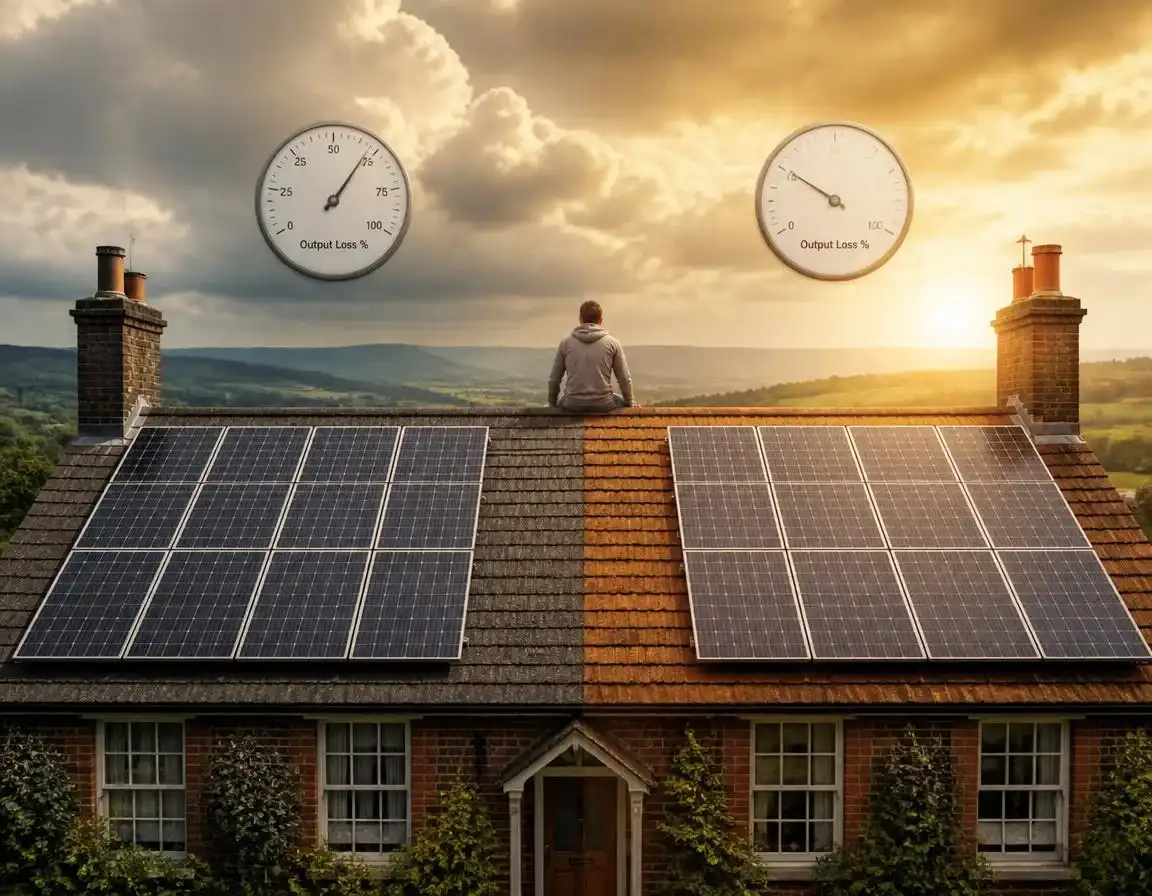
An east-west array (also called a split roof, dual-aspect or east/west layout) puts panels on both slopes of a pitched roof, or sets opposed rows facing east and west on a flat roof. The east slope works the morning, the west slope works the afternoon and evening, and together they give one broad generation curve instead of a single midday spike.
East-west is not the same as south-east/south-west. A SE/SW split keeps both slopes inside the sunny arc and loses only around 5-6% against due south. True east-west points the panels at the rising and setting sun. That is where the yield penalty comes from, and where the self-consumption benefit comes from too. To see how much roof you have to work with, start with my guide to sizing a UK solar system.
The real output loss, in honest numbers
The figure most people want first is the loss. On a pitched roof it is about 15-20% per installed kW compared with the same panels at the same tilt facing due south. That matches MCS irradiance data, which put east or west at roughly 80-85% of south, and PVGIS modelling of a typical 4.9kWp home system, which lands at about 80-82%. It is not a third, and nowhere near half. British weather narrows it a little, since much of our yield is diffuse light that cares less about which way the panel points.
Three refinements matter. First, tilt beats compass direction. At the shallow angles used on flat roofs (10-15 degrees), the east-west penalty against a south array at 35 degrees narrows to around 10-14%, and most of that is the low tilt, not the orientation. Second, west usually edges east by a point or two, so a west-heavy split is very slightly better than a perfectly even one. Third, the annual figure hides a seasonal swing. In June the sun rises and sets well north of east and west, so a split roof runs close to south. In December the gap is far wider than 15-20%. If most of your usage falls on winter evenings, plan for that.
| Roof layout | Tilt | Yield index (south = 100) |
|---|---|---|
| South | 35° | 100 |
| South-east / south-west | 35° | 93-96 |
| East-west flat-roof array | 10-15° | 86-90 |
| West only | 35° | 81-85 |
| East-west split (pitched) | 35° | 80-85 |
| East only | 35° | 79-83 |
| North | 35° | 50-60 |
Modelled ranges for unshaded UK roofs, based on MCS-style irradiance data and PVGIS orientation modelling. Your roof will differ with latitude, pitch and shading. Any decent MCS quote includes a site-specific yield estimate, and if it doesn’t, ask why. Even north-facing panels are less hopeless than the folklore suggests.
Here is what those indices mean in kWh per kWp, using the regional south-facing yields from my payback period guide:
| Region | South-facing, 35° (kWh per kWp a year) | East-west, pitched | East-west, flat roof |
|---|---|---|---|
| South England and South West | 950-1,050 | 760-890 | 820-945 |
| Midlands and Wales | 850-950 | 680-810 | 730-855 |
| North England and Northern Ireland | 800-900 | 640-765 | 690-810 |
| Scotland | 750-850 | 600-720 | 645-765 |
East-west columns apply the 80-85 (pitched) and 86-90 (flat) indices to the south-facing range. Treat them as planning estimates, not guarantees.
Why the flatter curve matters more than the headline loss
Annual kWh is half the story. The other half is when those kWh arrive. A south array puts most of its energy into a narrow midday window, which is when an empty house uses least. An east-west array spreads generation from early morning to early evening as a broad, flatter curve, sometimes with two shallow humps.
That shape fits how many British households use electricity: kettle and shower at seven, washing machine before work, then cooking, telly and charging from six onwards. A unit you use yourself saves roughly 26p at the current Ofgem cap (26.32p/kWh from 1 October 2026), while an exported unit on an open SEG tariff typically earns about 3-15p. Shifting output from export to self-use claws back part of the orientation penalty. It rarely claws back all of it, and the bigger prize is usually the extra capacity.
Batteries suit this curve too. On a clear spring or summer midday a 6kWp south array can briefly peak around 4.5-5kW. Whatever the house isn’t using, plus what the battery and inverter can absorb, gets exported or clipped. A 6kWp east-west array tends to peak nearer 3.5-4kW and feeds the battery steadily from mid-morning to early evening. If storage is in your plans, read my best solar battery guide before you pick hardware.
Flat roofs: where east-west stops being a compromise
On a flat roof, east-west is the standard design, and the reason is shading between rows. South-facing rows must be spaced far apart so they don’t shadow each other, which wastes much of the roof. Back-to-back east-west rows at around 10 degrees only shade each other at sunrise and sunset, when there is little light to lose. You can pack them tightly and fit up to about 30% more panels per square metre than a south-facing layout.
Flat-roof arrays are usually ballasted rather than fixed through the membrane, adding roughly 15-25 kg/m² of load. That puts the focus on structural capacity and wind uplift, which your installer should calculate and put in writing, not eyeball. Expect a flat roof to cost about £500-£1,500 more than a pitched one, with an east-west mounting layout adding around £300-£700 of that range, as set out in my flat roof solar costs and layouts guide. The low tilt also means rain washes panels less effectively, so allow for an occasional brush-off.
Low tilt helps with planning too. In England the highest part of flat-roof equipment generally can’t sit more than 600mm above the highest part of the roof. A panel tilted at 10-15 degrees on a low frame normally stays within that, though your installer should confirm it for your mounting system.
Bifacial modules pick up reflected light on their rear side, and low-tilt rows over a pale membrane or gravel are where that bonus shows up. On a dark pitched roof the gain is small. Whether the premium pays back depends on the surface below, which I cover in my bifacial panels review.
When a split roof wins
The test is arithmetic, not sentiment. At 80-85% of the per-kWp yield, a split layout breaks even on total kWh once it lets you install about 18-25% more capacity than the south-only option (1 ÷ 0.85 = 1.18, 1 ÷ 0.80 = 1.25). I use 20-25% as the working rule, and anything above that is a net gain in energy.
Worked example
Take a Midlands roof at about 900 kWh per kWp for a south array. A small clean south slope fits 9 panels of 440W, about 4kWp, giving roughly 3,600 kWh a year. Both slopes together fit 14 panels, about 6kWp, at an index of 82, giving roughly 4,430 kWh a year. That is 23% more energy from the same house, because roof area is usually the limit, not panel efficiency. It also costs more: my cost guide puts 4kWp at £5,500-£7,500 and 6kWp at £8,500-£11,500. Winning on kWh only pays off if you can use or sell the extra output.
- Your roof is flat or very low pitch. East-west is the default, and the yield gap is around 10-14%.
- Your south slope is small, shaded or cluttered with chimneys, dormers, flues or roof windows. A large clean split beats a small compromised south.
- You are home at the edges of the day, whether retired, working from home or cooking most evenings. Morning and evening generation gets used instead of exported cheaply.
- You are adding a battery. The long, gentle curve charges it over more hours and wastes less at the peak.
- You want a battery-backed evening export deal. Tariffs such as Octopus Flux pay most between 16:00 and 19:00, but they need a compatible battery and Octopus as your import supplier. The battery does the timing, and a west slope keeps it topped up later in the afternoon. See my Flux explainer and the SEG tariff comparison.
- Your electricity use is about to grow, with a heat pump, an EV or air conditioning on the way, and you want the biggest system the roof allows.
When south still wins
A split is not always right. On some roofs I would keep it simple.
- Your south slope already fits the system you need. If 4kWp on south covers your usage, chasing 6kWp east-west adds cost for energy you may not use.
- You are out all day and export most of your output on a fixed tariff. A flat export rate pays the same at noon as at six, so maximum yield per panel is what counts. See my piece on whether solar pays if you’re out all day.
- Space is tight and every panel must earn the full rate, as on a small cottage roof where spreading across two slopes adds no capacity.
- One slope is badly shaded by a tall tree or a neighbouring building for half the day. A shaded east slope drags the morning half of your curve down.
- Your budget is fixed and small. On a limited panel count, south-facing still gives the most kWh per pound.
Design rules that make an east-west array work
Get these right and the system performs as modelled. Get them wrong and you will lose more to bad design than to orientation.
- Never string east and west panels together on one MPPT. They peak at different times, and a single tracker will settle between the two and throw energy away. Use a string inverter with two MPPT inputs, east on one and west on the other, or go to microinverters or optimisers. My microinverter vs string inverter comparison explains the trade-offs.
- Keep optimisers and microinverters for shading or for roofs with three or more orientations. Two clean MPPTs handle a simple split fine, while a chimney shadow across three panels is what justifies panel-level electronics.
- Push the DC:AC ratio higher. An east-west array has a lower peak per kWp, so oversizing the panels to around 130% of the inverter rating is routine, and some inverters accept up to 150%. On a single-phase home the usual 3.68kW inverter (the G98 limit; larger needs network operator approval) can then carry roughly 4.8-5.5kWp of panels. Check the inverter’s maximum DC input and its warranty terms first.
- On flat roofs, keep tilt at 10-15 degrees and get row spacing, ballast weight and wind uplift calculations in writing. Low tilt is what keeps the yield penalty near 10-14%.
- Check both slopes for shade separately, morning and late afternoon. A wall that only matters at 8am still costs you every morning of the year.
- Monitor the two halves independently. Per-orientation data lets you spot a failed string on one slope instead of wondering why the whole system feels tired. Kit options are in my monitoring systems guide.
One thing to insist on
An MCS-certified installer should give you a projected annual yield for your specific roof as part of the quote. MCS certification is also what makes your system eligible for the Smart Export Guarantee. If two quotes for the same house differ by more than a few hundred kWh, ask each installer to show their azimuth, tilt and shading assumptions. That one question filters out poor quotes quickly.
Cost, payback and tariffs in 2026
On a pitched roof, an east-west array costs about the same per kWp as a south-facing one: same panels, same rails, similar labour, perhaps a little more cable and scaffold access. Qualifying domestic solar and battery installs in Great Britain carry 0% VAT until 31 March 2027, with the 5% reduced rate expected after that. On a £7,000-£11,000 job, that is roughly £350-£550 of VAT. VAT follows the tax point, so paying a deposit early does not always lock in the old rate. Ask your installer to confirm the VAT position in writing.
| Setup (installed, incl. 0% VAT) | Typical 2026 price range | Rough annual output, Midlands-type roof |
|---|---|---|
| 4kWp south-facing, pitched (for comparison) | £5,500-£7,500 | 3,400-3,800 kWh |
| 4kWp east-west split, pitched | £5,500-£7,500 | 2,700-3,200 kWh |
| 6kWp east-west split, pitched | £8,500-£11,500 | 4,100-4,800 kWh |
| 4kWp east-west, flat roof | £6,000-£9,000, plus about £300-£700 for the east-west mount layout | 2,900-3,400 kWh |
| Add a 5kWh battery | +£2,500-£4,500 | shifts more of it to self-use |
Output uses Midlands and Wales yields of 850-950 kWh per kWp for a south array (my sizing guide gives 3,400-3,800 kWh for 4kWp), then the indices above. London and complex roofs sit higher; Scotland yields less. Full breakdowns are in my 2026 solar panel cost guide.
Payback depends on how much of the output you use yourself versus export. Self-used units save about 26p/kWh at the current price cap. Exported units earn roughly 3-15p on open SEG tariffs, 15-25p on some supplier-tied fixed deals, and up to about 32p at peak on a time-of-use tariff like Octopus Flux if you have a battery. Typical UK payback runs around 8-12 years, and a split roof is not automatically slower or faster than a south one. What matters is whether you can use the extra capacity. Oversizing for energy you export at 5p stretches payback. The mechanics are in my payback period guide, and if you are still working out how many panels you need, start with how many solar panels do I need.
Then planning. Solar on a house in England is generally permitted development. According to the Planning Portal, panels on a pitched roof should not sit above the highest part of the roof (excluding the chimney) or project more than 200mm from the slope. On a flat roof the equipment can’t rise more than 600mm above the highest part of the roof, and a flat-roof install on designated land such as a conservation area or national park needs prior approval from the council. Listed buildings are excluded, and in a conservation area or World Heritage Site you can’t fit panels to a wall, balcony or roof enclosure facing a highway. The rules changed on 27 August 2026, with a transition period to 27 August 2027, so check the current wording or my solar panel planning permission guide before you commit. Leaseholders need their freeholder’s consent, and Scotland, Wales and Northern Ireland have their own rules.
FAQs
How much less energy do east-west solar panels produce than south-facing?
On a typical pitched roof at the same tilt, an east-west split produces about 15-20% less per kWp than due south, which puts it at roughly 80-85% of a south array. On a flat roof with panels tilted at 10-15 degrees, the gap narrows to around 10-14% against a south array at 35 degrees, because low tilt matters more than compass direction. The loss is widest in winter and narrowest in summer. If the alternative is a small or shaded south slope, a split roof often still wins on total kWh because you can fit more panels.
Are east-west solar panels worth it in the UK?
Often, yes. They cost about the same per kWp as south-facing panels on a pitched roof, and they generate from early morning to evening, which matches typical household use and suits a battery. A split roof tends to beat a south-only layout when it lets you fit roughly 20-25% more capacity, or when the south slope is small, shaded or missing. If one south slope already holds the system you need and you are out all day, south-facing usually still gives more kWh per panel.
Do east-west solar panels need optimisers or microinverters?
Not usually. A string inverter with two MPPT inputs handles a split roof well: put the east strings on one MPPT and the west strings on the other. Optimisers or microinverters earn their cost when individual panels are shaded by chimneys, trees or dormers, or when the roof has three or more orientations, not simply because it faces two ways. Ask your installer which MPPT layout they plan to use before you sign.