Are solar panels worth it if you’re out all day?

Are solar panels worth it if you’re out all day? The empty-house numbers
The short version
An empty house still suits solar, but the money arrives differently. With nobody home you self-consume barely a sixth of what the roof makes, so your export tariff carries the return: roughly £420–£650 in year one on a 4 kWp system with timers set, paying back in about 11–17 years. A battery only stacks up with a time-of-use import tariff and a modest export rate; against a 15p+ export deal, storage barely earns its keep.
Every solar sales pitch assumes someone’s home to catch the power. Yours isn’t. You’re out from eight to six, the house sits there at fridge-level consumption, and the roof does its best work onto an empty kitchen. So is it still worth it? Yes, with caveats that matter more here than on any other solar question I get asked.
The empty-house case isn’t a worse version of the normal case. It’s a different case, with different levers, so here are the numbers properly.
Why an empty house wastes sunlight (and how much)
Solar pays best when generation meets consumption in the same half-hour. In an occupied house that happens constantly: kettle, washing machine, telly, someone working at a desk. In an empty house, daytime demand collapses to the base load, the stuff that never switches off.
| Daytime base load | Typical draw | Honest note |
|---|---|---|
| Fridge-freezer | 20–50W on average (more while the compressor runs) | Your best daytime ally; leave it alone |
| Standalone freezer | 20–40W on average | Ditto, especially the old chunky ones |
| Router and hub | 10–15W | Never switches off, obviously |
| Standby clutter: TV box, console, microwave clock | 10–30W | Smart plugs kill this for pennies |
| Alarm, doorbell, cameras | 5–10W | Leave alone; they’re earning their keep |
So around five-sixths of your generation leaves the building as export, paid at Smart Export Guarantee (SEG) rates rather than saving you the full import price. That one fact reshapes everything downstream: which tariff you pick, whether a battery earns its keep and how long payback takes. One seasonal footnote too: December generation is about a fifth of July’s (105 kWh against 550 kWh in the monthly chart on our homepage), so the empty-house problem is really a summer-shaped one. Winter was always going to be grid power anyway.
The worked example: 4 kWp, lights on, nobody home
4 kWp system making ~3,600 kWh a year (about 900 kWh per kWp, the UK-average figure in our SEG rate comparison; central England runs 3,500–4,200 kWh). Import price 26p/kWh: Ofgem’s cap for October to December 2026 is 26.32p/kWh, with VAT on domestic electricity temporarily at 0% until 31 March 2027. Installed cost £7,000 (quotes run £6,500–£8,500) and a 5 kWh battery at £4,000 (£3,500–£4,500). Export is modelled twice: 6p/kWh, roughly what mid-market open tariffs pay (the typical unswitched rate is nearer 3.5p), and 15p/kWh, the best rate with no import tie-in. “Timers set” means dishwasher, washing and similar shifted to midday, at zero cost.
| Scenario | Solar self-consumed | Exported | Year-one benefit at 6p export | Year-one benefit at 15p export |
|---|---|---|---|---|
| 1. No help at all | ~600 kWh | ~3,000 kWh | ~£340 | ~£610 |
| 2. Timers and smart plugs set | ~1,000 kWh | ~2,600 kWh | ~£420 | ~£650 |
| 3. 5 kWh battery + time-of-use import tariff | ~1,900 kWh (incl. battery output) | ~1,600 kWh | ~£740 (incl. ~£150 arbitrage) | ~£880 (incl. ~£150 arbitrage; ~£730 without) |
Two things jump out. First, the gap between rows one and two costs nothing but a Sunday morning with the appliance manuals; our guide to the best time of day to run appliances with solar maps the midday cycles. Second, on a 15p export tariff the battery row only beats the timers row once you count time-of-use arbitrage, which is a separate trick from storing solar. The next section pulls that apart.
With and without a battery: the uplift maths
In an empty house a battery isn’t storing your solar for a rainy day. It moves surplus from the middle of the day into the evening, and each unit it moves is worth the import price you avoid minus the export payment you give up. Run it for 1,000 kWh a year at 90% round-trip efficiency and you get back 900 kWh worth 26p each, £234, against the export income you gave up on the 1,000 kWh you put in.
| Export tariff | Solar-shifting value | Time-of-use arbitrage | Total battery uplift | Payback on £4,000 |
|---|---|---|---|---|
| 6p, mid-market default | ~£174 | ~£150 | ~£324 | ~12 years |
| 15p, best with no import tie-in | ~£84 | ~£150 | ~£234 | ~17 years |
| 24p, tied to the supplier’s import deal | ~£0 | only if their import tariff is time-of-use | ~£0–£150 | 27 years or never |
On a weak export tariff paired with a time-of-use import tariff, the battery earns from both directions: shifting solar into your evening, and charging cheaply overnight (our retrofit guide quotes 7–12p) to discharge into the peak. That second trick is where most of the real money is, and our piece on making money from home battery storage covers it. For tariff compatibility, which batteries play nicely with Octopus Agile and Flux matters more than brand loyalty.
On a strong fixed export tariff, the battery spends its life withholding power you could have sold at 15p to save yourself 26p, a gap of 11p per unit instead of 20p. Against a battery that costs £3,500–£4,500 installed, the uplift pays back in 17 years even with arbitrage, which is longer than the 10-year warranties and 10–15 years of useful life you can expect. If you do add storage to an existing array, our battery retrofit guide and best solar battery roundup have the current prices; run them against your export rate first, not after. For context, the retrofit guide’s £200–£350 a year for a typical home on a single-rate tariff and £350–£550 on a time-of-use tariff bracket the empty-house figures above.
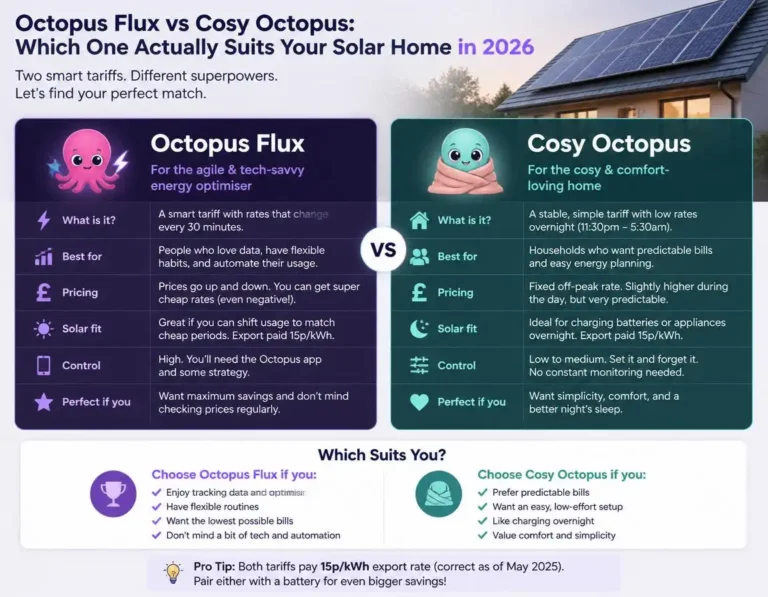
There is one exception. Time-of-use export tariffs such as Octopus Flux pay far more at peak (our Octopus export tariff guide quotes up to 32p, with a battery and Octopus import required), and a battery is the only way to export at that moment. Our Flux vs Cosy comparison shows when that works.
Payback reality check for an empty house
A 4 kWp system costs roughly £6,500–£8,500 installed in 2026, with £7,000 typical; our cost guide has the breakdown. Against the timers-set benefit of £420–£650 a year, that’s a payback of about 11 to 17 years on a £7,000 system, and 10 to 20 years across the full range of quotes. Our payback analysis quotes 7–12 years for typical homes, around 10 to 11 for a standard 4 kWp. The empty house sits at the slow end, and anyone telling you otherwise is selling.
Here’s the sensitivity most people miss: on this load profile, export rate moves hit you about two and a half times harder than import price moves, because you’re selling ~2,600 kWh and only self-consuming ~1,000. A 2p rise in your export tariff is worth ~£52 a year; a 2p rise in the import price is worth ~£20. Choose your export tariff like the investment decision it is, and revisit it yearly. Switching costs nothing.
Then there’s timing. 0% VAT applies to qualifying installs until 31 March 2027, and 5% returns from April 2027, which would add roughly £350 to a £7,000 system; our grant and VAT savings checker shows what you qualify for. Import prices move too: Ofgem announces the January to March 2027 cap on 25 November, and domestic electricity VAT is only at 0% until the end of March, so the unit price you avoid will not stay at 26p. Our price cap guide tracks what that does to payback.
Then apply the staying-put test. Panels comfortably outlive 25 years, so an 11–17 year payback is still a good trade if this is your forever house, and a poor one if you’re likely to move in seven. That isn’t unique to solar; it’s just how long-payback purchases work.
Free first: timers, smart plugs and scheduling
- Delay timers. Dishwasher (~1 kWh per cycle) and washing machine (~0.7 kWh) landing at midday instead of midnight is roughly 300–350 self-consumed kWh a year at about 200 cycles each. Add a slow cooker or a dehumidifier and 400 kWh is realistic. At 400 kWh that’s worth £80 a year on a 6p export tariff and £45 on 15p. Free.
- Smart plugs on standby clutter. Killing 10–30W of permanent draw trims the import hours you’d otherwise pay for, and costs about a tenner per plug.
- Immersion timing. If your hot water is electric, a midday immersion boost is storage you already own, and more on that below.
None of this needs permission, paperwork or an installer visit. It’s the least glamorous section of this article and, per pound spent, easily the best.
The diverter: a cheap battery with no degradation
If your hot water comes from a cylinder with an immersion element, a solar diverter sends surplus power into the cylinder instead of the grid. Hot water at the 26p you’d otherwise pay beats export at 6p so comprehensively that it behaves like a battery with no chemistry to wear out, and it costs £320–£700 fitted according to our diverter vs battery guide. Our complete diverter guide has the models and the maths.
A diverter needs a hot water cylinder, so it doesn’t work with a combi boiler. And if a gas boiler heats your cylinder, you’re only displacing gas at about 8p/kWh (Ofgem’s gas cap for October to December 2026 is 7.97p), which barely beats 6p export and loses to a 15p export deal. Check what actually heats your water first.
The export tariff twist nobody mentions
Pull the threads together and you get a counter-intuitive rule: the better your fixed export tariff, the less a battery is worth on an empty house. Weak export (under about 8p)? Storage has plenty of headroom, and arbitrage on top makes it work. Mid-range (8–12p)? Marginal, so run your own numbers with our SEG income estimator. Strong fixed export (15p and up)? Skip the battery unless you have real time-of-use arbitrage, love the export, and let the grid be your free infinite battery.
That’s the opposite of the occupied-house advice, where evening demand gives a battery somewhere valuable to put its power. It’s also why two neighbours can read identical battery reviews and reach opposite decisions.
A few practical points on tariffs. To qualify for the Smart Export Guarantee you normally need an MCS-certified installation and a smart meter that can send half-hourly export readings. The top fixed rates often come with strings: our July 2026 check found EDF’s Export Exclusive at 24p (you need to import from them too), E.ON Next Exclusive at 16.5p, and Good Energy and OVO at 15p with no import tie-in, against about 3.5p on a typical unswitched deal. Suppliers can change rates with 30 days’ notice, so confirm the live figure before you switch. Compare the options in our SEG rate comparison and the deeper list of every UK SEG tariff, and since an empty house’s income is mostly export, it’s worth a look at whether you pay tax on SEG income.
The honest verdict
Solar on an empty house is worth it when three things line up: you’re staying put for a dozen years or more, you can secure a decent export tariff, and you’ll actually bother with the timers. Miss the first and it’s someone else’s investment; miss the second and you’re donating power; miss the third and you’re leaving £45–£80 a year on the kitchen floor. Run your own address through our solar panel calculator before trusting mine or anyone else’s numbers.
And if “out all day” understates it, holiday lets and second homes that sit empty for weeks have a different load profile again, with their own quirks around export and insurance. We’ve covered those separately in our holiday let and Airbnb guide and our guide to solar panels for holiday homes.
The empty house doesn’t ruin solar. It just changes which levers matter: tariff first, timers second, storage a distant and conditional third.
FAQs
Usually yes, but the return leans on export rather than self-consumption. An unhelped empty house uses about a sixth of what its roof makes, so on our 4 kWp worked example expect roughly £340 to £610 in year one depending on your export tariff, rising to £420–£650 once timers are set. Payback on a typical £7,000 system lands around 11 to 17 years with timers set, longer than the 7–12 years we quote for typical homes, so the decision hinges on how long you’ll stay and how good an export tariff you can get.
Only with a time-of-use import tariff and a modest export rate. On a 6p export tariff a 5 kWh battery adds roughly £320 a year (about £175 from shifting solar into the evening plus about £150 from time-of-use arbitrage), a payback of about 12 years on £4,000. On a 15p export tariff the shifting value falls to about £85 a year, and on a 24p tied tariff it is close to nothing, so the payback runs to 17 years or more, longer than the battery’s useful life. Check your export rate first.
Delay timers and smart scheduling, by a distance. Moving the dishwasher, washing machine and slow cooker into midday cycles costs nothing and soaks up roughly 400 extra kWh a year, worth £45 to £80 depending on your export rate. If you have a hot water cylinder with an immersion heater, a solar diverter at £320–£700 fitted stores surplus as hot water with no battery degradation. It does not work with a combi boiler, and on a cylinder heated by gas the saving is small, so check what heats your water first.
Sources and assumptions
Checked on 12 October 2026. Tariff rates and prices change, so confirm live figures before you commit.
- Ofgem, energy price cap 1 October to 31 December 2026: electricity 26.32p/kWh, gas 7.97p/kWh, VAT on domestic electricity at 0% to 31 March 2027.
- GOV.UK, Smart Export Guarantee, for eligibility.
- Our own guides for export rates (SEG comparison, rates checked July 2026), battery costs and arbitrage (battery retrofit guide), payback (payback analysis) and diverter costs (diverter vs battery).
- Modelling: 4 kWp, ~3,600 kWh a year, 26p import, 90% battery round-trip efficiency, ~1,000 kWh a year shifted by a 5 kWh battery, £150 a year of time-of-use arbitrage. Illustrative, not a quote.