Does Your Solar Inverter Have a Hidden “Kill Switch”?

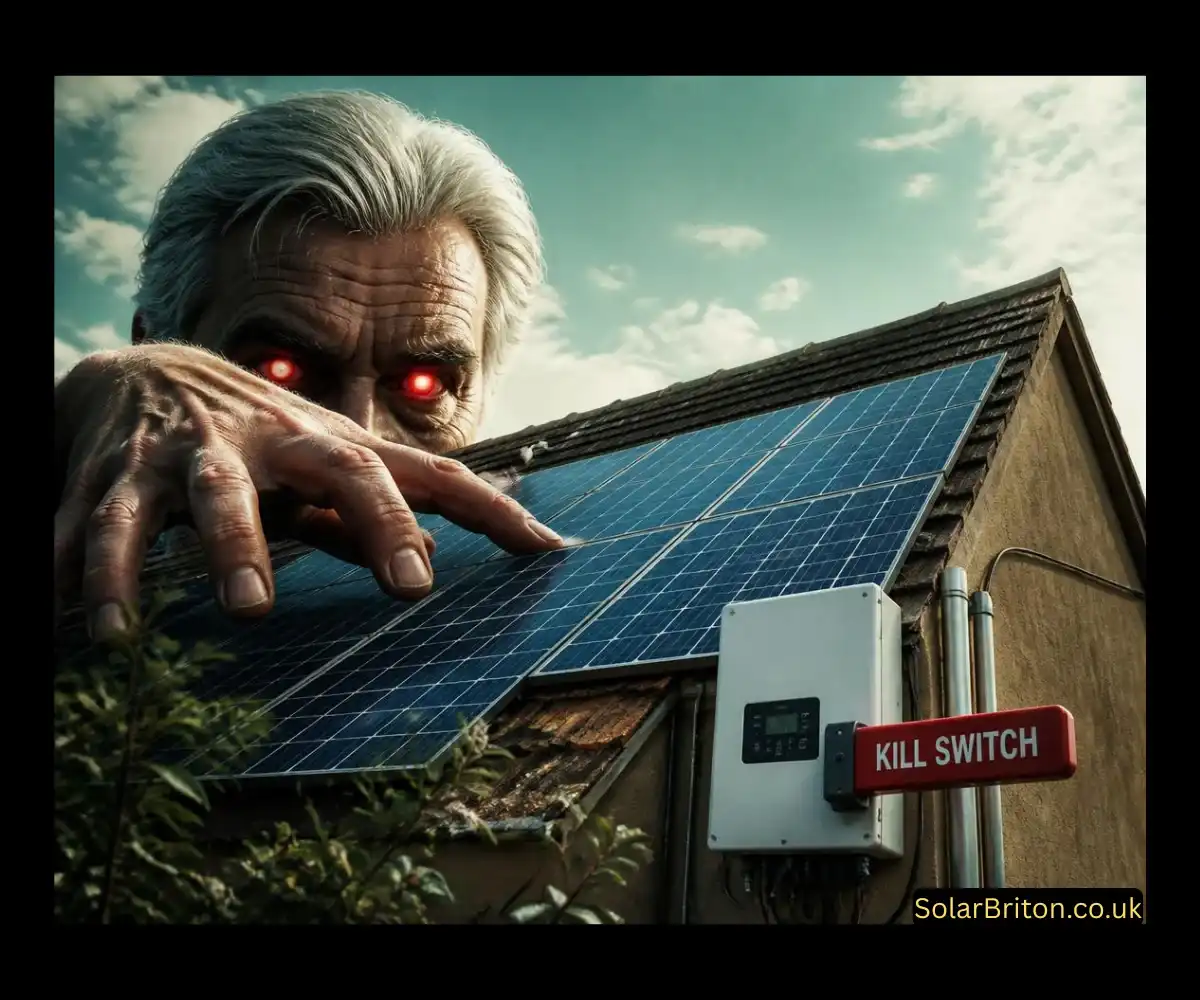
Headlines say your solar inverter could be switched off by a stranger with a laptop. I’ve spent 20 years in UK solar, so let’s unpack what’s actually true, what’s nonsense, and what you should do about that little box on your wall.
⚡ The 30-second answer
- No hidden switch has ever been found in UK home inverters. The “kill switch” devices were reportedly discovered in equipment at US solar farms, not on British roofs.
- The real risks are boring: default passwords, old firmware and exposed logins — and UK law (the PSTI Act) has banned the worst of these since April 2024.
- The only genuine remote “off switch” is one grid operators are adding openly, in writing, to balance the grid — and it mostly limits exports rather than killing your power.
If you’ve been anywhere near a neighbourhood WhatsApp or a solar Facebook group this summer, you’ll have seen the message doing the rounds: “Did you know your solar inverter has a kill switch? They can turn your panels off from abroad.” Usually it’s followed by a video of someone unplugging their Wi-Fi router “to be safe”.
I completely understand the worry — your inverter is the brain of your solar setup, and the idea of a stranger holding its off-button is properly unsettling. So I dug into the original investigations, the UK’s 2026 product-security rules and the grid codes, and separated the genuine security story from the folklore. Here’s everything you actually need to know.
🧐What the “kill switch” scare actually claims
The story usually goes like this: solar inverters — especially Chinese-made ones — contain secret hardware that lets a foreign government or a hacker switch them off at will, potentially plunging the country into darkness. It’s a great thriller plot. And like most thriller plots, the reality is more mundane, more interesting, and far more fixable.
The scare is a mash-up of three real stories that have been stitched together as it spreads online:
Story 2: genuine software vulnerabilities published by cyber-security researchers in 2025.
Story 3: grid operators (in Australia first, and now tentatively in the UK) adding legal, declared remote switch-off powers to manage solar overload.
Let’s take them one at a time, because each one has a very different meaning for your house.
🇺The US discovery that lit the fuse
The “kill switch” phrase comes from America. Investigators inspecting equipment at US solar farms reported finding rogue devices — including hidden cellular radios — inside Chinese-made power inverters, which could in theory let someone access the equipment outside the owner’s network. Similar supply-chain worries are now taken seriously by governments worldwide, including our own.

Then, in March 2025, security firm Forescout’s Vedere Labs published research — nicknamed SUN:DOWN — disclosing 46 vulnerabilities across solar equipment from three major vendors: Sungrow, Growatt and SMA. Some of the flaws could, in theory, let an attacker hijack a whole fleet of inverters and threaten grid stability. Around the same time, analysts counted roughly 35,000 solar devices worldwide sitting exposed on the open internet, many protected by little more than a default password.
Now the crucial bit that the forwarded messages leave out:
🇬🇧So what about the UK? (This bit is genuinely important)
Here’s where it gets relevant to us. Well over 70% of the world’s solar inverters come from Chinese manufacturers — Huawei, Sungrow and Ginlong Solis being the three biggest — and intelligence agencies including MI5 and other Five Eyes partners have publicly flagged remote connectivity in clean-tech equipment as a strategic concern. The UK already banned Huawei from its 5G networks on security grounds, yet Huawei-built inverters became some of the most common boxes on British roofs. It’s a contradiction policymakers are still wrestling with.
Two 2026 updates matter for homeowners. First, the UK passed 2 million solar installations in the year to April 2026, so the number of connected inverters has never been bigger. Second, Huawei withdrew from the UK residential solar market in January 2026 — existing owners keep their warranties (we cover that in our Huawei SUN2000 review), but it shows how quickly geopolitics can reshape your kit’s support network.
The good news: the UK already wrote a law for exactly this
While the headlines were panicking, Westminster had quietly put a guard rail in place. The Product Security and Telecommunications Infrastructure (PSTI) Act received Royal Assent in December 2022, and its product-security rules became enforceable on 29 April 2024, policed by the Office for Product Safety and Standards. Every consumer connectable product sold in the UK — and a Wi-Fi-enabled domestic inverter sits squarely in that world — must now meet three baseline rules:
| PSTI rule | What it means for your inverter | Why it kills the “kill switch” fear |
|---|---|---|
| No default passwords | Passwords must be unique per device or set by you | Removes the “admin/admin” back door hackers love |
| Vulnerability disclosure | Makers must publish a route to report security flaws | Flaws like SUN:DOWN get reported and patched in daylight |
| Update transparency | Makers must state the minimum period you’ll receive security updates | No more silent abandonment of old kit |
Break the rules and manufacturers face fines of up to £10 million or 4% of global turnover. Major vendors have already moved: SolarEdge, for instance, publicly certified its entire portfolio against the UK regime. It’s not a silver bullet, but it means a brand-new inverter bought in the UK today is materially harder to abuse than one bought five years ago. The National Cyber Security Centre (NCSC) publishes further plain-English guidance on keeping connected devices safe at home.
🔄The plot twist: the only real “kill switch” is one we’re installing ourselves
Here’s the irony the scare completely misses. The only organisation-level remote switch-off being fitted to rooftop solar isn’t hidden — it’s being added openly, by democratically accountable grid operators, because too much midday solar can overload the grid the same way too little can. Australia got there first: South Australia has required remote trip capability on new systems since 2020, Queensland followed in 2023, Victoria in 2024, and Western Australia since. They use it as a last resort — a handful of hours a year, not a blackouts-by-Beijing scenario.
In the UK the approach is gentler but moving the same way. The publicly owned National Energy System Operator (NESO) now balances a grid where solar regularly floods the system on sunny spring days. For homes, the tools are export limitation under the G98/G99 connection rules and, on some networks, cheaper “flexible” connection offers where your DNO can occasionally cap your export in exchange for a faster, cheaper connection. Even the government’s push on plug-in solar comes with tighter product rules from 2026 — the direction of travel is more regulated connectivity, not less.
How the scare story evolved (2020–2026)
South Australia becomes the first place to mandate remote trip capability on new rooftop solar — the world’s first open, legal “kill switch”.
UK PSTI Act receives Royal Assent — the law that will ban default passwords on connected devices.
Queensland mandates remote shutdown devices; US lawmakers publicly raise alarms over Chinese inverter supply chains.
UK PSTI enforcement begins. Default passwords banned, vulnerability reporting required; SolarEdge certifies its full UK portfolio compliant.
Forescout SUN:DOWN discloses 46 vulnerabilities across Sungrow, Growatt and SMA equipment; ~35,000 exposed solar devices counted worldwide.
Huawei exits the UK residential solar market (warranties on existing units stand).
UK passes 2 million solar homes; DNOs expand flexible connections; new plug-in solar product rules land on 2026.
🎛️Who can actually touch your inverter?
This is the diagram I wish every installer handed over at commissioning. On a typical UK home system, here’s the full list of who can reach your inverter, and how far that reach goes:
Anatomy of a connected UK solar setup
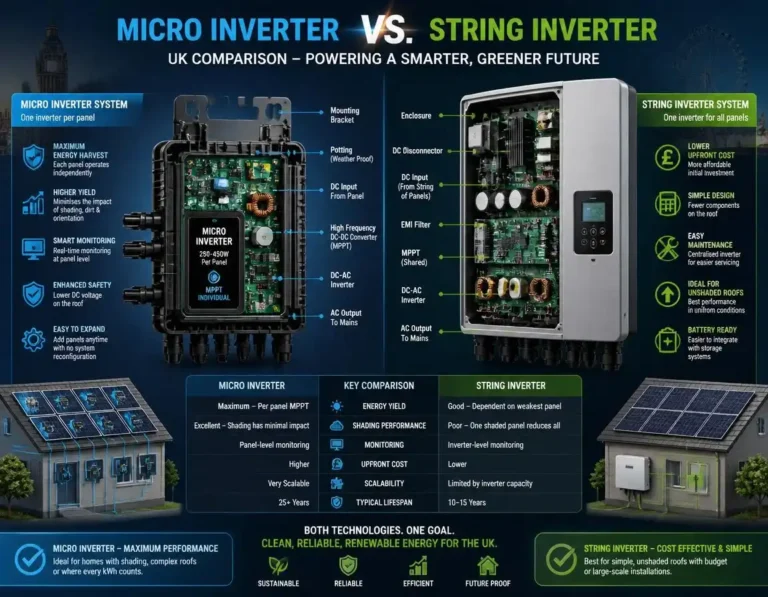
Notice what’s missing? A secret third party. Every path above is either yours, or exists because you (or your installer on your behalf) created the login. That’s the heart of why the viral scare overstates the danger — and why the practical advice below focuses on the logins you control. (If you’re still choosing your hardware, our guides on microinverters vs string inverters and SolarEdge vs Enphase monitoring explain how connectivity differs between systems.)
⚖️Myth vs fact: the 2026 scorecard
| What you may have heard | Verdict | The reality |
|---|---|---|
| “A foreign government can flick a switch and kill my solar.” | MYTH | No public evidence of this anywhere, let alone in the UK. Findings involved US solar-farm hardware, not British homes. |
| “Being online means my inverter is hackable.” | PARTLY | Any connected device has an attack surface — but unique passwords, updates and 2FA remove the vast majority of real-world risk. |
| “The National Grid can switch my panels off whenever it likes.” | MYTH | Standard G98/G99 home connections give no such power. Some new flexible agreements allow limited export capping — in writing, in advance. |
| “Chinese inverters are banned in the UK.” | MYTH | No ban exists. Huawei left the UK residential market commercially in Jan 2026; other Chinese brands remain on sale and must meet PSTI rules. |
| “Unplugging the Wi-Fi makes me safe.” | PARTLY | It removes remote risks but also fault alerts, security updates and export data — while the boring risks (poor configuration) remain. |
| “UK law now forces basic security on connected devices.” | FACT | The PSTI regime has been enforceable since 29 April 2024, with fines up to £10m or 4% of global turnover. |

🔐The 10-minute inverter lockdown (do this, not panic)
Forget conspiracy-proofing; here’s what a security professional would actually do with a domestic solar system. None of it costs a penny:
- Change any default password today. If your monitoring portal still uses “admin” or a factory code, change it now. PSTI bans defaults on new products, but older kit is on you.
- Switch on two-factor authentication (2FA) in your monitoring app if the brand offers it. It’s the single biggest upgrade available.
- Put the inverter on a guest Wi-Fi network. A separate network means a compromised gadget can’t hop across to your laptop or smart meter. (And no, solar doesn’t harm your Wi-Fi — we’ve tested the interference question here.)
- Keep firmware updated. Those SUN:DOWN-style flaws get patched — but only if updates are applied. Check for updates the same way you’d check your phone. Our annual maintenance checklist has a slot for it.
- Review who has access. If your installer set up remote diagnostics, that’s normal and useful — just confirm it’s still active because you want it, and revoke it when the relationship ends. Use an MCS-certified installer for anything hands-on.
- Know your connection type. Dig out your G98/G99 paperwork. Standard connection? No export capping applies. Flexible connection? The capping rules will be written in it — no surprises, no secrets.
- Watch for scare-selling. Anyone doorstep-calling with “your inverter isn’t safe, buy our replacement today” is exploiting this exact headline. It’s one of the classic seven red flags of UK solar scams.
- Keep monitoring on. Irony alert: the app you might be tempted to delete is also your early-warning system — a sudden zero-output day flags a fault (or a tamper) faster than anything else. See our picks of the best solar monitoring apps and how a monitoring system actually works.
🔌Should you just take the inverter offline?
It’s the question I get most often now, so here’s my honest take. Weigh it up:
Staying connected (my recommendation)
- Fault alerts catch dead systems weeks earlier — that’s real money saved
- Firmware security patches arrive automatically
- Export data supports SEG claims and time-of-use tariffs (top 2026 rates in our SEG comparison)
- Warranty claims are easier with a generation history
Going offline
- Removes the (already tiny) remote-attack surface entirely
- But: faults go unnoticed for weeks or months
- No security updates reach the device
- You lose app visibility and some export-tariff convenience
For 99% of homes, the connected option with the 10-minute lockdown above is both safer and more profitable. The inverter sitting silently offline isn’t “secure” — it’s just unmonitored, and unmonitored is how small faults become safety issues and warranty disputes.
🎯The bottom line
The “kill switch” scare is a classic modern myth: it borrows real ingredients — US solar-farm findings, a genuine 2025 vulnerability study, Australia’s remote trip rules — and cooks them into a story that’s scarier than the truth. The truth is better news: the UK has some of the world’s strongest connected-product security laws, your grid connection doesn’t give anyone a secret off-button, and the risks that remain are the ordinary, fixable kind. Spend ten minutes on the lockdown list, keep your firmware fresh, and let your panels do what they’ve done brilliantly for over two million British homes: quietly cut your bills.
💬Frequently asked questions
Can the National Grid or the UK government switch my solar panels off remotely?
For the overwhelming majority of UK homes, no. A standard G98 or G99 domestic connection does not give NESO or your DNO a remote off-switch for your panels. A small number of newer “flexible” connection agreements allow your export to be limited occasionally, but that is a capped export agreed with you in writing — not a hidden kill switch.
Are Chinese-made solar inverters sold in the UK a security risk?
There is no public evidence of any foreign government switching off UK home inverters. The hidden-radio devices were reportedly found in US solar farm equipment, not UK homes, and the 46 flaws disclosed by researchers in 2025 affect patchable software. The biggest real-world risks remain boring ones like default passwords — which the UK’s PSTI Act has banned since 29 April 2024.
Should I disconnect my solar inverter from Wi-Fi to make it safe?
Usually not. Going offline means losing fault alerts, firmware security updates, app monitoring and the export data some SEG tariffs rely on. A better approach is a strong unique password, two-factor authentication on the monitoring app, a separate guest Wi-Fi network and keeping firmware updated.
📚Worth reading next
Figures correct as of 2026. This article is independent guidance for UK homeowners, not formal security or legal advice — always confirm connection terms with your DNO and product security details with your manufacturer.