
The Small Print That Could Void Your Home Insurance After a Solar Fire -Claude ready

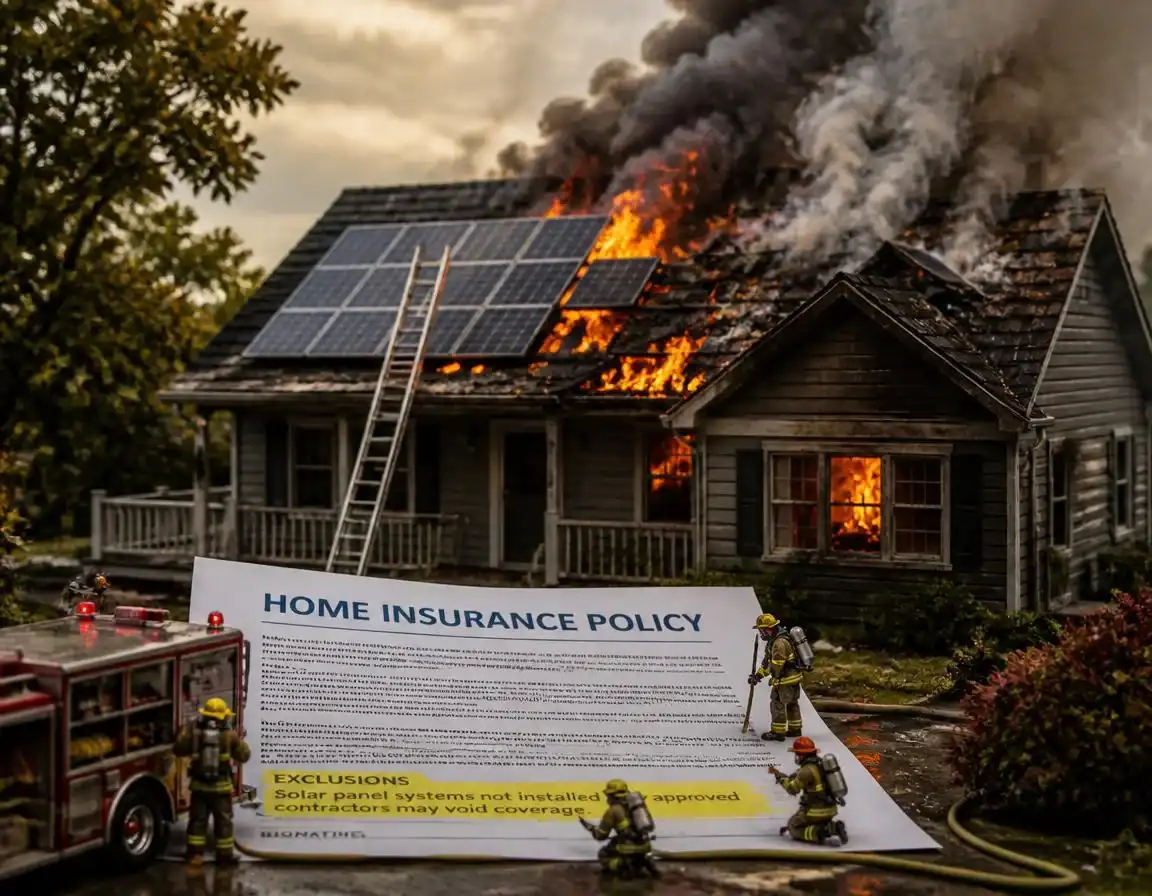
I’ve read more home insurance policy wordings this year than I care to admit — because a solar fire is exactly the kind of rare, high-value claim where the small print decides everything. Here’s every clause that can void your payout, in plain English, and the five-minute fixes that keep your cover alive.
📈 1. Rare, but rising: the fire numbers
Let’s be clear about the risk first: a UK solar installation has only around a 0.0046% chance of causing a fire, and most systems run for decades without a whisper of trouble. The problem is the trend. UK fire services attended 212 fires involving solar panels in 2025, more than double the 91 recorded in 2022 — and fires are growing at more than twice the rate of new installations, according to QBE’s analysis of fire service data. The government publishes its own official dataset of fires in England mentioning “solar panel” on GOV.UK, so this isn’t anecdote — it’s on the record.
UK fires involving solar panels, 2022–2025 🔥
Source: QBE analysis of UK Fire & Rescue Service FOI data (2026). DC cabling and connector faults were the single leading identified cause in 2025 (49 of the 212 fires) — improper installation, not the panels themselves, is what’s actually driving the trend.
Add batteries to the picture and insurers get even more cautious: UK fire services attended 713 lithium-ion battery fires in 2022 and 1,760 in 2025, with 46% happening in homes — though it’s worth being precise here, since that figure covers every lithium-ion device (phones, e-bikes, vapes, laptops and more), not solar battery storage specifically. That’s why the small print around solar has quietly hardened over the last couple of years regardless.
🔍 2. The 8 small-print clauses that void claims
These are the wordings I see again and again in UK policy documents. None of them are “anti-solar” — they’re standard conditions that solar simply makes easier to trip over.
The non-disclosure clause
“You must tell us of any material change to the property.” Solar is a material change. If a fire happens and the insurer discovers panels (or a battery) they were never told about, they can decline the whole claim — even for an unrelated burst pipe.
✔ Fix: one phone call before installation, not after.
The “competent installation” clause
Many wordings require work to be done “to a recognised standard”. In solar, the benchmark insurers reach for is MCS certification — some require it specifically for battery cover.
✔ Fix: use an MCS-certified installer and keep the certificate.
The electrical certification clause
After a fire, loss adjusters ask for the Electrical Installation Certificate showing the system meets BS 7671 (Section 712 for PV), plus your Part P Building Regulations compliance certificate. No certs, no proof it was legal work.
✔ Fix: file the EIC + Part P cert with your policy docs today.
The alterations & consent clause
Policies require alterations to comply with planning and building rules. Most roofs are permitted development, but listed buildings and conservation areas need consent — install without it and you’ve breached the policy.
✔ Fix: check the permitted development guidance on GOV.UK first.
The battery siting clause
Since 15 April 2026, batteries have their own dedicated chapter in the wiring regs (BS 7671 Amendment 4, Chapter 57), working alongside PAS 63100:2024. Together they rule out lofts, bedrooms and escape routes outright, and require at least 1 metre of clearance from any outdoor door, window or vent — a garage or an external wall mount is the compliant default.
✔ Fix: see our solar battery fire safety guide before choosing a location.
The “reasonable care” & recall clause
You must take reasonable steps to prevent damage. Ignoring a manufacturer recall or known connector defect undermines that. The GOV.UK product-safety register has carried live solar recalls — like the Sigenergy quick-connect AC plug report over overheating risk.
✔ Fix: register your inverter/battery with the manufacturer so recall emails reach you.
The DIY & plug-in clause
Self-installed kits may not meet BS 7671 or Part P. Plug-in and balcony solar is now a genuinely live UK category — legalised for sale and self-install from 27 August 2026 under DESNZ’s Interim Product Specification — but that framework currently excludes battery storage entirely, and insurers are writing “professionally installed” into more wordings regardless.
✔ Fix: read our DESNZ plug-in solar explainer and the BSI plug-in standard before DIY-ing.
The underinsurance “average” clause
A typical system adds £6,100–£14,000+ to your rebuild value. If you never updated your sum insured, the insurer can apply the “average” clause and pay only a proportion of any claim after a fire.
✔ Fix: update your rebuild value the day the system is commissioned.
🗂️ 3. The paper trail insurers expect
Keep these six documents in one folder (paper and cloud). Warranties — typically 25 years on panels and 10–12 years on inverters — cover manufacturing defects, not fire or storm damage; that’s the insurance job, and insurers frequently ask to see the MCS certificate and warranty paperwork together when a claim lands.
🚨 4. If a fire happens: the claim timeline
🗓️ 5. What’s changing in 2026–27 (and why insurers care)
- Plug-in solar is now live: after the government’s 24 March 2026 announcement, domestic plug-in solar became legal to buy and self-install from 27 August 2026 under DESNZ’s Interim Product Specification — see the GOV.UK plug-in solar consultation. Note the framework currently covers panels only, not battery storage, and expect policy wordings to specifically address self-installed kits.
- Battery rules tighten: BS 7671 Amendment 4 (Chapter 57) took effect 15 April 2026 alongside PAS 63100:2024, defining fire-safe battery siting in law via Part P, with full compliance required by 15 October 2026; MCS MIS 3012:2025 raises installer requirements too — both increasingly referenced in insurance assessments.
- Future Homes Standard: new-build homes in England must include solar PV from 24 March 2027, meaning insurers will treat solar as utterly standard — which actually works in favour of properly documented owners.
- Recall awareness: with live product-safety reports on the GOV.UK register, “did you act on the recall?” is becoming a genuine claims question.
✅ 6. The keep-your-cover checklist
| Do this | Why it matters | Cost / time |
|---|---|---|
| Tell your insurer before panels or a battery go in | Non-disclosure can void the entire policy | 5-minute call; typically £25–£50/yr |
| Use an MCS-certified installer | Insurer benchmark; needed for SEG too | Free to check |
| Collect EIC + Part P / Building Control certs | Proof of legal, BS 7671-compliant work | Should be handed over at commissioning |
| Site batteries to PAS 63100 / Chapter 57 (not lofts, bedrooms or escape routes) | Fire-spread protection; claims scrutiny | Design-stage decision |
| Update your rebuild value (£6,100–£14,000+ added) | Avoids the “average” clause cutting payouts | Free with your insurer |
| Service the system & keep records | “Reasonable care” clause; maintenance gaps can deny claims | See our maintenance checklist |
| Register for manufacturer recall alerts | Acts on safety reports protect your position | Free |
| Check installer financials / insurance-backed guarantee | If they go bust mid-way, our installer-gone-bust guide explains your options | Free |
💬 Frequently Asked Questions
Will home insurance pay out if my solar panels cause a fire?
Yes, in most cases — roof-mounted panels are treated as permanent fixtures under buildings insurance, provided you declared them and the system was installed to recognised standards (MCS, BS 7671, Part P). The claims that fail are usually the undeclared, uncertified or DIY ones.
What documents will my insurer ask for after a solar fire?
Typically your MCS certificate, the Electrical Installation Certificate (BS 7671, Section 712 for PV), the Part P/Building Regulations compliance certificate, battery fire-safety paperwork (PAS 63100), proof you notified the insurer, and maintenance or warranty records. Keep them in one folder from day one.
Does a DIY or plug-in balcony solar kit affect my insurance?
It can. Self-installed systems may not meet BS 7671 or Part P, and many wordings expect professional installation. Plug-in solar became legal to buy and self-install from 27 August 2026 under DESNZ’s Interim Product Specification, but that framework excludes battery storage — always confirm cover with your insurer before plugging anything in.

One Comment