
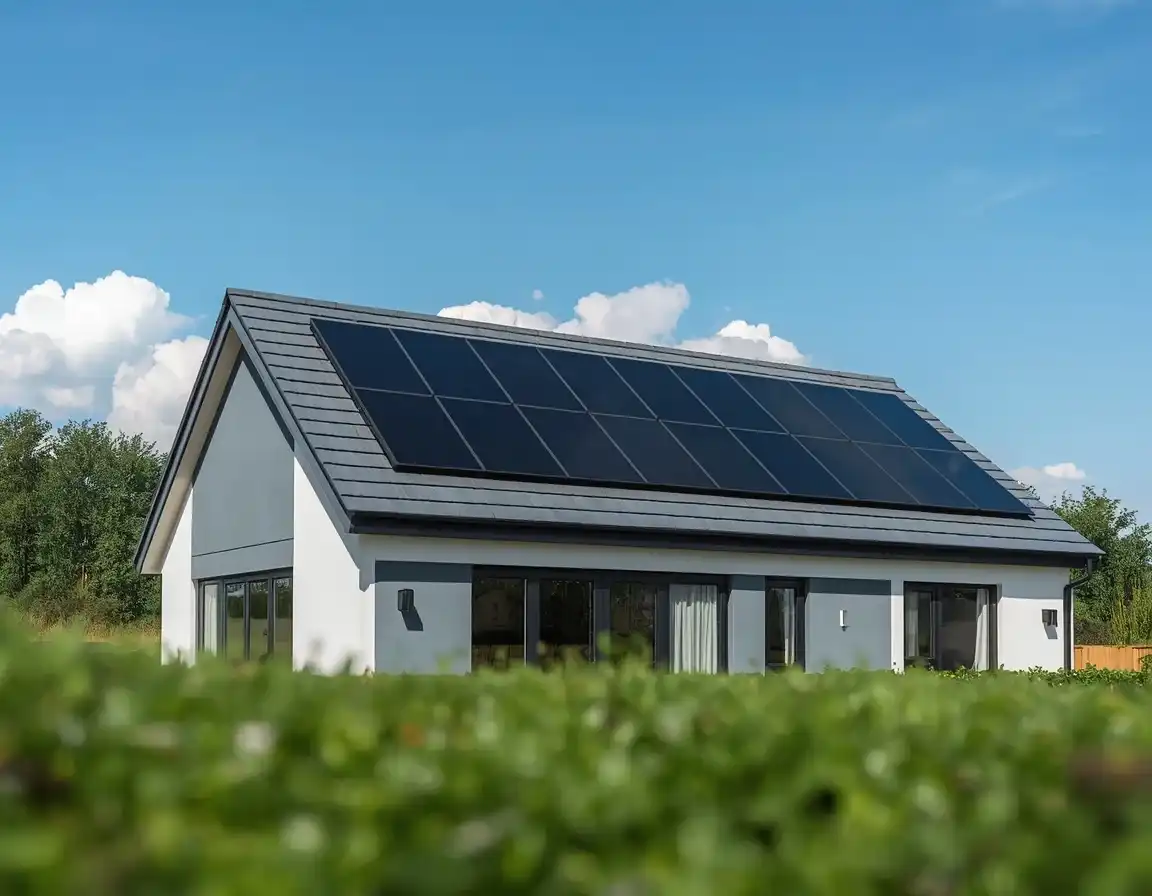
Solar Panels on New Build UK

Solar Panels on
New Build UK Homes
— Your 2026 Guide
The Future Homes Standard has been published. Solar panels are now on their way to becoming compulsory on virtually every new home built in England. Here’s what that actually means for you as a buyer, what your developer is obliged to include, how much you can realistically save, and the questions you really should ask before you sign anything.
So, do new builds come with solar panels?
If you’re buying a new build right now — or you’re considering it — there’s a really good chance your future home will come with solar panels already mounted on the roof. And that’s not just a nice extra thrown in by a conscientious developer. It’s increasingly the result of regulations that have been tightening for years, culminating in the biggest shift the UK’s new build market has ever seen.
Here’s the situation in plain terms: the government published the Future Homes Standard (Part L 2026) on 13 March 2026. From 24 March 2027, solar panels are effectively mandatory on virtually all new homes in England. The regulations require developers to install a solar PV array equivalent to at least 40% of the dwelling’s ground floor area — a non-tradeable requirement that can’t be swapped out for better insulation or anything else.
The market hasn’t waited for that deadline, either. 42% of all new homes built in England during Q4 2024 already had solar panels — a staggering jump from just 13% in the same quarter of 2023. Developers were well ahead of the curve.
But here’s what I’d want you to know before you get too comfortable: not all new build solar setups are the same. Developers often install just enough to tick the compliance box, not the system that’ll actually put the most money back in your pocket. There are questions you need to ask — and most buyers never think to ask them.
This guide covers everything: what the law currently says, what a typical new build solar system looks like in 2026, how much you can realistically save, whether you should add battery storage, how panels affect your property value, and the financial support on offer. By the end, you’ll know exactly what to look for and what to ask for.
A quick note on scope: The Future Homes Standard applies to England only. Scotland, Wales, and Northern Ireland all have separate building regulations. We’ve covered each of them later in this guide.
What are the rules on solar panels for new builds in 2026?
Understanding the regulations doesn’t need to be complicated, but it does need to be accurate — because there’s quite a bit of outdated information floating around online. Here’s the timeline that actually matters.
Where things stand right now (2026)
Since June 2023, all new homes in England have had to comply with the 2021 update to Part L of the Building Regulations. This requires a 31% reduction in CO₂ emissions compared to the 2013 baseline. Solar panels aren’t mandated by name, but for most developers they’ve become the clearest, most cost-effective route to hitting that target — especially when paired with a heat pump for heating.
As a result, solar panels are now common on new builds even before the 2027 deadline. The MCS reported that new build solar projects accounted for 35% of all rooftop solar installations in the first 11 months of 2025 — nearly double the figure from early 2024.
What changes from March 2027 (Future Homes Standard)
The Future Homes Standard, published as Part L 2026, comes into force on 24 March 2027. Here’s what it actually requires:
- Solar PV is non-tradeable and mandatory on virtually all new homes — you can’t swap it out for better walls or windows
- The array must cover an area equivalent to 40% of the dwelling’s ground floor area
- For a typical three-bedroom semi-detached house with an 85m² footprint, that works out to roughly 3.4–4kWp (about 8–10 panels)
- Carbon emissions must drop by at least 75% versus the 2013 baseline
- Gas boilers are banned in all new builds from March 2028 — heat pumps become the default heating solution
There’s a 12-month transitional period running to 24 March 2028 for projects already under construction when the rules change. But importantly, any scheme entering detailed design now is already being built to the new standard in practice.
Can developers skip solar if the roof is awkward? Exemptions exist, but only where shading or roof geometry genuinely prevents a viable installation. Developers can’t claim exemption on cost grounds or aesthetic preference. Where the full 40% isn’t achievable, they must still install “a reasonable amount” and demonstrate technical justification.
The regulatory timeline at a glance
Part L 2021 uplift Done
Came into force June 2023. Required a 31% CO₂ reduction on new homes. Many developers began including solar as the easiest compliance route.
2026 — Solar the new normal Right now
42%+ of new builds already include solar. The Future Homes Standard (Part L 2026) was published on 13 March 2026. Developers are spec-ing to the new standard ahead of the deadline.
Future Homes Standard — in force 24 March 2027 Upcoming
Solar PV mandatory on all new homes. 40% ground-floor coverage. 75% carbon reduction required. 12-month transition for existing projects runs to March 2028.
Gas boilers banned in new builds from March 2028 Upcoming
Full enforcement of the Future Homes Standard. Heat pumps + solar become the default package. Transition period ends.
New build solar adoption — how fast it’s growing
Sources: Solar Energy UK, MCS Certified, Part L 2026 Building Regulations. H1 2025 based on MCS data showing new builds accounted for 35% of all certified solar installations.
Check out the Solar Panels for Flat Roof
What solar system will actually be on my new build?
Here’s the honest truth that a lot of developer brochures won’t tell you: what gets installed to meet minimum building regulations is often not the same as what you’d choose if you were specifying the system yourself.
The typical new build solar package from a major housebuilder in 2026 looks like this:
- System size: 2–4kWp (5–10 panels), sized to hit compliance, not to maximise your return
- Panel brand: Usually mid-range, second-tier — functional, but not premium efficiency
- Orientation: South, south-east, or south-west facing
- Inverter: Typically a string inverter — adequate but not the most efficient option
- Battery storage: Not included as standard — often available as a paid upgrade
- Monitoring: Basic app (quality varies significantly between developers)
From March 2027, the minimum rises to roughly 3.4–5kWp depending on the home’s footprint. For a typical three-bedroom semi (around 85m² ground floor), you’re looking at 17m² of panels — approximately 8–10 modern 400W modules.
System size, output & savings comparison
| System Size | Typical Panels | Annual Output | Est. Bill Savings | Approx. Retail Cost* | Suits |
|---|---|---|---|---|---|
| 2kWp | 5 panels | ~1,700 kWh | £350–£440/yr | ~£5,000 | Flat / 1-bed |
| 3kWp | 7–8 panels | ~2,550 kWh | £520–£620/yr | ~£6,500 | 2-bed semi |
| 4kWp ★ | 9–10 panels | ~3,400 kWh | £650–£750/yr | ~£8,000 | 3-bed (most common) |
| 5kWp | 11–12 panels | ~4,250 kWh | £800–£950/yr | ~£10,000 | 4-bed detached |
*Retail cost if purchasing separately, including 0% VAT (valid until March 2027) and installation. Developer’s procurement cost will typically be lower. ★ = Most common new build specification in 2026. Savings based on an average electricity unit rate of 24.5p/kWh, 50% self-consumption.
Pro tip for off-plan buyers: If you’re buying before the home is completed, it’s almost always cheaper to upgrade the solar system or add battery storage at the build stage than to retrofit it later. Ask your developer what upgrade options are available — many now offer them.
Check out Solar Panels Maintenance
The MCS certification problem — and why it matters
This is the one that catches people out the most. Pay close attention to this section before you exchange contracts.
The Microgeneration Certification Scheme (MCS) is the UK quality standard that certifies solar panel installers and equipment. MCS certification matters for two very specific reasons:
- Smart Export Guarantee (SEG): You can only register for SEG payments — the scheme that pays you for surplus electricity exported to the grid — if your installation is MCS-certified
- Warranty & consumer protection: MCS certification means the installation meets tested quality standards and gives you much stronger recourse if things go wrong
Here’s the issue: solar panels installed by a developer’s main building contractor — rather than a specialist MCS-registered installer — are not always MCS-certified. The panels may be structurally sound and correctly wired, but without that certificate, you could be locked out of SEG income entirely.
What’s at stake? On a 4kWp system exporting around 50% of its generation, missing out on SEG at 16.5p/kWh could cost you £250+ per year — every single year you own the property. Over a 25-year panel life, that adds up to over £6,000.
The good news: many developers do use MCS-registered installers, and from March 2027 the tighter FHS rules make this much more likely. But right now in 2026, you should never assume. Always ask explicitly.
Check out Best SEG Tariff Rates UK
Getting paid for your surplus power — the Smart Export Guarantee
The Smart Export Guarantee (SEG) replaced the old Feed-in Tariff in January 2020. It’s a government-backed scheme requiring all licensed electricity suppliers with over 150,000 customers to pay you for the surplus electricity your solar panels generate and export to the grid.
There’s no government-set minimum rate — suppliers choose their own — so rates vary enormously. The difference between picking a mediocre SEG tariff and the best one could be worth an extra £150–£200 per year on a typical system.
“Using more of your solar electricity yourself saves 24.5p per kWh. Exporting earns you 3–16.5p per kWh. So self-consumption always wins — but choosing the right SEG tariff matters a lot for what you earn from the rest.”
— Solar Panels New Build UK Guide, based on 2026 market dataBest SEG tariff rates in 2026
Requires battery storage
Fixed rate — no battery needed
Fixed rate
Fixed rate
Variable rate
Varies — always shop around
SEG tariff rates as at June 2026. You are not required to use the same supplier for export as you use for importing electricity. Switch tariffs freely — there are no exit fees. Source: The Eco Experts, Expertsure, Better Home Energy (2026).
What will you actually earn?
For a 3.5kWp system generating around 3,000 kWh per year, with roughly 50% exported:
| SEG Rate | Approx. Annual Export (1,500 kWh) | Annual SEG Income |
|---|---|---|
| 16.5p/kWh (E.ON best fixed) | 1,500 kWh | £248/yr |
| 15p/kWh | 1,500 kWh | £225/yr |
| 12p/kWh | 1,500 kWh | £180/yr |
| 5p/kWh | 1,500 kWh | £75/yr |
Add this to your direct bill savings of £550–£700/year and you’re looking at a combined annual benefit of £650–£950 from a well-managed 3.5–4kWp system.
Remember: You must have an MCS-certified installation to register for SEG. You can switch SEG suppliers at any time with no exit fees, so it’s worth reviewing your rate annually.
Check out the best solar battery
Should I add a battery to my new build solar system?
Most new builds in 2026 don’t include battery storage as standard — but many developers offer it as an upgrade option. And the economics of adding one during the build are genuinely compelling.
The key figure here is the marginal cost. Adding a 5kWh battery to a new solar installation at build stage costs around £1,000–£1,500. Retrofitting that same battery to an existing system later will cost £3,000–£6,000. Same battery. Very different price.
Battery storage costs (2026, including 0% VAT)
| Battery Size | Added During New Build | Standalone Retrofit | Extra Annual Savings | Payback (upgrade) |
|---|---|---|---|---|
| 5 kWh | £1,000–£1,500 | £3,000–£4,500 | £300–£400/yr | 3–5 yrs |
| 10 kWh ★ | £2,000–£3,000 | £5,000–£7,000 | £450–£600/yr | 4–6 yrs |
| 13.5 kWh | £2,500–£4,000 | £6,000–£8,000 | £550–£750/yr | 4–7 yrs |
★ = Most commonly chosen for a 3–4 bed home. Battery capacity is usable capacity (lithium-ion). Payback period on the marginal upgrade cost only. Sources: EE Renewables, Green Tech Renewables, Better Home Energy (2026).
The honest case for and against
Reasons to add a battery
Use more of the power you generate. Cut grid imports to the minimum. Works brilliantly with time-of-use tariffs like Octopus Go. Much cheaper now than as a retrofit. Adds resale value. If you work from home or have an EV, the payback can be even faster.
Reasons to pause
Lithium-ion batteries degrade over 10–15 years — factor in a replacement. Less impactful in winter when solar output drops. An oversized battery that can’t fill each day wastes money. If you’re already home during the day, you may already self-consume a lot.
On balance, for most new build buyers — especially those working from home, charging an EV, or who are out during peak generation hours — adding battery storage at build stage makes strong financial sense. It’s one of the few upgrades where the marginal cost at build stage is genuinely low.
Check out Solar panels for renters uk
How do solar panels affect your EPC rating and home value?
This is one of those areas where the numbers are more significant than most people expect. Solar panels don’t just cut your bills — they directly improve your home’s Energy Performance Certificate (EPC) rating, which in turn affects your property’s value, its mortgage-ability, and how quickly it’ll sell.
The EPC uplift
Under the SAP methodology used to calculate EPC ratings, on-site renewable generation is credited directly against a home’s calculated energy demand. A standard 3.5kWp system on a three-bedroom semi-detached house typically delivers a 10–15 SAP point improvement — usually moving the home at least one full EPC band.
New builds with solar already tend to start with strong EPC ratings (B or above), but for existing homes adding solar, the uplift is even more meaningful. Moving from EPC band D to C pushes you past an increasingly important threshold that mortgage lenders, insurance companies, and buyers are paying growing attention to.
What does a better EPC mean for your property’s value?
| EPC Change | Avg. Property Value Uplift | On a £285,000 Home | Evidence |
|---|---|---|---|
| D → C (1 band) | +3% | +£8,550 | Rightmove (300,000 properties, 2023) |
| Owned solar installed | +1–4% | +£2,850–£11,400 | DESNZ / UK estate agents, 2026 |
| Solar + battery | +2–6% | +£5,700–£17,100 | Evergreen Power UK (2026) |
Leased panels ≠ owned panels. If your developer retains ownership of the solar panels and leases them to you, the value uplift is much smaller — and can actually complicate your mortgage application and future sale. Always clarify panel ownership before exchanging contracts.
The demand for solar homes is also growing fast. A 2023 survey of more than 2,000 UK homeowners by the Eco Experts found that 69% said they’d be ‘likely’ or ‘very likely’ to buy or rent a property with solar panels — and that appetite has only increased since. Rightmove now shows buyers actively filtering search results by EPC rating, and solar panels appear regularly in wish lists for the 25–45 age group.
Grants, VAT relief & financial support in 2026
Whether you’re looking to upgrade the system on your new build add battery storage, or you own an existing home and want to retrofit solar, there’s a reasonable amount of financial support available right now — some of which has a deadline.
1. Zero-rate VAT on solar — act before March 2027
Solar panels, battery storage, and installation are all charged at 0% VAT until 31 March 2027 under current HM Treasury policy. On a typical solar-plus-battery system costing £9,000–£12,000, that’s a saving of £1,800–£2,400 compared to paying standard rate VAT. If you’re planning any upgrades or retrofits, doing them before that date makes clear financial sense.
2. The Warm Homes Plan — the UK’s biggest ever home energy programme
The government launched its Warm Homes Plan in January 2026. With £15 billion in funding, it’s the largest public investment in home energy upgrades in British history, aiming to improve 5 million homes by 2030.
For solar and battery storage, the plan includes:
- Warm Homes Local Grant — the successor to ECO4, running until December 2026. Provides free solar, batteries, insulation, and clean heat for low-income households. Your local authority administers this; homeowners can apply via the government’s eligibility checker
- Warm Homes Fund (£5 billion) — a new low- and zero-interest loan scheme for all homeowners regardless of income, covering solar panels, batteries, heat pumps, and insulation. Full details and application routes are expected to be confirmed later in 2026
- Boiler Upgrade Scheme — expanded to £7,500 for heat pumps, relevant alongside solar on new builds
You can check your eligibility and find out more about the Warm Homes Plan directly on the government’s own pages. It’s worth doing — especially if you’re on a lower income or claiming certain benefits.
3. Smart tariff combinations
If you add battery storage, pairing it with a smart time-of-use import tariff (like Octopus Go or Intelligent Octopus) and the best SEG export tariff can make a material difference to your overall annual savings. With the right combination, some households are seeing combined savings of over £1,000 per year from a solar-plus-battery setup.
Scotland, Wales & Northern Ireland — what are the rules there?
It’s really important to be clear on this: the Future Homes Standard is an England-only regulation. Building regulations are a devolved matter, so Scotland, Wales, and Northern Ireland each operate their own frameworks.
Scotland
Scottish Building Standards have long required strong fabric energy performance in new homes, and heat pumps are already required in most new Scottish builds. Mandatory solar PV for all new homes on the same 2027 timescale as England has not been confirmed — Scotland has its own trajectory toward near-zero-carbon homes.
Wales
Wales operates under its own Technical Guidance to the Building Regulations in Wales. Rules are broadly similar to England’s pre-FHS requirements but are evolving. Check with your developer and local authority for the specific standards that apply to any new build you’re considering in Wales.
Northern Ireland
Northern Ireland has entirely separate building regulations. A solar mandate at the same level as England’s Future Homes Standard has not been confirmed. Solar is still a popular addition to new builds, driven by market demand and energy cost savings rather than regulation at this stage.
The Smart Export Guarantee applies across all four nations — so wherever you are in the UK, if your installation is MCS-certified, you can register for SEG export payments.
5 questions to ask your developer before you sign
I’ve pulled together the five questions that matter most for new build buyers. These are the things most people don’t think to ask — and the answers can make a real difference to your finances over the lifetime of the home.
- 1Is the solar installation MCS-certified, and will I receive a Microgeneration Installation Certificate?
Without MCS certification, you can’t register for Smart Export Guarantee payments. This is non-negotiable — always get a clear written answer before exchanging. - 2What is the system size (kWp), how many panels, and what brand are they?
Developer brochures rarely give you this level of detail. Push for specifics — panel brand, wattage, and inverter model. Premium panels generate more over 25 years. - 3Do I own the solar panels outright from completion, or are they leased?
Owned panels add more property value, give you stronger resale position, and avoid complications with mortgages. Leased panels can create headaches you don’t need. - 4Can I upgrade the system or add battery storage before completion, and what’s the cost?
This upgrade window closes at completion. Adding battery storage at build stage costs a fraction of the retrofit price. Many developers will negotiate this if you ask — especially off-plan buyers. - 5What monitoring system comes with the installation, and what’s the warranty?
A decent monitoring app lets you track generation and spot faults quickly. Panel performance warranties are typically 25 years; product (physical) warranties vary. Make sure both are documented.
Frequently asked questions about solar panels on new builds
From 24 March 2027, solar panels are legally required on virtually all new build homes in England under the Future Homes Standard (Part L 2026), which was published on 13 March 2026. Developers must install solar PV covering at least 40% of the dwelling’s ground floor area — that’s roughly 3.4–4kWp for a typical three-bedroom home. Exemptions are only permitted where shading or roof geometry genuinely prevents installation. Scotland and Wales have separate building regulations with their own timescales. Even before the 2027 deadline, over 42% of new homes built in England in Q4 2024 already included solar panels.
Yes — but only if the installation is MCS-certified. Solar panels installed by a developer’s main contractor are not always MCS-certified, which would prevent you from registering for Smart Export Guarantee (SEG) payments. Before exchanging contracts, always ask your developer explicitly whether the solar installation is MCS-certified and whether you will receive a Microgeneration Installation Certificate. In 2026, the best fixed-rate SEG tariffs pay up to 16.5p per kWh (E.ON Next Export Exclusive) for surplus electricity sent to the grid, and variable tariffs like Octopus Flux can pay up to 30p/kWh at peak times if you also have battery storage.
Most new build homes completed in 2026 include a 2–4kWp solar system (5 to 10 panels), sized by the developer to meet minimum building regulations. From 24 March 2027 under the Future Homes Standard, the minimum rises to an array covering 40% of the ground floor area — roughly 3.4–5kWp for a typical three-bedroom home. A 4kWp system generates around 3,400 kWh per year and can save approximately £650–£750 on electricity bills annually. Upgrading to a larger system when buying off-plan is almost always cheaper than retrofitting later, and many developers now offer this as an option before completion.

2 Comments